Assessing Claims of Crisis Inside Iran: Facts and Speculation About Power, Public Sentiment, and Missiles
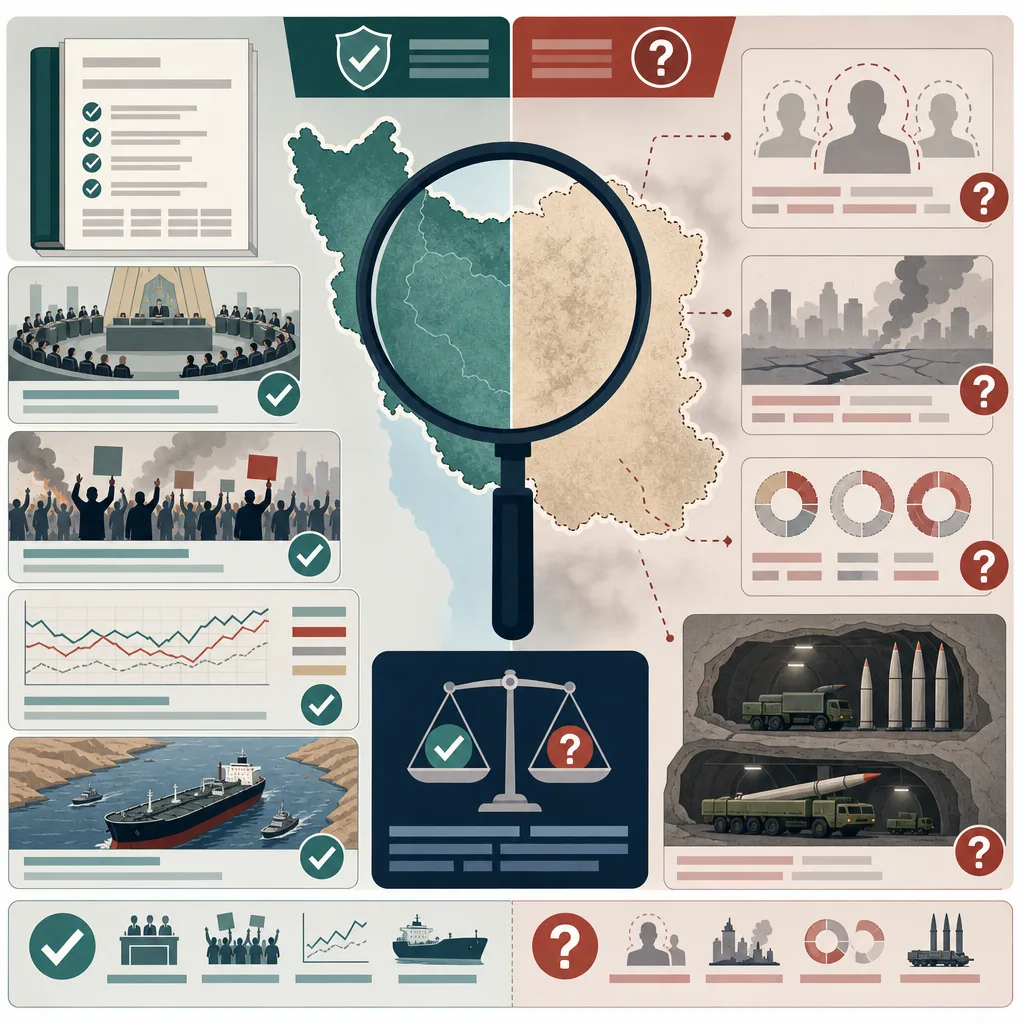
Claims that Iran is on the verge of collapse because its leaders have gone into hiding, a power struggle is underway, public anger is erupting, and it possesses a secret missile arsenal mix verified facts with unsourced speculation. Based on the constitution, investigations by international organizations, energy statistics, and military analysis, this article distinguishes what has been confirmed from what requires further verification.
- Under Iran's constitution, the Supreme Leader is elected by the Assembly of Experts and is not a position that automatically passes from father to son.
- Claims about Mojtaba Khamenei's rise, disappearance, and secret rule cannot be treated as fact without dated official records and reporting by multiple independent sources.
- The Islamic Revolutionary Guard Corps' political and economic influence and its repression of protesters since 2022 have been widely confirmed, but claims that it monopolizes the entire economy require separate evidence.
- The existence of underground missile bases has been publicly disclosed, but the percentage of the arsenal that remains and the number of missiles that can be launched per day are difficult to verify reliably from outside Iran.
- Economic hardship and conflict among elites increase the regime's vulnerability, but they do not allow predictions that the government will immediately collapse or enter a foreign war.
Analyses surrounding Iran often combine confirmed structural problems with wartime rumors of unclear origin. The observation that a leader has not been seen does not immediately prove injury or a power vacuum, and the existence of underground missile facilities does not prove a specific figure for remaining capabilities.
This article does not claim that Iran is stable. Economic hardship, state violence, elite privilege, sanctions, and military tensions are all substantial risk factors. However, conclusions such as “the greatest crisis since the country’s founding,” “on the verge of collapse,” or “the truth the media is hiding” require each link in the chain to be independently verified.
Summary of Verification Results
| Claim | Assessment | Basis for Assessment |
|---|---|---|
| Mojtaba Khamenei is Iran’s de facto Supreme Leader | Further verification required | Reports about influence and constitutionally assuming office as Supreme Leader are different matters. Official election records take precedence. |
| Mojtaba was seriously injured in an airstrike and went into hiding | Unable to verify | No date or location of the attack, medical information, satellite data, or reporting by multiple independent sources has been provided. |
| A father-to-son succession is itself unconstitutional in Iran | Inaccurate | The Supreme Leader is elected by the Assembly of Experts. A son cannot automatically succeed his father merely because he is his son, but kinship alone does not determine whether an election is unconstitutional. |
| 61% of the public cited domestic corruption as the cause of economic hardship | Source required | Representativeness cannot be assessed without the polling organization, question wording, sample, timing, and methodology. |
| The Islamic Revolutionary Guard Corps wields enormous political and economic influence | Largely confirmed | It has long been assessed as possessing networks of organizations and companies connected to construction, energy, and numerous other sectors beyond its military role. Its exact share of the economy remains opaque. |
| Government negotiators and IRGC hard-liners are in conflict | Structurally plausible | Policy differences between the elected government and unelected power institutions are a longstanding feature. The specific claim that a statement was reversed within 23 hours requires checking the original text. |
| 90% of Iran’s missile capabilities have been destroyed, or 70% remain | Unable to verify | Both claims require independently verified data on inventories, launchers, crews, and command networks. |
| Iran can launch 15–30 missiles and 50–100 drones per day | Unable to verify | No source or calculation method is given, and inventory size is not the same as a sustainable operational launch rate. |
How the Supreme Leadership and Succession Structure Work
Iran is a system that combines the principle of rule by an Islamic jurist with republican institutions that include a president and parliament. The Supreme Leader has extensive powers, including command of the armed forces, appointment of the head of the judiciary, and oversight of state broadcasting. The president leads the executive branch but is constrained by the Supreme Leader, the Islamic Revolutionary Guard Corps, and unelected institutions such as the Guardian Council.
Under Iran’s Constitution, the Assembly of Experts elects the Supreme Leader, and the specific provisions should be checked against the current constitutional text. The Constitution also stipulates procedures for the Supreme Leader’s death, resignation, removal, or inability to perform official duties, and the specific provisions should be checked against the current constitutional text. The system is therefore institutionally different from a hereditary monarchy in which a son automatically assumes office simply because he is the successor.
Mojtaba Khamenei has long been the subject of speculation regarding succession and informal influence. However, the following three propositions must be distinguished.
- The assessment that the Supreme Leader’s son exercises political influence
- The speculation that the ruling elite prefers him as successor
- The fact that he has actually been elected Supreme Leader through the Assembly of Experts’ constitutional process
Even if the first two are true, the third does not automatically follow. The identity of the incumbent Supreme Leader and whether an official successor has been designated must be checked again against Assembly of Experts records, gazette-level announcements, and the Supreme Leader’s official website as of the time of publication.
What Absence from Public Appearances Does and Does Not Prove
If a leader has not appeared in public for a certain period, there may be several explanations, including heightened security, health issues, a private schedule, or a change in video-release strategy. Verifying reports of injury requires at least the following information.
- The date and location of the last authenticated public activity
- When subsequently released videos were recorded and whether they were edited
- Whether the timing and target of an attack corresponded with the leader’s movements
- Reporting by multiple media outlets independent of one another
- Cross-verification of official announcements against physical evidence such as satellite imagery and on-site footage
Conclusions such as “he was seriously injured because there is no video” or “he is ruling from a secret location because written orders were issued” are inferences that run ahead of the evidence.
Anger Surrounding the Islamic Revolutionary Guard Corps and Aghazadehs
The Islamic Revolutionary Guard Corps is a military organization formed after the Islamic Revolution to protect the regime, and its exact founding date should be checked against its official history. Separate from the regular military, it operates ground, naval, and aerospace forces, and also oversees the Quds Force, which is associated with overseas operations. Multiple studies assess that the IRGC and affiliated foundations and companies are deeply involved in economic sectors including construction, energy, logistics, and telecommunications.
However, claims that it “monopolizes all key industries” or controls a specific percentage of the economy should be made cautiously. Iran’s ownership structure is a complex web of state institutions, religious foundations, pension funds, state-owned companies, and private companies, while transparent consolidated financial data is lacking.
“Aghazadeh” is a Persian expression used critically to refer to the children of senior officials or influential figures. It is not a legal status or official rank, but a social term symbolizing connections, privilege, and double standards. Photos purportedly showing luxurious lifestyles abroad or violations of dress codes may have been mistakenly linked to the wrong people unless the individuals’ identities and the location and date of the photos are verified.
The Mahsa Amini Case and State Violence
Mahsa Jina Amini died after being detained by Iran’s morality police in 2022, after which the “Woman, Life, Freedom” protests spread nationwide. The United Nations Independent International Fact-Finding Mission on Iran found the state responsible for Amini’s death and determined that serious human rights violations, including murder, imprisonment, torture, sexual violence, and persecution, occurred during the suppression of protests. The mission stated that some acts amounted to crimes against humanity.
This record shows that discontent within Iranian society is not merely external propaganda. However, descriptions of the use of specific weapons, death tolls, or the responsibility of individual commanders should remain within the scope of UN findings and verified incident records.
Why Negotiators and Hard-Liners Clash
Policy differences within Iran are more complex than a simple confrontation between two factions. Elected politicians include a mix of conservative, pragmatic, and reformist tendencies, while neither the IRGC nor the clerical establishment is entirely monolithic.
Even so, the following distinctions are useful as an analytical framework for understanding policy choices.
| Issue | Negotiation and Pragmatist Approach | Hard-Line and Deterrence Approach |
|---|---|---|
| Nuclear negotiations | Emphasizes deals to ease sanctions and restore the economy | Wary of verification demands and the West’s failure to honor commitments |
| Foreign military strategy | Avoids direct confrontation and seeks a diplomatic exit | Emphasizes deterrence through missiles, drones, and regional armed groups |
| Domestic control | Manages discontent through limited social relaxation | Maintains strict security controls on the grounds of threats to the regime |
| Strait of Hormuz | Prefers stable navigation to support exports and diplomacy | Emphasizes its potential use as leverage during a crisis |
The claim that an IRGC official reversed the foreign minister’s statement within 23 hours requires comparing the original texts of both statements, their posting times, translations, and full context. A threatening statement by a specific commander also does not immediately constitute the Iranian government’s settled policy or an order to close the strait.
Why the Strait of Hormuz Actually Matters
The Strait of Hormuz is a globally important energy transit chokepoint connecting the Persian Gulf and the Gulf of Oman. The volume of oil and petroleum products passing through the strait should be checked against the U.S. Energy Information Administration’s latest Strait of Hormuz statistics. Its share of global petroleum consumption should also be checked using the same source’s reference year and calculation method.
A complete, prolonged closure of the strait would also impose heavy costs on Iran. It would constrain Iran’s own export routes while provoking opposition from neighboring oil producers and major importers. Threats, ship seizures, the risk of mine-laying, limited controls, and an actual long-term blockade should therefore be treated as different stages.
What matters for international oil prices is not a declaration itself but observable changes such as the following.
- An increase in actual attacks on and seizures of merchant ships or oil tankers
- Higher marine insurance premiums and war-risk surcharges
- Shipping companies’ decisions to suspend or reroute operations
- Reduced shipment volumes from Gulf ports
- Changes in the deployments and rules of engagement of U.S. and Iranian forces
What Underground Missile Bases Prove
Iran has publicly displayed underground tunnels and storage facilities, mobile launchers, ballistic missiles, and cruise missiles. Dispersed underground facilities make it difficult to eliminate these capabilities all at once through a preemptive strike and compel an attacker to commit more reconnaissance, surveillance, and precision-strike assets.
However, propaganda videos or satellite imagery of tunnel entrances alone cannot establish the following.
- The number of operational missiles versus mock-ups
- The condition of fuel, warheads, and spare parts
- Whether mobile launchers and trained crews have survived
- Whether communications, target acquisition, and command-and-control systems are functioning
- The sustainable daily launch rate after the initial attack
“Missile capabilities” do not refer only to the missile bodies themselves. Launchers, crews, targeting intelligence, communications networks, warheads, fuel, and reloading capacity must all function together. A single percentage claiming that 70% of the force remains or that 90% has been eliminated therefore has limited meaning unless the assessed components and calculation criteria are disclosed.
Nor can the effect of an attack be judged by range alone. Accuracy, warhead weight, air-defense penetration rates, simultaneous launch volume, and the level of target protection determine the damage. Underground bases improve survivability, but entrances, communications facilities, and launch preparations may be exposed, so they are not absolutely secure spaces.
Why Economic Hardship Does Not Automatically Mean Regime Collapse
Sanctions, high prices, currency instability, unemployment, and corruption are key factors intensifying discontent in Iranian society. However, determining whether economic hardship will lead to regime collapse requires examining not only the scale of discontent but also the state’s capacity for repression, elite cohesion, the opposition’s organizational strength, and the existence of an alternative center of power.
| Possible Path | Key Conditions | Indicators to Watch |
|---|---|---|
| Managed instability | Continued cohesion of security agencies and dispersion of protests by region and social group | Scale of arrests, internet shutdowns, limited subsidies, and personnel changes |
| Negotiations and partial easing | Tangible benefits from sanctions relief and policy agreement among leaders | Nuclear negotiation schedule, sanctions waivers, changes in oil exports and exchange rates |
| Elite fragmentation | Open conflict over succession and economic interests | Senior-level purges, resignations, contradictory official orders, and commander transfers |
| Nationwide regime crisis | Large-scale solidarity protests and defections from security organizations | Sustained general strikes, simultaneous protests in major cities, and military or police refusal to obey orders |
| External military escalation | Miscalculation, pressure to retaliate, and command-and-control failure | Missile deployments, evacuation orders, airspace closures, attacks on merchant ships, and U.S. military reinforcements |
The proposition that a regime will necessarily choose war to divert domestic discontent is not a universal law either. External conflict may create a short-term rallying effect, but it also brings greater risks of military defeat, economic deterioration, and losses among the leadership.
How to Verify Unsourced Claims of an Iran Crisis
In an environment such as Iran, where access to information is restricted and wartime propaganda is intense, each claim should be broken down into at least five elements. This verification process is a crucial perspective that is easily omitted from the original narrative.
- Fix the claim to a specific time. Confirm the year and date instead of relying on “recently,” “currently,” or “last February.”
- Confirm the person’s official status. Distinguish influential relatives and succession candidates from constitutionally installed officeholders.
- Find the original source. Prioritize the original statement, full interview, and official record over reposted videos.
- Check independence. Multiple outlets repeating the same anonymous account or single government announcement do not constitute multiple confirmations.
- Check the denominator and methodology behind figures. Verify polling samples and questions, the scope used to calculate military capability percentages, and the duration for which launch volumes can be sustained.
In particular, the phrase “the media is keeping quiet” is not evidence. It is first necessary to distinguish whether major outlets are not reporting something because of concealment or because it cannot be independently verified.
Conclusion
Iran does have serious internal vulnerabilities. The IRGC’s extensive influence, anger over state violence, economic hardship, elite privilege, and tensions between the elected government and unelected power institutions are verifiable problems. The Strait of Hormuz and Iran’s missile and drone capabilities also pose substantial risks to the region and the global economy.
However, the information provided does not verify Mojtaba Khamenei’s serious injury and secret rule, a specific polling figure, a policy reversal within 23 hours, the percentage of missile capabilities remaining, or the daily launch volume. Rather than defining Iran as a “pressure cooker about to explode,” it is more accurate to continuously monitor the official succession process, defections from security institutions, nationwide strikes, actual disruptions to navigation through the strait, and verified military deployments.
FAQ
Is Mojtaba Khamenei Iran's Supreme Leader?
Whether he is officially the Supreme Leader must be verified through the election records of Iran's Assembly of Experts and official state announcements. Being the Supreme Leader's son or being regarded as a leading successor does not by itself make him the Supreme Leader under the constitution.
If the Supreme Leader does not appear in public, does that mean he has been injured or killed?
No. There are several possibilities, including health issues, heightened security, undisclosed schedules, and the use of prerecorded video. Reports of an injury become more credible only when the last confirmed activity, the location of the attack and his movements, the time the video was recorded, and multiple independent reports all align.
If a son is elected Supreme Leader in Iran, is that automatically unconstitutional?
Kinship alone does not determine whether it is unconstitutional. Iran's constitution stipulates that the Assembly of Experts elect the Supreme Leader after considering the qualification requirements, so automatic hereditary succession is not permitted. However, it also cannot be concluded that a candidate is legally disqualified solely because he is the son. The actual procedure and qualification review must be examined.
Does the Islamic Revolutionary Guard Corps control Iran's entire economy?
Many studies indicate that companies and foundations linked to the Revolutionary Guard exert strong influence in various sectors, including construction, energy, and logistics. However, because ownership structures are opaque and complex, it is difficult to establish their exact share of the overall economy or whether they monopolize all key industries.
Is aghazadeh an official social rank in Iran?
No. Aghazadeh is a social term referring to the children of senior officials or influential figures, and it is used in contexts criticizing connections, privilege, and double standards. It is not a legal status or official position.
Can Iran actually blockade the Strait of Hormuz?
Iran is assessed as having the capability to seriously disrupt shipping through its geographic position and its missiles, mines, small vessels, and other assets. However, a prolonged blockade would also harm Iran's exports and could provoke an international military response, so threatening statements must be distinguished from an actual sustained blockade.
If Iran has underground missile bases, can its military capabilities be preserved safely?
Underground facilities and dispersed deployment increase survivability against a preemptive strike, but they do not guarantee complete protection. Entrances, communications networks, launchers, and crews may be struck, and it is difficult for outside observers to accurately determine the number and operational status of combat-ready missiles inside the facilities.
Do economic hardship and large-scale protests mean the collapse of the Iranian regime?
Economic hardship and protests increase the regime's vulnerability, but they are not sufficient conditions for collapse. The cohesion of the security agencies, divisions among the elite, a nationwide general strike, the opposition's organizational capacity, and whether an alternative center of power has been established must also be considered.
Sources
- Constitution of the Islamic Republic of Iran 1989
- Findings of the United Nations Independent International Fact-Finding Mission on Iran in 2024
- U.S. Energy Information Administration: World Oil Transit Chokepoints
- CSIS Missile Threat: Missiles of Iran
- Council on Foreign Relations: Iran’s Revolutionary Guards
- World Bank: Iran Overview
Images