Tenant Move-Out Day Settlement Order for Management Fees, Utilities, and the Long-Term Repair Reserve Fund
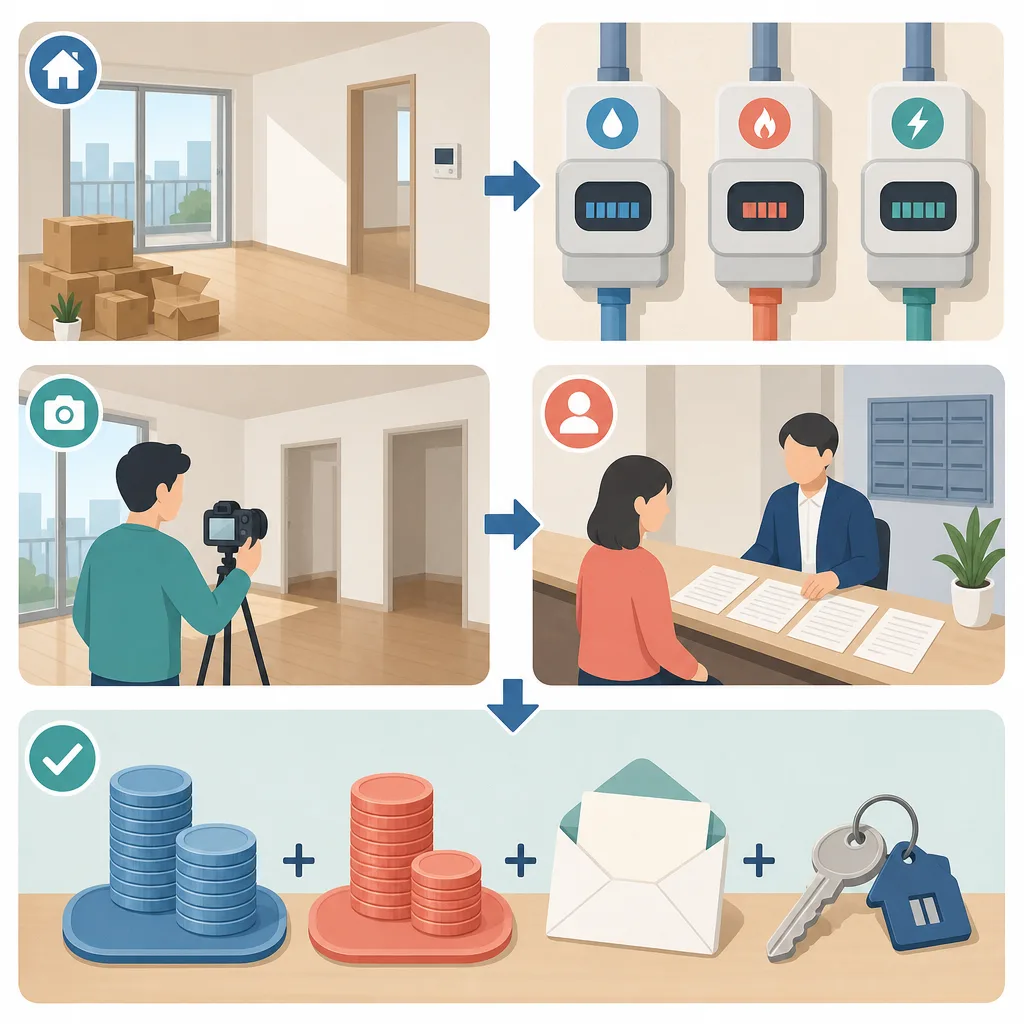
For a safe move-out day settlement, tenants should proceed in this order: confirm details with the management office, record meter readings, finalize utility bills, separate the long-term repair reserve fund, and hand over the keys after settling the security deposit. Because management fee items and utility contract arrangements vary by home, be sure to keep settlement statements and proof of payment.
- First confirm whether electricity and water charges are included in the management fees to avoid duplicate payments or omissions.
- Immediately before moving out, record the electricity, water, and gas meters and the condition of the home's interior with photos or video.
- The long-term repair reserve fund paid by the tenant on the owner's behalf can be settled with the owner separately from regular management fees.
- It is safest to process any deductions from the security deposit together with the key handover, after checking the basis and calculations for each item.
- At the new home, confirm the meter readings at move-in and ensure that any unpaid management fees from the previous resident have been kept separate.
Moving-day settlement is not simply a matter of paying the final maintenance fee bill. The maintenance fee billing cutoff date may differ from the actual move-out date, and the contract arrangements for electricity, water, and city gas vary by home. When the return of the long-term repair reserve fund and deductions from the security deposit are also involved, disputes can easily arise over who must pay how much.
The safest approach is to confirm the settlement method with the management office and each utility provider before moving, record the meter readings and condition of the home immediately before moving out, and then compare the documents before handing over the keys and settling the security deposit.
Three Things to Check Before Moving
1. Check whether utilities are included in the maintenance fees
In apartments and some other multi-unit housing, the management office reads electricity or water meters collectively and includes the charges in the maintenance fees. Other homes have individual electricity contracts, individual water meters, or individual city gas contracts.
Confirm the following with the management office or landlord.
- Whether electricity charges are included in the maintenance fees or settled directly with Korea Electric Power Corporation
- Whether water charges are based on individual household meter readings or allocated according to the number of occupants, floor area, or another standard
- Whether city gas is supplied under an individual contract or central heating costs are included in the maintenance fees
- Whether there are separate charges for parking, elevator use, moving work, or other services
- How interim maintenance fees through the move-out date are calculated
You must first distinguish the contract arrangements to prevent the same charge from appearing both in the maintenance fees and on a utility provider’s bill.
2. Check the maintenance fee billing cutoff date
If the maintenance fee billing period does not match the move-out date, usage after the last regular bill must be calculated separately. This is commonly called an interim maintenance fee, but there is no single calculation formula used nationwide.
Items that can be metered, such as electricity and water, can be calculated based on actual usage. Fixed charges, such as general management, cleaning, and security fees, may be prorated according to the management bylaws or the management office’s standards. Therefore, do not ask only for the total amount; request the applicable billing period and the amount for each item.
3. Schedule the city gas move-out procedure
If you use individually supplied city gas, notify the local city gas provider that you are moving out. Depending on the region and equipment, a technician’s visit, meter inspection, or safety measures may be required, so it is better to apply several days before the move rather than on moving day.
When applying online or by phone, have the address, account holder’s information, customer number, scheduled move-out time, and meter location ready. City gas providers vary by region, so check the relevant provider with the landlord or on a previous bill.
Order for Settling Maintenance Fees and Utilities on the Move-Out Date
Step 1: Photograph the meters after the home is empty
After you have finished using the appliances and lights, photograph the electricity, water, and gas meter readings. It is best for the photographs to show not only the readings but also the meter identification numbers and the time they were taken.
Also record the following:
- The condition of each room, wall, floor, window, and built-in fixture
- Equipment included in the rental property, such as the boiler, air conditioner, and door lock
- The number of keys, access cards, parking cards, and remote controls
- Wide views of the empty home showing that no waste or belongings have been left behind
Meter readings establish the cutoff for final usage, while records of the home’s condition provide evidence in case of a dispute over deductions for restoration costs.
Step 2: Have the management office calculate the interim maintenance fees
Inform the management office of the actual move-out date and meter readings, and request the settlement details for the household. If electricity and water are included in the maintenance fees, the management office’s settlement comes first.
Check the following on the settlement statement:
- The start and end dates of the billing period
- The distinction between general management fees and usage charges
- Meter readings and unit rates for electricity, water, heating, and other services
- Whether unpaid balances, late fees, or advance payments are included
- Whether the long-term repair reserve fund is shown as a separate item
- The names and calculation basis of any additional moving-related charges
If you paid the amount, keep the receipt or bank transfer record. If the management office issues certificates of full payment, you may request one, but not every management office issues a document under the same name or in the same format.
Step 3: Close out individually billed utilities
Utilities not included in the maintenance fees must be settled separately with each provider.
| Item | What to check | Records to keep |
|---|---|---|
| Electricity | Whether there is an individual contract, customer number, final meter reading, service end date | Meter photograph, settlement receipt |
| Water | Whether it is included in the maintenance fees or billed directly by the relevant waterworks office | Meter photograph, maintenance fee settlement statement or payment record |
| City gas | Relevant provider, move-out application, whether a visit is required, final usage | Application number, meter photograph, payment receipt |
| Internet and paid TV | Relocation or cancellation, return of rented equipment | Cancellation or relocation application details, equipment return confirmation |
Before immediately canceling automatic payments, check how the final bill will be withdrawn. If settlement and cancellation of automatic payments are handled in the wrong order, an unpaid balance or duplicate payment may result.
Step 4: Calculate the long-term repair reserve fund separately
The long-term repair reserve fund is money accumulated to replace or repair major facilities in multi-unit housing in the future. Under the Multi-Family Housing Management Act, the management entity generally collects it from the owner. If a tenant, as the occupant, paid it on the owner’s behalf, the owner is to reimburse that amount.
If the long-term repair reserve fund is listed separately on the maintenance fee bill, request a payment certificate or payment statement from the management office. The Enforcement Decree of the Multi-Family Housing Management Act requires the management entity to issue a certificate when an occupant requests confirmation of payment.
However, the following must be distinguished:
- Long-term repair reserve fund: A reserve for replacing and repairing major facilities under a long-term repair plan, for which the owner is generally responsible.
- Repair and maintenance expenses: Maintenance fee expenses for routine repairs and upkeep, which may ordinarily be charged to the actual occupant.
- Maintenance fee deposit or advance maintenance fees: An amount deposited at the beginning of occupancy; the name and refund arrangement must be confirmed separately with the management office.
- Special provisions in the lease agreement: If there is a separate special provision concerning responsibility for the long-term repair reserve fund, its wording and effect must be reviewed. Legal advice may be needed if there is a dispute.
For officetels, multiplex housing, and similar properties, the long-term repair reserve fund system under the Multi-Family Housing Management Act may not apply in the same way, depending on the building’s legal classification and management method. First check whether the item was actually charged on the bill.
Step 5: Reconcile all amounts on one sheet
The final settlement sheet should distinguish at least the following items.
| Category | Payment direction | Supporting basis |
|---|---|---|
| General maintenance fees through the move-out date | Pay after confirming whether the tenant is responsible | Interim maintenance fee settlement statement |
| Electricity, water, and gas usage charges | Settle actual usage | Meter readings and utility provider receipts |
| Long-term repair reserve fund | Request reimbursement from the owner if the tenant paid it on the owner’s behalf | Payment certificate from the management office |
| Rent or overdue amounts | Confirm based on the contract and payment history | Lease agreement, bank account records |
| Restoration costs | Discuss only items for which responsibility and amounts have been confirmed | Move-in and move-out photographs, estimates and receipts |
| Remaining security deposit | Refund after reflecting the above items | Settlement sheet and transfer record |
The long-term repair reserve fund should be shown on a separate line rather than combined with other unpaid maintenance fees to reduce calculation errors.
Documents to Obtain from the Management Office
Document names may vary by complex, so check the contents rather than the names.
- Maintenance fee settlement statement as of the move-out date: A document showing the settlement period, charges by item, unpaid balances, and payments
- Maintenance fee receipt or proof of payment: A document proving that payment was actually made
- Long-term repair reserve fund payment certificate: A periodic or total record of the long-term repair reserve fund paid during the tenant’s occupancy
- Full-payment confirmation records: If issued by the management office, a document showing whether the household had any unpaid balance at the time of settlement
- Household meter-reading records: The opening and closing readings for electricity, water, and heating usage included in the maintenance fees
If the management office does not issue a document called a certificate of full payment, you can keep a settlement statement showing a balance of KRW 0 together with the payment receipt. It is advisable to request the long-term repair reserve fund payment certificate separately from the general maintenance fee records.
How to Calculate the Long-Term Repair Reserve Fund Refund
The most accurate refund amount is the total of the actual payment records issued by the management office. Simply multiplying the number of months of occupancy by the current monthly charge may fail to reflect changes in the rate during the tenancy or records of nonpayment or reductions.
The calculation procedure is as follows.
- Confirm the start and end dates of occupancy under the lease.
- Obtain the long-term repair reserve fund payment records for that period.
- Identify any amounts paid directly by the landlord or another person.
- Add only the amounts actually paid by the tenant on the owner’s behalf.
- Present the payment certificate and bank account information to the landlord and request reimbursement.
If the contract contains a special provision concerning the long-term repair reserve fund, check it before settlement. If the parties interpret the provision differently, the management office is not an institution that determines legal liability, so you must consult with the landlord or seek legal advice.
Matters to Check When Settling the Security Deposit and Handing Over the Keys
At the end of the lease, the landlord must return the security deposit, and the tenant must hand over the home. In practice, it is safest to agree in advance to handle the security deposit transfer, final inspection of the home, and handover of the keys and access devices at the same time.
What to check before deductions are made from the security deposit
- A settlement sheet listing the name and amount of each deduction
- The billing period and items for unpaid maintenance fees
- Photographs showing whether damaged areas existed before move-in
- The basis for calculating the amount, such as repair estimates or receipts
- Whether the condition is deterioration or wear from ordinary use, or damage for which the tenant is responsible
- Whether the long-term repair reserve fund refund has been omitted
You do not need to immediately agree to a full deduction without supporting evidence simply because the landlord claims repair costs. Conversely, continuing to retain the keys solely because of a settlement dispute may create an additional dispute over when the handover of the home was completed. It is advisable to distinguish disputed amounts from undisputed amounts and document any agreement in text messages or on the settlement sheet.
Final handover records
- Confirm actual receipt of the security deposit
- Record the number of keys and access cards
- Agree on how the door lock password will be handled
- Cancel parking registration and common entrance access privileges
- Record the time of key handover and the recipient
- Share the final settlement sheet and photographs with the landlord
If settling in cash, prepare a receipt. If paying by bank transfer, keep the transfer completion screen and transaction record.
How to Check a Previous Occupant’s Unpaid Balance When Moving into a New Home
Before moving into a new home, separate the household’s maintenance fees and baseline meter readings from those of the previous occupancy. You should not conclude that a new tenant is immediately obligated to pay merely because the previous occupant has an unpaid balance. Check the period in which the unpaid balance arose, the nature of the costs, the terms of the lease agreement, and the legal basis, and ask the landlord to resolve the matter.
Follow these steps on the move-in date.
- Register the move-in date with the management office and confirm the date on which charges to the new tenant begin.
- Ask whether any unpaid balance from the previous period remains on the household ledger.
- If there is an unpaid balance, request a document showing the period and items, and forward it to the landlord.
- Photograph the electricity, water, and gas meter readings to establish the move-in baseline.
- Record the condition of the walls, floors, windows, appliances, and equipment on the move-in inspection sheet.
- Share the photographs with the landlord and notify the landlord of existing defects by text message or email.
The management office may decline to provide detailed information about the previous occupant for privacy reasons. In that case, request confirmation not of personal information, but of the billing period for the household, the unpaid items, and whether the balance as of the move-in date has been separated.
Final Moving-Day Checklist
Maintenance fees and utilities
- I confirmed the maintenance fee billing end date.
- I photographed the electricity, water, and gas meters and their identification numbers.
- I distinguished utilities included in the maintenance fees from items requiring separate settlement.
- I completed the city gas move-out procedure or safety measures.
- I confirmed the cancellation of automatic payments and the final withdrawal schedule.
- I received the interim maintenance fee settlement statement and payment receipt.
Long-term repair reserve fund and security deposit
- I received the long-term repair reserve fund payment certificate.
- I distinguished repair and maintenance expenses from the long-term repair reserve fund.
- I checked the relevant special provisions in the lease agreement.
- I confirmed the security deposit deductions and the basis for their calculation.
- I coordinated the timing of the security deposit payment and key handover.
Handover of the home
- I photographed or recorded video of the empty home.
- I confirmed the number of keys, access cards, and remote controls.
- I documented responsibility for any damage or repairs required.
- I shared the final settlement sheet with the landlord.
- I stored all documents and conversation records separately.
The key to moving settlement is not paying the total amount quickly, but separating the billing period, responsible party, and calculation basis for each amount. In particular, separating utilities included in the maintenance fees from individually billed utilities, and general maintenance fees from the long-term repair reserve fund, can prevent most duplicate payments and omitted refunds.
FAQ
On moving day, who settles the maintenance fees, the landlord or the tenant?
The tenant generally settles the regular maintenance fees and utility bills for the period they actually occupied and used the property, but items for which the owner is responsible in principle, such as the long-term repair reserve fund, must be handled separately. Both the special provisions of the lease agreement and the maintenance fee settlement statement should be reviewed.
How are interim maintenance fees calculated?
Metered items such as electricity and water are calculated based on actual usage, while fixed items such as general maintenance fees are often prorated by day according to the management office's standards. There is no single nationwide formula, so you should request the settlement period and an itemized calculation.
Can a tenant be reimbursed for the long-term repair reserve fund?
If a tenant in a multi-unit residential building paid the long-term repair reserve fund on behalf of the owner, the tenant may, in principle, request reimbursement from the owner. You should obtain a certificate of actual payment from the management office and also review the relevant special provisions of the lease agreement.
Are the long-term repair reserve fund and repair and maintenance fees the same expense?
No. The long-term repair reserve fund is money accumulated for the long-term replacement and repair of major facilities, while repair and maintenance fees are maintenance-related expenses used for routine inspections and minor repairs. The names and amounts of the two items should be distinguished on the bill.
What should I do if the management office does not issue a certificate of full payment?
If there is no document called a certificate of full payment, you can keep the maintenance fee settlement statement showing the balance and settlement period, along with payment receipts or bank transfer records. It is advisable to request the certificate of payment for the long-term repair reserve fund separately from the regular maintenance fee records.
Can I settle the city gas bill immediately on moving day?
Depending on the region and equipment, a technician's visit or safety measures may be required, so it is advisable to notify the local city gas provider of your move-out in advance. You should photograph the final meter reading immediately before vacating and keep the service request number and payment receipt.
Do I have to hand over the keys before receiving my security deposit?
In practice, it is safest to agree to inspect the condition of the home, transfer the security deposit, and hand over the keys within the same time frame. If there is a dispute over the settlement, the undisputed amount and the amount in dispute should be separated, and the time of the key handover and the terms of the agreement should be documented.
Do I have to pay the previous tenant's unpaid maintenance fees at my new home?
It cannot be assumed that the new tenant is automatically responsible simply because the unpaid amount is owed by the previous occupant. You should verify the period and items for which the unpaid charges arose and who is responsible under the contract, ask the management office to separate the unit's ledger as of the move-in date, and then demand that the landlord resolve the matter.
Why are photos of the meters needed when moving out?
Photos of the meters serve as evidence distinguishing the tenant's final usage from the next occupant's starting usage. The photos should clearly show the numbers and meter identification numbers, and if possible, the time they were taken should also be recorded.
Sources
- Korean Law Information Center Multi-Family Housing Management Act
- Korean Law Information Center Enforcement Decree of the Multi-Family Housing Management Act
- Korean Law Information Center Civil Act
- Q&A on Settling Interim Maintenance Fees When Moving
- Q&A on Moving and Settling City Gas Charges
- Q&A on Refunds of Long-Term Repair Reserves
Images