Injoys
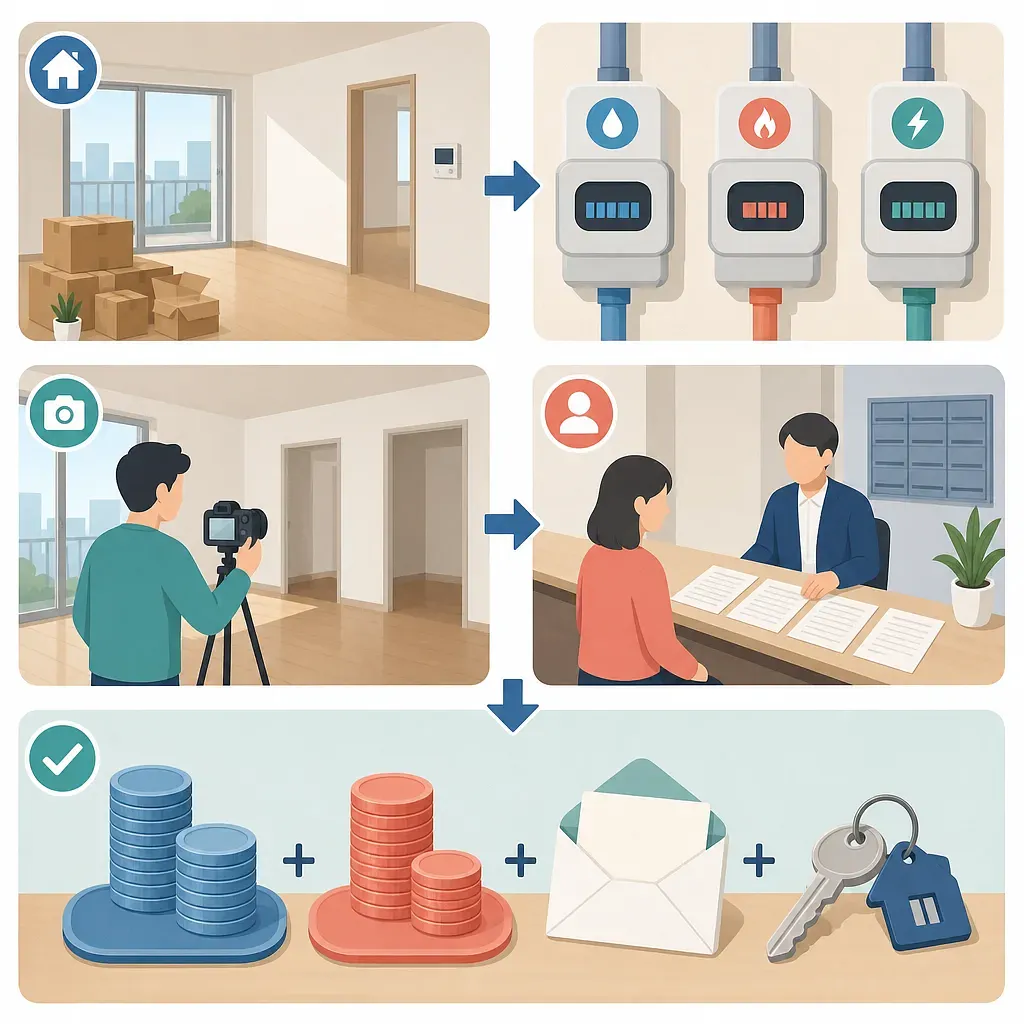
Moving-day settlement is not simply a matter of paying the final maintenance fee bill. The maintenance fee billing cutoff date may differ from the actual move-out date, and the contract arrangements for electricity, water, and city gas vary by home. When the return of the long-term repair reserve fund and deductions from the security deposit are also involved, disputes can easily arise over who must pay how much.
The safest approach is to confirm the settlement method with the management office and each utility provider before moving, record the meter readings and condition of the home immediately before moving out, and then compare the documents before handing over the keys and settling the security deposit.
Three Things to Check Before Moving
1. Check whether utilities are included in the maintenance fees
In apartments and some other multi-unit housing, the management office reads electricity or water meters collectively and includes the charges in the maintenance fees. Other homes have individual electricity contracts, individual water meters, or individual city gas contracts.
Confirm the following with the management office or landlord.
- Whether electricity charges are included in the maintenance fees or settled directly with Korea Electric Power Corporation
- Whether water charges are based on individual household meter readings or allocated according to the number of occupants, floor area, or another standard
- Whether city gas is supplied under an individual contract or central heating costs are included in the maintenance fees
- Whether there are separate charges for parking, elevator use, moving work, or other services
- How interim maintenance fees through the move-out date are calculated
You must first distinguish the contract arrangements to prevent the same charge from appearing both in the maintenance fees and on a utility provider’s bill.
2. Check the maintenance fee billing cutoff date
If the maintenance fee billing period does not match the move-out date, usage after the last regular bill must be calculated separately. This is commonly called an interim maintenance fee, but there is no single calculation formula used nationwide.
Items that can be metered, such as electricity and water, can be calculated based on actual usage. Fixed charges, such as general management, cleaning, and security fees, may be prorated according to the management bylaws or the management office’s standards. Therefore, do not ask only for the total amount; request the applicable billing period and the amount for each item.
3. Schedule the city gas move-out procedure
If you use individually supplied city gas, notify the local city gas provider that you are moving out. Depending on the region and equipment, a technician’s visit, meter inspection, or safety measures may be required, so it is better to apply several days before the move rather than on moving day.
When applying online or by phone, have the address, account holder’s information, customer number, scheduled move-out time, and meter location ready. City gas providers vary by region, so check the relevant provider with the landlord or on a previous bill.
Order for Settling Maintenance Fees and Utilities on the Move-Out Date
Step 1: Photograph the meters after the home is empty
After you have finished using the appliances and lights, photograph the electricity, water, and gas meter readings. It is best for the photographs to show not only the readings but also the meter identification numbers and the time they were taken.
Also record the following:
- The condition of each room, wall, floor, window, and built-in fixture
- Equipment included in the rental property, such as the boiler, air conditioner, and door lock
- The number of keys, access cards, parking cards, and remote controls
- Wide views of the empty home showing that no waste or belongings have been left behind
Meter readings establish the cutoff for final usage, while records of the home’s condition provide evidence in case of a dispute over deductions for restoration costs.
Step 2: Have the management office calculate the interim maintenance fees
Inform the management office of the actual move-out date and meter readings, and request the settlement details for the household. If electricity and water are included in the maintenance fees, the management office’s settlement comes first.
Check the following on the settlement statement:
- The start and end dates of the billing period
- The distinction between general management fees and usage charges
- Meter readings and unit rates for electricity, water, heating, and other services
- Whether unpaid balances, late fees, or advance payments are included
- Whether the long-term repair reserve fund is shown as a separate item
- The names and calculation basis of any additional moving-related charges
If you paid the amount, keep the receipt or bank transfer record. If the management office issues certificates of full payment, you may request one, but not every management office issues a document under the same name or in the same format.
Step 3: Close out individually billed utilities
Utilities not included in the maintenance fees must be settled separately with each provider.
| Item | What to check | Records to keep |
|---|---|---|
| Electricity | Whether there is an individual contract, customer number, final meter reading, service end date | Meter photograph, settlement receipt |
| Water | Whether it is included in the maintenance fees or billed directly by the relevant waterworks office | Meter photograph, maintenance fee settlement statement or payment record |
| City gas | Relevant provider, move-out application, whether a visit is required, final usage | Application number, meter photograph, payment receipt |
| Internet and paid TV | Relocation or cancellation, return of rented equipment | Cancellation or relocation application details, equipment return confirmation |
Before immediately canceling automatic payments, check how the final bill will be withdrawn. If settlement and cancellation of automatic payments are handled in the wrong order, an unpaid balance or duplicate payment may result.
Step 4: Calculate the long-term repair reserve fund separately
The long-term repair reserve fund is money accumulated to replace or repair major facilities in multi-unit housing in the future. Under the Multi-Family Housing Management Act, the management entity generally collects it from the owner. If a tenant, as the occupant, paid it on the owner’s behalf, the owner is to reimburse that amount.
If the long-term repair reserve fund is listed separately on the maintenance fee bill, request a payment certificate or payment statement from the management office. The Enforcement Decree of the Multi-Family Housing Management Act requires the management entity to issue a certificate when an occupant requests confirmation of payment.
However, the following must be distinguished:
- Long-term repair reserve fund: A reserve for replacing and repairing major facilities under a long-term repair plan, for which the owner is generally responsible.
- Repair and maintenance expenses: Maintenance fee expenses for routine repairs and upkeep, which may ordinarily be charged to the actual occupant.
- Maintenance fee deposit or advance maintenance fees: An amount deposited at the beginning of occupancy; the name and refund arrangement must be confirmed separately with the management office.
- Special provisions in the lease agreement: If there is a separate special provision concerning responsibility for the long-term repair reserve fund, its wording and effect must be reviewed. Legal advice may be needed if there is a dispute.
For officetels, multiplex housing, and similar properties, the long-term repair reserve fund system under the Multi-Family Housing Management Act may not apply in the same way, depending on the building’s legal classification and management method. First check whether the item was actually charged on the bill.
Step 5: Reconcile all amounts on one sheet
The final settlement sheet should distinguish at least the following items.
| Category | Payment direction | Supporting basis |
|---|---|---|
| General maintenance fees through the move-out date | Pay after confirming whether the tenant is responsible | Interim maintenance fee settlement statement |
| Electricity, water, and gas usage charges | Settle actual usage | Meter readings and utility provider receipts |
| Long-term repair reserve fund | Request reimbursement from the owner if the tenant paid it on the owner’s behalf | Payment certificate from the management office |
| Rent or overdue amounts | Confirm based on the contract and payment history | Lease agreement, bank account records |
| Restoration costs | Discuss only items for which responsibility and amounts have been confirmed | Move-in and move-out photographs, estimates and receipts |
| Remaining security deposit | Refund after reflecting the above items | Settlement sheet and transfer record |
The long-term repair reserve fund should be shown on a separate line rather than combined with other unpaid maintenance fees to reduce calculation errors.
Documents to Obtain from the Management Office
Document names may vary by complex, so check the contents rather than the names.
- Maintenance fee settlement statement as of the move-out date: A document showing the settlement period, charges by item, unpaid balances, and payments
- Maintenance fee receipt or proof of payment: A document proving that payment was actually made
- Long-term repair reserve fund payment certificate: A periodic or total record of the long-term repair reserve fund paid during the tenant’s occupancy
- Full-payment confirmation records: If issued by the management office, a document showing whether the household had any unpaid balance at the time of settlement
- Household meter-reading records: The opening and closing readings for electricity, water, and heating usage included in the maintenance fees
If the management office does not issue a document called a certificate of full payment, you can keep a settlement statement showing a balance of KRW 0 together with the payment receipt. It is advisable to request the long-term repair reserve fund payment certificate separately from the general maintenance fee records.