Do Damaged Bills Still Have Cash Value? Exchange Guidelines and Precautions
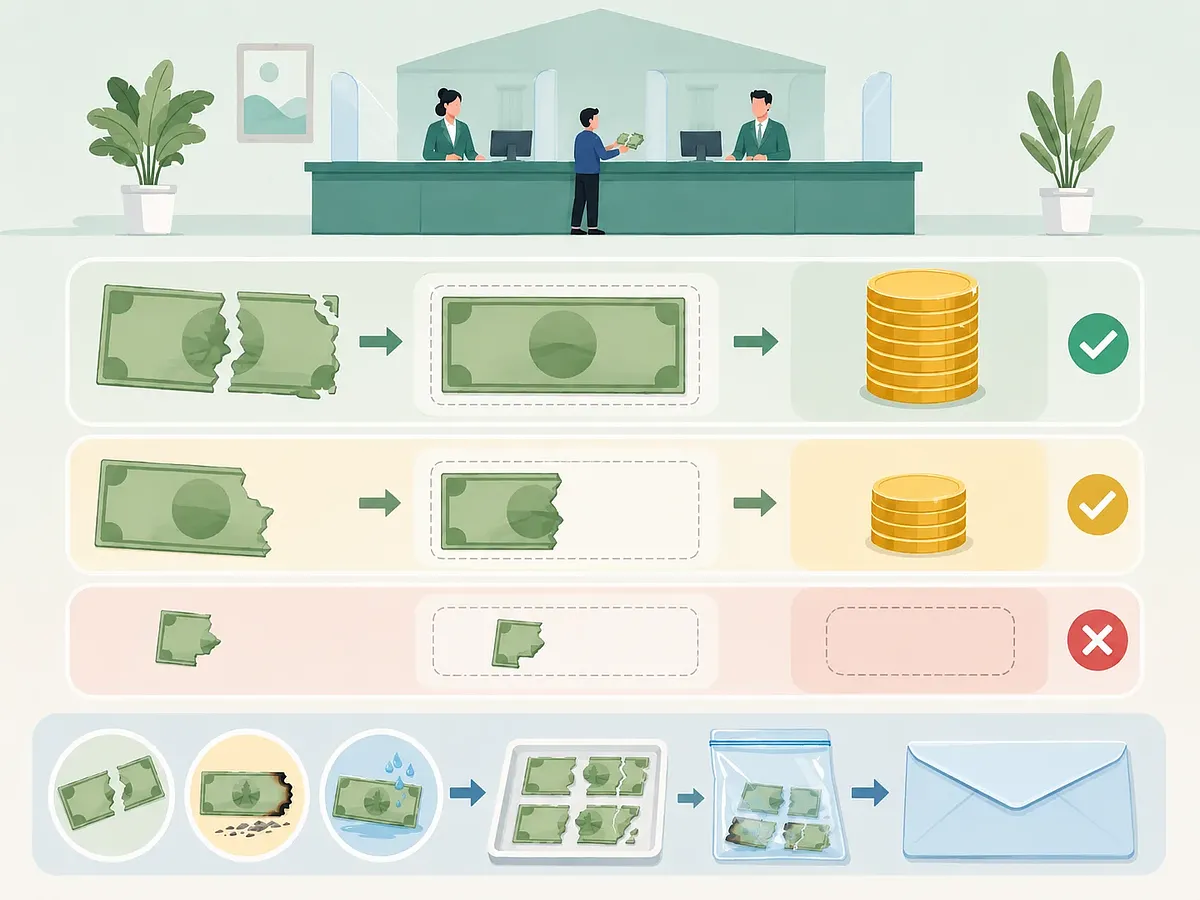
Even damaged banknotes can be identified as such, and if the remaining area meets certain criteria, they can be exchanged for cash. According to the Bank of Korea’s standards, if the remaining area is 3/4 or more, the full amount is exchanged; if it is 2/5 or more but less than 3/4, half the amount is exchanged; and if it is less than 2/5, exchange is generally not possible.
Damaged banknotes do not immediately lose their value; instead, the exchange amount is determined based on the remaining surface area and the extent to which the note can be identified.
According to the Bank of Korea’s standards for exchanging damaged banknotes, if more than 3/4 of the surface area remains, the full value is reimbursed; if more than 2/5 but less than 3/4 remains, half the value is reimbursed; and if less than 2/5 remains, the note is invalid.
A 10,000-won bill that is half gone is usually exchanged for 5,000 won, since the remaining area is between 2/5 and less than 3/4 of the original bill.
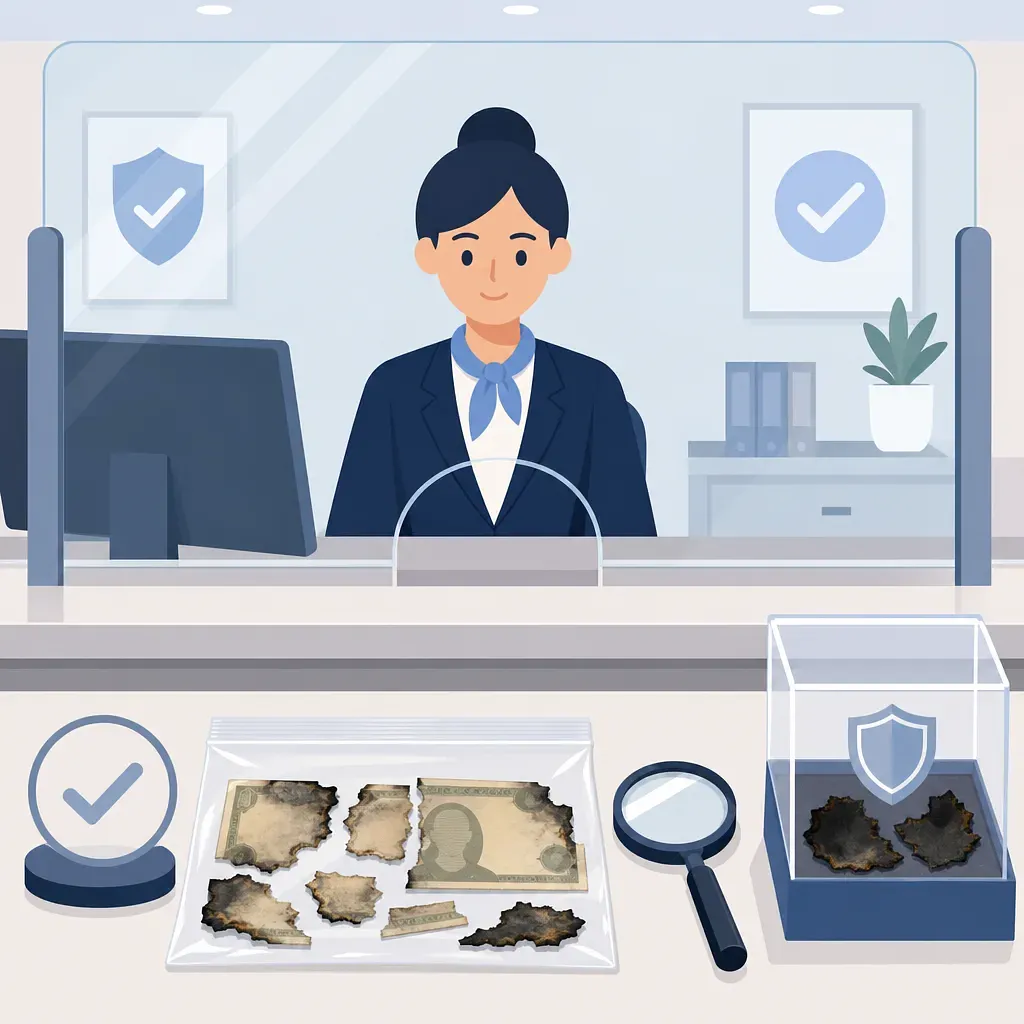
Even if banknotes have been burned or soaked in water, you should bring them in as close to their original condition as possible; brushing off ash or fragments may make it difficult to determine the remaining area.
Exchanges may be restricted in cases of intentional damage, suspected counterfeiting or alteration, or when banknotes cannot be identified.
At a Glance
Even damaged banknotes may still retain their cash value. Even if a banknote is torn, burned, or wet, it can be exchanged at a bank or the Bank of Korea as long as it can be identified as a genuine banknote and the remaining area meets certain criteria.
However, the exchange amount depends not only on “the denomination of the bill” but also on how much of the original bill’s area remains.
Key Exchange Criteria
In South Korea, damaged banknotes are generally exchanged based on the remaining area as follows:
Remaining Area of the Banknote | Exchangeable Amount | Example
3/4 or more of the original area | Full exchange | 10,000 won for a 10,000-won note
2/5 or more but less than 3/4 of the original area | Half the face value | 5,000 won for a 10,000-won bill
Less than 2/5 of the original area | Not exchangeable | Difficult to recognize value, even for a 10,000-won bill
Note: While it is sometimes mistakenly reported that the standard for damaged banknotes is “2/3 or more for full exchange,” the Bank of Korea’s exchange criteria for damaged banknotes are **3/4 or more for full exchange and **2/5 or more but less than 3/4 for half exchange.
How much is a 10,000-won bill worth if only half remains?
If about half of a 10,000-won bill torn in half is actually remaining, the remaining area is approximately 1/2 of the original bill. Since this falls within the 2/5 or more but less than 3/4 range, it is generally exchanged for half the face value, or 5,000 won.
In other words, just because a bill is torn in half doesn’t mean it loses all its value. However, it must be possible to verify that the remaining portion is indeed a 10,000-won bill and to determine its remaining area.
Which bills can be exchanged?
The following are key factors in determining whether a banknote can be exchanged:
1. The fragment must be identifiable as a banknote
The bank or the Bank of Korea must be able to verify that the fragment is an actual banknote. This can be determined through various clues, such as the face value, design, serial number, and security features.
2. The remaining area must be determinable
For torn, burned, or water-damaged banknotes, calculating the remaining area is crucial. Particular caution is needed with burned banknotes, as the loss of ash may make the remaining area appear smaller than it actually is.
3. The damage must be natural or unavoidable
Banknotes damaged due to unavoidable causes—such as everyday accidents, fire, water damage, washing, or damage during storage—may be eligible for exchange. Conversely, exchanges may be restricted if the banknote was intentionally damaged or if there is suspicion of counterfeiting or alteration.
Precautions by Type of Damage
Type of Damage | Exchange Eligibility | Precautions When Bringing It In
Torn banknotes | Possible if the remaining area meets the criteria | Gather all pieces and bring them with you
Burned banknotes | Possible if the banknote can be identified and the area verified | Do not brush off the ashes; store them carefully in a box or envelope
Water-damaged banknote | Exchangeable if identifiable | Do not forcefully dry or rub the banknote
Banknote that went through a washing machine | Exchangeable depending on the extent of damage | Keep all torn pieces
Partially remaining banknote | Exchangeable for at least half the face value if more than 2/5 remains | Remaining area is the key criterion
Where can I exchange them?
You can generally consult with or apply to exchange damaged banknotes at the following locations:
· Commercial bank branches
· Bank of Korea Headquarters or Regional Offices
Minor damage can often be handled at a regular bank, but in cases where assessment is difficult—such as with burned banknotes—a determination by the Bank of Korea may be required. Contacting a nearby bank before visiting can help you avoid unnecessary trips.
What to Do Before Exchanging
· Do not discard any pieces Even small-looking pieces can help determine the remaining area.
· Preserve burned banknotes as they are Brushing off ash or rubbing the banknote may make it difficult to have the area recognized.
· Do not use excessive tape This can make verification difficult, so it is best to bring the banknote in its original condition whenever possible.
· Do not forcefully straighten damp banknotes Pulling hard on a wet bill may cause it to tear further.
· Bring a form of ID when visiting You may be required to verify your identity depending on the amount, condition, and processing procedures.
Understanding Through Examples
Situation | Assessment
80% of a 50,000-won bill remains | Since this is more than 3/4, it is highly likely to be exchanged for the full 50,000 won
Half of a 10,000-won bill remains | Since this is more than 2/5 but less than 3/4, it is highly likely to be exchanged for 5,000 won
Only 30% of a 1,000-won bill remains | Since this is less than 2/5, it is highly unlikely to be exchanged
A significant portion of the ashes and fragments of a burned 10,000-won bill remains | If identification and area calculation are possible, a full or half exchange may be granted
Conclusion
Damaged banknotes can be exchanged for cash if they meet certain conditions. The key factors are whether the note can be identified as a banknote and how much of its original area remains. If the remaining area is between 2/5 and less than 3/4—as in the case of a 10,000-won bill with only half remaining—the value is generally recognized as half the face value, or 5,000 won. If you have a damaged bill, do not discard the pieces; it is safest to preserve the original shape as much as possible and contact your bank or the Bank of Korea.