Kimjang Waste Disposal: Cabbage Leaves and Salted Cabbage
Check your local government's notice for the relevant year for instructions on disposing of cabbage leaves and salted cabbage. Guidance on sorting by material and examples of local notices from 2026 can help you check bag sizes, labeling requirements, and disposal locations for apartment complexes.
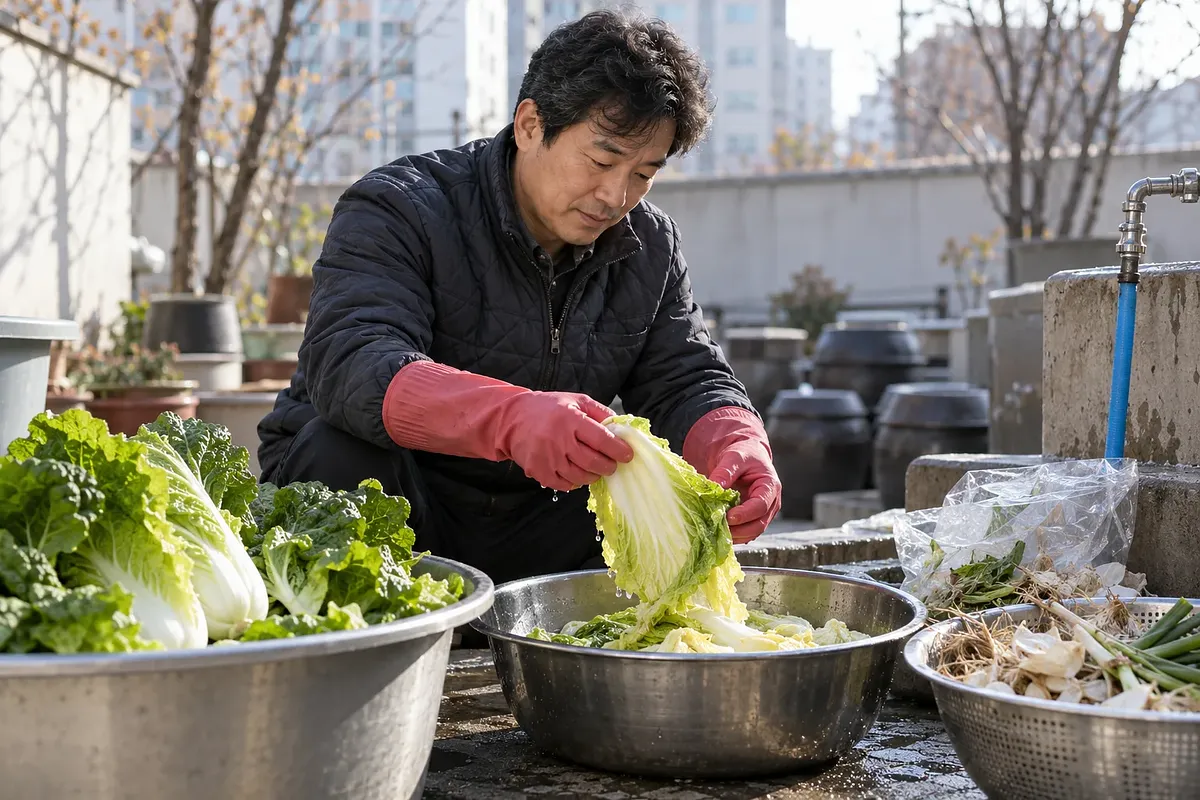
Sort cabbage leaves and radishes, salted or seasoned scraps, roots and peels, and packaging separately.
Find the kimjang-season waste disposal notice for the relevant year on your city, county, or district office's website.
Check the special collection period, accepted items, bag sizes, and labeling and sticker requirements.
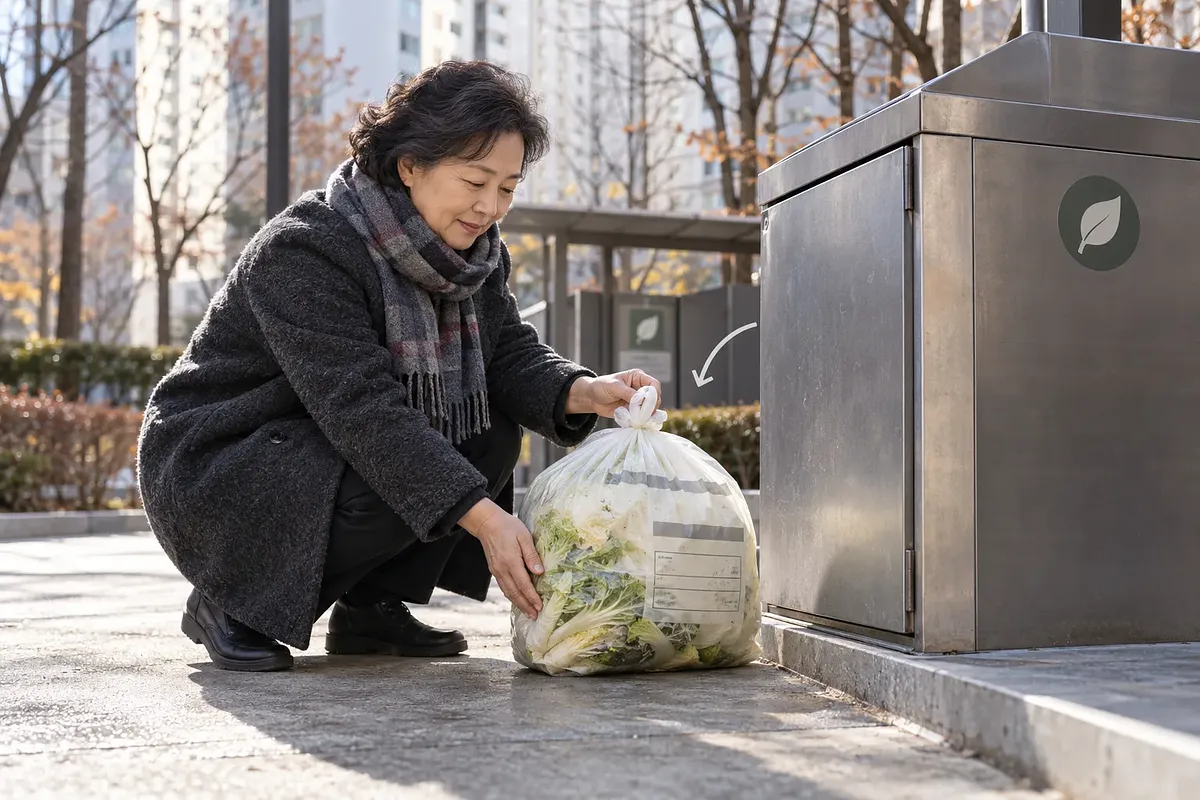
For apartment complexes, check with the management office about whether to use dedicated collection containers and where to leave the waste.
Remove foreign materials and drain excess water, then dispose of the waste in the specified way and at the designated time.
First, separate napa cabbage leaves and salted napa cabbage from roots, skins, and packaging. Whether you can use general pay-as-you-throw trash bags depends on your local notice for the current year. Before disposal, check with your city, county, or district office for the permitted period and bag sizes.
This year’s figures are based on Guro-gu’s October 1, 2026 notice and Gangdong-gu’s October 21 notice.
How to check kimchi-making waste disposal rules
Before preparing bags, check this year’s notice for your area. Special collection applies only during the period set locally. For items not listed in the notice, contact the department responsible for waste collection.
· Separate napa cabbage leaves and radishes from salted or seasoned scraps. Collect scallion roots, garlic skins, and packaging separately as well.
· Search for “2026 kimchi-making waste” on your city, county, or district office’s website. Check the applicable year in the body of the notice before relying on its title.
· Check the permitted items and bag sizes. Also check whether stickers or markings on the outside of the bag are required.
· Check the disposal location for your housing type. For apartments, ask the management office where to leave waste within the complex.
· Remove foreign materials such as soil and twine. Reduce the vegetables’ volume and drain excess moisture, then put them out at the designated time.
If you cannot find this year’s notice, do not apply last year’s special collection conditions. Also check the regular food waste disposal instructions. Contact the local department responsible for waste collection to ask whether special collection is available.
Sorting napa cabbage leaves, salted napa cabbage, roots, and skins
Napa cabbage leaves and salted napa cabbage do not go in the same type of bag nationwide. Some areas distinguish between raw and salted vegetables. The past examples below illustrate these differences in classification.
Category | Examples found in official guidance | What to check before disposal
Raw vegetable scraps, such as outer napa cabbage leaves and radishes | Gyeryong-si’s 2025 guidance classifies outer napa cabbage leaves and scraps as general waste | Whether raw vegetables count as food waste or qualify for special collection
Salted napa cabbage and salted radishes | Gyeryong-si’s 2025 guidance classifies these as food waste | Whether food waste disposal methods are required or general trash bags are also permitted
Seasonings and salted seafood | Gangdong-gu’s 2026 notice instructs residents to drain excess moisture and dispose of these as food waste | Whether these must be kept separate from vegetables for special collection
Scallion and green onion roots, garlic and onion skins | Gangnam-gu’s 2025 guidance classifies these as general waste | Whether these must be bagged separately from vegetable scraps
Plastic packaging and twine | Classified as foreign materials to remove from vegetables | Recycling and general waste disposal rules for the packaging itself
Gyeryong-si’s 2025 disposal guidance distinguishes between raw and salted vegetables. Gangnam-gu’s 2025 guidance also included salted napa cabbage among the items temporarily permitted in general trash bags. Do not apply these conditions unchanged to other areas or to 2026.
Comparing local conditions for using pay-as-you-throw bags in 2026
Guro-gu and Gangdong-gu allow different bag sizes even during the same period. Both areas’ collection periods run from November 1 to December 31, 2026. Check separate guidance for disposal outside this period.
Item | Guro-gu, Seoul | Gangdong-gu, Seoul
Notice date | October 1, 2026 | October 21, 2026
Applicable period | November 1 to December 31, 2026 | November 1 to December 31, 2026
General pay-as-you-throw bag sizes | White 20L, 30L, or 50L bags when disposing of at least 20L | 20L, 50L, or 75L bags
Small quantities | Food waste pay-as-you-throw bags for less than 20L | No separate threshold for small quantities specified in the notice
Additional markings | No additional marking requirements in the cited notice’s body | Mark bags “kimchi-making waste”
Mixing waste | Do not mix with general waste or plastic sheeting used for kimchi-making | Do not mix with general waste
Detailed conditions are available in the notice from Guro-gu’s Waste Management Division. Gangdong-gu specifies its conditions in the 2026 food waste disposal guidance. Gangdong-gu’s eligible premises include single-family homes, multi-unit housing, and general restaurants.
Items to check in the notice
Checking only the period and bag sizes may cause you to miss other disposal conditions. Also check the marking requirements and items that must not be mixed in. If the notice does not specify a location or time, contact the responsible department.
Item to check | Details to confirm
Special collection period | Start and end dates, and your planned disposal date
Eligibility | Whether households, restaurants, single-family homes, and multi-unit housing are included
Permitted items | Whether raw vegetables, salted napa cabbage, and seasoned scraps are included
Bag specifications | Distinctions between food waste bags, general trash bags, and designated bags, and the permitted capacities
Additional markings or stickers | Whether to mark the bag yourself or use a designated sticker
Restrictions on mixing waste | Whether mixing with household waste, other food waste, or packaging is prohibited
Disposal location and time | Designated locations, such as outside your home, communal collection points, or near pay-by-weight machines, and collection schedules
Stickers can also serve different purposes in different areas. Gwangjin-gu’s 2025 guidance required a designated label on general trash bags. Gyeryong-si’s 2025 guidance required the purchase of food waste disposal stickers. Before reusing last year’s stickers or templates, check this year’s guidance.
Disposal conditions for houses and multi-unit housing
Living in an apartment does not always mean you should put this waste into a food waste pay-by-weight machine. Whether to use an RFID machine that weighs food waste also depends on the local notice. Special collection methods can differ even among multi-unit housing properties.
Housing or collection conditions | Disposal method to check
Houses | Designated bag types and permitted disposal locations, such as outside your home
Multi-unit housing using dedicated collection containers | Whether kimchi-making scraps are allowed in the containers and where separate collection takes place
Disposal of at least 20L during Guro-gu’s 2026 special collection period | Place in general pay-as-you-throw bags and leave near the RFID pay-by-weight machine
RFID users under Gwangjin-gu’s 2025 special collection guidance | A past example instructing users to dispose of waste in the RFID pay-by-weight machine
Guro-gu notes that large quantities can cause collection containers to overflow. By contrast, Gwangjin-gu’s 2025 notice instructed RFID users to put waste into the pay-by-weight machine. Do not use Gwangjin-gu’s past method as the operating rule for your apartment complex this year.
Why waste must not be mixed even in general trash bags
Permission to use general pay-as-you-throw bags does not mean permission to mix in household waste. These bags may be used solely to collect vegetable scraps. Check the bag type and the permitted contents separately.
Guro-gu’s Waste Management Division states the following in its “Notice on the Kimchi-Making Waste Collection Period.”
※ Do not mix plastic sheeting used for kimchi-making with kimchi-making waste
Common mistake | What to check
Adding scallion roots and packaging because it is a general trash bag | Distinguish vegetable-only disposal from general household waste disposal
Using a bag size permitted in another district without checking | Check the sizes listed in your local notice
Treating the latest crawl date in search results as the notice’s effective date | Check the year and collection period in the body of the notice
Assuming something is general waste simply because it has been salted | Check the local classification that specifically mentions salted napa cabbage
What to check when the official notice and apartment complex guidance differ
If the instructions differ, first check whether they cover the same items and period. You may be comparing last year’s notice with this year’s guidance. Also distinguish cases where the apartment complex’s guidance simply specifies the disposal location under the district office’s notice.
· Check the applicable year in both sets of instructions. Distinguish the posting date from the actual collection period.
· Compare the items covered. Check whether raw vegetables and salted or seasoned scraps are listed as the same category.
· Compare the housing types and quantity conditions. Check that guidance for houses is not being applied to multi-unit housing.
· If differences remain, contact the district office’s department responsible for waste collection. Provide the items, quantity, housing type, and the contents of both sets of instructions.
· Ask the management office for the actual disposal location under the confirmed method. Establish where to leave the bags before putting them out.
 Injoys