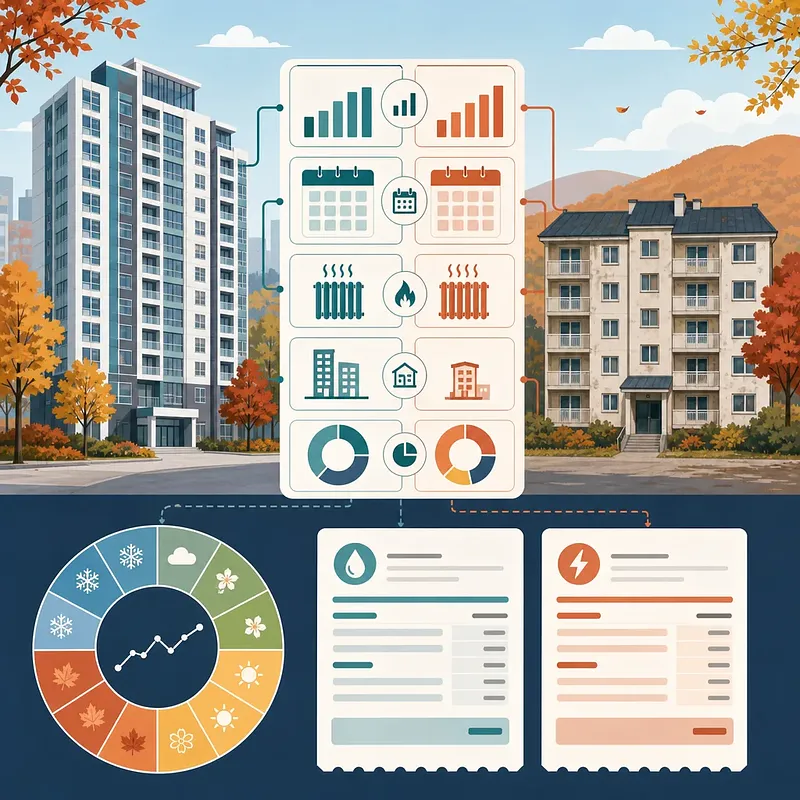
Older Seoul Apartments vs Gyeonggi New Builds: Total Cost
Compare older apartments in Seoul and newly built apartments in Gyeonggi based on total costs, including repairs, and actual commuting conditions rather than administrative boundaries. Instead of treating low-floor discount rates or complex size as fixed criteria, check transaction records and how well shared facilities are maintained.
Whether older Seoul apartments or new Gyeonggi apartments are better depends on each complex's location and purchase price.
Include repair and transaction costs, not just the home price, in your purchase budget.
A price still below its previous peak does not, on its own, mean a property is undervalued.
The number of units in a complex alone is not enough to judge whether you can sell when you want to.
If you plan to sell your home and buy another, also calculate how much cash you will need if the sale is delayed.
The choice between an older apartment in Seoul and a newly built one in Gyeonggi should start with the total cost you can afford. Actual commuting time and the prospects for selling later also matter. If your budget is the same for both, compare the living conditions of individual apartment complexes first.
Check prices by contract date in the Ministry of Land, Infrastructure and Transport’s real estate transaction price disclosure system.
Criteria for Comparing Older Apartments in Seoul and Newly Built Apartments in Gyeonggi
Compare the two options under the same living conditions. The labels “newly built” and “older” alone do not tell you enough about an apartment’s condition. Check both when occupancy was approved and the actual repair history.
Comparison item | What to check in an older Seoul apartment | What to check in a newly built Gyeonggi apartment
Commute | Actual travel time from home to work | Time including travel to the station and transfers
Costs before moving in | Repairs needed and construction estimates | Option installation fees and additional construction costs
Housing condition | Plumbing, windows, leaks, and parking | Defect repairs and whether facilities are actually operating
Local amenities | Routes to schools, hospitals, and shops | Amenities currently operating
Ongoing costs | Maintenance fees and planned work on shared facilities | Maintenance fees and charges for using additional facilities
Future sale | Transaction trends for the same floor area and competing listings | New housing supply and competing listings in the same local area
Access to workplaces varies by complex even within Seoul. Newly built apartments in Gyeonggi also differ depending on rail lines and transfer routes. Use regional averages as a reference, but make the final comparison property by property.
Calculating Total Costs Including Repairs
Even if the purchase prices are the same, the amount needed before moving in may differ. Do not assume every older apartment needs a full renovation. Check the condition of its systems, then get estimates for the work it needs.
Cost category | What to include | What to check
Home purchase | Purchase price | Terms of the purchase contract
Transaction costs | Acquisition-related taxes, brokerage fees, registration costs | Applicable tax rates and individual estimates
Moving in | Repairs, options, moving costs, temporary accommodation | Construction and moving estimates
Monthly expenses | Loan principal and interest payments, maintenance fees, transportation | Loan repayment schedule and maintenance fee statements
Separate emergency funds | Money for a drop in income or unexpected repairs | Household cash plan
Initial total spending is the purchase price plus transaction and moving-in costs. Subtract the loan amount to calculate how much of your own money you need. Set aside emergency funds to keep after paying the balance.
Repair estimates must cover the same scope of work to be comparable. Even a difference in whether window replacement is included changes what an estimate means. Check whether VAT and waste disposal costs are included.
Include monthly principal repayments in cash outflows. However, do not treat the entire principal repayment as a cost like interest. Do not count the home purchase price and principal repayments twice.
Choosing Based on Your Circumstances
Priorities depend on your plans for living in the home and your household’s constraints. As a couple, first write down the conditions each of you would find hard to give up. Comparing properties that meet those conditions makes the decision easier.
Current situation | Option to consider first | What to check
Large difference in travel time to a Seoul workplace | Older apartment in Seoul | Whether it fits the budget even after including repair costs
Small commuting difference and a priority on local amenities | Newly built apartment in Gyeonggi | Whether the actual facilities and maintenance fees meet expectations
Not enough cash available before moving in | Property needing little additional work | Check the actual condition of both older and newly built properties
High likelihood of moving because of a job change or a child’s schooling | Complex with ongoing transactions | Transactions for the same floor area and competing listings
Repayments are burdensome for both options | Adjust the budget or reconsider when to buy | Compare the cost of continuing to rent with the amount you can save
Measuring the commute from your front door to your workplace entrance is more realistic. Include the walk to the station and time spent waiting for trains. If both partners work, record each person’s travel burden separately.
Treat planned rail openings separately from transportation available now. The question is whether you could live there even if the plan is delayed. Check school and childcare routes based on what is currently available.
Criteria for Assessing Lower Floors and Small Complexes
Assess lower-floor units and small complexes by the price differences between individual properties. It is difficult to apply a fixed discount rate by floor. Compare transactions in the same complex with similar floor areas and contract dates.
Option | Potential advantages | What to check on-site
Lower floor | Price difference, shorter routes in and out | Sunlight, privacy, dampness, outside noise
Unit with no residential floor below it | Possibly fewer noise complaints from downstairs | Actual structure below the unit and surrounding noise
Small complex | Individual location and purchase price | Transaction frequency, maintenance fees, management system
Large complex | Facilities and transaction data for comparison | Access by building, competing listings, actual costs
A lower floor does not mean less noise from the unit above. Whether there is a residential unit below also depends on the building’s structure. Visit to check noise, regardless of floor.
600 households is not a universal threshold that guarantees a future sale. Demand for small complexes also varies with location and price. Use the number of households as a supporting factor when interpreting transaction records.
The Difference Between an Apartment That Has Risen Less and an Undervalued One
A price below a past peak does not, by itself, mean an apartment is undervalued. Undervaluation is a judgment about whether the price is low relative to current conditions. Keep that separate from an expectation that the price will return to its former level.
· Differences in floor area, floor, and conditions between a past peak transaction and current transactions
· Whether access to workplaces and local amenities have actually improved
· Nearby alternative complexes and planned new housing supply
· Changes in purchase demand and jeonse and monthly rental demand
· Specific reasons the price remains low
To use 2021 prices as a comparison point, find transactions with matching conditions. Do not assume transactions then marked the peak for every complex. Mixing in peak prices from other floors or floor areas distorts the rate of recovery.
Even if jeonse demand rises, it does not immediately lead to higher purchase prices. Lending conditions and new supply also have an effect. Treat predictions that demand will shift to outlying areas as hypotheses to test.
What to Check in Transaction Price Records
To compare prices, you need records that distinguish asking prices from actual contract amounts. An asking price is the price set by the seller. Use the Ministry of Land, Infrastructure and Transport’s real estate transaction price disclosure system to check transactions.
· Find transactions with the same exclusive-use floor area in each candidate complex.
· Use the same contract period for comparisons.
· Record the floor and transaction type as well.
· Separate transactions marked as canceled.
· Check the difference between current asking prices and transaction amounts.
When there are few transactions, the price of one can appear to represent the overall trend. Do not select only unusually high-priced transactions and present them as a regional rate of increase. Also distinguish the contract date from the date reported data becomes public.
Check the scope of disclosure in the disclosure guide for the Ministry of Land, Infrastructure and Transport’s real estate transaction price disclosure system. (Based on the disclosure guide reviewed: Publicly disclosed sales include housing, officetels, land, commercial and business properties, factories, warehouses, and other properties reported since January 2006, as well as apartment presale and occupancy rights contracted after June 29, 2007. Jeonse and monthly rentals include housing rentals reported since June 2021 · source rt.molit.go.kr · checked 2026-10-05) Supplement the records with an on-site check of each property’s repair condition. Transaction data alone cannot establish that the interiors are in the same condition.
The Difference Between Repairs Inside a Home and Repairs to Shared Facilities
Repairing the inside of a home does not resolve aging issues throughout the building. Work on shared plumbing or elevators is separate from work inside a unit. Check the complex’s repair plans before buying.
The Korea Real Estate Board supports the disclosure of maintenance fees on K-apt. Maintenance history is also among the main information disclosed. You can check the disclosure items in the apartment management information guide.
· Major work scheduled in the long-term repair plan
· The balance of long-term repair reserves and planned spending
· Repair history for major facilities, including leaks, plumbing, and elevators
· Items whose maintenance fees have changed substantially and why
· Unresolved defects and repair progress in newly built complexes
Long-term repair reserves are funds set aside to repair major shared facilities. The size of the reserve alone does not tell you whether it is sufficient. Consider it alongside the scale of upcoming work.
Ask the management office about details that are not publicly available. It is best to compare maintenance fees for the same season and similar floor areas. Do not skip defect checks just because a complex is newly built.
How to Assess Loans and Apartment Subscription Applications Together
Being a first-time buyer alone does not determine how much you can borrow. Government-backed loans and bank mortgages have different requirements. Before signing a contract, seek advice based on the home you intend to buy.
Didimdol loans have separate requirements for income, home price, and other factors. First-time buyer benefits alone do not let you buy a home at any price. Check the requirements in the Korea Housing Finance Corporation product guide.
· Prepare the candidate home’s address and purchase price.
· Gather your income information and existing loan details.
· Check which products you can use and the expected repayments.
· Check the conditions for receiving the loan in time to pay the balance.
· Calculate household spending if income falls because of a leave of absence or another reason.
Decide whether to wait to apply for a new apartment based on complexes where you can actually apply. Calculate housing costs between the sales schedule and the move-in date. Check eligibility and schedules in the relevant resident recruitment notice on ApplyHome.
Option | Costs to compare | Uncertainties to check
Buy an existing apartment | Transaction costs, repairs, loan repayments | Purchase price and prospects for a future sale
Continue renting while preparing to apply | Rent, moving costs, housing costs until move-in | Recruitment schedule and whether your application succeeds
Funding Gaps When Moving to Another Home
Moving from one owned home to another is not just about the difference in home prices. The order in which money comes in matters too. The balance on the new home may be due before you receive the balance from selling the existing one. First calculate whether you have the funds to withstand a delayed sale.
Liquidity is how easily an asset can be sold and converted to cash. There is no guarantee an apartment will sell at both your desired price and time. The number of transactions alone cannot establish how long a sale will take.
Funding item | What to check
Proceeds from selling the existing home | Amount left if it sells below your target price
Existing loan | Balance to repay on sale and related costs
New home purchase | Deposit and balance payment schedule and additional costs
Timing gap | Possible temporary accommodation and additional financing costs
Transaction conditions | Tenant’s move-out schedule and required permit procedures
Check whether a candidate home is subject to a land transaction permit using its address. Ask the relevant local government about the applicable use conditions. You can also find the procedure in Dobong-gu’s land transaction contract permit guide.
For an older apartment with redevelopment potential, check the project’s actual stage. Additional contributions and relocation plans need separate review. Do not factor in redevelopment profits simply because a building is old.
Common Mistakes When Comparing Options
Using unverified figures as universal benchmarks can lead to poor decisions. Prices and construction costs need a defined scope and reference date. Replace unsupported ranges with actual transactions or estimates.
Common assumption | Better basis for comparison
A Seoul address means higher future returns | Individual location, purchase price, and ongoing costs
A lower-floor unit should be cheaper by a set percentage | Transactions with similar conditions in the same complex
A complex above a certain number of households will be easy to sell | Transaction trends and competing listings
Every older apartment needs a full renovation | Condition checks and estimates by scope of work
An area where prices have risen less will soon rise | Actual conditions that explain the price difference
A newly built apartment has low maintenance fees and repair needs | Maintenance fee statements and defect repair status
Record the reference date for each candidate’s information. For a transaction amount, note the contract date. For maintenance fees, also record the month they were charged for. For repair costs, note the estimate date and the work included.
 Injoys