Samsung Electronics ₩500M Staff Loan: Terms & Impact
Under the reported terms, Samsung Electronics' housing stability loan provides employees who do not own a home with up to ₩500 million in home purchase funds at an annual rate of 1.5%. Actual purchasing power varies depending on monthly repayments, the senior mortgage lien, and the amount of additional bank financing available.
The reported limit is up to ₩500 million for home purchases and up to ₩300 million for rental deposits.
The stated condition requires both the employee and their spouse to own no home.
Repaying ₩500 million over 10 years at an annual rate of 1.5% results in a monthly payment of approximately ₩4.49 million.
If a senior mortgage lien is registered for 110% of the loan amount, the capacity for subordinated bank lending may decrease.
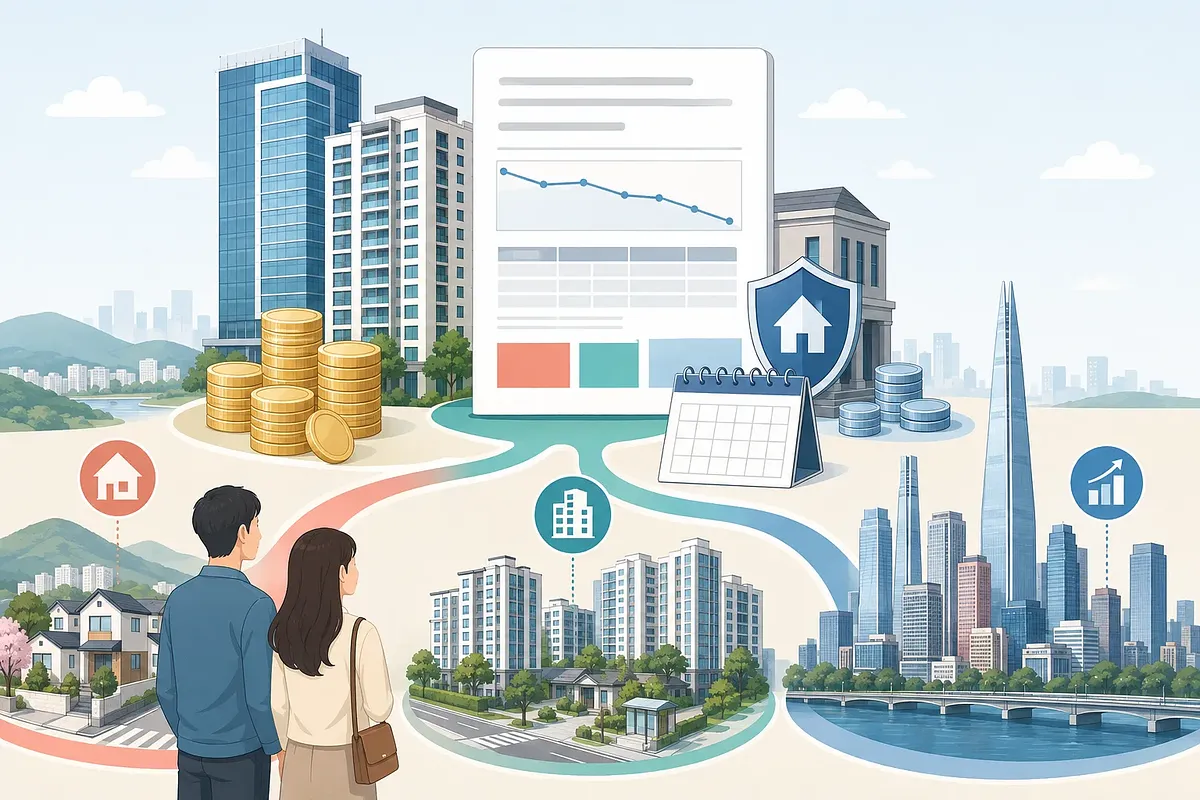
The funds may be divided between first-home demand in southern Gyeonggi and move-up demand in Bundang and Seoul.
According to reported terms, Samsung Electronics’ employee loan program offers up to KRW 500 million for home purchases at an annual interest rate of 1.5%. Demand will likely be divided between owner-occupied homes in southern Gyeonggi and moves to Seoul or Bundang. However, repayment amounts and the senior mortgage lien limit the actual range of possible moves.
The implementation date must be confirmed in the internal housing stability loan notice.
Samsung Electronics Employee Loan Terms
The key feature of the reported program is low-interest housing financing. The home purchase loan limit is up to KRW 500 million. The rental housing loan limit is up to KRW 300 million.
Category | Reported Terms
Eligibility | Employees who, together with their spouses, do not own a home
Eligible regions | Seoul metropolitan area and six metropolitan cities
Home price | KRW 2.5 billion or less
Floor area | Exclusive-use area of 85㎡ or less
Eligible properties | Homes and officetels
Home purchase funds | Up to KRW 500 million
Rental housing funds | Up to KRW 300 million
Interest rate | 1.5% annually
Repayment | Equal principal-and-interest payments over 10 years, with a possible 3-year grace period
Early repayment fee | None
Collateral | First-priority mortgage lien set at approximately 110% of the loan amount
It has also been reported that moving from one home to another by selling the existing home on the same day as purchasing the new one is permitted. However, the point in time at which non-homeownership is determined is unclear from the public explanation alone. The order in which the sale and purchase must be executed should be confirmed in the internal notice.
Differences Between Loan Regulations and Employee Loans
Employee loans are structured differently from bank mortgage loans. According to the reported explanation, they are not directly subject to the financial sector’s DSR rules. However, this does not guarantee an additional bank loan.
Banks assess both existing debt and available collateral value. If the company establishes a first-priority mortgage lien, the bank becomes a junior lienholder. If the collateral value is insufficient, the additional loan limit may be reduced or the application may be rejected.
The figures for the “8.13 Real Estate Measures” cited in the market analysis are as follows. However, the year of the policy and the detailed eligibility requirements were not provided. The latest financial authority standards must be separately applied to housing contracts.
Item | Cited Figure | Details Requiring Confirmation
Bank LTV in regulated areas | 40% | Exceptions by number of homes owned and region
Bank LTV in non-regulated areas | 70% | Whether preferential treatment applies, including for first-time buyers
Individual DSR for first-tier financial institutions | 40% | Calculation method by borrower and loan type
Individual DSR for second-tier financial institutions | 50% | Scope of application by sector and product
Loan limit for homes priced at KRW 1.5 billion or less | Up to KRW 600 million | Eligible regions and implementation period
More than KRW 1.5 billion and KRW 2.5 billion or less | Up to KRW 400 million | Criteria for determining boundary prices
Loan limit for homes priced above KRW 2.5 billion | Up to KRW 200 million | Exceptions and handling of existing contracts
Calculation Example
If the full KRW 500 million is borrowed, monthly cash flow becomes the key consideration. Repaying principal and interest over 10 years at an annual rate of 1.5% results in a monthly payment of approximately KRW 4.49 million. This figure includes only principal and interest.
· Set the loan principal at KRW 500 million.
· Convert the annual interest rate of 1.5% into a monthly rate.
· Apply a repayment period of 120 months.
· The equal monthly principal-and-interest payment is approximately KRW 4.49 million.
The burden varies significantly depending on how the 3-year grace period is interpreted. If only interest is paid during the grace period, the monthly interest is KRW 625,000. Company rules must be checked to determine whether the total loan term is 10 years or 13 years.
Repayment Interpretation | Monthly Payment During Grace Period | Monthly Payment After Grace Period
10-year repayment without a grace period | Not applicable | Approximately KRW 4.49 million
3-year grace period included in the 10 years | Approximately KRW 625,000 | Approximately KRW 6.27 million
10-year repayment after a 3-year grace period | Approximately KRW 625,000 | Approximately KRW 4.49 million
The company’s mortgage lien can also be calculated. 110% of KRW 500 million is KRW 550 million. This amount is not the actual debt but the basis for establishing the security interest.
Housing Relocation Paths by Circumstance
First-home demand and demand from existing homeowners moving to another home involve different candidate areas. Commuting and monthly repayment capacity are the primary criteria. It is difficult to determine a relocation path based solely on price forecasts.
Demand Type | Areas Mentioned | Reasons for Selection | Main Constraints
First home purchase | Dongtan in Hwaseong, Yeongtong in Suwon | Access to workplaces in Hwaseong, Giheung, and Suwon | Personal funds and monthly repayment amount
First home purchase | Suji and Giheung in Yongin | Established living base and commuting within southern Gyeonggi | Additional bank loan limit
Move to a higher-tier area in southern Gyeonggi | Bundang in Seongnam | Residential preference and expectations for reconstruction | High purchase prices
Move to Seoul | Gangdong, Songpa, and Dongjak | Access to Seoul and connections to southern Gyeonggi | Timing of existing home sale
In reported examples, homes with an exclusive-use area of 84㎡ in southern Gyeonggi were listed in the KRW 1.0 billion to KRW 1.5 billion range. Hillstate Yeongtong was mentioned in the KRW 1.2 billion to KRW 1.4 billion range. Dongtan Station Central Xi was presented in the KRW 1.1 billion to KRW 1.4 billion range.
Prices for candidate properties in Seoul were higher. Godeok I'Park was priced between KRW 2.11 billion and KRW 2.15 billion. Sangdo Station Lotte Castle Parkel was priced between KRW 2.07 billion and KRW 2.19 billion.
These prices do not include details such as transaction dates and floor levels. They should not be used as current market prices without adjustment. Before signing a contract, they must be checked again against actual transaction price data from the Ministry of Land, Infrastructure and Transport.
Common Mistakes
Repayment capacity should not be assessed based only on the 1.5% annual interest rate. When the loan principal is large, the monthly principal burden is also substantial. The payment amount after the grace period ends should be calculated first.
· Interpreting exemption from DSR rules as allowing unlimited bank borrowing
· Mistaking the registered mortgage lien amount for the actual outstanding loan balance
· Assuming eligibility requires only the employee, rather than both spouses, to be a non-homeowner
· Concluding that permission to move between homes allows applications while still owning a home
· Omitting earned income tax on the interest rate benefit
· Using past transaction price ranges as current asking prices
The interest rate benefit has reportedly been treated as taxable earned income. The taxable benchmark interest rate and calculation method were not included in the public explanation. The amount reflected on the payslip should be confirmed through the company’s internal tax guidance.
Why the Market Impact May Be Limited
A KRW 500 million limit does not necessarily mean KRW 500 million in new demand. The number of users and actual disbursement amounts have not been disclosed. Each employee also has different income and personal funds.
The market impact may be concentrated in certain residential areas. Southern Gyeonggi, within commuting distance of company workplaces, is the primary candidate. Higher-tier areas in Seoul are easier to access when funds from the sale of an existing home are available.
Transactions may increase if autumn moving demand coincides with bonus payments. However, price direction cannot be attributed to a single company program. Housing supply, interest rates, and local listings also have an effect.
Items Requiring Official Confirmation
Samsung Electronics’ internal notice is the final authority for application decisions. No publicly available official terms and conditions have been confirmed. There are also no company policy provisions available in public materials that can be quoted directly.
The following items should be confirmed through the internal HR channel.
· Eligibility based on length of employment and employment type
· The date on which non-homeownership is determined and the execution order for moving between homes
· Whether the 3-year grace period is included in the total 10-year term
· Repayment terms upon resignation or transfer to an affiliate
· Criteria for calculating the interest rate benefit as earned income
· Requirements for an officetel to qualify as residential
· Collateral priority when used together with a bank loan
The documents to check are the May labor-management wage agreement and the internal housing stability loan notice. The original text should be reviewed under the benefits or housing support menu on Samsung Electronics’ internal HR portal.
 Injoys