Skip to content
Injoys
How-to 🇰🇷 South Korea

This content applies specifically to South Korea.

How to Compare Apartment Management Fees 1-to-1 on K-apt Before a Fall Move

K-apt's 1-to-1 comparison feature lets you check management fees for the same billing month and per-unit costs by category for two prospective apartments. Do not look only at the total; also verify the past 12 months, heating system, number of units, year of completion, and actual bills.

Listen or read this article

13:17

Listen, or read the text only.

How to Compare Apartment Management Fees 1-to-1 on K-apt Before a Fall Move

Kokoro 82M AI-generated voice

0:00 13:17

Advertisement

Download audio

File name
k-apt-apartment-management-fee-comparison-en.mp3
Format
MP3 (audio/mpeg)
Duration
13:17
File size
9.13 MB
Engine
Kokoro 82M

This audio was generated by AI.

You may download and use it freely for personal use.

How to Compare Apartment Management Fees 1-to-1 on K-apt Before a Fall Move

10 min read

How to Compare Apartment Management Fees 1-to-1 on K-apt Before a Fall Move
K-apt's 1-to-1 comparison feature lets you check management fees for the same billing month and per-unit costs by category for two prospective apartments. Do not look only at the total; also verify the past 12 months, heating system, number of units, year of completion, and actual bills.
The two complexes must be compared using the same management fee billing month and similar unit sizes.
Common management fees, individual usage charges, and long-term repair reserves differ in the nature of the costs and who bears them.
Ignoring differences in heating systems, number of units, and building age can distort comparisons of total management fees.
K-apt figures are complex-wide averages, so they may not match the actual amount billed to the specific unit you plan to rent or buy.
Before signing a contract, check the past 12 months of trends, similar nearby complexes, and the actual management fee bills for the unit.
When preparing for a fall move, comparing only monthly rent or loan repayments can easily lead to underestimating actual housing costs. Apartment maintenance fees vary depending on the season, heating system, complex size, facility level, and building age, so it is important to review the breakdown by item and annual trends rather than just one month’s total.
K-apt is an official system for viewing and comparing maintenance fees and complex information for apartment complexes subject to maintenance fee disclosure. However, because the disclosed figures are complex-level data, they should be used as verification data to identify anomalies before signing a contract, not as confirmation of the actual amount that will be billed for a specific unit.
Information to Prepare Before Comparing
Before comparing two candidate complexes, organize the following information using the same criteria.
· The complex’s exact name and road-name address · The maintenance fee accrual month to compare · The unit’s exclusive-use area and the area basis used to assess maintenance fees · Heating system: individual heating, central heating, district heating, etc. · Total number of households and buildings · Date of occupancy approval or year of completion · Shared facilities such as elevators, parking lots, and community facilities · Recent maintenance fee statements for the unit you intend to contract for
The most important criterion is the accrual month. If January data is selected for one complex and April data for another, seasonal differences in heating and hot-water costs may appear to be differences in operational efficiency. If the latest available months differ, use the most recent accrual month disclosed for both complexes.
Comparing Two Candidate Complexes on K-apt
· Search for the locations and names of the candidate complexes on K-apt’s maintenance fee comparison screen. · Check basic information such as the address, number of households, and heating system to verify that you have not mistakenly selected a different complex with a similar name. · Designate the first and second candidates for comparison. · Select the same maintenance fee accrual month for which data is available for both. · Review not only the total maintenance fee but also common-area maintenance fees, individual usage charges, and long-term repair reserves separately. · Review the amount or rate per unit area shown on the screen and confirm that the area basis is the same. · Record the most recent 12 months in the same way to identify seasonal highs and lows and items with recurring spikes. · On the map-based comparison screen, add nearby complexes with similar sizes, heating systems, and completion dates to compare them against local levels.
K-apt figures are complex averages or officially disclosed complex data. The billed amount may vary depending on the specific unit’s floor, orientation, number of household members, heating usage, electricity usage, and area type. A value calculated by simply multiplying the per-area rate by a specific unit’s area is only an estimated bill, not a confirmed amount.
Differences Among the Three Maintenance Fee Categories
Category | General meaning | What to review when comparing Common-area maintenance fees | Costs used for shared operations, including management office operations, security, cleaning, disinfection, elevator maintenance, and repair and upkeep | Economies of scale based on the number of households, staffing, number of shared facilities, and whether repair costs are repeatedly increasing Individual usage charges | Costs related to usage, such as heating, hot water, electricity, and water | Whether the season, number of residents, metering and assessment method, and heating system are comparable Long-term repair reserves | Amounts accumulated for the long-term replacement and repair of major facilities | Changes in reserve amounts, building age, future construction plans, and settlement when a tenant moves out
Common-Area Maintenance Fees
Common-area maintenance fees are heavily affected by the complex’s operating structure. Complexes with many households can distribute security and management staffing costs or shared equipment costs among more households, but costs may also be higher because of large community facilities or numerous elevators. Therefore, a complex cannot be assumed to be less expensive simply because it has more households.
Individual Usage Charges
Individual usage charges are sensitive to residents’ usage and the season. Even if a complex’s average heating cost is low on K-apt, the actual burden may be higher if the unit under consideration is an end unit adjoining an exterior wall or has many household members. Conversely, an average from a month with many vacant units or low usage may not fully reflect normal occupancy costs.
Long-Term Repair Reserves
Unlike routine common-area maintenance fees, long-term repair reserves are funds accumulated for the replacement and repair of major facilities. Under a lease, even if the tenant initially pays the amount shown on the statement, it may need to be settled with the owner, so the contract terms and actual payment records should be checked. Even if the maintenance fee appears low, check whether the long-term repair reserve is shown separately.
Common Cases in Which Total Comparisons Are Distorted
When Heating Systems Differ
Individual-heating complexes and central- or district-heating complexes may differ in how energy costs are aggregated and assessed. Comparing only the total for one winter month mixes together energy rates, basic charges, household usage, and shared heating costs. If the heating systems differ, heating and hot-water items should at least be compared separately across several winter months.
When the Difference in the Number of Households Is Large
Suppose hypothetical Complex A has 800 households and Complex B has 120 households. Complex A can distribute management staffing costs among many households, but it may have numerous community facilities. Complex B may have simple facilities, but a smaller number of households may have to bear the fixed costs of elevators or management staff. Differences in totals should not immediately be interpreted as the result of management quality or waste.
When Completion Years Differ
Older complexes may incur higher maintenance and repair expenses for elevators, piping, exterior walls, and mechanical equipment. New complexes may have low repair costs initially but may incur additional maintenance costs for community facilities, security equipment, and home networks. Review trends in repair and upkeep costs and long-term repair reserves rather than looking only at the completion year.
When Area Bases Differ
Even with the same exclusive-use area, the supplied area and the area used to assess maintenance fees may differ by complex. Conclusions may differ if the total maintenance fee is reviewed for one complex while only the per-area rate is reviewed for the other. It is safer to check both the rate basis shown on K-apt and the area stated on the actual unit’s maintenance fee statement.

Why You Should Review the Most Recent 12 Months and Nearby Complexes Together
One month’s maintenance fees may reflect seasonality and one-time expenses. Reviewing the most recent 12 months makes it easier to distinguish the following.
· The extent of increases in winter heating and hot-water costs · Changes in shared electricity charges and cooling-related costs during summer · Recurring monthly levels of common-area maintenance fees · Sudden increases in repair and upkeep costs occurring only in specific months · The timing of increases or changes in long-term repair reserves · Months that appear to have been omitted or corrected later
When reviewing nearby averages, choose complexes with similar conditions rather than simply those that are nearby. Comparisons are more meaningful when the number of households, completion year, heating system, shared facilities, and area range are similar.
Comparison item | Candidate A | Candidate B | Similar nearby complexes Total or rate for the same accrual month | Record | Record | Record Common-area maintenance fees | Record | Record | Record Heating and hot-water costs | Record | Record | Record Long-term repair reserves | Record | Record | Record Highest month in the most recent 12 months | Record | Record | Record Average for the most recent 12 months | Record | Record | Record Heating system, number of households, and completion year | Record | Record | Record
When a Complex Is Not Subject to Disclosure or Current Data Is Unavailable
A lack of search results does not mean that there are no maintenance fees or that they are low. Check in the following order.
· Search by address or map instead of the complex name, and check whether the complex name has changed, an abbreviated name is used, or it is a separately registered complex. · Check the disclosure eligibility and registration status in K-apt’s basic complex information. · Confirm again that the latest displayed month is the accrual month, not the billing month. · Move the comparison period back to the most recent accrual month disclosed for both complexes. · Ask the management office or real estate agent for maintenance fee records and itemized statements for the most recent 12 months. · Review the unit’s statements from the previous winter and summer, and ask why they differ significantly from the K-apt complex average.
A month with no current data must not be treated as KRW 0. First check the delay in data submission or disclosure, any corrections, or the complex’s registration status. For complexes not subject to disclosure, a comparison cannot be completed using K-apt alone, so actual statements and explanations from the management office are more important.
Final Pre-Contract Verification Checklist
· Are the accrual months being compared the same for both complexes? · Have you checked the difference between the exclusive-use area and the area used to assess maintenance fees? · Have you reviewed common-area maintenance fees and individual usage charges separately? · Is the long-term repair reserve included or shown separately? · Have you reviewed the most recent 12 months, including winter and summer? · Have you used complexes with similar heating systems, numbers of households, completion years, and shared facilities as benchmarks? · Have you reviewed the actual statements for the unit under consideration? · Have you asked the management office about recent repair work or planned maintenance fee increases? · If you are a tenant, have you confirmed with the contracting party how the long-term repair reserve will be settled?
Significance of the 2026 Self-Estimate Feature for Repair Work
In April 2026, a self-estimate feature linked to K-apt was introduced, allowing users to independently review the estimated costs of apartment complex repair work. This feature can serve as a reference for management entities or residents’ representative councils when reviewing construction plans and cost levels, but it does not constitute a confirmed quote from a specific contractor or guarantee future maintenance fees for individual units.
Individuals reviewing potential complexes before moving can use it as supplementary information when asking about recent changes in repair and upkeep costs and long-term repair reserves, as well as whether major construction work is planned. The existence of a construction plan should not be interpreted to mean that the same amount will immediately be assessed as maintenance fees for each household.
0:00 0:00
1 / 47

Advertisement

Download text

File name
k-apt-apartment-management-fee-comparison-en.txt
Format
TXT (text/plain)
Paragraphs
47

Downloads exactly what you see as a text file.

Please cite the source when quoting.

Large text

Makes the text larger and the colors clearer. Turn it on if the text feels too small.

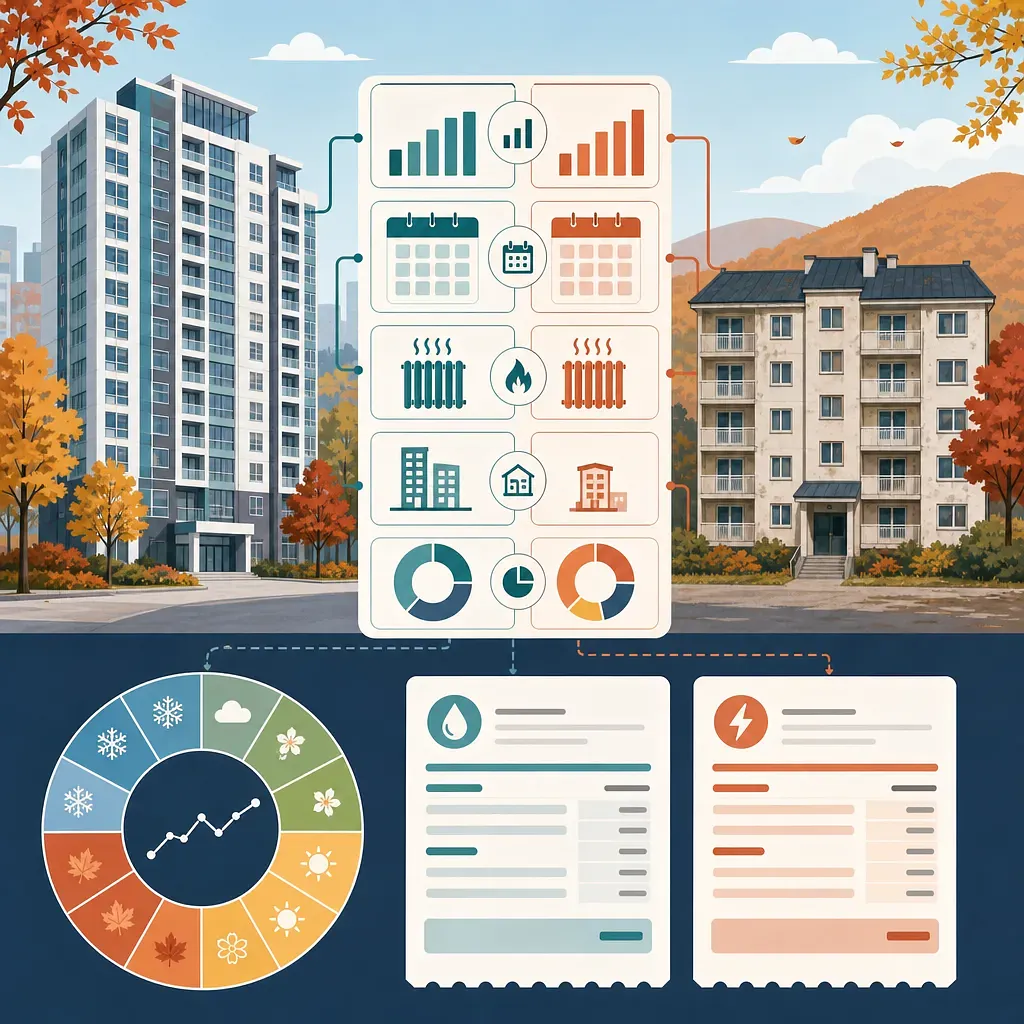
The illustration compares seasonal fees and utility costs for two apartment buildings.

Key points

  • The two complexes must be compared using the same management fee billing month and similar unit sizes.
  • Common management fees, individual usage charges, and long-term repair reserves differ in the nature of the costs and who bears them.
  • Ignoring differences in heating systems, number of units, and building age can distort comparisons of total management fees.
  • K-apt figures are complex-wide averages, so they may not match the actual amount billed to the specific unit you plan to rent or buy.
  • Before signing a contract, check the past 12 months of trends, similar nearby complexes, and the actual management fee bills for the unit.

When preparing for a fall move, comparing only monthly rent or loan repayments can easily lead to underestimating actual housing costs. Apartment maintenance fees vary depending on the season, heating system, complex size, facility level, and building age, so it is important to review the breakdown by item and annual trends rather than just one month’s total.

K-apt is an official system for viewing and comparing maintenance fees and complex information for apartment complexes subject to maintenance fee disclosure. However, because the disclosed figures are complex-level data, they should be used as verification data to identify anomalies before signing a contract, not as confirmation of the actual amount that will be billed for a specific unit.

Information to Prepare Before Comparing

Before comparing two candidate complexes, organize the following information using the same criteria.

  • The complex’s exact name and road-name address
  • The maintenance fee accrual month to compare
  • The unit’s exclusive-use area and the area basis used to assess maintenance fees
  • Heating system: individual heating, central heating, district heating, etc.
  • Total number of households and buildings
  • Date of occupancy approval or year of completion
  • Shared facilities such as elevators, parking lots, and community facilities
  • Recent maintenance fee statements for the unit you intend to contract for

The most important criterion is the accrual month. If January data is selected for one complex and April data for another, seasonal differences in heating and hot-water costs may appear to be differences in operational efficiency. If the latest available months differ, use the most recent accrual month disclosed for both complexes.

Comparing Two Candidate Complexes on K-apt

  1. Search for the locations and names of the candidate complexes on K-apt’s maintenance fee comparison screen.
  2. Check basic information such as the address, number of households, and heating system to verify that you have not mistakenly selected a different complex with a similar name.
  3. Designate the first and second candidates for comparison.
  4. Select the same maintenance fee accrual month for which data is available for both.
  5. Review not only the total maintenance fee but also common-area maintenance fees, individual usage charges, and long-term repair reserves separately.
  6. Review the amount or rate per unit area shown on the screen and confirm that the area basis is the same.
  7. Record the most recent 12 months in the same way to identify seasonal highs and lows and items with recurring spikes.
  8. On the map-based comparison screen, add nearby complexes with similar sizes, heating systems, and completion dates to compare them against local levels.

K-apt figures are complex averages or officially disclosed complex data. The billed amount may vary depending on the specific unit’s floor, orientation, number of household members, heating usage, electricity usage, and area type. A value calculated by simply multiplying the per-area rate by a specific unit’s area is only an estimated bill, not a confirmed amount.

Differences Among the Three Maintenance Fee Categories

Category General meaning What to review when comparing
Common-area maintenance fees Costs used for shared operations, including management office operations, security, cleaning, disinfection, elevator maintenance, and repair and upkeep Economies of scale based on the number of households, staffing, number of shared facilities, and whether repair costs are repeatedly increasing
Individual usage charges Costs related to usage, such as heating, hot water, electricity, and water Whether the season, number of residents, metering and assessment method, and heating system are comparable
Long-term repair reserves Amounts accumulated for the long-term replacement and repair of major facilities Changes in reserve amounts, building age, future construction plans, and settlement when a tenant moves out

Common-Area Maintenance Fees

Common-area maintenance fees are heavily affected by the complex’s operating structure. Complexes with many households can distribute security and management staffing costs or shared equipment costs among more households, but costs may also be higher because of large community facilities or numerous elevators. Therefore, a complex cannot be assumed to be less expensive simply because it has more households.

Individual Usage Charges

Individual usage charges are sensitive to residents’ usage and the season. Even if a complex’s average heating cost is low on K-apt, the actual burden may be higher if the unit under consideration is an end unit adjoining an exterior wall or has many household members. Conversely, an average from a month with many vacant units or low usage may not fully reflect normal occupancy costs.

Long-Term Repair Reserves

Unlike routine common-area maintenance fees, long-term repair reserves are funds accumulated for the replacement and repair of major facilities. Under a lease, even if the tenant initially pays the amount shown on the statement, it may need to be settled with the owner, so the contract terms and actual payment records should be checked. Even if the maintenance fee appears low, check whether the long-term repair reserve is shown separately.

Common Cases in Which Total Comparisons Are Distorted

When Heating Systems Differ

Individual-heating complexes and central- or district-heating complexes may differ in how energy costs are aggregated and assessed. Comparing only the total for one winter month mixes together energy rates, basic charges, household usage, and shared heating costs. If the heating systems differ, heating and hot-water items should at least be compared separately across several winter months.

When the Difference in the Number of Households Is Large

Suppose hypothetical Complex A has 800 households and Complex B has 120 households. Complex A can distribute management staffing costs among many households, but it may have numerous community facilities. Complex B may have simple facilities, but a smaller number of households may have to bear the fixed costs of elevators or management staff. Differences in totals should not immediately be interpreted as the result of management quality or waste.

When Completion Years Differ

Older complexes may incur higher maintenance and repair expenses for elevators, piping, exterior walls, and mechanical equipment. New complexes may have low repair costs initially but may incur additional maintenance costs for community facilities, security equipment, and home networks. Review trends in repair and upkeep costs and long-term repair reserves rather than looking only at the completion year.

When Area Bases Differ

Even with the same exclusive-use area, the supplied area and the area used to assess maintenance fees may differ by complex. Conclusions may differ if the total maintenance fee is reviewed for one complex while only the per-area rate is reviewed for the other. It is safer to check both the rate basis shown on K-apt and the area stated on the actual unit’s maintenance fee statement.


Why You Should Review the Most Recent 12 Months and Nearby Complexes Together

One month’s maintenance fees may reflect seasonality and one-time expenses. Reviewing the most recent 12 months makes it easier to distinguish the following.

  • The extent of increases in winter heating and hot-water costs
  • Changes in shared electricity charges and cooling-related costs during summer
  • Recurring monthly levels of common-area maintenance fees
  • Sudden increases in repair and upkeep costs occurring only in specific months
  • The timing of increases or changes in long-term repair reserves
  • Months that appear to have been omitted or corrected later

When reviewing nearby averages, choose complexes with similar conditions rather than simply those that are nearby. Comparisons are more meaningful when the number of households, completion year, heating system, shared facilities, and area range are similar.

Comparison item Candidate A Candidate B Similar nearby complexes
Total or rate for the same accrual month Record Record Record
Common-area maintenance fees Record Record Record
Heating and hot-water costs Record Record Record
Long-term repair reserves Record Record Record
Highest month in the most recent 12 months Record Record Record
Average for the most recent 12 months Record Record Record
Heating system, number of households, and completion year Record Record Record

When a Complex Is Not Subject to Disclosure or Current Data Is Unavailable

A lack of search results does not mean that there are no maintenance fees or that they are low. Check in the following order.

  1. Search by address or map instead of the complex name, and check whether the complex name has changed, an abbreviated name is used, or it is a separately registered complex.
  2. Check the disclosure eligibility and registration status in K-apt’s basic complex information.
  3. Confirm again that the latest displayed month is the accrual month, not the billing month.
  4. Move the comparison period back to the most recent accrual month disclosed for both complexes.
  5. Ask the management office or real estate agent for maintenance fee records and itemized statements for the most recent 12 months.
  6. Review the unit’s statements from the previous winter and summer, and ask why they differ significantly from the K-apt complex average.

A month with no current data must not be treated as KRW 0. First check the delay in data submission or disclosure, any corrections, or the complex’s registration status. For complexes not subject to disclosure, a comparison cannot be completed using K-apt alone, so actual statements and explanations from the management office are more important.

Final Pre-Contract Verification Checklist

  • Are the accrual months being compared the same for both complexes?
  • Have you checked the difference between the exclusive-use area and the area used to assess maintenance fees?
  • Have you reviewed common-area maintenance fees and individual usage charges separately?
  • Is the long-term repair reserve included or shown separately?
  • Have you reviewed the most recent 12 months, including winter and summer?
  • Have you used complexes with similar heating systems, numbers of households, completion years, and shared facilities as benchmarks?
  • Have you reviewed the actual statements for the unit under consideration?
  • Have you asked the management office about recent repair work or planned maintenance fee increases?
  • If you are a tenant, have you confirmed with the contracting party how the long-term repair reserve will be settled?

Significance of the 2026 Self-Estimate Feature for Repair Work

In April 2026, a self-estimate feature linked to K-apt was introduced, allowing users to independently review the estimated costs of apartment complex repair work. This feature can serve as a reference for management entities or residents’ representative councils when reviewing construction plans and cost levels, but it does not constitute a confirmed quote from a specific contractor or guarantee future maintenance fees for individual units.

Individuals reviewing potential complexes before moving can use it as supplementary information when asking about recent changes in repair and upkeep costs and long-term repair reserves, as well as whether major construction work is planned. The existence of a construction plan should not be interpreted to mean that the same amount will immediately be assessed as maintenance fees for each household.

See which one costs less

K-apt Management Fee One-to-One Comparison

Apartment complexes subject to K-apt disclosure can be searched without a separate application period. Have the exact names or addresses of the two complexes to be compared and the same management fee billing month ready. Because the results are publicly disclosed complex data, they must be checked against the actual bill for the unit covered by the contract. Korea Real Estate Board K-apt Home > Management Fees > Management Fee Comparison.

You are leaving for an external site that Injoys does not operate. Please re-check eligibility, dates, and amounts on that institution's own notice.

Go to the official page

Opens in a new window.

Advertisement

Images

The illustration compares seasonal fees and utility costs for two apartment buildings.
The illustration represents a comparison of seasonal management costs for two apartments.

FAQ

Who can use the K-apt maintenance fee comparison service?

General users can view apartment complex data disclosed on K-apt. However, because not all apartment complexes disclose data covering the same scope and period, complexes that do not appear in searches should be checked separately through the management office and actual billing statements.

Why is the month incurred important when comparing maintenance fees?

The month incurred refers to the period in which the maintenance fees were actually incurred. Comparing winter data, when heating and hot water usage is high, with spring data may cause seasonal differences to be mistaken for differences in costs between complexes, so the month incurred should be the same for both complexes.

Is the amount shown on K-apt the maintenance fee I will have to pay?

No. K-apt data consists of complex averages or complex-level disclosures, so it is not the finalized billed amount for a specific household. The actual amount varies depending on the household's area, number of residents, heating, electricity, and water usage, and billing method.

Is a complex with lower common-area maintenance fees always more economical?

Not always. Even if common-area maintenance fees are low, individual heating costs or long-term repair reserve contributions may be high, and you should also check separately whether necessary maintenance may have been postponed. It is advisable to review all items together with the 12-month trend.

Can I directly compare maintenance fees for complexes with individual heating and district heating?

Comparing only the total amounts directly may be misleading. Because the billing structures for base charges and usage charges may differ by heating method, you should review heating and hot water costs over several months for the same winter months incurred and also consider differences in household area and actual usage.

Is the tenant responsible for long-term repair reserve contributions?

Long-term repair reserve contributions are funds set aside to replace and repair major common facilities. In a lease, the tenant may first pay them through the maintenance fee bill and later settle them with the owner. You should check the contract, payment confirmation, and settlement terms.

What should I do if the latest maintenance fees for a candidate complex have not been disclosed?

Do not treat the missing month as KRW 0; compare the most recent month incurred for which data is available for both complexes. Then check the latest actual billing statements, the disclosure lag, and whether any revisions were made through the management office or a real estate agent.

Which months in the last 12 months should I pay particular attention to?

You should check winter months when heating costs increase, summer months when common-area electricity usage may differ, and months when repair and maintenance costs or long-term repair reserve contributions changed suddenly. It is useful to record not only the average but also the peak month and items showing repeated increases.

Does the K-apt repair work self-estimate provide future maintenance fees for individual households?

No. It is a reference tool for reviewing repair work cost levels and does not guarantee a finalized estimate from a specific contractor or future charges for each household. It should be used as supplementary information when reviewing planned work and the long-term repair plan.

Sources

Data formats

This content is available in several machine-friendly formats.

Data-only languages (machine translated, files only)

Indonesian JSON MD Portuguese JSON MD Chinese (Traditional) JSON MD Deutsch JSON MD

Reuse & AI usage

Search indexing and AI citation with attribution are welcome. See the license policy for details.

CC BY · License

Loading…

Loading…

Related content