Renter Repair Duties and Housing Benefits for 2026
Repair responsibility in a monthly rental is determined by the cause of the problem and how it affects use. This guide covers 2026 tax credits, youth rent assistance eligibility, contracts, and deposit protection standards.
The same repair obligation principles apply to ordinary jeonse and monthly rental leases.
The monthly rent tax credit and cash receipt income deduction cannot both be claimed for the same rent payment.
Regular applications for 2026 youth rent assistance closed at 4:00 p.m. on May 29 (South Korea).
The jeonse-to-monthly-rent conversion rate is calculated based on the deposit difference being converted into monthly rent.
The requirements for opposability, preferential repayment rights, and top-priority repayment for small-deposit tenants are different.
Monthly rent tenants can ask the landlord to repair major aging facilities. Eligibility for tax deductions and youth monthly rent assistance is assessed separately. Protecting the deposit requires moving in and filing a move-in report.
Tax information is based on laws applicable in 2026, and assistance information is based on announcements as of March 2026.
Who is responsible for repairs in a monthly rent lease?
The landlord must maintain the home so that it can be used normally during the lease term. The same principle applies to standard jeonse and monthly rent leases. Paying monthly rent does not give the tenant stronger repair rights.
The legal basis is the landlord's duty under Article 623 of the Civil Act. The tenant's duty to notify the landlord after discovering a defect is set out in Article 634. The statutory provisions and case law commentary are available from Easy Legal Information for Everyday Life.
Conditions based on the cause of the problem
Responsibility for repair costs depends more on the cause of the problem and the degree of inconvenience than on the name of the facility.
Situation | General assessment of responsibility | What to check
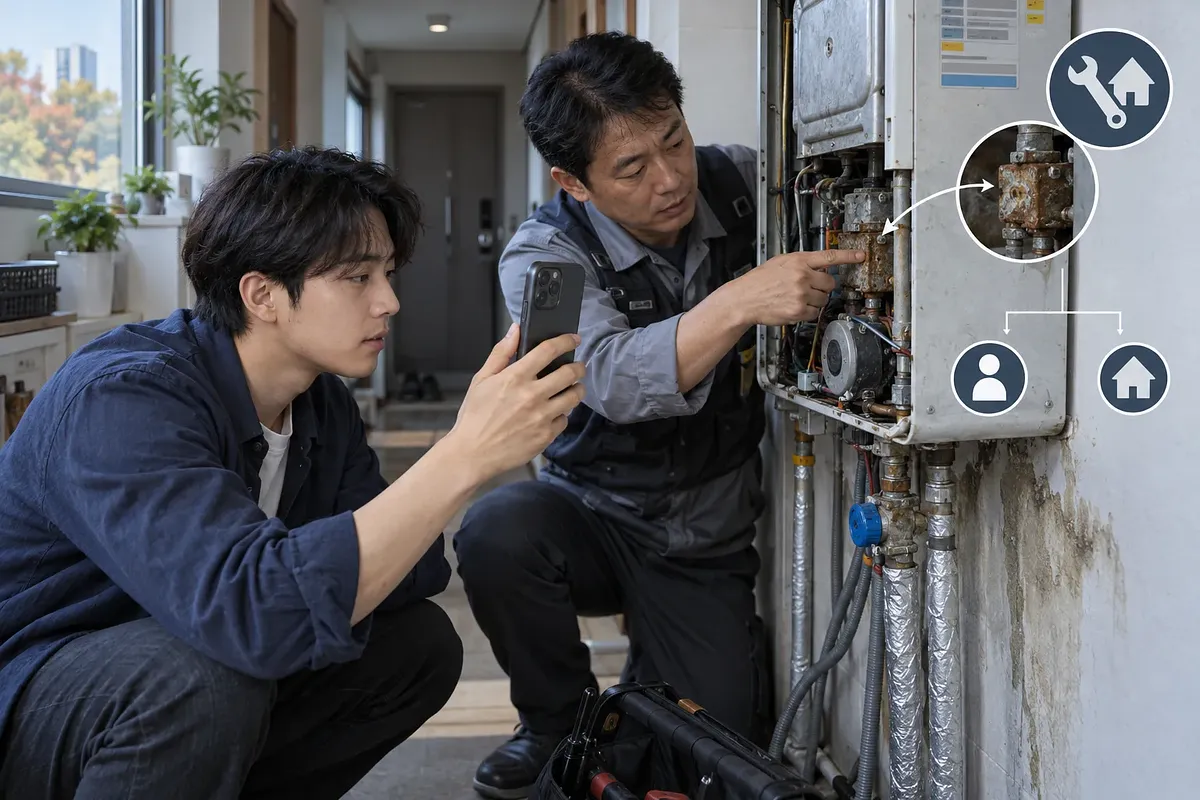
Failure of a major component in an aging boiler | Subject to repair by the landlord | Whether it is aging and whether heating and hot water are available
Leakage caused by a wall crack or building defect | Subject to repair by the landlord | Cause of the leak and extent of the damage
Defective electrical wiring that prevents normal use | Subject to repair by the landlord | Whether the equipment is defective
Light bulbs and similar items that can be replaced easily at low cost | Tenant may be responsible | Whether it is simply a consumable item
Damage caused by the tenant's fault | Tenant may be responsible | Cause of the damage and scope of responsibility
Discoloration or damage to wallpaper or flooring | Depends on the condition and cause | Whether it is merely a cosmetic issue or a defect such as leakage
Replacement of wallpaper and flooring is not guaranteed merely because the home is rented monthly. If wallpaper was damaged by a leak, first identify the cause of the leak. Simply changing the color requires a separate agreement with the landlord.
You should also review any special provisions that assign repair responsibility. Broad language requiring payment of repair costs has limits in how it may be interpreted. It is difficult to conclude that such language shifts even major repairs to the main structure and basic facilities to the tenant.
How to ask the landlord for repairs
When you discover a defect, document its condition and notify the landlord immediately. Article 634 of the Civil Act generally requires notification without delay. An exception applies if the landlord already knows about the defect.
· Take photos or videos of the damaged area and record the date it was discovered.
· Request repairs through text messages or another method that leaves a record.
· Describe specifically which facility cannot be used normally and the resulting inconvenience.
· Discuss the repair company, scope of work, and who will pay the cost.
· After the repair is completed, keep the work details and receipts.
A repair request should describe the symptoms and their impact on daily life. For a boiler, specify whether the hot water or heating is not working. If you reached an agreement by phone, you can summarize the details again by text message.
If you paid for an emergency repair first
You may claim reimbursement from the landlord for repair costs necessary to preserve the home. The law calls these necessary expenses. The legal basis is explained in the Everyday Legal Information commentary on Article 626 of the Civil Act.
A claim is not always barred merely because the landlord did not approve the repair in advance. However, you must explain why the repair was necessary and why the cost was reasonable. Simple decoration expenses do not all qualify as necessary expenses.
Records to keep | What they establish
Photos and videos from before the repair | The actual defect and extent of the damage
Communications sent to the landlord | The notification and consultation process
Inspection opinion from the repair company | Cause of the problem and need for repair
Estimate and work statement | Scope and cost of the repair
Receipts and transfer confirmations | Amount actually paid
If you agreed to deduct the repair cost from the monthly rent, keep a record of the settlement. You cannot stop paying all monthly rent merely because there is a defect. The assessment varies depending on the extent to which the home cannot be used.
Comparison of the monthly rent tax credit and cash receipt income deduction
The two deductions reduce tax at different stages. A tax credit subtracts the credit amount from the calculated tax. An income deduction reduces the income on which tax is calculated.
Category | Monthly rent tax credit | Income deduction through cash receipts
How it applies | Applies the credit rate to eligible monthly rent payments | Included in the income deduction for credit card and similar spending
Main assessment criteria | Total salary, household without a home, and housing and address requirements | Employment income, spending threshold, and deduction limit
Basic deduction rate | 15% or 17% | 30% for general cash receipt spending
Amount threshold | Eligible monthly rent capped at KRW 10 million per year | Eligible spending must exceed 25% of total salary
Duplicate deduction for the same monthly rent | Not allowed | Not allowed
The 30% cash receipt rate is not a refund rate. The actual tax savings vary depending on the applicable tax rate and deduction limit. It does not mean that 30% of the total monthly rent will be refunded.
The National Tax Service advises employees who are not eligible for the tax credit to use cash receipts. This involves submitting the lease agreement and proof of monthly rent payments through Hometax. Review both the National Tax Service guidance and the income deduction calculation standards.
Basic conditions for the monthly rent tax credit
The basic eligible group consists of employees in households without a home whose total salary is at most KRW 80 million. Those whose aggregate income exceeds KRW 70 million are excluded. The salary stated in an employment contract may differ from total salary under tax law.
· The head of household must meet the no-home-ownership requirement as of the end of the tax period.
· A household member must confirm that the head of household is not claiming the relevant housing deduction.
· The lease must be in the name of the taxpayer or a person eligible for the basic deduction.
· The registered residential address of the employee claiming the credit must match the address in the lease agreement.
· In principle, the home must meet the National Housing Size standard or have a standard market value of at most KRW 400 million.
The National Housing Size standard is generally a dedicated floor area of at most 85㎡. In an eup or myeon outside the Seoul metropolitan area that is not an urban area, the limit is at most 100㎡. Residential officetels and gosiwons may also qualify for the credit.
The 2026 credit rates are as follows. The income thresholds and annual limit are available in Article 95-2 of the Restriction of Special Taxation Act.
Income condition | Credit rate | Calculated credit when the annual KRW 10 million limit applies
Total salary of at most KRW 55 million and aggregate income of at most KRW 45 million | 17% | KRW 1.7 million
Meets the basic income requirements but does not qualify for the 17% rate | 15% | KRW 1.5 million
The calculated credit and actual refund are different. The refund is also affected by taxes already paid and other deductions. If the tax payable is low, the full calculated amount may not be refunded.
Additional conditions to check in 2026
In 2026, eligibility was expanded for spouses living separately and households with multiple children. Spouses cannot each claim the credit merely because they have different addresses. For detailed conditions, see Article 95 of the Enforcement Decree of the Restriction of Special Taxation Act.
Situation | Additional points to check
Spouses pay monthly rent for different homes | Each spouse must meet the basic credit requirements
The spouse of the head of household applies for an additional credit | Their addresses must be in different cities, counties, or autonomous districts
A family member specified by law lives at the spouse's address | That family member must meet the no-home-ownership requirement as of the end of the tax period
Both spouses claim credits for their respective monthly rent payments | Eligible monthly rent for both spouses combined is capped at KRW 10 million per year
There are at least 3 children or grandchildren eligible for the basic deduction | Dedicated floor area of at most 100㎡ or standard market value of at most KRW 400 million
Order for preparing deduction documents
Gather documents that verify your address and payment of monthly rent.
· Check the resident registration certificate to confirm that the address matches the lease agreement.
· Prepare a copy of the lease agreement.
· Gather proof of payment, such as monthly rent transfer confirmations.
· Apply for the credit according to your employer's year-end tax settlement procedure.
You can apply for cash receipts through Hometax. Enter "application for issuance of cash receipts for residential monthly rent" in the search box. When applying the tax credit, make sure the same monthly rent is not also included in the income deduction.
Calculation example for monthly rent of KRW 500,000
If you pay KRW 500,000 per month for 12 months, the annual monthly rent is KRW 6 million. The calculations below assume that the entire amount qualifies for the credit. Maintenance fees and the deposit are not included.
Applicable condition | Calculation | Calculated tax credit
Eligible for the 17% credit | KRW 500,000 × 12 months × 17% | KRW 1.02 million
Eligible for the 15% credit | KRW 500,000 × 12 months × 15% | KRW 900,000
This example does not determine the actual refund amount. If you moved in or out during the year, the lease period within that year must be considered. The Enforcement Decree calculates monthly rent based on the contract term and the number of rental days in the relevant tax period.
2026 youth monthly rent assistance conditions and application period
Regular applications for 2026 closed at 16:00 on May 29. Describing the program as ongoing does not mean that applications are accepted year-round. Check Bokjiro and announcements from the local government for your address for the next application period or additional applications.
Bokjiro's March 24, 2026 application guidance describes the scope of assistance as follows.
Assistance of up to KRW 200,000 for the monthly rent actually paid, excluding the rental deposit, maintenance fees, and similar charges
Item | 2026 central government program standards
Basic eligibility | Young people aged 19 to 34 who do not own a home and live separately from their parents
Eligible birth years | Born from 1991 through 2007
Young household income | At most 60% of the standard median income
Young household assets | At most KRW 122 million
Original household income | At most 100% of the standard median income
Original household assets | At most KRW 470 million
Assistance amount | Up to KRW 200,000 per month within the amount of actual monthly rent
Number of payments | Up to 24 payments, taking previous benefits into account
Regular application period | From 09:00 on March 30, 2026 to 16:00 on May 29
The original household is assessed by including the parents in the young household. Assessment of the original household is waived when a specified ground for recognizing independent livelihood applies. Do not determine eligibility based only on your own salary.
Asset requirements and exclusions are available in the 2026 Youth Monthly Rent Assistance Program Manual. Living in public rental housing or receiving other monthly rent assistance is subject to separate review. For housing benefit recipients, the monthly rental assistance portion is deducted when calculating the benefit.
Changes from previous guidance
The limits of a KRW 50 million deposit and KRW 700,000 monthly rent are no longer current standards. These housing requirements were abolished on April 12, 2024. The abolition is confirmed in the Bokjiro notice.
The housing subscription savings account requirement was also removed from new applications in 2026. The Ministry of Land, Infrastructure and Transport reconfirmed this in its July 2026 guidance. Programs independently operated by local governments may have separate conditions.
Documents needed to apply include the lease agreement and proof of monthly rent transfers for the latest 3 months. An income and asset declaration, family relations certificate, and copy of a bankbook are also required. When the next application period opens, check the document list in that announcement again.
Calculating the jeonse-to-monthly-rent conversion rate and comparing deposits
The jeonse-to-monthly-rent conversion rate is the annual monthly rent as a percentage of the deposit converted into monthly rent. The denominator is the difference being converted, not the entire jeonse deposit. The formula for converting jeonse to monthly rent is as follows.
Annual jeonse-to-monthly-rent conversion rate = monthly rent × 12 months ÷ reduced deposit × 100
Assume that you are offered monthly rent of KRW 500,000 for a jeonse deposit of KRW 100 million. The calculation varies depending on the deposit retained.
Deposit after conversion | Deposit converted into monthly rent | Annual monthly rent | Annual conversion rate
KRW 1 million | KRW 99 million | KRW 6 million | Approximately 6.06%
KRW 10 million | KRW 90 million | KRW 6 million | Approximately 6.67%
Both rates were rounded to the second decimal place. The calculation will be wrong if you write KRW 1 million for the deposit but subtract KRW 10 million. Use the same deposit amount in the lease agreement and calculation table.
The statutory ceiling is the lower of 10% per year or the Bank of Korea base rate plus 2 percentage points. The legal basis is Article 7-2 of the Housing Lease Protection Act and Article 9 of its Enforcement Decree. The applicable base rate must be checked at the time of conversion. (Confirmed value: Bank of Korea base rate of 3.00% per year, resulting statutory ceiling on the jeonse-to-monthly-rent conversion rate of 5.00% per year · Source: bok.or.kr · Checked on 2026-08-27)
This ceiling is a rule for converting an existing deposit into monthly rent. It is not a market rent ceiling uniformly applied to the initial monthly rent of a new tenant. For registered rental housing, also check the separate rent regulations.
How should you prepare to protect your deposit?
Monthly rent tenants must also check whether they will be able to recover their deposit. A small deposit does not by itself guarantee full recovery. Review both the rights attached to the property before signing and the protection requirements after moving in.
· Check the owner and security interests on the real estate registration certificate.
· Review the maximum secured claim amount and registration order of any mortgage.
· For a multi-household home, check other tenants' deposits and priority rankings.
· File a move-in report after moving in.
· Obtain a fixed date on the lease agreement.
The maximum secured claim amount in the registry is not the same as the actual outstanding loan balance. Deposits held by other tenants in a multi-household home are difficult to identify from the registry alone. Ask the landlord and real estate agent for supporting information.
Difference between opposability and preferential repayment rights
Opposability and preferential repayment rights provide different protections.
Right | Meaning | Main requirements
Opposability | The power to assert the lease against a new owner and others | Takes effect the day after possession of the home and resident registration are completed
Preferential repayment right | The right to receive distributions before junior rights holders in an auction or public sale | Opposability requirements and a fixed date
Super-priority repayment for small-amount tenants | Priority protection for a specified portion of a qualifying small deposit | Regional amount thresholds, opposability requirements before the auction, and other conditions
Obtaining only a fixed date does not create opposability. Small-amount tenants must also consider the region and when senior security interests were created. In an auction, you must also check the deadline for requesting a distribution.
For detailed standards, see the guidance on deposit protection for small-amount tenants. The distribution procedure is explained in the Everyday Legal Information guidance on distribution requests. The expected distribution amount varies depending on senior rights and the actual sale price.
Items to check in repair provisions and maintenance fees
Special provisions should specifically identify the repairs, the responsible person, and the completion date. It is also advisable to record defects found before moving in. Specifying repair responsibility does not eliminate the need to document the actual defects.
· Operating condition of the boiler and basic facilities before move-in
· Locations where leaks or mold were found
· Repairs to be completed before move-in
· Person responsible for repair costs and payment method
· Items included in maintenance fees and items billed separately
Check both the total maintenance fee and its detailed components. It is also advisable to keep separate records of monthly rent and maintenance fee payments. This helps when determining the amount eligible for a tax deduction or monthly rent assistance.
Standards for refunding the long-term repair reserve
In principle, the owner is responsible for the long-term repair reserve for multi-unit housing. If the tenant paid it on the owner's behalf, the tenant may claim reimbursement from the owner. The legal basis is available in the Everyday Legal Information guidance on refunds of long-term repair reserves.
When moving out, ask the management office for a payment statement. General maintenance fees and the long-term repair reserve must be distinguished. You can list the confirmed amount as a separate item on the deposit settlement statement.
How should monthly rent transaction statistics be interpreted?
The monthly rent share must be considered together with the region, housing type, and date of compilation. Seoul apartment statistics cannot be interpreted as covering all housing nationwide. Transaction volumes for previous months may also change as additional reports are filed.
The figures released by the Seoul Metropolitan Government as of September 15, 2026 are as follows. The source is a Seoul Housing Portal press release analyzing actual transaction price data from the Ministry of Land, Infrastructure and Transport.
Contract month | Seoul apartment jeonse transactions | Seoul apartment monthly rent transactions
June 2026 | 8,530 | 10,728
July 2026 | 8,855 | 9,264
August 2026 | 7,263 | 7,347
The August figures may change as additional reports are filed. In this compilation, monthly rent transactions outnumbered jeonse transactions in all 3 months. However, transaction counts alone cannot establish the cause of conversion to monthly rent.
Common mistakes in monthly rent living
It is easy to overlook conditions if you reach a conclusion based only on the name of a facility or a deduction rate.
Common misconception | Standard to check
Wallpaper must always be replaced for a monthly rent tenant | Cause of the defect, usable condition, and lease terms
Cash receipts provide a refund of 30% of monthly rent | Difference between an income deduction and a tax credit
Youth monthly rent assistance can be applied for at any time | Application period for the relevant year
A small deposit is fully protected | Small-amount tenant requirements and distribution limit
Deposit protection is complete once a fixed date is obtained | Move-in, move-in report, and distribution procedure
Repair costs can be deducted from monthly rent immediately after payment | Basis for claiming the expense and settlement agreement
 Injoys