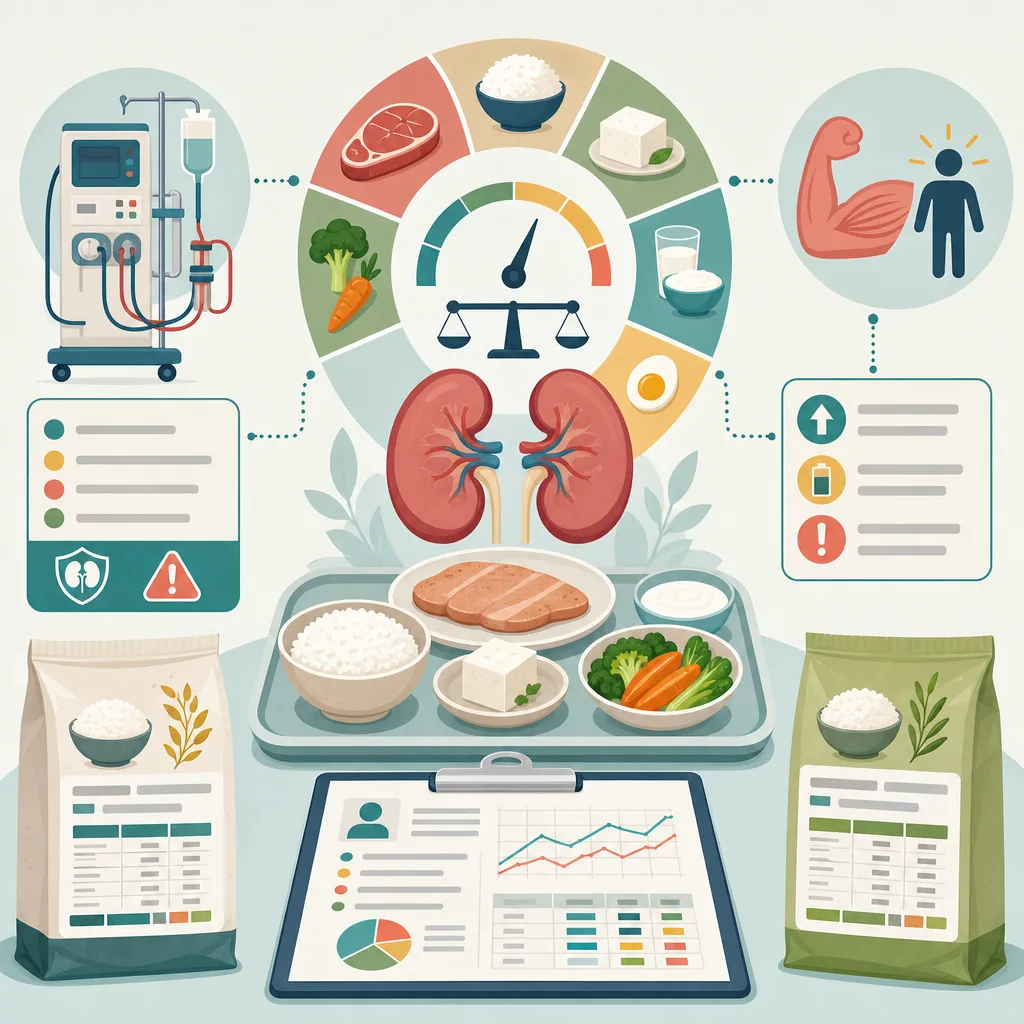
Should You Stop Eating Meat If Your Kidneys Are Weak?
Reduced kidney function does not mean you must stop eating meat altogether, but it also does not mean you can continue eating the same amount as before. Protein from meat, rice, and side dishes must all be counted within the total protein target appropriate for your disease stage and dialysis status.
- In a chronic kidney disease diet, total daily protein intake is more important than whether meat is prohibited.
- KDIGO provides protein intake recommendations for adults with chronic kidney disease who are not on dialysis, but the specific applicable stages and target amounts should be confirmed in the guidelines and with your healthcare team.
- Rice, bread, noodles, tofu, and dairy products also contain protein, so counting only meat may underestimate actual intake.
- Low-protein rice can help leave room for meat, but you should check each product's nutritional information and the total calories in the overall meal.
- For people on dialysis or at risk of malnutrition or sarcopenia, reducing protein too much may instead be harmful.
The claim that people with poor kidney function should avoid meat as much as possible is overly simplistic. Conversely, the claim that people with kidney disease can continue eating meat as usual does not apply to every patient either. The key is not to ban meat itself, but to adjust total daily protein intake according to disease stage, dialysis status, and nutritional status.
The Misconception That Meat Must Be Avoided Entirely
Meat provides high-quality protein, iron, vitamin B12, and other nutrients. However, protein metabolism produces nitrogenous waste that must be processed through the kidneys, so excessive protein intake can burden some patients whose kidney function has significantly declined.
The following distinctions are important.
- This does not mean that meat is a toxic food. An appropriate amount can be included in the diet.
- Nor is there any guarantee that the usual intake is appropriate. If the existing diet was high in protein, intake may need to be reduced.
- The target is not the same for every patient with kidney disease. It varies according to chronic kidney disease stage, proteinuria, diabetes, age, weight changes, and dialysis status.
- Do not start an extremely low-protein diet on your own. Insufficient calories and essential nutrients can lead to weight loss and muscle loss.
Therefore, the accurate statement is: “People with kidney disease can eat meat within their prescribed total protein range.”
Protein Targets Vary by Disease Stage and Dialysis Status
The KDIGO guidelines provide protein intake standards for adults with chronic kidney disease who are not on dialysis, but the specific disease stages covered and target amounts should be confirmed with the relevant guidelines and healthcare professionals. These are population-level standards and do not replace an individualized prescription.
| Situation | General dietary approach | What must be checked |
|---|---|---|
| Early-stage chronic kidney disease | Preventing excessive intake takes priority over banning meat unconditionally | Proteinuria, diabetes, current eating habits |
| G3–G5 without dialysis | Adjust total protein while ensuring adequate calorie intake | The weight basis and target amount determined by the healthcare team |
| Undergoing hemodialysis or peritoneal dialysis | Protein requirements may be higher than for patients not on dialysis | Dialysis method, test results, nutritional status |
| Older age, low body weight, or risk of sarcopenia | Prioritize guarding against malnutrition caused by excessive restriction | Weight loss, muscle strength, appetite, serum albumin, etc. |
| Acute kidney injury, nephrotic syndrome, or post-transplant | A general chronic kidney disease diet may be difficult to apply as-is | Separate instructions from the healthcare professionals treating the condition |
The type of body weight used to calculate intake per kilogram is also important. For people with edema, obesity, or low body weight, standard weight or adjusted weight may be used rather than simply applying current body weight, so this should be confirmed with a healthcare professional or clinical dietitian.
Why Reducing Meat Alone Does Not Make the Calculation Work
Protein is not found only in meat, fish, and eggs. Protein from the following foods must also be included in the daily total.
- Grains such as white rice, multigrain rice, bread, and noodles
- Beans, tofu, and nuts
- Milk, yogurt, and cheese
- Fish, eggs, and meat
- Protein drinks and workout supplements
- Some convenience foods and nutritional supplements
Even if no meat is eaten at a meal, protein adds up when rice, tofu side dishes, milk, and nuts are eaten together. Conversely, when eating meat, adjusting the protein from grains and other side dishes can create room to compose a meal within the prescribed range.
It is safer to calculate actual intake in the following order.
- Confirm the daily protein target with a healthcare professional.
- For packaged foods, distinguish between the serving size shown in the nutrition information and the amount actually consumed.
- Record protein from rice, noodles, tofu, and dairy products as well as meat.
- Divide the daily total among meals without concentrating too much in a single meal.
- If weight and appetite continue to decline, seek medical care rather than tightening the restriction.
When Can Low-Protein Rice Help?
Regular white rice also contains protein. Therefore, if someone prescribed protein restriction by a healthcare professional wants to eat a certain amount of preferred side dishes such as meat or fish, low-protein rice or low-protein instant rice can be used to reduce the protein coming from grains.
However, not every low-protein product contains exactly one-tenth the protein of a regular product. Because ingredients, manufacturing methods, and serving sizes differ, the figures shown on product packaging must be compared directly.
What to Look for When Comparing Products
| Item to check | Why it should be checked |
|---|---|
| Serving size | One package may differ from the reference amount used in the nutrition information |
| Protein | Needed to determine the actual reduction achieved in a meal |
| Calories | Necessary energy must still be obtained while reducing protein |
| Sodium | Seasoned products or convenience foods may be high in sodium |
| Potassium and phosphorus | Management may be needed depending on individual test results |
| Phosphate additives | Checking the ingredient list is useful because they can increase phosphorus intake from processed foods |
Low-protein rice is not a treatment but a tool for dietary management. Eating this product does not mean that the amount of meat can be increased without limit or that protein from other side dishes can be excluded from the calculation.
What Meat Should Be Chosen, and How?
Even among protein foods, sodium and additive content can vary substantially. Processed meats such as ham, sausage, bacon, jerky, and marinated meat may contain large amounts of salt and phosphate additives, so it is advisable to check the ingredient list and nutrition information.
Relatively simple principles for choosing meat are as follows.
- Prioritize fresh meat with fewer additives over processed meat.
- After grilling or boiling it, do not add excessive amounts of salt, soy sauce, or sauce.
- For soups and stews, consider not only the amount of meat but also the sodium in the broth.
- When eating meat together with eggs, tofu, or cheese, count all of them toward total protein.
- Do not add protein supplements without consulting a healthcare professional.
Whether red meat, chicken, fish, or plant-based protein is appropriate depends on the individual’s blood test results and coexisting conditions. For example, if potassium or phosphorus levels are high, general healthy-eating advice may not apply as-is.
The Pitfall of Reducing Protein Alone: Insufficient Calories and Sarcopenia
If other energy sources, such as rice and fat, are also excessively reduced while protein is restricted, the body may use not only stored fat but also muscle protein for energy. In this case, even if dietary protein intake is restricted, muscle breakdown can increase waste products in the body and worsen nutritional status.
In particular, if any of the following signs occur, stop an extremely low-protein diet and consult a healthcare professional.
- Unintentional weight loss
- Reduced appetite or skipped meals
- Decline in grip strength and walking ability
- Becoming easily fatigued or having difficulty with daily activities
- Nausea, vomiting, or difficulty eating
- Worsening edema or a sudden change in urine output
The goal of a low-protein diet is not “to eat less,” but to reduce only excessive protein while ensuring sufficient calories and nutrition. The risk of malnutrition must be assessed even more carefully in older adults, dialysis patients, and patients with cancer or infection.
Sodium, Potassium, and Phosphorus Must Also Be Considered
A kidney disease diet cannot be explained by protein alone.
- Sodium: It affects the management of edema and blood pressure. Intake can easily increase through processed meat, broth, sauces, and pickled foods.
- Potassium: Not every patient needs to restrict it. Intake is adjusted according to blood potassium levels and medications.
- Phosphorus: Management may be necessary when kidney function declines. Phosphate additives in processed foods should also be checked.
- Calories: If intake is insufficient, body weight and muscle mass may decrease.
- Fluids: Guidance varies according to edema, heart failure, dialysis status, and urine output.
If test results are normal but potassium and phosphorus are both severely restricted based only on online diets, the range of foods that can be eaten may become excessively narrow. As a rule, restrictions should be determined based on test results.
Helpful Information to Prepare Before a Medical Appointment
Having the following information available when consulting a healthcare professional or clinical dietitian can help you receive more specific advice.
- Foods eaten over 2–3 days and their approximate amounts
- A list of current medications, dietary supplements, and protein supplements
- Recent weight changes and appetite status
- Dialysis status and dialysis method
- Recent test results related to kidney function, potassium, phosphorus, and proteinuria
- Photos of the nutrition information for frequently eaten instant rice and processed foods
In conclusion, people with kidney disease do not need to stop eating meat unconditionally, nor is there any reason to continue eating it as usual without restriction. An appropriate amount should be determined based on the entire daily diet, and products such as low-protein rice should be used as aids for achieving that target.
FAQ
If my kidneys are unhealthy, do I have to stop eating meat completely?
In most cases, meat is not completely prohibited. However, portions should be adjusted so that total daily protein from meat, fish, eggs, rice, tofu, and dairy products does not exceed the individual's target.
Can I continue eating meat as usual if I have chronic kidney disease?
You should not continue eating the same amount without first checking whether your current intake is appropriate. If your usual diet has been high in protein or your kidney function has declined significantly, you may need to reduce your intake; conversely, if you are on dialysis, you may need more protein.
How is the daily protein intake determined?
The protein target for adults with chronic kidney disease who are not on dialysis varies depending on the disease stage, nutritional status, age, proteinuria, and comorbidities, so you should consult your healthcare team. If you have edema or obesity, the body weight used for the calculation may also need to be adjusted, so you should consult your healthcare team.
Do dialysis patients also need to reduce protein intake?
Dietary guidelines for dialysis patients differ from those for patients who are not on dialysis. Protein requirements may be higher due to losses during dialysis and metabolic status, so you should not start a low-protein diet on your own.
Is it better to eat low-protein rice on days when I eat meat?
If your healthcare team has prescribed protein restriction, low-protein rice can reduce the protein obtained from grains, leaving room for meat or fish. However, you should check the protein content, calories, and sodium in each product and use it in line with your total daily allowance.
Does low-protein instant rice always have one-tenth the protein of regular rice?
No. Because the ingredients, manufacturing methods, and serving sizes vary by product, the reduction ratio also varies, so you should directly compare the serving size and protein content shown on the packaging.
Should people with kidney disease eat only chicken and fish?
There is no rule that only certain types of meat are allowed. In many cases, the amount consumed, degree of processing, and sodium and phosphate additives matter more than the type, and the individual's potassium and phosphorus levels and comorbidities should also be considered.
If I eat tofu or beans instead of meat, can I exclude them from my protein calculation?
Tofu and beans are also protein foods, so they should be included in the daily total. Plant-based proteins have benefits, but that does not mean they can be eaten without limit. People who need to manage potassium and phosphorus should seek separate advice on how much to consume.
What should I do if I lose weight and muscle after reducing protein intake?
Do not restrict your diet further; inform your healthcare team or a clinical dietitian. The possibility of insufficient calorie intake or malnutrition should be assessed, and your protein target and meal plan should be readjusted.
Sources
Images