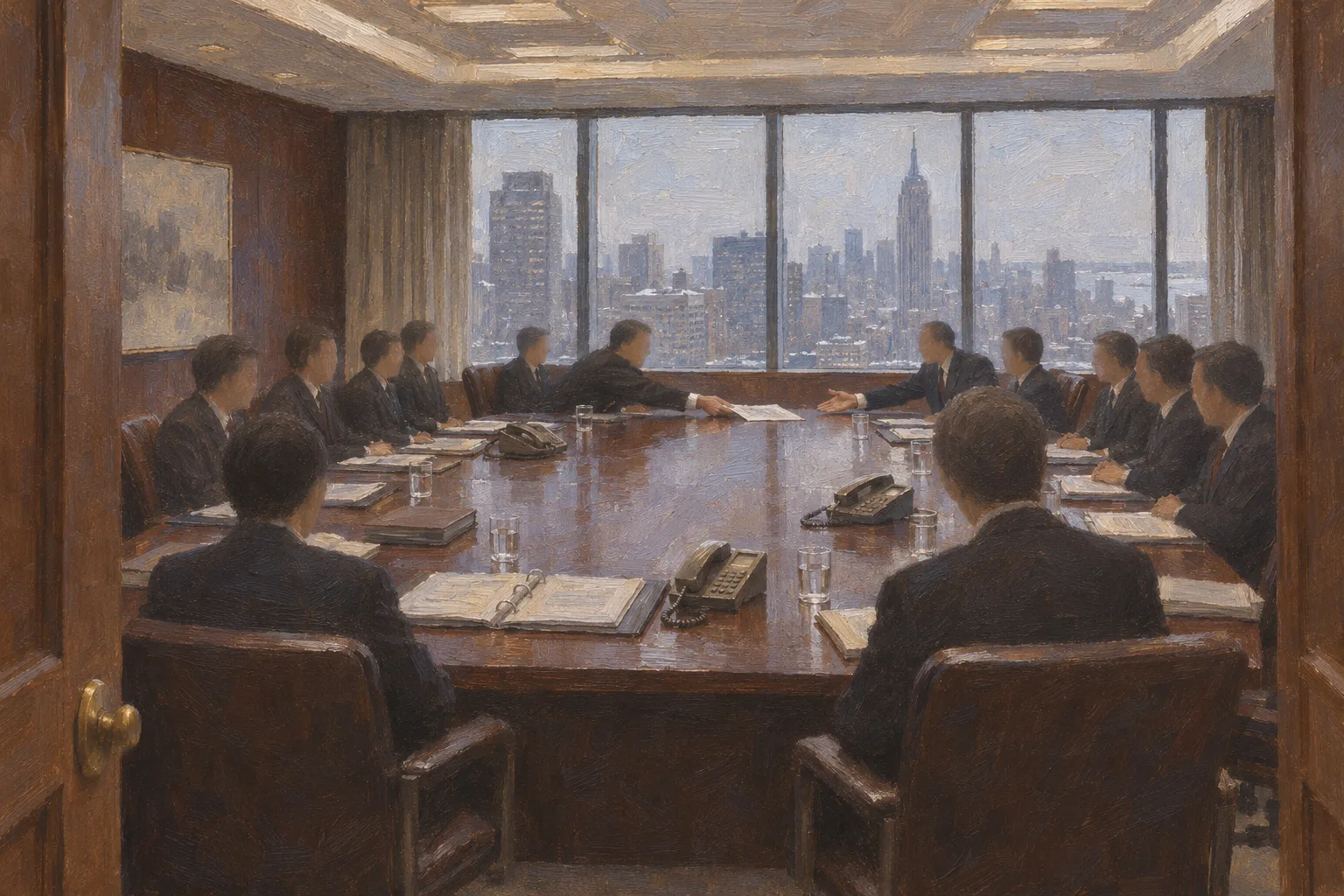
South Korea's 1998 Short-Term Foreign Debt Extension Deal
In January 1998 in New York, South Korean negotiators and representatives of foreign creditor banks agreed to convert the short-term foreign debt of South Korean financial institutions into government-guaranteed debt with 1-year, 2-year, and 3-year maturities. The amount extended, announced on March 16, was $21.839 billion. This eased the immediate pressure on South Korean financial institutions to repay their debts in foreign currency.
- IMF emergency funding gave South Korea more foreign currency to work with, but changing the maturities of domestic financial institutions' existing loans required the creditor banks' consent.
- On January 28, 1998, in New York, South Korean negotiators agreed on the extension terms with representatives of 13 creditor banks from 7 countries.
- The $21.839 billion in extensions announced on March 16, 1998, accounted for 94.8% of the eligible debt as of March 11.
- On April 8, 1998, the government began guaranteeing repayment of $21.836 billion in confirmed debt owed by 33 banks and 9 merchant banks.
During the IMF foreign exchange crisis, South Korean financial institutions struggled to repay the dollars they had borrowed abroad on time. In January 1998, Korean negotiators in New York reached an agreement with creditor banks to push back repayment dates. A government guarantee allowed principal repayments to be spread over several years, giving the foreign exchange market time to stabilize.
In November 2026, the Ministry of Finance and Economy's announcement was checked against the Bank of Korea's “Monthly Economic Chronology.”
Why Korea still needed to negotiate its foreign debt after IMF emergency funds arrived
The arrival of IMF funds did not change the maturity dates on loans that domestic banks had taken out with foreign banks. In 1997, a wave of corporate defaults made it harder for domestic financial institutions to collect on their loans. As the currency turmoil that began in Thailand spread, foreign banks grew reluctant to extend the maturities of their loans to Korea.
Domestic banks could normally repay foreign currency loans as they came due by borrowing again. When that option dried up, they ran short of dollars to make immediate payments. According to the IMF's later evaluation, even after the emergency funds arrived, Korea's available foreign exchange reserves were nearly depleted by the end of December 1997.
| Response | Who did what | What changed in Korea |
|---|---|---|
| IMF emergency funding | The International Monetary Fund (IMF) lent foreign currency to Korea | More foreign currency was available for payments abroad |
| Extension of short-term foreign debt maturities | Foreign creditor banks agreed to push back repayment dates for domestic financial institutions | Less foreign currency was needed for payments in the near term |
Timeline from the New York framework agreement to the payment guarantee
The January 1998 talks in New York set common terms for the creditor banks to follow. Each bank then decided whether to extend its loans and, if it chose to do so, applied for the maturity it wanted. After confirming which debts qualified, the Korean government began providing guarantees in April.
| Date | What happened | Record |
|---|---|---|
| November 21, 1997 | The Korean government announced that it had decided to request funding from the IMF | National Archives of Korea, “Overcoming the IMF Foreign Exchange Crisis” |
| December 4, 1997 | The IMF Executive Board approved a Stand-By Arrangement for Korea | IMF evaluation of its support during the Asian crisis |
| Late December 1997 | Major foreign banks agreed to keep existing loans in place during the negotiations | IMF evaluation of its support during the Asian crisis |
| January 28, 1998, New York local time | Korea's working-level negotiating team and representatives of 13 creditor banks from 7 countries agreed on basic principles | Ministry of Finance and Economy announcement on the New York negotiations |
| March 16, 1998 | The Ministry of Finance and Economy announced the results of individual financial institutions' applications for maturity extensions | Bank of Korea, “March 1998” |
| April 8, 1998 | Government payment guarantees took effect for debts confirmed for extension | Bank of Korea, April 14 entry in “April 1998” |
| August 23, 2001 | Korea repaid the remaining balance of the funds it had borrowed from the IMF | National Archives of Korea, “Overcoming the IMF Foreign Exchange Crisis” |
Maturities and interest rates in the New York negotiations
The agreement covered foreign currency debt that domestic financial institutions had taken on for less than 1 year and were due to repay in 1998. Trade-related financing and borrowing in the form of securities were excluded. The Korean government would guarantee payment if creditor banks agreed to extend the maturities.
The rates below come from the January 1998 framework agreement announced by the Ministry of Finance and Economy. The benchmark was LIBOR, the London interbank rate at the time. The longer creditor banks had to wait to get their principal back, the higher the rate added to that benchmark.
| New maturity | Rate added to LIBOR | Terms by maturity |
|---|---|---|
| 1 year | 2.25 percentage points | Capped at 20% of total eligible debt |
| 2 years | 2.50 percentage points | Early repayment allowed after 6 months |
| 3 years | 2.75 percentage points | Early repayment allowed after 6 months |
Domestic financial institutions agreed to repay the principal in a single payment at the new maturity date. Interest was payable every 6 months. If foreign currency conditions improved, debts extended to 2 or 3 years could be repaid before the agreed maturity date.
The difference between the March extension amount and the April guarantee amount
On March 16, 1998, the Ministry of Finance and Economy announced that maturities had been extended on $21.839 billion in debt. The Bank of Korea's Economic Chronology recorded this amount as 94.8% of the debt eligible as of March 11. A total of 134 financial institutions from 32 countries applied for extensions.
| Category | Amount | Basis for the total |
|---|---|---|
| Debt covered by the January framework agreement | About $25 billion | Short-term foreign debt identified as eligible for extension as of the end of 1997 |
| Extension amount announced on March 16 | $21.839 billion | Results of applications for extensions from creditor financial institutions |
| Amount guaranteed starting April 8 | $21.836 billion | Confirmed debts of 33 domestic banks and 9 merchant banking corporations |
Subtracting the April guarantee amount from the amount announced in March gives a difference of $300,000. The two Economic Chronology entries show the stage at which each amount was tallied, but do not give the specific reason for the difference. When citing the 94.8% figure, the denominator is the debt eligible as of March 11.
The record and its interpretation
What the records from the time confirm is that the foreign debt repayment schedule changed. The Ministry of Finance and Economy specified that principal would be repaid at the new maturity date. The Bank of Korea later recorded when the guarantees took effect and how much debt they covered.
The IMF's later evaluation sees the creditor banks' decision not to call in their loans as a turning point that eased currency turmoil. Funding from international institutions and financial and corporate restructuring also went ahead. For households that experienced corporate bankruptcies and mass unemployment at the time, stability in the foreign exchange market and the recovery of jobs were separate issues.
Opinions differ on whether negotiations could have started earlier. Some creditors interviewed by the IMF's Independent Evaluation Office had been interested in a coordinated response from the start of the crisis. Governments of major shareholder countries, however, worried that intervention could trigger capital outflows from other emerging markets. The office concluded that it was difficult to say with certainty whether an earlier agreement would have been possible.
Why maturity schedules matter when reading records of the foreign exchange crisis today
Even if the total amount of foreign debt stays the same, the more that is due this month, the more dollars are needed right away. The New York negotiations spread dollar debt repayments across maturities of 1, 2, and 3 years. To understand Korea's foreign currency position at the time, it is therefore necessary to compare available foreign exchange reserves with debt coming due at the same point in time.
FAQ
Why did Korea negotiate separately with foreign banks when the IMF had provided funding?
The IMF loan replenished Korea's foreign currency reserves for payments abroad. Changing the repayment dates on money domestic financial institutions had already borrowed required the consent of the foreign creditor banks that were parties to the loan agreements.
What is the difference between the 13 banks that negotiated in New York and the 134 financial institutions that applied for extensions?
The 13 banks from 7 countries formed the creditor bank delegation that negotiated common terms on January 28, 1998. The 134 financial institutions from 32 countries applied for extensions under those terms and were included in the figures announced on March 16.
What was the 94.8% maturity extension rate based on?
The denominator was the amount of debt eligible for maturity extensions as of March 11, 1998. On March 16, the Ministry of Finance and Economy announced that extensions covered $21,839,000,000, or 94.8% of the eligible debt.
Was the annual interest rate on 3-year loans 2.75%?
The 2.75 percentage points were a spread added to LIBOR, the benchmark rate at the time. The actual interest rate was LIBOR plus that spread.
What happens to a financial institution's debt if the government guarantees repayment?
The financial institution that borrowed the money remains responsible for repaying the principal and interest. The government assumed responsibility for payment if the financial institution failed to repay as agreed.
Did the government guarantee take effect on April 8 or April 14, 1998?
The guarantee took effect on April 8. The Bank of Korea's economic chronology recorded this under the Ministry of Finance and Economy entry for April 14.
How did the gold collection campaign differ from the extension of foreign debt maturities?
The gold collection campaign raised foreign currency by exporting gold that citizens contributed. In the New York negotiations, the creditor banks pushed back the date when they would be repaid the principal, reducing the amount of foreign currency domestic financial institutions needed immediately.
What debt did Korea repay early in August 2001?
On August 23, 2001, Korea paid off the remaining balance on its IMF loans. The debt whose maturities were adjusted in New York in 1998 was owed by domestic financial institutions to foreign creditor banks.
Sources
- Ministry of Finance and Economy, "Agreement on Basic Principles in Negotiations to Extend the Maturities of Korean Financial Institutions' Short-Term External Debt"
- Bank of Korea, "Monthly Economic Chronology, March 1998"
- Bank of Korea, "Monthly Economic Chronology, April 1998"
- IMF, "IMF-Supported Programs in Indonesia, Korea, and Thailand"
- IMF Independent Evaluation Office, appendix to the capital account crisis evaluation report, "Ex Post Evaluation of Korea's Negotiations with Creditor Banks"
- National Archives of Korea, "The Republic of Korea Through Its Records: Overcoming the IMF Foreign Exchange Crisis"
- National Institute of Korean History, Our History Net, "Efforts Toward an Advanced Welfare Economy in the 21st Century"
Images