Safe Setup and Inspection Procedures for Portable Generators During Hurricane Outages
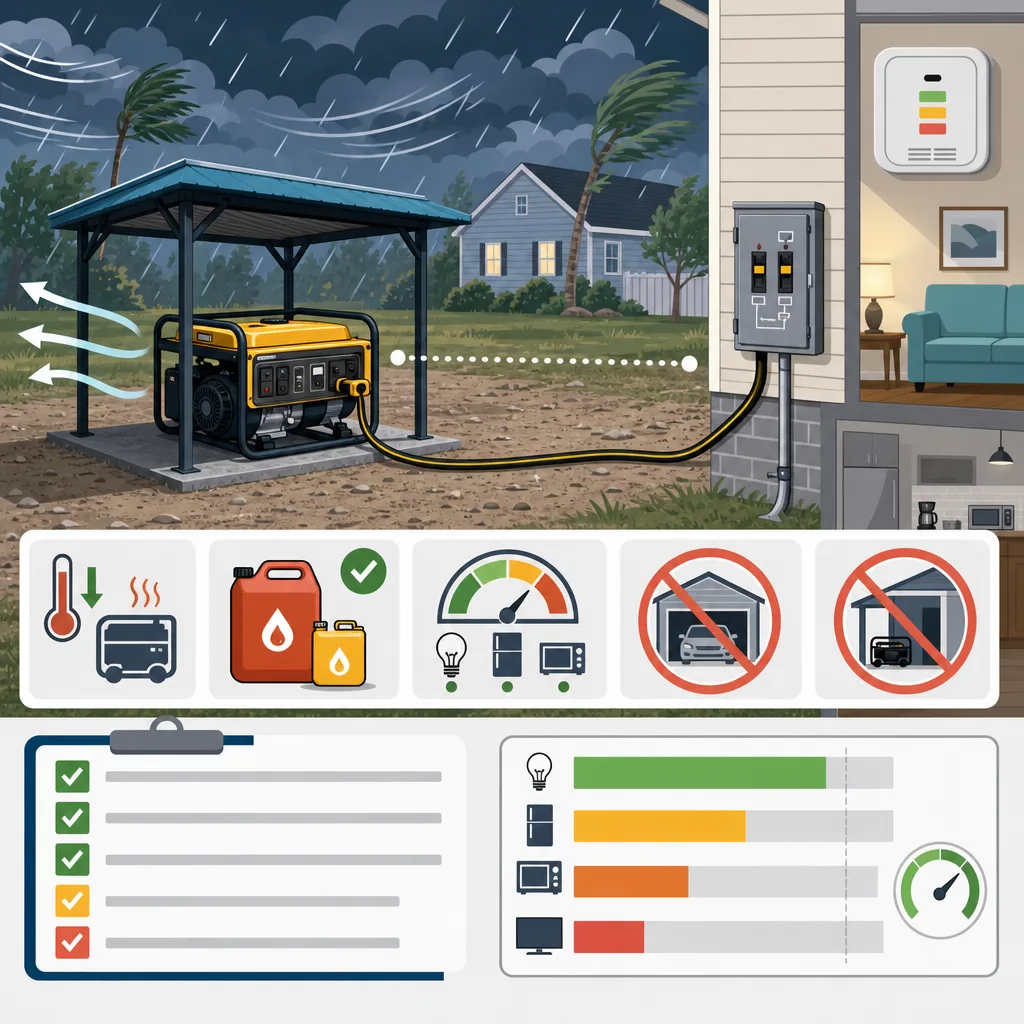
Never operate a portable fuel-powered generator indoors, in a garage, or on a covered patio. Following U.S. public agency guidelines, place it outdoors at least 20 feet from the home and any openings. Before operation, check carbon monoxide alarms, weather protection, cord capacity, the transfer switch, and fuel status.
- Check the manufacturer's manual and local regulations, and prepare the generator, fuel, alarms, and properly rated cords before an outage.
- Place the generator in an open outdoor area at least 20 feet from the home, with the exhaust facing away from all building doors, windows, and vents.
- Use an open-sided rain cover designed for generators, verify the proper placement of carbon monoxide alarms in the manufacturer's instructions, and test them.
- Connect appliances directly using properly rated outdoor extension cords, or use an inlet and transfer switch installed by a qualified electrician.
- Continuously monitor the load and fuel status. Before refueling, turn off the generator and let it cool completely, then inspect and store it after the outage ends.
If a hurricane-related power outage is expected, do not wait until after starting the generator to decide where to put it. Before the storm arrives, determine a safe operating location and connection method. This procedure is intended for households using portable generators that burn gasoline, propane, or other fuels. Safe installation and purchasing parts may become difficult after high winds, flooding, and outages begin, so prepare in advance.
In the United States, first consult generator and carbon monoxide guidance from the EPA, CDC, and CPSC, along with the generator manufacturer’s manual. Confirm electrical connection work with the local permitting authority and a qualified electrician. If the minimum distance specified by a public agency differs from the clearance required by the manufacturer, it is safer to apply the stricter requirement.
1. Prepare the Equipment and Installation Location Before an Outage
Prepare the following before a hurricane warning is issued.
- Generator owner’s manual and rated-output chart
- List of the starting and running wattage of necessary appliances
- Outdoor-rated three-wire grounded extension cords or a properly installed generator inlet and transfer switch
- An open-sided rain cover designed for generator operation
- Battery-powered or battery-backup carbon monoxide alarms
- Approved fuel containers, a fire extinguisher, and flashlights
- Engine oil, spark plugs, and other consumables specified by the manufacturer
When test-running the generator, use the same outdoor location that you would use during an actual outage. Fuel type, oil level, starting procedure, grounding, and neutral configuration vary by model, so the manual for that specific model takes precedence over general online advice.
Reduce Your Power-Use List First
Begin by listing essential loads such as refrigerators, medical devices, communications equipment, and lights. Connecting appliances with high running and starting wattage, such as air conditioners, electric water heaters, and electric ranges, at the same time may cause an overload.
Check each appliance’s nameplate or manual for its wattage or amperage. For motor-driven equipment with a separately listed starting wattage, include that value as well. If the calculation is uncertain, reduce the load further rather than continuously operating the generator at its maximum output.
2. Place It Outdoors in an Open Area at Least 20 Feet Away
The EPA and CPSC advise operating fuel-powered portable generators outdoors at least 20 feet, approximately 6.1 meters, from the home, with the exhaust directed away from the building. Measuring the distance involves more than simply moving the generator away from one window of your home.
Check all of the following.
- Check the distance from the generator to your home and neighboring buildings.
- Locate doors, windows, garage doors, soffit vents, bathroom exhaust vents, dryer vents, and HVAC outdoor-air intakes.
- Position the exhaust outlet so that it points away from all buildings and openings.
- Choose firm, level ground that will not flood.
- Avoid fences, walls, shrubs, outdoor HVAC units, and other objects that obstruct exhaust and cooling airflow.
- Also apply the side and overhead clearances specified by the manufacturer and all local fire and building codes.
If you cannot maintain a distance of 20 feet or the exhaust may enter a neighbor’s home, do not operate the generator at that location. A shorter distance, a fan, or an open window cannot substitute for safe outdoor placement.
Locations Where Operation Is Prohibited
| Location | Use | Reason |
|---|---|---|
| Indoors, including living rooms, basements, and sheds | Prohibited | Carbon monoxide can accumulate rapidly |
| Garage with the door open | Prohibited | Even with the door open, exhaust can collect near the ceiling and enter the home |
| Roofed terrace, veranda, or porch | Prohibited in principle | A roof, walls, or railings can trap exhaust or redirect it indoors |
| Apartment balcony | Prohibited | It is too close to openings in your own unit and in units above, below, and beside it |
| Directly below a window or near an outdoor-air intake | Prohibited | Exhaust can enter the building directly |
| Location where water can collect or flooding may occur | Prohibited | Risk of electric shock, short circuits, and engine damage |
| Open outdoor area with sufficient separation | Conditionally permitted | All distance, exhaust direction, rain protection, ground, and manufacturer requirements must be met |
Do not select a terrace simply because its roof provides protection from rain. Generator exhaust contains carbon monoxide, which is difficult to detect by smell or color, and it can accumulate even in partially open areas due to roofs, walls, and wind.
3. Keep Out Rain Without Trapping Exhaust
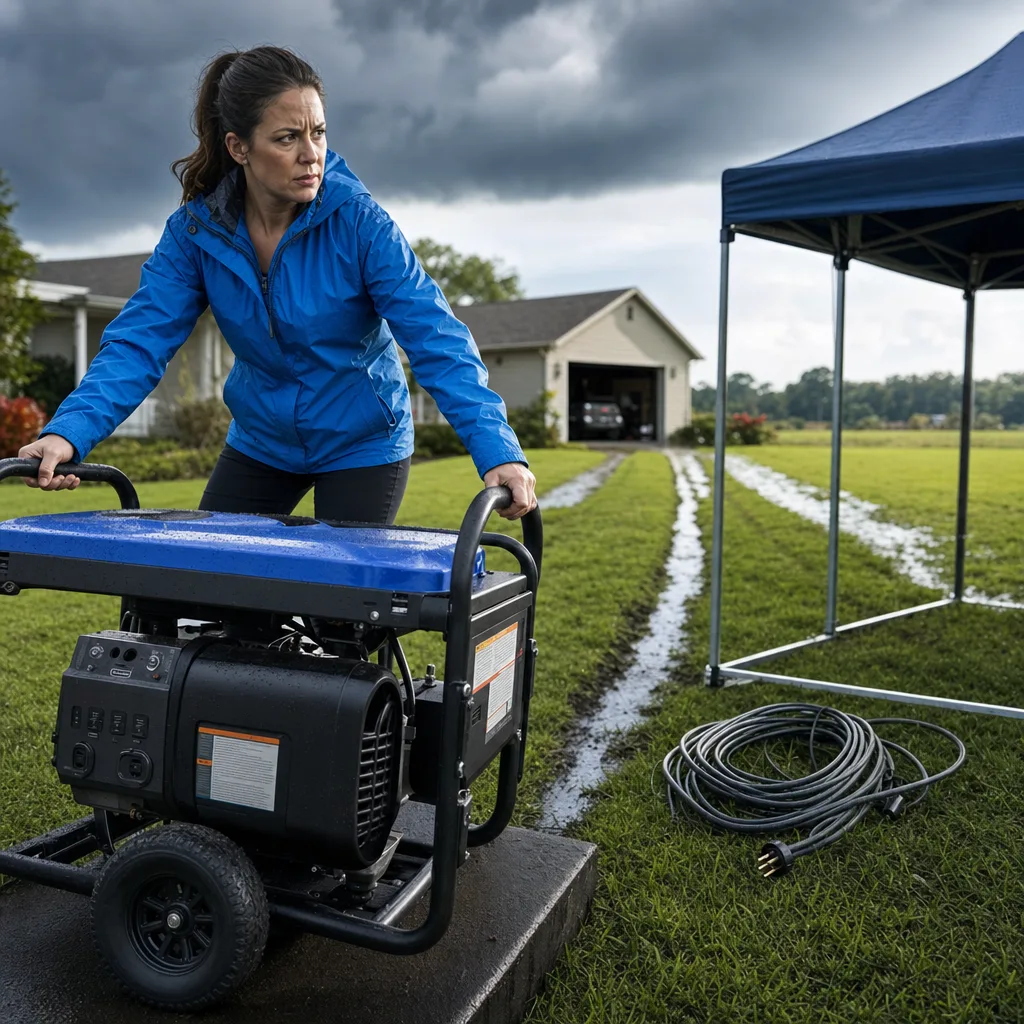
Operating a generator while it is exposed to rain or wet ground increases the risk of electric shock. However, wrapping the generator in a tarp or enclosing it in a box for waterproofing traps exhaust and heat, creating risks of carbon monoxide poisoning, fire, and overheating.
A safe rain-protection device must meet all of the following conditions.
- Be designed for generator operation or approved by the manufacturer
- Not block the exhaust outlet, engine cooling vents, or air intake
- Have sufficiently open sides to allow exhaust to escape freely
- Prevent contact between the hot muffler and combustible materials
- Be secured so that it does not blow away in high winds or collapse onto the generator
- Protect power connections and plugs from water
- Maintain the overhead and side clearances required by the manufacturer
Do not place a tarp directly over the generator or put it in a small shed, tent, or plastic box. If you do not have a dedicated rain-protection method that maintains safe distance and ventilation, the general rule is not to operate the generator while it is raining. Do not touch plugs or controls when the generator or your hands are wet.
4. Test the Carbon Monoxide Alarms
Carbon monoxide alarms are still required even when the generator is in a safe location. Wind direction can change, or exhaust may enter through an unexpected opening.
- Check the manufacturer’s instructions for alarm placement.
- In particular, check the manufacturer’s instructions for placement requirements near sleeping areas.
- Follow the alarm manufacturer’s instructions for wall or ceiling placement and clearance from kitchens and bathrooms.
- Use battery-powered or battery-backup alarms so they continue operating during an outage.
- Before the storm, check the test button, battery status, and expiration or replacement date.
- Do not rely solely on the alarm’s display or app; test whether the audible alarm actually works.
Do not omit household alarms even if the generator has an automatic carbon monoxide shutoff feature. Automatic shutoff is a supplementary safeguard that responds to a specific concentration near the unit; it cannot monitor every situation in which exhaust enters the home.
If an Alarm Sounds or Symptoms Appear
Headache, dizziness, nausea, weakness, chest pain, and confusion may be symptoms of carbon monoxide exposure. If an alarm sounds or these symptoms occur, do not remain behind to check the generator. Immediately move all people and pets to fresh air. In the United States, call the emergency number officially designated by local authorities or contact the local fire department, and do not reenter the building until it has been declared safe.
5. Connect Safely With Extension Cords or a Transfer Switch
When Connecting Appliances Directly With Extension Cords
Check extension cords against the following criteria.
- Rated for outdoor use
- Three-wire cord with a grounding pin
- Wire gauge appropriate for the voltage, current, wattage, and cord length of the connected load
- No damage to the insulation, plug, or grounding pin
- Meets the grounding and GFCI requirements specified by the generator manufacturer
- Routed away from puddles, doorways, vehicle paths, and sharp edges
Longer or thinner cords can cause greater voltage drop and overheating. Do not daisy-chain multiple household power strips and extension cords. Fully unwind cord reels as directed by the manufacturer to prevent overheating.
When Supplying Power to Home Wiring
Never backfeed generator power through a wall outlet, dryer outlet, or improvised cable. This can energize utility lines and electrocute workers, as well as cause a house fire and damage the generator.
Connecting to home circuits requires the following equipment.
- Exterior generator inlet
- Transfer switch or approved interlock device suitable for the generator rating and home wiring
- Circuit breakers and wiring that comply with local electrical codes
- Required permits and inspections
Have the system designed and installed by a qualified electrician. The generator’s neutral bonding configuration, the need for a grounding electrode, and GFCI compatibility depend on the generator model and transfer equipment design. Do not arbitrarily add a ground rod or modify the neutral connection.
6. Manage Starting, Loads, and Fuel in Order
The basic sequence is as follows, but follow the manufacturer’s manual for detailed procedures.
- Place the generator in a safe location and check the oil, fuel, and unit for damage.
- Start it with all connected loads and the generator’s output circuit breaker turned off.
- Allow it to run steadily for the amount of time specified by the manufacturer.
- Connect necessary appliances one at a time in order of priority.
- Periodically check for overload warnings, abnormal vibration, fuel leaks, and hot cords.
- When shutting down, disconnect or turn off the loads, then stop the generator according to the manufacturer’s procedure.
Refueling and Fuel Storage
- Do not add fuel to a running or hot generator.
- Before refueling, turn off the engine and allow it to cool for the amount of time required by the manufacturer.
- Store fuel in approved containers in a ventilated location away from living spaces and ignition sources.
- If the garage is attached to the home, check local fire codes regarding gasoline storage.
- Keep propane cylinders upright outdoors, and inspect hoses and connections according to the manufacturer’s instructions.
- Keep children and pets away from the generator, hot muffler, and fuel.
7. Recheck Neighbors, Wind Direction, and Flood Paths
Generator guidance often emphasizes only the distance from your own home, but in densely populated residential areas, air intake paths of neighboring units must receive equal attention. Even if the generator is 20 feet from your home, it is not in a safe location if it is close to a neighbor’s window, a shared hallway, an underground parking garage entrance, or a building HVAC intake.
Also consider the following environmental changes.
- If the wind direction changes, exhaust may be redirected toward your home or a neighboring building.
- Low-lying terrain, passages between walls, and courtyards can allow exhaust to stagnate.
- Drainage channels and slopes may direct water beneath the generator during heavy rain.
- Adding a fence or sound barrier can change cooling and exhaust airflow.
- Moving the generator closer to a wall to reduce noise can eliminate the required safety distance.
During operation, periodically recheck the location, wind direction, standing water, cords, and cover. Do not leave the generator running unattended while you sleep or while the home is unoccupied for an extended period. Follow the manufacturer’s monitoring and operating-time instructions.
8. Shut Down, Maintain, and Store It After the Outage
Do not move a hot generator into a shed immediately after utility power is restored.
- Turn off and disconnect loads one at a time.
- Follow the manufacturer’s procedure for no-load operation or cooling before shutdown.
- Leave the generator in a safe outdoor area until the engine and muffler have cooled completely.
- Inspect for fluid leaks, damaged cords, loose fasteners, and wet components.
- Follow the manual for fuel treatment and oil changes before long-term storage.
- Store fuel and the generator away from flames, ignition sources, and living spaces.
- Replenish used fuel, oil, alarm batteries, and consumables.
Recording test-run dates, maintenance history, and fuel replacement dates before the next hurricane season can reduce equipment failures and overlooked items during an actual outage.
Quick Final Checklist
| Item | Acceptance Criteria |
|---|---|
| Installation location | Open outdoor area, not indoors, in a garage, or on a terrace |
| Distance | At least 20 feet from the home; apply stricter manufacturer or local requirements |
| Exhaust direction | Away from all openings in your home and neighboring buildings |
| Ground | Firm, level, and not subject to flooding |
| Rain protection | Open-sided cover designed for operation; exhaust and cooling vents must not be blocked |
| CO alarms | On every floor and near sleeping areas, with battery backup and testing completed |
| Cords | Outdoor-rated three-wire cords, properly sized for rating and length, with no damage |
| Home connection | Use an inlet and transfer switch; improvised backfeeding is prohibited |
| Load | Within the rated capacity, including starting wattage; connect essential appliances first |
| Fuel | Use approved containers; shut down and cool before refueling; keep away from ignition sources |
| Surroundings | Check neighboring openings, wind direction, drainage, and access by children and pets |
FAQ
Can I run a portable generator on a covered terrace?
As a rule, you should not. A terrace with a roof, walls, or railings can trap exhaust fumes or allow them to flow back indoors through doors and windows. Place the generator in an open outdoor area at least 20 feet from the home, with the exhaust directed away from all openings in any building.
Can I use a generator in the garage if the garage door is fully open?
No. Even with the garage door open, carbon monoxide can accumulate near the ceiling or enter the home through a connecting door. Do not run a fuel-powered generator inside a garage, whether it is attached or detached.
Exactly how far should a generator be from the house?
The EPA and CPSC recommend outdoor use at least 20 feet, approximately 6.1 meters, from the home. You must also follow the manufacturer's required side and overhead clearances and local regulations, and point the exhaust away from doors, windows, vents, and neighboring buildings.
If I cannot maintain a distance of 20 feet, can I use it at a shorter distance?
If you cannot maintain a safe distance, do not run it at that location. Closing windows or using a fan to push the exhaust away is not an alternative. Consider a safer location, battery storage, or another emergency power option.
Can I cover the generator with a tarp when it rains?
Placing a tarp directly over the generator can block exhaust and cooling, creating risks of carbon monoxide, overheating, and fire. Use an open-sided rain cover permitted by the manufacturer or designed for operating a generator, and do not run the generator if you cannot provide safe protection from rain.
Where should carbon monoxide alarms be installed?
Check the alarm manufacturer's instructions for specific installation locations inside the home. Follow the product manual for the exact placement on a wall or ceiling. Use battery-powered alarms or alarms with battery backup so they work during a power outage, and check the test button and replacement date before a storm.
If the generator has an automatic CO shutoff feature, do I still need indoor alarms?
Indoor alarms are still necessary. The generator's automatic shutoff sensor is an auxiliary feature that monitors the area around the unit and cannot be assumed to detect carbon monoxide at every location after it is carried by the wind into the house.
Can I plug the generator into a wall outlet to power the entire house?
Never do this. Backfeeding power through a wall outlet or dryer outlet can create dangerous voltage in external power lines and the home's wiring. To supply power to home circuits, use a generator inlet and transfer switch installed by a qualified electrician, or a device approved under local regulations.
Can I use a standard household extension cord with a generator?
Use only a grounded outdoor extension cord that is rated for the connected load and length, as confirmed in the generator manual or by an electrician. Discard cords with damaged insulation or grounding pins, and do not daisy-chain multiple power strips and thin extension cords. If you do not know the required wire gauge, check the generator manual or consult an electrician.
Can I refuel the generator while it is running?
No. Turn off the generator and refuel it only after the hot engine and muffler have cooled sufficiently. Spilled fuel or vapors can cause a fire if they come into contact with hot parts.
Is it safe for the generator exhaust to point toward a neighbor's house as long as it is far from my own house?
No. Distance and exhaust direction must be assessed in relation not only to your own home but also to the doors, windows, and vents of neighboring buildings and to shared spaces. If you cannot ensure a safe direction, do not run it at that location.
Sources
Images