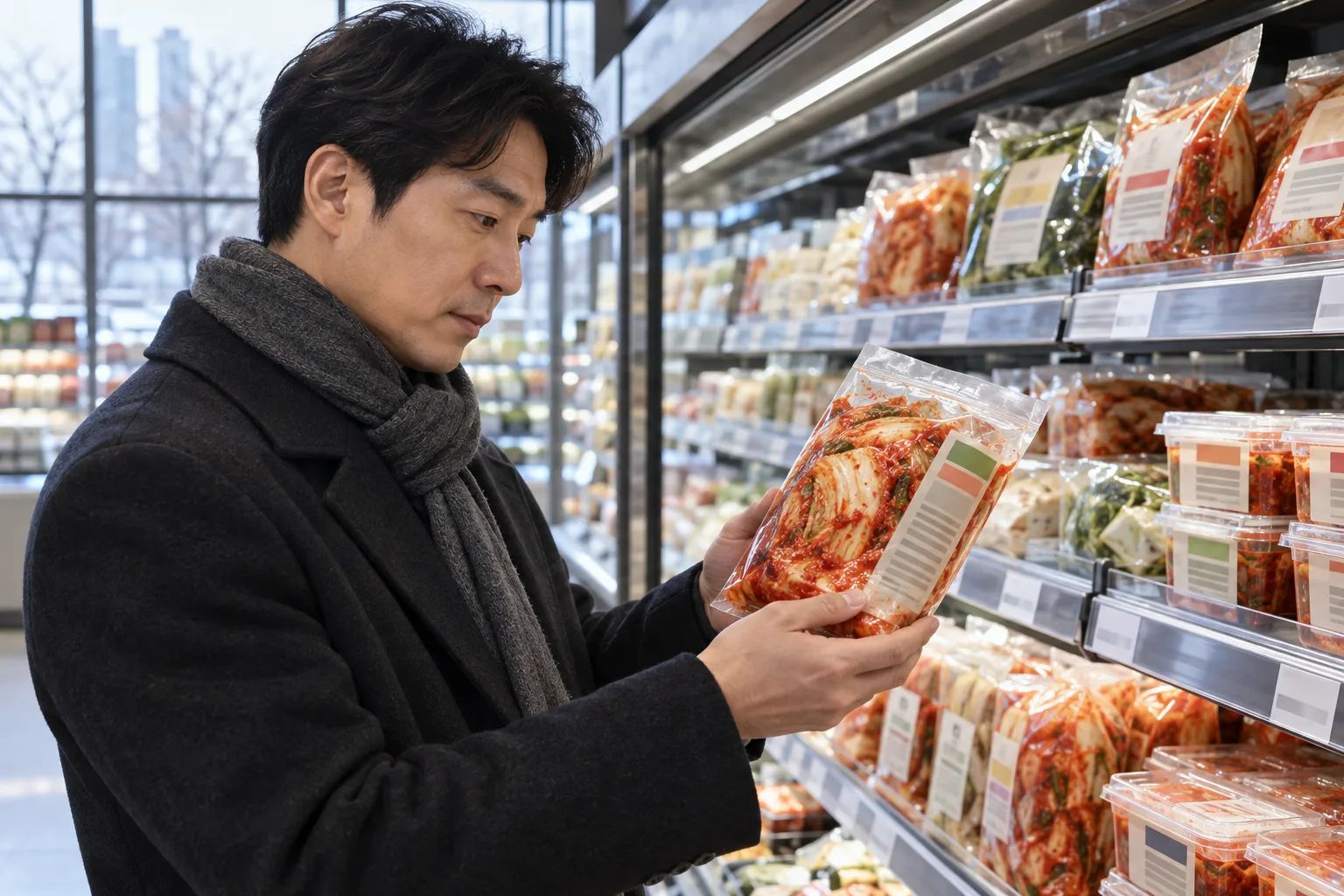
Napa Cabbage Kimchi: Packaged and Restaurant Origin Labels
For kimchi made in Korea, the ingredients requiring origin labels depend on whether chili powder is used. Restaurants must label the origins of napa cabbage and chili powder in napa cabbage kimchi, and the place of manufacture must be distinguished from the origins of the ingredients.
- Kimchi made in Korea with chili powder must list the origins of the top two ingredients excluding chili powder and salt, as well as the origins of the chili powder and salt.
- Kimchi made in Korea without chili powder must list the origins of the top two ingredients excluding salt, as well as the origin of the salt.
- Restaurants must label the origins of napa cabbage and chili powder in napa cabbage kimchi.
- For agricultural product origin labeling, "Korean origin" and "domestic origin" can be used interchangeably.
- A description stating that a product is made in Korea does not by itself mean that all its ingredients are of Korean origin.
Origin labeling standards for napa cabbage kimchi differ between domestically made packaged products and restaurants. For packaged products, check the ingredients selected by their proportions, as well as red pepper powder and salt. At restaurants, napa cabbage and red pepper powder are subject to labeling.
The latest labeling standards are available under “Origin Labeling Management” from the National Agricultural Products Quality Management Service. (Verified details: Domestically made kimchi products that use red pepper powder must label the top 2 ingredients, red pepper powder, and salt. Those without red pepper powder must label the top 2 ingredients and salt. Pickled products must label the top 2 ingredients excluding salt, along with salt. · Source: naqs.go.kr · Checked 2026-10-23)
The difference between ingredient origins and manufacturing locations
An ingredient’s origin is different from the location of the factory that makes the kimchi. The napa cabbage may be grown somewhere other than where the kimchi is made. A manufacturer’s domestic address alone therefore cannot establish the origins of the ingredients.
Refers to the country, region, or waters where agricultural or fishery products were produced, gathered, or caught.
This is the definition given in “Origin Labeling Management” by the National Agricultural Products Quality Management Service. “Korean” and “domestic” have the same meaning in agricultural origin labeling. “Domestic” does not mean that imported ingredients were processed domestically. National Agricultural Products Quality Management Service: Origin Labeling Management
Comparing origin checks for packaged kimchi
For domestically made products, first distinguish between kimchi products and pickled products. For kimchi products, the ingredients subject to labeling depend on whether red pepper powder is used. The following standards do not apply unchanged to imported finished products.
| Type of domestically made product | Ingredients selected by proportion | Ingredients labeled separately |
|---|---|---|
| Kimchi products made with red pepper powder | Top 2 ingredients, excluding red pepper powder and salt | Red pepper powder and salt |
| Kimchi products made without red pepper powder | Top 2 ingredients, excluding salt | Salt |
| Pickled products | Top 2 ingredients, excluding salt | Salt |
Pickled products have an exception based on ingredient proportions. If one ingredient other than salt accounts for at least 98%, that ingredient and salt must be labeled. Kimchi made with processed products containing red pepper powder also requires checking the red pepper powder’s origin. Questions and Answers on Agricultural and Food Origin Labeling
What do the top 2 ingredients mean?
The top 2 ingredients do not mean only the second ingredient. They mean the first and second ingredients after the specified exclusions. Water, food additives, ethyl alcohol, sugars, and similar ingredients are excluded from both the ranking by proportion and the labeling requirements.
Whether the origin of salt in kimchi must be labeled does not depend only on salt’s ranking by proportion. Salt is subject to separate labeling in kimchi products. Reading only the labels for napa cabbage and red pepper powder may cause you to miss an item you need to check. National Agricultural Products Quality Management Service: Label Content Guide
Origin checks for kimchi at restaurants
For napa cabbage kimchi served at restaurants, napa cabbage and red pepper powder are subject to labeling. The salt labeling standards for packaged processed products do not apply unchanged to menus. Restaurant origin labeling guidance also distinguishes between these two ingredients. National Agricultural Products Quality Management Service: Restaurant Origin Labeling Guide
| Category | Information to check | Points to note when interpreting labels |
|---|---|---|
| Domestically made kimchi | The respective origins of napa cabbage and red pepper powder | Do not assume that both ingredients have the same origin |
| Imported finished kimchi products | The origin of the imported finished product | The origin stated on the packaging may be used |
| Processed or cooked dishes, such as kimchi stew | The origin of the napa cabbage kimchi used | Labeling is not required only for kimchi served as a side dish |
For finished products processed abroad, the origin stated on the packaging may be used. This differs from ingredient-by-ingredient labeling for domestically made products. Enforcement Rule of the Act on Origin Labeling of Agricultural and Fishery Products: Labeling Methods
Processed products containing kimchi are also subject to labeling when cooked and served. The Ministry of Government Legislation interpreted the rules as also covering kimchi contained in retort-packaged kimchi stew. This interpretation was issued on December 31, 2013. Ministry of Government Legislation: Legal Interpretation 13-0341
How to read package labels
Read package labels by connecting the product category with the origin of each ingredient. Kimchi made by salting and seasoning napa cabbage is not the same finished product as salted napa cabbage. The number of whole cabbages or the weight sold alone cannot determine which ingredients must be labeled.
- Distinguish between domestically made products and imported finished products.
- Check whether the product’s food category is kimchi products or pickled products.
- For kimchi products, check whether red pepper powder is used.
- Read each ingredient subject to labeling together with its origin in the ingredient list.
- Check the manufacturer’s address and ingredient origins as separate pieces of information.
As a rule, origin information must be printed directly in the ingredient list section. Stickers, adhesive labels, and similar methods are also allowed. Reading the entire labeling section is more accurate than relying only on the product description on the front. National Agricultural Products Quality Management Service: Packaging Labeling Methods
Common mistakes and what labels establish
Origin labels tell you where the listed ingredients come from. Knowing that napa cabbage is domestic does not tell you the origins of the other ingredients. This distinction is also necessary when reading packaged product labels alongside restaurant labels.
| Common interpretation | Correct interpretation |
|---|---|
| It was made in a domestic factory, so all the ingredients are domestic | The manufacturing location and ingredient origins are separate |
| If the napa cabbage is domestic, the red pepper powder is domestic too | The origin of each ingredient must be checked |
| Only the top 2 ingredients are labeled, so there is no need to check salt | Salt in domestically made kimchi products is subject to separate labeling |
| If a restaurant does not show the origin of salt, its labeling is incomplete | Restaurant labeling for napa cabbage kimchi covers napa cabbage and red pepper powder |
The list of ingredients subject to mandatory origin labeling must also be distinguished from the full ingredient list. Origin information for some ingredients should not be extended to all ingredients. Keep this in mind when applying the labeling standards above to actual products.
The scope of information on kimjang timing
The 2025 survey of kimjang intentions does not establish a start date for kimjang in 2026. The Korea Rural Economic Institute released the related report on November 7, 2025. At that time, intended kimjang dates were concentrated between mid-November and early December. 2025 Consumer Intentions for Kimjang and Supply Outlook for Major Vegetables
This survey explains the seasonal background to preparing for kimjang purchases. It is difficult to use it as a basis for setting a particular household’s kimjang date. The origin labeling standards also contain no purchase deadline that applies only during the kimjang season.
Frequently asked questions
Is the origin of salt labeled on white kimchi too?
Domestically made kimchi products without red pepper powder are also subject to salt labeling. Check the top 2 ingredients excluding salt as well.
For salted napa cabbage, is checking the cabbage’s origin enough?
For domestically made pickled products, salt must also be checked. Salt labeling is still required under the exception for products in which one ingredient accounts for at least 98%.
Does this also apply to kimchi made at the restaurant?
Making kimchi at the restaurant does not exempt it from origin labeling. The standard requiring separate identification of the origins of napa cabbage and red pepper powder applies.
Does a domestic napa cabbage label mean that all ingredients are domestic?
The label describes only the origin of the napa cabbage. It does not establish the origins of other ingredients, such as red pepper powder and salt.
FAQ
Which ingredients in domestically manufactured kimchi products must have their country of origin labeled?
Products containing chili powder must list the top 2 ingredients, excluding chili powder and salt. Chili powder and salt must also be listed separately.
Does "top 2 ingredients" mean only the second ingredient?
It means both the first and second ingredients. You must first identify which ingredients are excluded when ranking ingredients by their proportions.
Does kimchi without chili powder also require country-of-origin labeling?
Domestically manufactured kimchi products must list the top 2 ingredients excluding salt, as well as salt.
What is the 98% exception for pickled products?
It applies when a single ingredient accounts for at least 98% of the ingredients excluding salt. In this case, the country of origin of that ingredient and salt must be listed.
Must the country of origin of salt also be listed on restaurant menus?
For napa cabbage kimchi served in restaurants, the ingredients subject to labeling are napa cabbage and chili powder. The salt labeling standards for domestically manufactured packaged products do not apply in the same way.
How should restaurants label imported finished kimchi products?
If a finished product processed abroad is purchased and used, the country of origin shown on the packaging may be listed.
Is the kimchi used in kimchi stew also subject to labeling?
It is. Even when processed foods such as retort-packaged kimchi stew are prepared and served, the country of origin of the napa cabbage kimchi they contain must be listed.
Do "domestic" and "domestically produced" mean different things?
They can be used with the same meaning in country-of-origin labeling for agricultural products. They must be distinguished from the description "manufactured domestically."
Can the 2025 survey of kimchi-making intentions be used to decide this year's kimchi-making date?
The results of the 2025 survey cannot be taken as the start date for kimchi-making in 2026. That report describes when consumers at the time intended to make kimchi.
Sources
- National Agricultural Products Quality Management Service, country-of-origin labeling management
- Questions and answers on the country-of-origin labeling system for agricultural and food products, labeling for domestically manufactured processed products and restaurants
- National Agricultural Products Quality Management Service, guide to country-of-origin labeling in restaurants
- National Law Information Center, labeling methods under the Enforcement Rule of the Act on Origin Labeling of Agricultural and Fishery Products
- Ministry of Government Legislation, statutory interpretation 13-0341, country-of-origin labeling in restaurants for napa cabbage kimchi included in processed products
Images