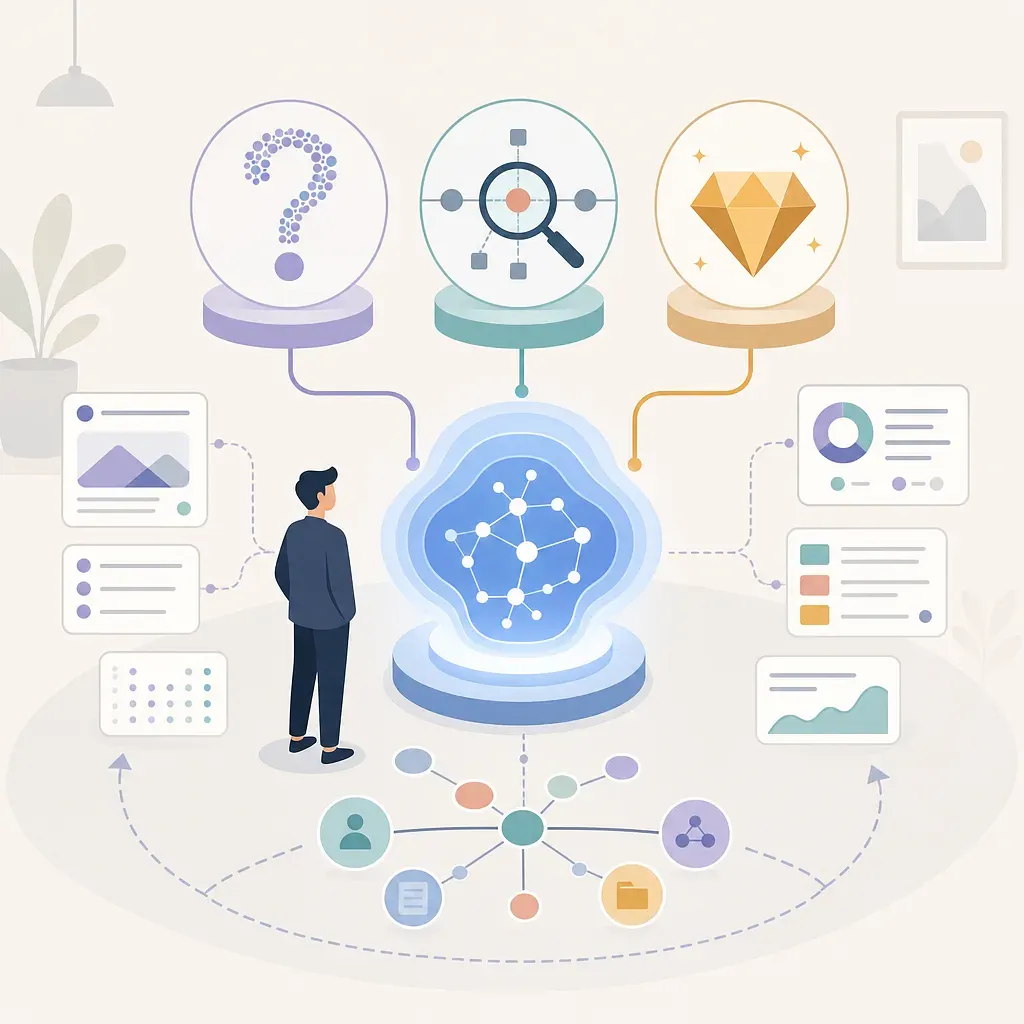
3 Skills That Will Keep People from Being Replaced in the Age of AI
In the age of AI, competitiveness does not come from simply knowing how to use tools or engaging in automated side jobs, but rather from deeply integrating AI into one’s work and accumulating unique data and judgment. In particular, the ability to formulate questions, a critical mindset, and insight that combines experience and intuition are what make one irreplaceable.
Content on AI automation and monetization can serve as a reference for understanding technological trends, but it is not a sustainable competitive advantage in and of itself.
As generative AI becomes more widespread, what sets organizations apart is not access to models, but the unique data and context that individuals and organizations possess.
While some of the coordination and reporting tasks performed by mid-level managers can be replaced by AI agents, the ability to make responsible judgments and manage people remains crucial.
In the age of AI, creativity extends beyond the ability to create something from nothing to include an aesthetic sensibility that identifies and refines the best options among those generated by AI.
An irreplaceable person is someone who possesses a refined way with words, a keen sense of social issues, and the experience and intuition gained on the ground.
Conclusion at a Glance
In the age of AI, the people who make money and survive aren’t simply those who know a lot about the latest AI tools. What’s more important is accurately defining the problems in your work, building up unique data and context that AI can utilize, and developing the discernment to evaluate the results.
YouTube and online courses are full of messages claiming that you can work just 30 minutes a day with AI and make a fortune. While some do feature real-life examples of productivity gains, a significant number are essentially just selling content that teaches how to make money with AI. Therefore, the key question is this: It’s not about what you can automate with AI, but rather which bottlenecks in your work you will solve with AI.
1. Breaking Free from the Illusion of AI Automation Profits
The Competitive Edge of Automation-Based Side Hustles Doesn’t Last Long
After generative AI became mainstream, monetization methods such as automated text generation, image generation, short video production, automated blog posting, and chatbot operation spread rapidly. However, in fields where anyone can use the same tools, competition quickly becomes overheated. If the output is low-quality or repetitive, it’s easy to be shunned by platforms, search engines, and users alike.
Google Search Central explains that mass-generated low-quality content or “scaled content abuse” intended to manipulate search rankings are subject to its spam policies. In other words, it is not the fact that AI was used that is risky, but rather the practice of mass-producing content that offers no real value to people.
AI Is Not a Side Hustle Generator, but a Productivity Engine
Sustainable revenue comes not from AI tools themselves, but from increasing the efficiency of existing work and businesses.
Approach | Short-Term Appeal | Long-Term Limitations | Better Direction
Mass-producing automated blog posts and Shorts with AI | Easy to get started | Low differentiation and difficult quality control | Producing content that includes unique experiences, data, and verification
Selling prompt collections | Can be created quickly | Vulnerable to changes in tools | Refining into templates that solve specific job or industry problems
Automating simple, repetitive tasks | Immediate time savings | Anyone can replicate it | Systematizing work by integrating with the organization’s data and processes
Integrating AI into Core Business Operations | Initial training required | Implementation can be challenging | Potential for sustainable cost savings and quality improvements
For example, a restaurant owner can use AI not only to write menu descriptions but also to analyze inventory records, seasonal sales figures, review data, and local event information to adjust order volumes and promotions. Planners can go beyond simply having AI generate summaries; they can input past proposals and examples of failed projects to improve the quality of their decision-making.
2. Your True Weapons Are Your Own Data and Insight
When Everyone Uses Powerful AI, the Difference Lies in the Data
High-performance AI services like ChatGPT, Claude, and Gemini are accessible to many people simply by paying a subscription fee. The era when access to these models alone was a scarce competitive advantage is rapidly coming to an end. Even when using the same AI, results vary because the context, data, criteria, and feedback provided by users differ.
Examples of personal and organizational data that can be provided to AI include the following:
· Past planning documents, reports, proposals, and meeting minutes
· Customer inquiries, reviews, and consultation records
· Personal notes, idea journals, and reading logs
· Root cause analysis reports for failed projects
· Work checklists and decision-making criteria
· On-site work videos, observation logs, and know-how documents
Organizing this material creates a personal wiki or organizational knowledge base. It transforms the data into an asset that is not merely stored but is searchable, summarizable, and recombinable.
Practical Ways to Create a Personal Wiki
A personal wiki doesn’t have to be a complex system. The key is to gather scattered records and organize them into a structure that AI can understand.
· Gather materials: Consolidate notes from note-taking apps, cloud documents, emails, local files, and screenshots into one place.
· Record dates and sources: You must be able to trace the basis for the AI’s summaries later on.
· Add topic tags: Keep tags simple—such as “customers,” “products,” “ideas,” “failures,” “lessons learned,” and “recurring tasks.”
· Remove sensitive information: Delete or anonymize personal information, contractual secrets, and customer identifiers.
· Create a list of questions: Prepare in advance what you want to ask the AI.
Here are some example questions:
· What are the recurring strengths and weaknesses in my proposals over the past three years?
· Which types of customer complaints are most likely to result in actual revenue loss?
· What common patterns do the tasks I frequently procrastinate on share?
· What are the differences in decision-making between successful and failed projects?
Insight: Quantifying Tacit Knowledge and Judgment Criteria
Generally, “tacit knowledge” is translated into Korean as “암묵지.” It refers to knowledge that is difficult to fully explain in writing or through manuals but is instinctively understood by skilled practitioners. The “insight” discussed here refers specifically to the sense—within tacit knowledge—that distinguishes what is good from what is awkward and determines which choices are appropriate for the situation.
For example, the following types of knowledge are difficult to express using only numbers or sentences:
· A designer’s intuition that the white space on a screen looks awkward
· A chef’s ability to judge the degree of doneness using their fingertips and sense of smell
· A salesperson’s intuition for detecting a customer’s hesitation in the flow of conversation
· An editor’s ability to recognize the rhythm of a sentence and identify points where readers might lose interest
· A field manager’s ability to intuitively sense a work workflow that could lead to an accident
While AI can learn from vast amounts of text and images, it cannot automatically acquire the on-the-ground intuition accumulated by specific organizations and individuals. Therefore, future competitiveness depends on how well we document our tacit knowledge, illustrate it with examples, and transform it into feedback data.
3. The Workplace Will Be Reorganized Around Work Units
Work Units Will Change Before Entire Occupations Do
It is difficult to conclude that AI will eliminate entire occupations. In reality, change will first occur at the level of the work units that make up a job. Tasks with a high degree of predictability—such as data research, drafting, schedule coordination, summarization, categorization, and report formatting—are highly likely to be automated quickly. On the other hand, human capabilities remain crucial for responsible decision-making, conflict resolution, on-site judgment, ethical judgment, and building trust through face-to-face interactions.
The World Economic Forum’s Future of Jobs Report 2025 predicts that technological change, the green transition, and shifts in economic structure will simultaneously create new jobs and replace existing ones. The key point is not the simple conclusion that jobs will disappear, but rather that the required skill sets are changing rapidly.
The Crisis and Redefinition of Middle Management
Middle managers have traditionally been responsible for breaking down goals into tasks, assigning them to people, monitoring progress, and reporting to upper management. Some of these tasks fall within the scope of what AI agents and automated systems can handle effectively.
Middle Management Tasks | Likelihood of AI Replacement | Value That Humans Must Retain
Scheduling and status reporting | High | Interpreting critical delay signals and determining priorities
Assigning repetitive tasks | Medium to high | Assignments that consider individual development stages and team dynamics
Compiling performance data | High | Assessing context that numbers cannot explain
Writing meeting minutes and summaries | High | Identifying the core of debates and determining accountability
Strategic decision-making | Low to medium | Judgments involving uncertainty, ethics, and accountability
Managing organizational culture | Low | Building trust, motivation, and psychological safety
Therefore, the future of middle managers is less about disappearance and more about redefinition. Roles limited to mere messengers and report managers are becoming obsolete, while “orchestrator”-type managers—who structure problems and coordinate people and AI—are becoming increasingly important.
The Value of Junior Employees Won’t Disappear, but Their Roles Will Change
As AI takes over drafting and research tasks, traditional training opportunities for new hires and junior employees may decrease. At the same time, new opportunities are emerging for junior employees. This is because the ability to quickly review an AI-generated “80-point” draft, incorporate on-the-spot feedback, and refine it by adding a sense of current trends will become increasingly important.
However, it’s difficult to assume that the value of junior staff will automatically skyrocket. The key lies in whether companies position junior staff not merely as support personnel, but as experimenters and field data collectors who work alongside AI. Junior staff, too, must grow not as people who simply submit AI-generated output as-is, but as individuals who identify errors and provide contextual context.
4. Three Competencies for Thriving in the AI Era
1) Prompting Skills: Designing Questions That Unlock AI’s Potential
A prompt is not merely a command. A good prompt includes the objective, context, constraints, criteria, examples, and output format. Since AI constructs answers based on the conditions provided by the user, ambiguous questions lead to ambiguous answers.
The components of a good prompt are as follows.
Component | Description | Example
Objective | Clearly specify what you want to achieve | Categorize the causes of customer churn into 5 categories
Context | Describe the industry, target audience, and situation | It’s a beauty subscription service targeting women in their 20s
Data | Provide data for analysis | Base your analysis on 300 reviews from the past 6 months
Criteria | Outline the criteria for a good answer | Evaluate in order of feasibility, cost, and effectiveness
Constraints | Specify conditions to avoid | Do not infer personal information, and avoid unfounded assumptions
Format | Specify the structure of the output | Organize the results into tables and prioritized lists
A bad prompt demands an answer. A good prompt designs a thought process.
2) Problem Awareness: The Sense of Turning Inconvenience into an Opportunity for Automation
People who use AI effectively are generally sensitive to inconvenience. Here, “complaints” refer not to emotional frustration but to the ability to detect problems.
· Why is this report written the same way every week?
· Why do people have to read customer inquiries from scratch every time?
· Why are the decisions and responsible parties unclear after a meeting ends?
· Why are new employee training materials always delivered only verbally?
· Why are failure cases not documented and simply forgotten?
These questions are the starting point for AI adoption. Rather than looking for technology first, you must first identify recurring inefficiencies and bottlenecks, and then determine whether AI is the right solution.
3) The Combination of Experience and Intuition: The Discerning Eye for Selecting AI Outputs
AI rapidly generates many options. However, as the number of options increases, the ability to choose becomes an even more critical skill. The discernment needed to distinguish between good results and merely plausible ones stems from a combination of experience and intuition.
If you have only experience but fail to read trends, you may become trapped in outdated judgments. Conversely, if you have only intuition but lack experience, you may make choices that seem plausible but are unfeasible. Decision-makers in the AI era must possess both.
Competency | Meaning in the Past | Meaning in the AI Era
Knowledge | Knowing a lot | A standard for verifying errors and gaps in AI responses
Experience | Having done something for a long time | The ability to know what questions to ask
Instinct | Intuitive taste | The ability to detect subtle awkwardness in AI outputs
Creativity | The ability to create something new | The ability to select valuable combinations from countless alternatives
Execution | The ability to handle things directly | The ability to integrate AI and human input to finalize results
5. An Action Checklist Individuals Can Start Right Away
Today’s Tasks
· Gather all documents and notes created over the past year into a single folder.
· List 10 recurring tasks and record the time required and frequency.
· Distinguish between tasks that are risky to delegate to AI and those that are safe to delegate.
· Save frequently used prompts and compare the quality of the results.
· Record errors in AI responses to create your own verification checklist.
This Month’s Tasks
· Create a basic classification system for your personal wiki or team knowledge base.
· Organize feedback from customers, colleagues, and users by topic.
· Choose one task and compare the time it takes before and after applying AI.
· Try converting your tacit knowledge into an explainable checklist.
· Create an evaluation rubric for AI-generated outputs.
Essential Principles
· Do not indiscriminately enter personal information or trade secrets into external AI services.
· Treat AI responses as drafts and hypotheses, and establish verification procedures for important decisions.
· For content requiring sources, provide verifiable evidence.
· Prioritize unique experiences and verified information over low-quality mass production.
· Expand the purpose of AI adoption beyond mere cost reduction to include quality improvement and faster learning.
Conclusion: AI Is Not a Magic Wand, but an Amplifier
AI is not a magic wand that automatically makes money for people who do nothing. AI is more like an engine that significantly amplifies the ability of people who are already identifying problems, accumulating data, and striving to produce better results.
Going forward, the difference will arise from something more fundamental than simply knowing the latest tools. What matters is how deeply you understand the context of your work, how well you organize your own data, whether you have the discernment to evaluate AI-generated results, and whether you have the attitude to see difficult problems through to a resolution.
The people who won’t be replaced by AI aren’t those who reject it. They are the ones who integrate AI into the structure of their work to achieve a higher level of judgment and execution.
 Injoys