Injoys
Overview
For a long time, satellites were treated as infrastructure that was “launched, operated, and then discarded once they broke down or ran out of fuel.” However, as launch costs, satellite manufacturing costs, orbital congestion, and space debris issues have grown, “in-orbit services”—which involve inspecting and repairing satellites in orbit to extend their lifespans—are emerging as a core sector of the space industry.
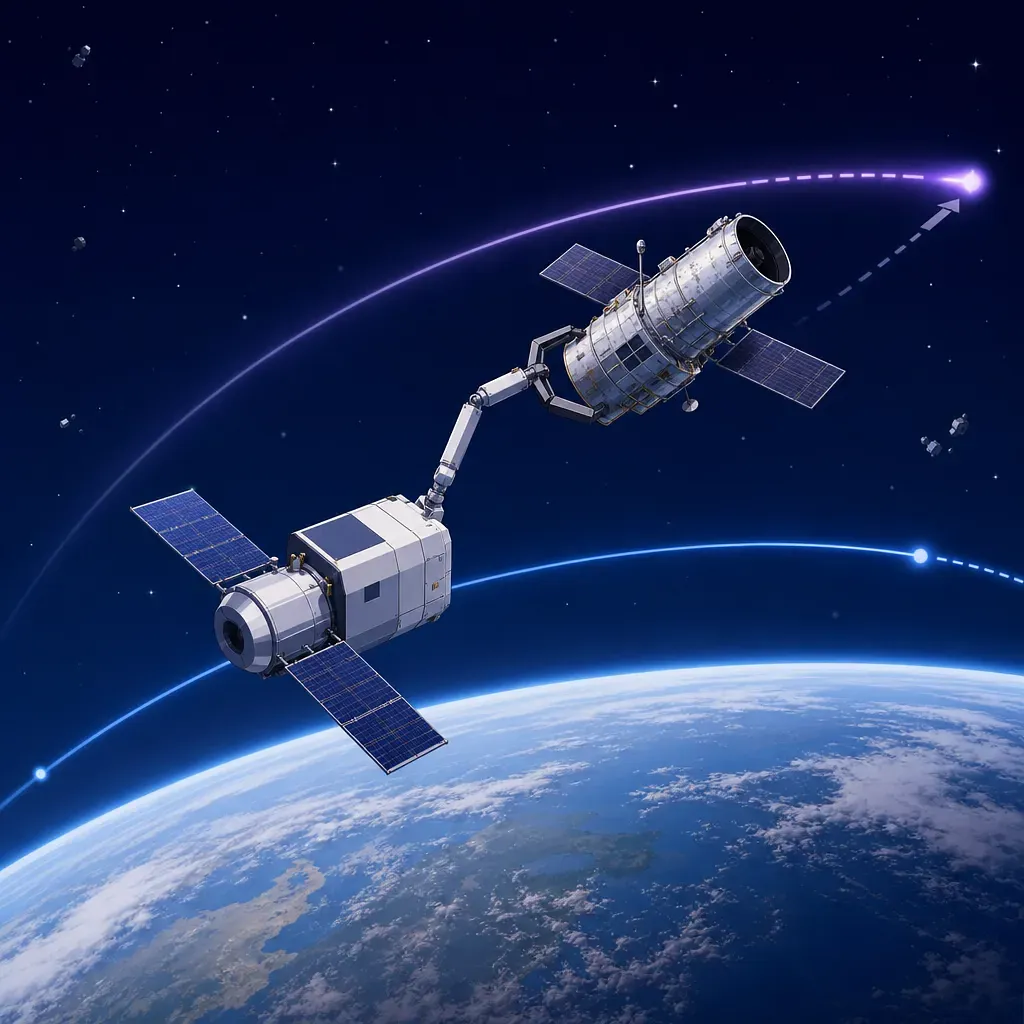
The rescue mission for the Neil Gehrels Swift Observatory, jointly conducted by NASA and the startup Katalyst and reported in July 2026, is a prime example of this shift. Swift is a gamma-ray burst observation mission launched in 2004 and is a low-Earth orbit observatory that has been accumulating scientific data over a long period. According to reports, the goal of the rescue mission is to raise Swift’s orbit as it descends, thereby delaying the risk of atmospheric reentry and extending its operational lifespan for scientific purposes.
Taking the Swift rescue mission as a starting point, this article summarizes what in-orbit services are, what technologies they require, why they are important from both an industrial and scientific data perspective, and what risks and regulations are involved.
Key Definition: What Are Orbital Services?
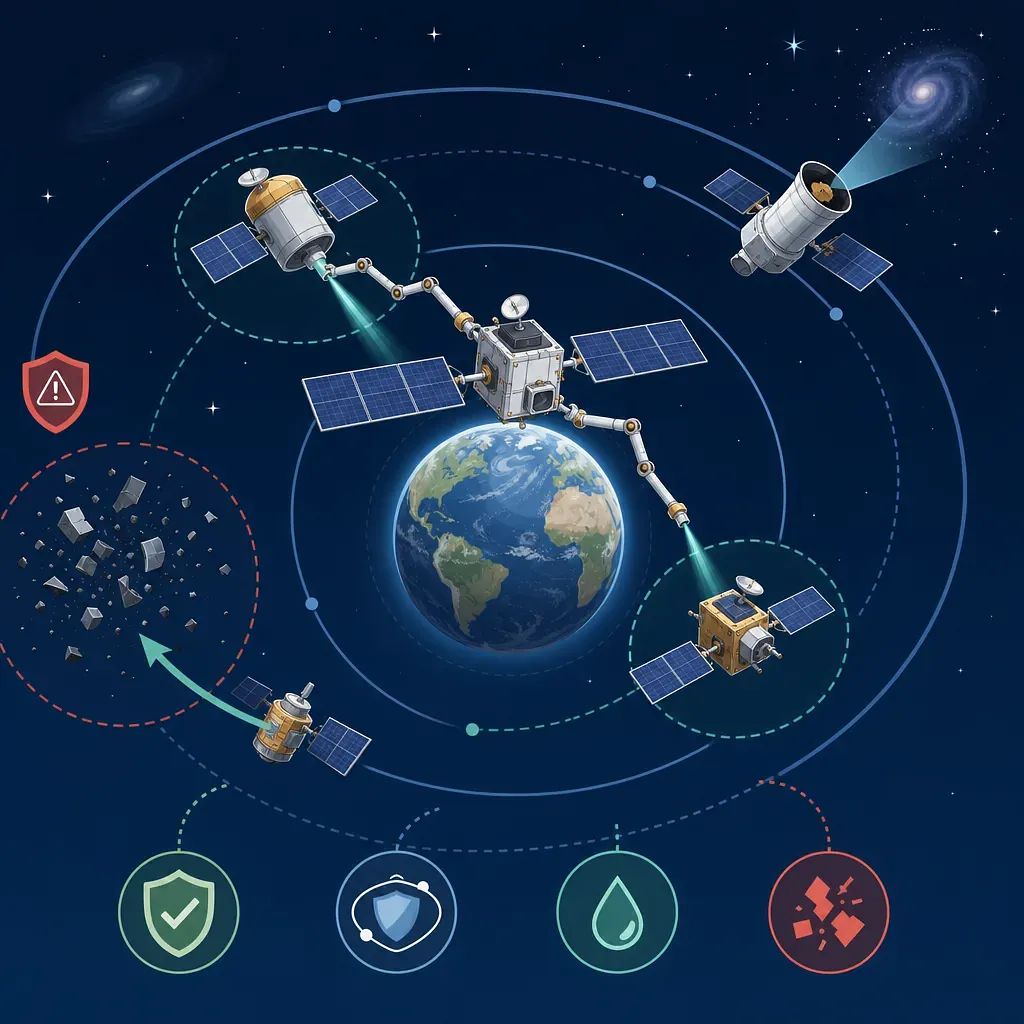
Orbital services, or on-orbit services, refer to maintenance and operational support performed in orbit on satellites, space telescopes, spacecraft, and space debris objects already in space.
Key Functions
| Function | Description | Key Value |
|---|---|---|
| Inspection | Close-range verification of satellite status using cameras and sensors | Fault diagnosis, insurance and operational decision-making |
| Rendezvous and Docking | Matching relative velocity with the target satellite and approaching/docking | Prerequisite for repairs, towing, and refueling |
| Grappling | Grasping the target using robotic arms, clamps, adapters, etc. | Capture of uncooperative satellites; support for rescue and disposal |
| Orbit Ascent and Maintenance | Raising the target satellite’s altitude using the service spacecraft’s propulsion | Life extension, reentry delay, mission continuation |
| Refueling | Transferring propellant to restore the satellite’s attitude and orbital control capabilities | Extending the operational lifespan of high-value satellites |
| Component Replacement and Repair | Replacing or calibrating batteries, sensors, modules, optical systems, etc. | Fault recovery, performance improvement |
| Active Debris Removal | Moving end-of-life satellites or debris to a safe orbit or reentry trajectory | Reducing space debris, protecting the orbital environment |
Why the Swift Rescue Mission Is Drawing Attention
The Neil Gehrels Swift Observatory is a NASA space observatory designed to observe gamma-ray bursts, supernovae, and high-energy phenomena around black holes. A long-term observatory is not merely a piece of equipment but a data asset that accumulates over time. Prolonged observations with the same equipment enhance the reliability of analyses regarding changes in astronomical phenomena, explosion frequencies, the connectivity of follow-up observations, and long-term trends.
There are three reasons why the Swift rescue mission is important.
- Extending the Lifespan of Scientific Instruments: Building and launching new observatories requires significant time and expense. If existing instruments continue to produce valid data, simply raising their orbit can preserve substantial scientific value.
- Validating the Difficulty of Low-Earth Orbit Services: Low-Earth orbit satellites can continue to lose altitude due to atmospheric drag. The ability to safely approach and capture a fast-moving target to raise its orbit lays the foundation for future satellite rescue and decommissioning missions.
- Public-Private Partnership Model: When public agencies such as NASA utilize service spacecraft from private startups, government science missions and the commercial space services market can grow in tandem.
Key Technologies: Essential Elements for Swift-Type Rescue Missions
1. Precise Orbit Prediction and Rendezvous
Service spacecraft must precisely calculate the target satellite’s position, velocity, attitude, and rotation. The difficulty increases significantly if the target lacks a service docking port or cannot provide cooperative communications.
The required technologies are as follows:
- Relative navigation: Estimating relative position using radar, LiDAR, optical cameras, star trackers, etc.
- Automatic approach control: Reducing relative velocity with the target while maintaining a collision-avoidance zone
- Emergency disengagement procedures: Immediate separation in the event of unexpected rotation of the target satellite, communication delays, or sensor failures
2. Robotic Arms and Grappling
Not all satellites are designed with repair in mind. Older satellites may lack standard docking adapters. In such cases, the service spacecraft must stabilize the target using robotic arms, clamps, capture devices, or the satellite’s own structural components.
The risks are significant. Improper handling could damage solar panels, antennas, or scientific equipment, and could also generate space debris.
3. Orbit Elevation and Propellant Management
In rescue missions like Swift, the key objective is to safely elevate the target’s orbit. The service spacecraft must calculate the required delta-v based on the combined mass of itself and the target satellite, and control the rotational forces and vibrations generated during propulsion.
4. Risk Management and Liability
While successful in-orbit services increase asset value, failure can result in collisions, debris, and mission loss. Therefore, the following criteria are critical during all pre-mission phases:
- Access permissions and the scope of responsibility for the operating entity
- Collision-avoidance procedures and independent verification
- Accurate data sharing on the target satellite’s status
- Safe orbit or separation procedures in the event of failure
- Compliance with international and domestic regulations, including space object registration, liability agreements, and frequency and operating licenses
How Is the Existing “Launch-and-Discard” Model Changing?
The traditional satellite business model has largely involved manufacturing and launching satellites, then replacing them with new ones once their design lifespans end. Orbital services are transforming this model in three key ways.
| Existing Model | Orbital Service Model | Implications of the Change |
|---|---|---|
| Mission termination upon failure | Failure diagnosis and repair possible | Increased recovery value of satellites |
| Disposal upon fuel depletion | Fuel replenishment or external propulsion support | Extended revenue period for high-value satellites |
| Focus on design life | Operation based on actual condition | More sophisticated asset management |
| Increase in space debris | Support for orbital transfer and reentry | Improved sustainability of the orbital environment |
| Reliance on new launches | Reuse of existing infrastructure | Reduced costs, time, and risk of launch failure |
In other words, satellites are transforming from single-use equipment into “operational infrastructure assets.” This marks an extension into space of the same mindset used to maintain and prolong the service life of aircraft on the ground.
Major In-Orbit Service Missions and Industry Examples
The table below presents representative examples to help understand the evolution of in-orbit services. Some involve crewed maintenance, some are robotic demonstrations, and others are commercial mission life extensions.
| Year | Mission/Operator | Target | Method | Results/Significance |
|---|---|---|---|---|
| 1993–2009 | NASA Hubble Space Telescope servicing missions | Hubble Space Telescope | Maintenance by the Space Shuttle and astronauts | Optical calibration, equipment replacement, and mission life extension. A prime example of successful in-orbit maintenance |
| 1997–1999 | Japan’s ETS-VII | Experimental satellite | Automatic rendezvous and docking, robotic arm experiments | Demonstration of autonomous docking and space robotics operation technologies |
| 2007 | DARPA Orbital Express | ASTRO·NEXTSat | Automatic docking, refueling, and component replacement | Demonstration of core technologies for unmanned orbital servicing |
| 2020 | Northrop Grumman MEV-1 | Intelsat 901 | GEO Communications Satellite Docking and Lifespan Extension | A leading example of commercial satellite lifespan extension services |
| 2021 | Northrop Grumman MEV-2 | Intelsat 10-02 | Docking with the GEO satellite during operation | Expansion of docking services with satellites in commercial operation |
| Since 2021 | Astroscale ELSA-d | Low-Earth Orbit Capture Demonstration Target | Demonstration of Magnetic Capture and Proximity Operations | Contributing to the verification of space debris removal and satellite capture technologies |
| 2024 | Decision to terminate NASA OSAM-1 | Landsat 7 planned | Plans to demonstrate refueling, assembly, and manufacturing | Challenges identified in complex maintenance missions with high cost and schedule risks |
| 2026 Report | Katalyst·NASA Swift Rescue Mission | Neil Gehrels Swift Observatory | Objectives: Rendezvous, Grappling, and Orbit Elevation | Growing interest in the possibility of rescuing and extending the lifespan of low-Earth orbit science observatories. Final results require further verification |