Heat Waves Are No Longer Just “Weather”—They’re a Public Health Crisis: Reading About Rising Deaths in Europe and Global Heat Stress Research
The July 2026 warning from the WHO Regional Office for Europe and the estimates of excess deaths in France demonstrate that heat waves are not merely a phenomenon of high temperatures, but a health crisis that simultaneously exerts pressure on mortality rates, the workforce, healthcare systems, and urban inequalities. By considering heat stress indicators—such as the heat index and UTCI—alongside simple temperature readings, we can more accurately design early warning systems, cooling centers, adjustments to working hours, and policies to protect vulnerable populations.
Heat waves are a public health risk that simultaneously leads to an increase in deaths, the worsening of chronic diseases, a decline in labor productivity, and a strain on the healthcare system.
Excess deaths are a key indicator that captures the impact of heat waves more broadly than the direct cause listed on a death certificate.
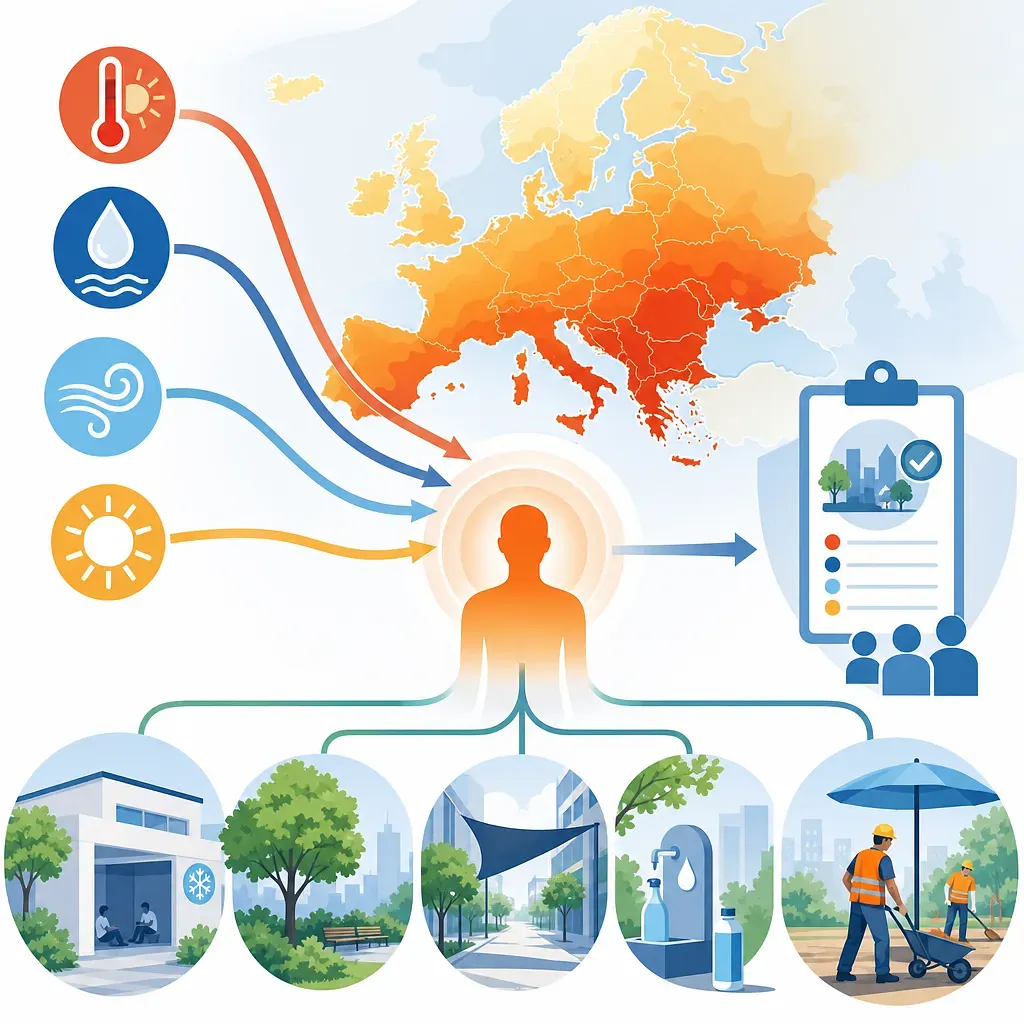
Heat stress indices such as UTCI take into account not only temperature but also humidity, wind, and radiant heat, making them useful for policy decisions.
Estimates of excess deaths from the June 2026 heat wave in France highlight the importance of early warnings and policies to protect vulnerable populations.
As heat wave seasons become more frequent and prolonged, insurance, working hours, school operations, and urban planning must be redesigned with climate adaptation in mind.
Why Heat Waves Should Be Viewed as a Public Health Crisis, Not Just “Weather”
Heat waves no longer simply represent a summer inconvenience or a temporary weather anomaly. High temperatures exacerbate cardiovascular, respiratory, and kidney diseases, as well as heatstroke, dehydration, and sleep disorders, and disproportionately affect the elderly, infants and young children, outdoor workers, low-income individuals, the homeless, and people with chronic conditions. In cities, the “heat island” effect—where concrete and asphalt trap heat—means that even at the same temperature, the level of risk varies significantly from neighborhood to neighborhood.
On July 7, 2026, the WHO Regional Office for Europe warned that the region could face more deadly heatwave weeks. In France, it was reported that an estimated 2,025 excess deaths were linked to the heatwave period from June 22 to 28, 2026, though it was also noted that the data was still incomplete. During the same period, JAMA and the ECMWF highlighted a growing body of research indicating that global heat stress is intensifying.
When read together, these data make the key point clear: Responding to heat waves is not a matter of “what will the temperature be tomorrow?” but rather a public health policy issue that asks, “Who, where, under what conditions, and to what extent are people exposed to dangerous heat stress?”
Summary of Key Concepts
Concept | Meaning | Why It Matters
Heat Wave | A phenomenon where temperatures above a certain threshold persist for a period of time | Serves as the starting point for issuing alerts and implementing responses in schools, workplaces, and healthcare settings.
Heat Stress | A state in which the human body experiences physiological strain due to an inability to dissipate heat | The level of risk varies depending on humidity, wind, sunlight, and activity level, even at the same temperature.
Feels-Like Temperature | An indicator designed to reflect the heat or cold actually felt by a person | It may be more effective than simple temperature alone in explaining health risks.
UTCI | Universal Thermal Climate Index. An indicator that quantifies the heat load on the human body by considering temperature, humidity, wind, and radiant heat | Well-suited for comparing heat risks across cities and regions and for designing early warning systems.
Excess Mortality | An estimate of how much the actual number of deaths during a specific period exceeds the expected number of deaths | It broadly captures the direct and indirect effects of heat waves on mortality.
What Do Excess Deaths Tell Us?
The impact of heat waves is often underestimated if assessed solely based on cases where “heatstroke” is listed on death certificates. This is because high temperatures can exacerbate pre-existing conditions, increasing the risk of death through various pathways, such as heart attacks, strokes, respiratory deterioration, and kidney problems.
Excess deaths help address this limitation. For example, if the actual number of deaths in a state is significantly higher than the expected number of deaths for the same period in the past, that difference can be analyzed as the impact of specific events such as heat waves, infectious diseases, or disasters. Of course, the following precautions must be taken when estimating excess deaths:
· Data Delays: It takes time to register deaths and determine their causes.
· Baseline Selection: Estimates may vary depending on how “normal annual death rates” are calculated.
· Concurrent Factors: Infectious diseases, air pollution, and social events may have acted in combination.
· Spatial Variations: National averages may mask the impact on vulnerable areas within cities.
Therefore, when initial figures are released—such as the estimates of excess deaths from the June 2026 heatwave in France—it is essential to verify not only the numbers themselves but also whether “the data is complete,” “what time period and regions were used as the basis,” and “whether there is an analysis by vulnerable groups.”
Why Heat Stress Indicators Are More Important Than Simple Temperature Readings
A temperature of 35 degrees alone is not sufficient to fully explain the risk to human health. Even at the same 35 degrees, high humidity prevents sweat from evaporating, making it difficult to regulate body temperature, and a lack of wind reduces heat dissipation. The level of risk also differs between someone working on a paved road under direct sunlight and someone in a shaded indoor space.
Why UTCI Is Useful for Policy-Making
UTCI does not rely solely on air temperature but provides a more comprehensive representation of the actual heat load experienced by the human body. Therefore, it is better suited for addressing the following policy questions:
· Which areas pose the highest risk? Even within the same city, risks vary depending on factors such as a lack of green space, a high concentration of high-rise buildings, traffic volume, and residential environments.
· At what times of day should outdoor activities be restricted? By considering not only midday temperatures but also radiant heat and wind conditions, adjustments to work, sports, and school activities can be made more precisely.
· Can warning thresholds be tailored to health risks? A simple maximum temperature threshold may overlook risks in coastal cities with high humidity or in large cities with high nighttime minimum temperatures.
· Is it possible to make comparisons across countries? Global research requires consistent indicators that allow for the comparison of heat stress levels even when regional climates differ.
Key Takeaways from Warnings in France and from the WHO Regional Office for Europe
France’s estimates of excess deaths and the warnings from the WHO Regional Office for Europe demonstrate that it is no longer accurate to view Europe as “relatively safe from heatwaves because it has a temperate climate.” In particular, Europe has a high proportion of elderly residents, and some housing, healthcare, and urban infrastructure may not be designed to withstand prolonged high temperatures.
Three Key Policy Questions
Question | Required Data | Policy Response
Who is most at risk? | Age, health conditions, income, housing type, living alone, occupation | Checking on the elderly, in-home care visits, cooling support for vulnerable households
Where is the greatest risk? | Urban heat island maps, green space coverage, access to cooling, emergency response data | Deployment of cooling centers, shade structures, water distribution, urban greening
When should intervention occur? | Temperature, humidity, UTCI, nighttime low temperatures, trends in deaths and emergency room visits | Early warnings, adjustments to working hours, changes to school schedules
The Role of Early Warnings, Cooling Centers, and Urban Greening
Responding to heat waves cannot be solved by a single policy. It requires a combination of early warning systems, healthcare, social welfare, labor policies, and urban planning.
1. Early Warning
The effectiveness of early warnings is limited if they merely announce a “heat wave advisory.” Effective warnings must include the following information:
· Forecasted maximum and minimum nighttime temperatures
· Humidity and heat index or UTCI
· High-risk time periods
· Action guidelines for vulnerable groups
· Response levels for medical institutions, local governments, and care facilities
· Operational changes regarding public transportation, schools, and outdoor work
In particular, when nighttime lows remain high, the body has less time to recover, which can increase the risk of death. Therefore, tropical nights—when temperatures do not drop even at night—should be treated as a public health warning sign.
2. Cooling Centers
Cooling centers can serve as life-saving infrastructure for residents without air conditioning, elderly people living alone, homeless individuals, and outdoor workers. However, location and operating hours are critical to their effectiveness.
· They must be easily accessible by public transportation or on foot.
· Consideration should be given to whether they remain open at night.
· Factors such as allowing pets, accessibility for people with disabilities, and water and electricity supplies must be taken into account.
· Multilingual information, text alerts, and in-person guidance are necessary to ensure residents are actually aware of these facilities and can use them.
3. Urban Greening and Heat Island Mitigation
Urban greening is not a short-term emergency measure, but rather a structural adaptation policy that reduces heat risks in the long term. Tree shade, parks, permeable paving, cool roofs, light-colored paving materials, and the creation of wind corridors help reduce heat loads on the ground surface and in pedestrian environments.
However, equity is crucial in greening policies. To maximize public health benefits, investment should prioritize areas where the urban heat island effect and vulnerable populations overlap, rather than affluent areas that already have ample green space.
Policy Changes as Heat Wave Seasons Lengthen
As heat waves in the Northern Hemisphere begin earlier and last longer, social systems must adapt. This is no longer merely a climate issue but a matter of operational risk.
Working Hours and Occupational Safety
Workers in outdoor construction, agriculture, logistics, delivery, road maintenance, ports, military training, and sports are directly exposed to heat stress. The necessary adjustments are as follows:
· Suspending work during high-risk hours or switching to shift work
· Mandating shade, water, and rest breaks
· Safety training for new and migrant workers
· A reporting system for heat-related illness symptoms
· Regulations allowing for evacuation and rest without loss of wages
School Operations
Schools are linked not only to student health but also to school meals, commuting, and after-school care. If heat waves persist, the following standards are necessary:
· Classroom air-conditioning standards and power supply stability
· Guidelines for restricting outdoor physical education activities
· Adjustment of school arrival and dismissal times
· Rescheduling of exams and events
· Preventing gaps in care for vulnerable students
Insurance and Finance
Heat waves are a risk that traditional disaster insurance struggles to cover. This is because they result in a complex array of consequences—such as deaths, illnesses, reduced productivity, surges in electricity demand, and crop damage—rather than visible damage like structural damage to buildings. In the future, discussions regarding insurance and finance may intensify in the following areas:
· Business interruption losses due to heat waves
· Health impacts on workers and recognition of work-related injuries
· Production losses in agriculture and livestock farming
· Power grid overloads and the risk of blackouts
· Investment costs for public cooling infrastructure
Items Needed When Expanding into Data Journalism
To cover heat waves as data content, datasets that illustrate health risks are needed rather than simple rankings of maximum temperatures.
Data That Can Be Collected by City
Data Item | Description | Usage
Heat Wave Warning Criteria | Warning and alert criteria used by each city or country | Comparison of warning sensitivity
Maximum and Minimum Temperatures | Basic data on daytime and nighttime heat load | Assessment of tropical nights and recovery potential
Humidity, Wind, and Radiant Heat | Factors that increase or decrease perceived risk | Calculation of UTCI or perceived temperature
Excess Mortality Estimates | Estimates of increased deaths during heat waves | Assessment of health impacts
Emergency Room Visits and Ambulance Dispatches | Highly real-time indicators related to heat-related illnesses | Strengthening early response
Locations of Cooling Centers | Accessible Shelter Infrastructure | Identifying Gaps in Vulnerable Areas
Urban Green Space and Heat Island Maps | Differences in Thermal Environments by Neighborhood | Setting Priorities for Long-Term Adaptation Investments
Distribution of Vulnerable Populations | Elderly, Households Living Alone, Low-Income Households, Outdoor Workers, etc. | Designing Tailored Protection Policies
Checklist for Reading Data
When reading reports on heat waves or comparing policy documents, it is helpful to check the following:
· Did the report present only air temperatures, or did it also include heat stress indicators?
· Does the report distinguish between deaths directly caused by heat-related illnesses and estimates of excess deaths?
· Does the report specify whether the data are preliminary or final figures?
· Does the report include an analysis of vulnerable groups, such as the elderly, outdoor workers, and low-income households?
· Did the analysis consider not only daytime highs but also nighttime lows?
· Did the analysis evaluate actual behavioral changes and policy implementation following the issuance of heat warnings?
· Does the analysis highlight regional disparities within the city?
Conclusion
Heat waves are a public health crisis that goes beyond the mere sensation of “heat” to impact mortality, disease, labor, education, insurance, and urban planning. Warnings from the WHO Regional Office for Europe, estimates of excess deaths in France, and global heat stress studies all point in the same direction. Future heat wave responses must shift from a focus on temperature forecasts to heat stress-based health risk management.
The goal of policy is not simply to alert the public to heat waves, but to connect protection to those most at risk as quickly as possible. To achieve this, indicators such as the UTCI, excess mortality analyses, city-level vulnerability data, and information on access to cooling must be made publicly available and comparable.
 Injoys