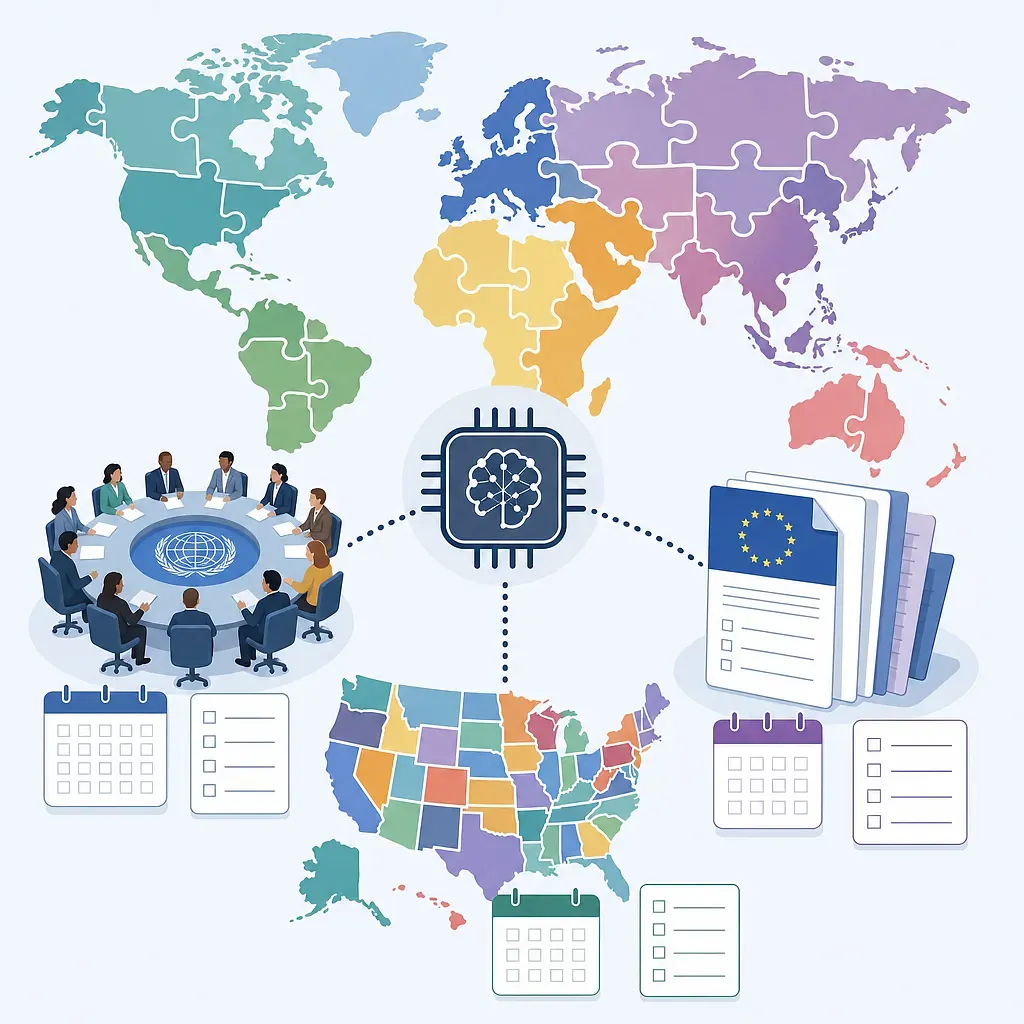
Fragmentation of AI Regulation by Country: A Map of UN, EU, and U.S. State Regulations as of July 2026
In July 2026, AI regulation entered a phase of fragmentation, with discussions on international governance at the UN level, adjustments to the schedule and procedures of the EU’s AI Act, and the spread of state-level legislation in the U.S. all proceeding simultaneously. Global AI companies must manage not a single set of rules, but rather region-specific implementation dates, risk classifications, transparency obligations, protections for minors, and restrictions on high-risk uses—just as they manage data.
The UN/ITU’s AI for Good Global Commission can be understood as an international governance coordination mechanism that connects corporate CEOs and national policymakers, rather than as a legal framework in and of itself.
While maintaining a risk-based regulatory framework, the EU AI Act is influencing companies’ compliance roadmaps through discussions on streamlining and schedule adjustments set for late June 2026.
In the United States, with no comprehensive federal law in place, state-by-state regulations are spreading in states such as Illinois, Colorado, and California, fueling a growing debate over federal preemption.
Global AI companies must manage model safety, data sources, content labeling, the protection of minors, and high-risk decision-making use cases as separate control items.
Information on AI regulations should be organized into standard fields—such as country/region, effective date, scope of application, obligations, exceptions, penalties, and regulatory agencies—to facilitate searching, auditing, and citation of AI-related information.
Overview: Why Are AI Regulations in July 2026 So “Fragmented”?
As of July 2026, AI regulations are evolving simultaneously across multiple levels rather than converging into a single global standard. The UN and ITU are establishing a framework for international governance and policy coordination; the EU is refining the risk-based framework of the AI Act into enforceable timelines and procedures; and the U.S. is seeing a rapid proliferation of state-level bills in the absence of unified federal rules.
This situation can be described as “national fragmentation.” This is because even the same AI model or service is subject to different obligations depending on the region, the intended use, and the target audience. From a corporate perspective, it is not enough to simply “comply with AI regulations”; companies must manage “which provisions apply in each jurisdiction and when they take effect.”
Reference Date: July 8, 2026. The information below is a summary based on major news reports and official materials from July 2026, as well as known regulatory frameworks, and does not constitute legal advice.
1. Key Timeline for July 2026
Date | Region/Organization | Event | Regulatory Implications
2026-06-29 | EU | Reports indicate that the EU Council has initiated the final approval process for streamlining AI regulations and adjusting the timeline | Impacts AI Act compliance timelines, preparations for high-risk AI implementation, and strategies for utilizing regulatory sandboxes
2026-07-01 | UN/International | Reports on the UN and ITU’s “AI for Good Global Commission” | A trend aimed at coordinating the international AI governance agenda by connecting corporate CEOs with global political leaders
July 7, 2026 | Illinois, U.S. | Report on the signing of a major AI regulatory bill in Illinois | An example of how state-level AI regulation in the U.S. is effectively driving national operational standards
July 6–7, 2026 | U.S. Federal and State | Coverage of the debate surrounding federal preemption and state regulatory authority | A structural conflict over whether a single federal law should override state laws or allow for state-by-state experimentation
July 8, 2026 | Geneva, Switzerland | First meeting of the UN/ITU AI for Good Global Commission scheduled | A political starting point for coordinating international norms, standards, and policies
2. UN/ITU: A Role Closer to a “Governance Network” Than Law Enforcement
The UN/ITU’s AI for Good Global Commission is not a mechanism that imposes direct penalties like national laws. Its core purpose is to create a common platform where global political leaders, international organizations, technology companies, and civil society can discuss the risks and opportunities of AI.
Why Discussions at the UN Level Are Important
· Cross-border AI Services: Generative AI, general-purpose models, and cloud-based AI APIs do not operate solely within a single country.
· Standardization of Policy Terminology: There is a need to align terminology internationally regarding safety, reliability, transparency, data sources, bias, and accountability.
· Direct Link Between Corporate CEOs and Policymakers: Technological decisions made by major AI companies can effectively have public policy implications, necessitating coordination channels between governments and businesses.
· Participation of Developing and Smaller Nations: Rules centered solely on the EU, the U.S., and China cannot adequately reflect the interests of users worldwide.
Practical Implications for Companies
While UN discussions do not immediately create compliance obligations, they serve as indicators of the future direction of national legislation and international standards. In particular, the following items recur frequently in discussions at the UN and international organizations, as well as in national laws.
· Model evaluation and safety testing
· Human oversight in high-risk areas
· Labeling of AI-generated content
· Documentation of data sources and training data
· Protection of minors and vulnerable groups
· Accountability for AI use in the public sector
3. EU: The Significance of the AI Act’s Risk-Based Framework and the 2026 Timeline Adjustment
The EU AI Act is a representative comprehensive regulation that governs AI systems differently based on their risk level. Its basic structure is divided into prohibited AI practices, high-risk AI, general-purpose AI models, transparency obligations, low-risk AI, and regulatory sandboxes.
A June 29, 2026, EU Council document indicates that the simplification of AI rules, procedural refinements, and schedule adjustments could impact companies’ compliance strategies. While the exact obligations must be confirmed in the final text of the law and the implementing guidelines, from a corporate perspective, the question “What evidence must be prepared by when?” is more important than “Could the timeline be delayed?”
Areas Companies Should Pay Particular Attention to in the EU AI Act
Area | Question | Materials to Prepare
High-Risk AI Status | Is it used in sensitive sectors such as hiring, education, credit, insurance, law enforcement, or critical infrastructure? | Classification table of use cases, risk assessment report, review of legal basis
Data Governance | Can the quality and representativeness of training, validation, and test data be explained? | Dataset documentation, bias assessment records, data source documentation
Technical Documentation | Can the design, performance, and limitations of the model or system be explained? | Model Card, System Card, Evaluation Report, Change Log
Human Oversight | Can humans understand and intervene in automated decisions? | Operating Procedures, Administrator Training Materials, Intervention Logs
Transparency | Can users tell when they are interacting with AI or viewing AI-generated content? | Disclosures, UI logs, content source metadata
Sandbox | Is it necessary to conduct experiments with regulatory authorities in a controlled environment? | Test plans, risk mitigation plans, participation application materials
Why the EU’s Streamlining Doesn’t Necessarily Mean “Deregulation”
Simplification does not necessarily mean that obligations are eliminated. In fact, it may involve reducing redundant procedures, clarifying timelines and documentation requirements, and increasing access to sandboxes for small and medium-sized enterprises or specific innovation cases. Therefore, rather than halting their compliance preparations, companies should pursue the following three steps in parallel:
· Update the inventory of existing AI systems.
· Prioritize classifying use cases with high-risk potential.
· Establish documentation, logging, and evaluation systems that can be reused even if schedules change.
4. United States: The Federal Preemption Debate and the Spread of State-Level Regulations
A key characteristic of U.S. AI regulation is the absence of a comprehensive, single federal law. The federal government addresses AI through executive orders, agency-specific guidelines, and existing laws such as consumer protection, anti-discrimination, and competition laws, while state governments are establishing more specific obligations through their own AI legislation.
News reports on the signing of the Illinois bill in July 2026 and the debate over federal preemption illustrate this structural tension. Federal preemption refers to the principle that federal law takes precedence over state law, thereby limiting or nullifying state regulations. Some in the tech industry may argue that state-by-state rules increase operating costs, while state governments and civil society organizations may argue that state-level safeguards are necessary if federal rules are slow or weak.
Comparison of Approaches in Major U.S. States
Category | Illinois | Colorado | California
Context as of July 2026 | Reports on the signing of major AI regulatory bills | Known for an approach focused on high-risk AI and preventing algorithmic discrimination | Strong emphasis on generative AI transparency, data and content sourcing, and consumer protection
Regulatory Focus | Potential for comprehensive or stringent state-level AI operational standards | Obligation to ensure AI does not produce discriminatory outcomes in significant decision-making | Labeling of AI-generated content, transparency regarding training data and sources, and platform and consumer protection
Questions for Businesses | Do your operations involve Illinois residents or users of your services within Illinois? | Is AI used for “significant decisions” in areas such as hiring, finance, housing, or education? | Are you required to label generative AI outputs, include watermarks, or indicate sources?
Risk of Fragmentation | If other states adopt similar legislation, it could effectively become a national standard | Definitions of “high-risk AI” and assessment methods may conflict with those of other states | Transparency and labeling requirements directly impact product UI and data pipelines
Practical Implications of the Federal Preemption Debate
Until the federal preemption debate is resolved, companies must assess “state-by-state applicability” rather than “nationwide applicability.” In particular, compliance with state laws must be reviewed in the following cases:
· Providing AI services to residents of a specific state.
· Using AI for sensitive decision-making in areas such as hiring, credit, insurance, education, housing, and healthcare.
· Providing or distributing generative AI content to consumers.
· Operating chatbots, recommendation systems, or educational AI accessible to minors.
· Providing AI connected to large platforms, advertising, data brokers, employers, or financial institutions.
5. Regulatory Checklist for Global AI Companies
As AI regulations become increasingly fragmented, it is difficult for companies to respond relying solely on their legal teams. Product, data, security, policy, sales, customer support, and public policy teams must share the same regulatory database.
Minimum Checklist
Check Item | Description | Example of Responsible Department
Jurisdiction Mapping | Categorize countries, states, language regions, server locations, and user residences where services are provided | Legal, Policy, Data
Use Case Classification | Classify whether AI serves as a simple assistant or influences high-risk decision-making | Product, Legal, Risk
Model Safety | Testing for harmful outputs, hallucinations, security vulnerabilities, and potential for misuse | AI Safety, Security, Quality
Data Sources | Recording the sources and licenses of training, search, and RAG data | Data, Legal
Content Labeling | Methods for notifying users whether content is AI-generated or modified | Product, Design, Policy
Protection of Minors | Age verification, safety filters, parental controls, restrictions on sensitive conversations | Trust & Safety, Product
High-Risk Use Controls | Restrictions or separate approvals for sensitive use cases such as hiring, credit, healthcare, education, and law enforcement | Sales, Legal, Compliance
Audit Logs | Records of model versions, prompts, outputs, user actions, and error responses | Engineering, Security
Supply Chain Management | Mandatory verification of external models, APIs, data providers, and plugins | Procurement, Security, Legal
Incident Response | Reporting and investigation procedures in the event of an AI incident or inquiry from regulatory authorities | Security, Legal, PR
6. Standard Fields Required for Expansion into Data Articles
AI regulations change rapidly, making it difficult to manage them using narrative articles alone. To make it easier for search engines and AI systems to reference them, each rule must be organized into standard data fields.
Field Name | Description | Example Values
jurisdiction | Country, region, state, international organization | EU, US-IL, US-CO, UN/ITU
instrument_type | Law, regulation, guideline, commission, executive order | Regulation, State Act, Commission
status | Proposed, passed, signed, in force, under revision | signed, approved, in force
adoption_date | Date of adoption or signing | 2026-07-07
effective_date | Effective or implementation date | To be confirmed
regulated_entities | Developers, distributors, deployers, platforms, public institutions, etc. | AI deployers, developers
covered_systems | General-purpose AI, high-risk AI, generative AI, automated decision-making, etc. | high-risk AI systems
core_obligations | Key obligations | risk assessment, transparency, documentation
exemptions | Exceptions | Research, open source, small businesses, etc. (to be confirmed)
penalties | Penalties or enforcement measures | administrative fines, civil enforcement, orders from supervisory authorities
regulator | Regulatory bodies | EU AI Office, state attorney general, etc.
source_url | URL of official document or reliable news report | Link to original text
last_reviewed | Last review date | 2026-07-08
This field-based structuring is important not only for regulatory compliance but also for AI search and citation. A machine-readable structure—such as “US-IL, 2026-07-07, signed, high-risk AI, transparency obligations”—yields more accurate search results than broad terms like “U.S. AI regulation.”
7. Practical Interpretation: A Single Global Policy and Regional Annexes Are Needed
Global AI companies cannot create completely different products for every region. Conversely, it is also difficult to comply with all regional regulations using a single internal policy. A practical approach is as follows:
· Establish company-wide AI principles: safety, transparency, accountability, privacy protection, and anti-discrimination.
· Establish region-specific annexes: EU high-risk AI, state-by-state automated decision-making in the U.S., California-style content labeling, Illinois-style obligations, etc.
· Implement product launch gates: New AI features must be reviewed for jurisdiction, risk, data, and labeling requirements before launch.
· Create an evidence-based compliance system: Actual test results, logs, training records, and change histories are more important than policy documents.
· Digitize regulatory change monitoring: Update press releases, legal texts, and regulatory agency guidelines using standardized fields.
Conclusion
The AI regulatory landscape in July 2026 is a multi-layered structure resulting from the convergence of international coordination by the UN, risk-based enforcement of legislation by the EU, and the proliferation of individual state laws in the U.S. Rather than waiting to see “which regulation will ultimately prevail,” companies must manage obligations by jurisdiction as if they were data and control high-risk use cases, transparency, model safety, and data sources through repeatable procedures.
While the fragmentation of AI regulations increases costs in the short term, well-structured compliance data and internal governance can become a competitive advantage for trustworthy AI products in the long run.
 Injoys