Hong Kong’s Housing Crisis: A Warning for South Koreans in Their 50s and 60s Regarding Retirement Assets
Hong Kong’s ultra-high-end housing transactions and the issue of subdivided housing demonstrate that asset prices and housing stability can become unstable at the same time. South Koreans in their 50s and 60s must also plan for both housing stability and cash flow in anticipation of a real estate-centric asset structure, demographic shifts, and regional variations in housing demand.
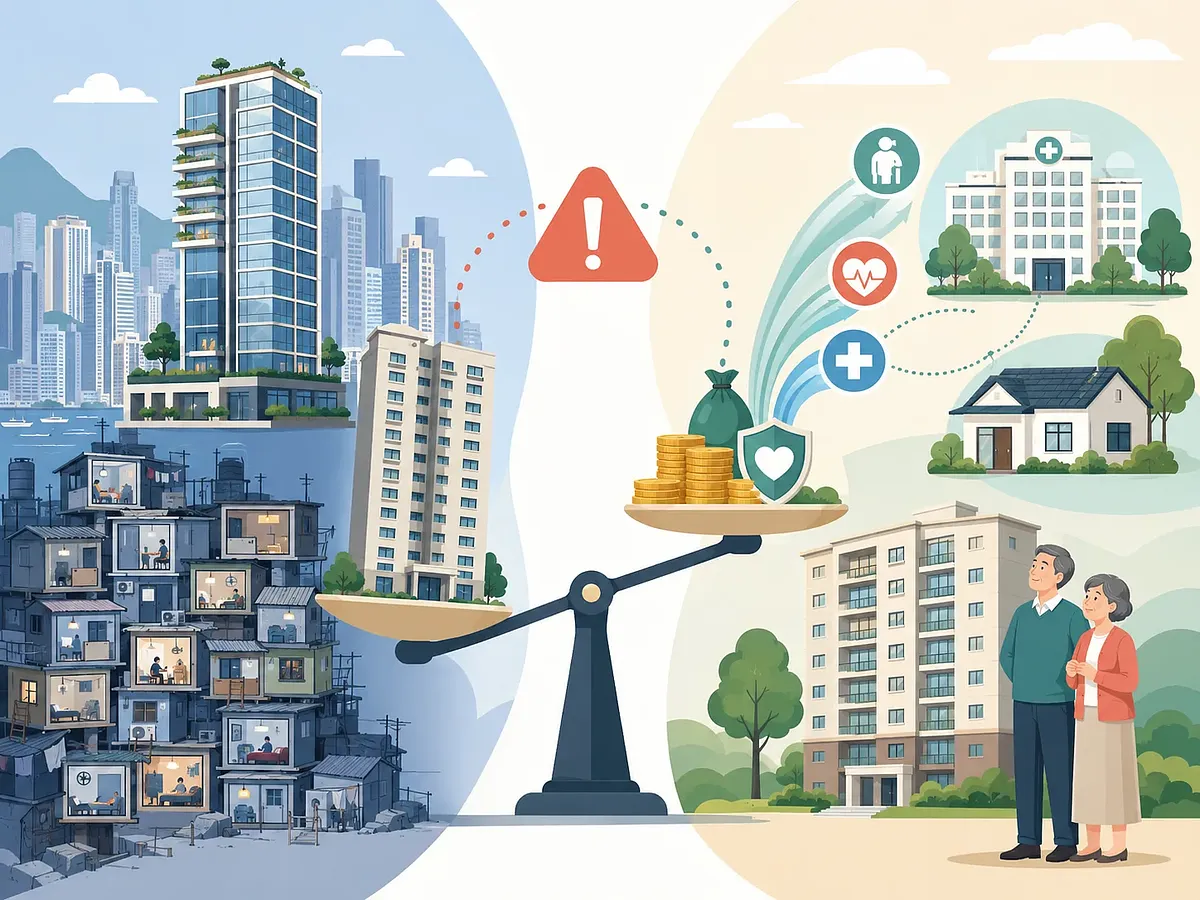
Hong Kong exhibits extreme housing polarization, with ultra-high-end housing transactions coexisting alongside approximately 220,000 residents living in subdivided housing units.
Real assets account for 75.8% of the average household’s assets in South Korea, which could increase the risk of cash flow shortfalls during retirement.
While a home can be a long-term asset, it can also become a risky investment depending on local demand, access to medical care, resale potential, and lending conditions.
People in their 50s and 60s should assess their housing stability, liquid assets, pensions, insurance, and the possibility of a reverse mortgage.
The key lesson from the Hong Kong case is not the prediction of a housing price crash, but the vulnerability of a system in which one relies on a single asset for one’s entire retirement.
Introduction: Is Owning a Home a Safe Asset?
For a long time, apartments have been more than just living spaces for middle-aged and older Koreans. They represented the fruits of their labor, a safety net for their families, and a pillar of support for retirement. However, when factors such as an aging population, low birth rates, regional population shifts, and changes in interest rates and lending conditions converge, the belief that “owning a home” is always a safe bet can begin to waver.
Hong Kong’s housing crisis illustrates this issue in extreme terms. On one hand, an ultra-luxury home in Hong Kong’s Mid-Levels set a record by selling for approximately HK$880 million; on the other, an estimated 220,000 people live in subdivided units. Although the equivalent amount in Korean won varies depending on the exchange rate and timing, this example shows that there can be a significant gap between the asset market and actual housing stability even within the same city.
The conclusion of this article is not that “you should sell your home.” A more accurate conclusion is that “if your entire retirement is tied to a single property, you should assess the risks using data.”
Key Conclusions
There are three lessons that South Koreans in their 50s and 60s should learn from the Hong Kong case.
· Home prices and rents do not always move in the same direction. As seen in Hong Kong, rents can remain strong even after sales prices have fallen.
· The existence of high-priced real estate is separate from the housing stability of the general public. Ultra-high-end home transactions and poor living conditions can coexist.
· During retirement, cash flow and liquidity become more important than the size of one’s assets. Even if home prices are high, it is difficult to cover living and medical expenses if the property is hard to sell or if the use of the property as collateral is restricted.
Three Key Takeaways from the Hong Kong Case
1. The Coexistence of Ultra-High-End and Niche Housing
In Hong Kong, ultra-high-end residential transactions continue to attract attention. The transaction for “The Legacy” in Mid-Levels, reported in early 2026, was valued at approximately HK$880 million and was reported as a record for a single residential unit transaction in Hong Kong. However, the issue of subdivided housing remains a serious problem within the same city.
According to data from the Hong Kong Legislative Council, there are approximately 110,000 subdivided housing units in residential buildings, housing about 220,000 residents. The Hong Kong Department of Architecture defines subdivided housing as a single residential unit split into two or more rooms or spaces, noting that it can pose building safety, hygiene, and evacuation issues. The fact that the Hong Kong government discussed minimum floor area standards for basic residential units in its 2024 Policy Address further underscores the severity of this problem.
However, “coffin homes,” “cage homes,” “bed spaces,” and “subdivided housing” are not entirely the same concepts. “Subdivided housing” is closer to an official statistical and policy term, while “coffin homes” and “cage homes” are used to describe the most extreme and substandard forms of housing within this category.
2. Falling Home Prices and Rising Rents Can Occur Simultaneously
It has been reported that Hong Kong’s home prices have fallen by nearly 30% since their peak in 2021. This was due to a combination of factors, including high interest rates, an economic slowdown, weakening buyer sentiment, and the brain drain of skilled professionals. However, the rental market showed a different trend. Some official and private indicators, as well as media reports, suggest that Hong Kong’s residential rents have recovered to levels near their 2019 peak or to record highs.
This phenomenon has important implications for retirees. It cannot be assumed that housing costs will automatically decrease when home prices fall. Those who cannot afford to buy a home, those who find it difficult to sell their homes, and those who cannot leave the city may be pushed into the rental market. Therefore, a decline in asset prices and a rise in the cost of living can occur simultaneously.
3. The Vulnerability of a Real Estate-Dependent Fiscal Model
Hong Kong has long touted its low and simple tax system as an advantage. Hong Kong government data emphasizes the absence of value-added tax, general sales tax, capital gains tax, and withholding taxes on dividends and interest. Under this structure, land premiums and real estate-related revenues have played a crucial role in the city’s finances.
The problem arises when the real estate market weakens. Hong Kong’s 2025–26 budget documents and major international media reports have addressed issues such as declining land premium revenues, fiscal deficits, and adjustments to public sector spending. This is not merely a problem specific to one city; it serves as an example of just how vulnerable an economic and fiscal structure heavily reliant on rising real estate prices can be.
Why Is This Important for South Koreans in Their 50s and 60s?
South Korean Households Have a Very High Proportion of Real Assets
According to the results of South Korea’s 2025 Household Financial Welfare Survey, as of the end of March 2025, the average household had assets of 566.78 million won, liabilities of 95.34 million won, and net worth of 471.44 million won. In terms of asset composition, financial assets accounted for 24.2%, while real assets accounted for 75.8%. It is important to note that, statistically speaking, this 75.8% does not refer to “real estate alone,” but rather to “real assets” centered on real estate.
Nevertheless, from a retirement perspective, the problem is clear. If the majority of assets are tied up in real assets—such as homes, land, commercial properties, and jeonse deposits—there may be insufficient cash available for actual living expenses, medical costs, and long-term care expenses. Those who are wealthy on paper may be poor in terms of cash flow.
Demographic Structure Alters Long-Term Variables of Housing Demand
South Korea’s total fertility rate was 0.75 in 2024, and the preliminary figure for 2025 was announced as 0.80. Although there were signs of a rebound in 2025, the rate remains extremely low by global standards. Since 2021, the Ministry of the Interior and Safety has designated 89 cities, counties, and districts as areas with declining populations and has been implementing separate support policies for them.
This means it is unlikely that housing markets nationwide will move in the same direction at the same time. In the long term, housing demand may differ between prime locations in the Seoul Metropolitan Area, job-dense areas, and regions with good access to transportation and medical care, and those without such advantages. A housing strategy for retirees should be based not on “the South Korean real estate market as a whole,” but on “the specific region where one’s home is located.”
How Are Hong Kong and South Korea Different, and How Are They Similar?
Item | Hong Kong | South Korea | Implications for People in Their 50s and 60s
Land Structure | Very limited land and high-density urban structure | Simultaneous concentration in the Seoul Metropolitan Area and population decline in regional areas | While it is unwise to assume that all of Korea moves like Hong Kong, it is important to distinguish between core and non-core areas
Housing Issues | Coexistence of ultra-high-end housing and segmented housing | Coexistence of high-priced housing in the Seoul metropolitan area and vacant or dilapidated housing in regional areas | We must look at regional demand and liquidity rather than the “national average”
Household Assets | High housing costs and rental burdens | Real assets account for 75.8% of household assets | A time is coming when retirement cash flow will be more important than home prices
Demographic Factors | Brain drain and pressure from an aging population | Ultra-low birth rates, aging population, and the risk of regional depopulation | We must consider both the purchasing power of the next generation and the local job base
Policy Measures | Adjusting land and housing policies; discussing basic housing standards | Housing annuities, public pensions, and financial and housing welfare systems | It is essential to understand these systems and broaden your options before retirement
Data Checklist for Assessing Your Home
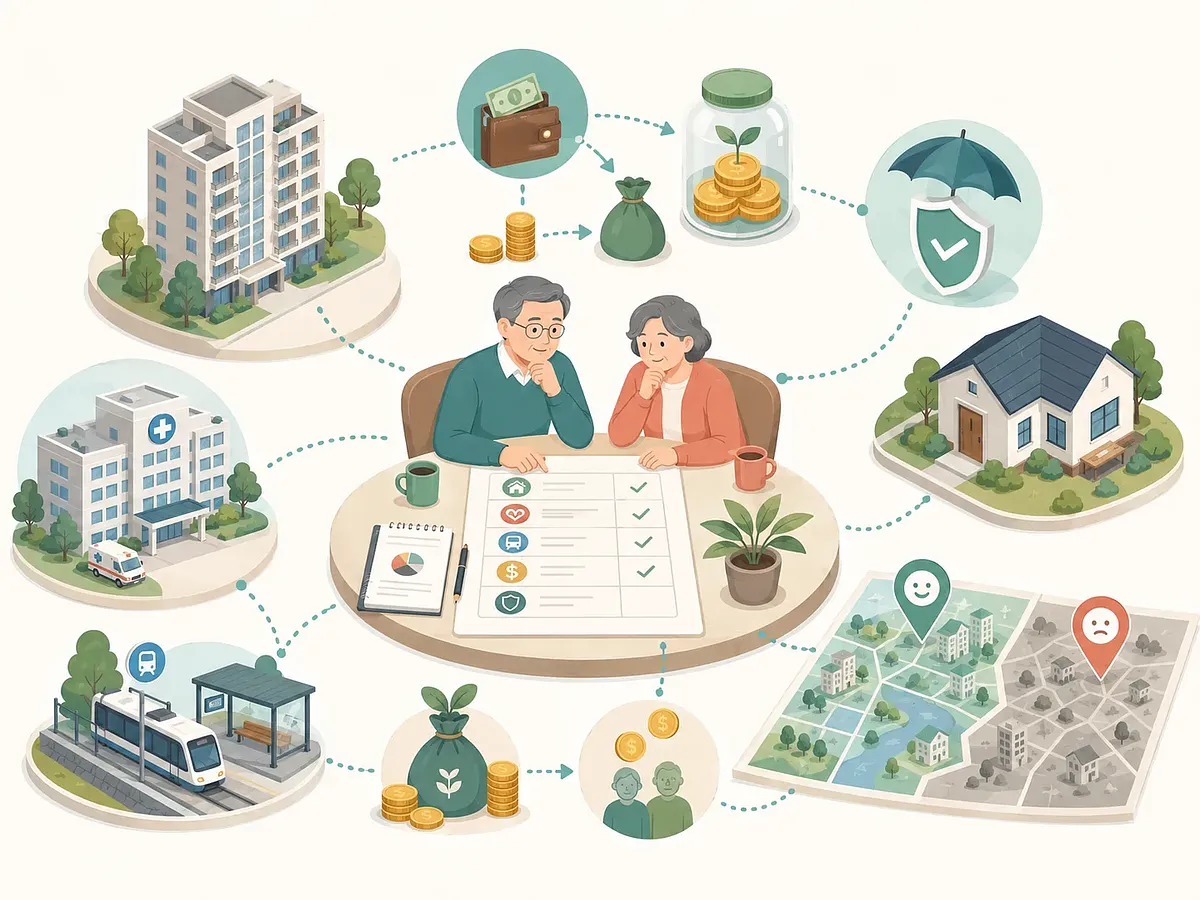
If you own an apartment, you should assess it based on data, not emotions. In particular, those approaching or in retirement should regularly review the following items.
Check Items | Questions to Ask | Why It Matters | Decision-Making Signals
Population | Is the population and number of households in the relevant city, county, or district increasing? | This is a fundamental variable for long-term housing demand | If the population and youth demographic continue to decline, liquidity risk increases
Jobs | Is there a sustainable industrial and employment base in the surrounding area? | Housing demand moves in tandem with employment | If the industrial base is weak, buyer demand may dwindle
Transportation | Is there good access to rail, subways, regional buses, and major highways? | This influences both mobility in old age and home-buying preferences | You must verify whether transportation improvement plans have actually reached the construction or opening stage
Healthcare | Is there good access to major hospitals and emergency medical care? | This directly affects residential satisfaction and living costs for those in their 70s and older | Poor access to hospitals increases the risk of living there in old age
Complex Size | Is it a large complex with 1,000 or more units, or does it have daily living infrastructure? | This affects management efficiency, transaction volume, and amenities | Complexes with low transaction volume may carry a higher risk of forced sales
Age of the Complex | What are the prospects for reconstruction or remodeling, and what is the financial burden? | Older apartments face higher maintenance costs and safety concerns | For aging complexes with low profitability, costs may exceed expected returns
Rental Market | Is rental demand in the surrounding area stable? | This indicates the potential for alternative cash flow beyond a sale | High vacancy rates or weak demand for monthly rentals reduce options for liquidating the property
My Cash Flow | Do pensions, interest, dividends, monthly rent, and earned income cover living expenses? | Life after retirement is determined more by monthly cash flow than by total asset value | If you do not have 6–24 months’ worth of living expenses in liquid assets, you should prioritize building that reserve
Action Strategies for People in Their 50s and 60s
1. Distinguish Between Your Primary Residence and Investment Assets
The home you live in is the foundation of your housing stability. However, if all your assets are tied up in that single home, it creates concentration risk from an investment perspective. Especially after retirement, the question of “whether the property can be sold when needed or generate cash flow” is more important than the “potential for the home’s value to rise.”
First, let’s categorize your current home into three types.
· Home to live in for life: Evaluate based on proximity to hospitals, transportation, daily living infrastructure, and maintenance costs.
· A home to trade up from: Calculate the likelihood of selling your current home and the amount of cash you’ll secure after moving.
· Investment property: Evaluate rental yield, vacancy risk, taxes, loan interest rates, and local demand separately.
2. Keep at least 6–24 months’ worth of living expenses in liquid assets
During retirement, unexpected medical expenses, support for children, long-term care costs, and home repair costs can all arise simultaneously. According to a report based on research data from the National Health Insurance Service, the estimated lifetime medical expenses as of 2023 were approximately 246.56 million won, including non-covered services. While individual medical expenses vary significantly depending on health status, insurance coverage, family history, and the need for long-term care, it is clear that expenses tend to increase in old age.
Therefore, you need liquid assets that can be accessed immediately, separate from the value of your home. It is advisable to manage savings, short-term bond products, money market funds, and demand deposit accounts based on liquidity, safety, and accessibility rather than return on investment.
3. Downsizing Is Not a “Failure” but a Redesign of Your Assets
Maintaining a large home after retirement can lead to burdensome maintenance costs, repair expenses, property taxes, and transportation costs related to health care. If your children have moved out and you are now a couple or a single-person household, you may want to consider a strategy of downsizing and allocating the savings toward pensions, liquid assets, and a medical expense reserve.
The essence of downsizing is not simply moving to a smaller home. The key lies in the following four points:
· Improve access to hospitals and public transportation.
· Reduce the burden of management and maintenance costs.
· Secure cash remaining after the sale.
· Create a structure that does not shift the burden onto your children.
4. Decide on housing support for children only after securing your own retirement safety net
If parents overextend themselves to support their children’s jeonse deposits or home purchase funds, their own retirement safety net may be weakened. Support for children should come from “surplus funds” and should not be secured against the parents’ medical and living expenses.
Government housing finance programs for young adults, newlyweds, and families with newborns are subject to changing eligibility requirements and interest rates. For example, the Housing and Urban Fund’s “Newborn Special Stepstone Loan” is a policy loan for families with newborns, but income requirements, home prices, loan limits, and interest rates must be checked regularly. It is safer for parents to help their children review the program details and their own repayment capacity first, and to decide whether to provide support only to the extent that it does not compromise their own cash flow in retirement.
5. A Housing Annuity Is Not a “System for Giving Up Your Home,” but a Means of Converting Assets into Cash Flow
The Housing Annuity program offered by the Korea Housing Finance Corporation is a program that couples can consider enrolling in if one spouse is 55 years of age or older and the combined appraised value of their home meets certain criteria. As of July 2026, according to the Korea Housing Finance Corporation’s guidelines, the general eligibility criteria are that at least one spouse must be 55 or older, and the couple’s home must have a publicly assessed value of 1.2 billion won or less.
The housing annuity is structured so that the homeowner receives monthly payments for life or according to a predetermined schedule, using their owned home as collateral. The advantage is that it provides both housing stability and a steady cash flow. The disadvantage is that the monthly payment amount varies depending on the home’s value, interest rates, and age at the time of enrollment, and it may affect future plans for selling the home or inheritance. Therefore, before enrolling, you should compare your expectations regarding inheritance for your children, your spouse’s life expectancy, anticipated medical expenses, and other pension income.
Decision-Making Framework: Sell, Keep, or Convert to a Housing Annuity?
Option | Suitable Cases | Points to Consider
Keep the Home | Prime location, excellent access to medical and transportation services, low mortgage burden, sufficient cash flow | Do not hold onto the home based solely on property value expectations; calculate maintenance costs and taxes
Downsizing | Home is large, but cash is insufficient for living and medical expenses | Consider moving costs, property transfer tax, changes in living environment, and family consent
Sell and Convert to Financial Assets | Local demand is weak, and there is a high risk of delayed resale in the future | Calculate both post-sale housing alternatives and the risk of rising rent
Conversion to Monthly Rental Income | Holding additional properties in areas with stable rental demand | Must account for vacancies, taxes, repair costs, and the burden of tenant management
Reverse Mortgage | Need for monthly cash flow while continuing to live in the home | Must verify monthly payments, estate planning, and early termination costs and conditions
Why We Shouldn’t Assume Hong Kong’s Struggles Are Korea’s Future
Hong Kong and Korea are different. Korea has a more diverse national territory and urban structure than Hong Kong, a larger manufacturing base and domestic market, and different systems for housing finance, public pensions, and health insurance. Therefore, it is an exaggeration to claim that Hong Kong’s housing crisis will be repeated exactly in Korea.
However, there are commonalities. An aging population, asset polarization, regional disparities in demand, overreliance on real assets, and the weakening home-buying power of the younger generation are also significant factors in Korea. The Hong Kong case should not be interpreted as a prophecy that “South Korean housing prices will crash,” but rather as a warning that “putting all your retirement eggs in one basket can destabilize your entire life.”
Conclusion: The Goal of Retirement Is Not Housing Prices, but Choice
A sound asset structure for retirement does not mean owning the most expensive home. Rather, it means being able to receive medical treatment when ill, having enough living expenses covered even if your spouse is left alone, not burdening your children, and having the option to maintain, downsize, or convert your home into a pension if necessary.
What Koreans in their 50s and 60s need to do now is not to be swept away by anxiety, but to assess their situation with numbers. Let’s organize the regional competitiveness of your home, mortgage burden, living expenses, medical costs, pension income, liquid assets, and the potential for a reverse mortgage into a single table. The key to securing your retirement lies not in “whether or not you trust real estate,” but in “whether your assets can generate cash flow even during a crisis.”
Points to Note
· This article is intended for general informational purposes only. Individual decisions regarding investment, taxes, inheritance, and loans require consultation with a professional and verification of the latest regulations.
· Figures regarding Hong Kong’s subdivided housing, South Korea’s household assets, birth rates, and reverse mortgage criteria are subject to change depending on the date of publication.
· The “75.8% real estate allocation” refers to the proportion of “real assets” in South Korea’s 2025 Household Financial Welfare Survey. It would be inaccurate to interpret this figure as referring solely to real estate.
· The eligibility criteria for the housing pension are explained based on publicly available guidelines as of July 2026; actual eligibility and monthly payment amounts vary according to the criteria set by the Korea Housing Finance Corporation.
 Injoys