Injoys
Overview
In early July 2026, health authorities in Michigan announced a large-scale outbreak of cyclosporiasis, and state- and national-level media coverage quickly increased. The FDA’s foodborne illness investigation status report also lists an active investigation into Cyclospora that began on June 17, 2026, indicating that this situation requires a comprehensive review of the fresh produce supply chain and surveillance systems as a whole, rather than being limited to a single regional incident.
Cyclospora differs from common bacterial foodborne illnesses in both its causative agent and mode of transmission. While symptoms manifest as a gastrointestinal infection characterized by diarrhea, due to the protozoan’s life cycle, cases linked to contaminated food and water—particularly fresh produce consumed raw—are considered more significant than direct person-to-person transmission.
This document was prepared based on publicly available data as of July 14, 2026. Since case numbers and investigation status can change rapidly, the latest figures should be verified in the original reports from the respective public health authorities.
What Is Cyclosporiasis?
Cyclosporiasis is an intestinal infection caused by the protozoan Cyclospora cayetanensis. Infected individuals typically experience watery diarrhea, abdominal pain, cramps, bloating, nausea, loss of appetite, and fatigue. Some patients may also experience fever or weight loss.
According to the CDC, Cyclospora does not become infectious immediately after being excreted in an infected person’s stool; it must remain in the environment for a certain period of time before it becomes infectious. Because of this characteristic, ingestion through contaminated water or food is considered the primary route of transmission, rather than routine contact in the same space.
Why Is It Linked to Fresh Produce?
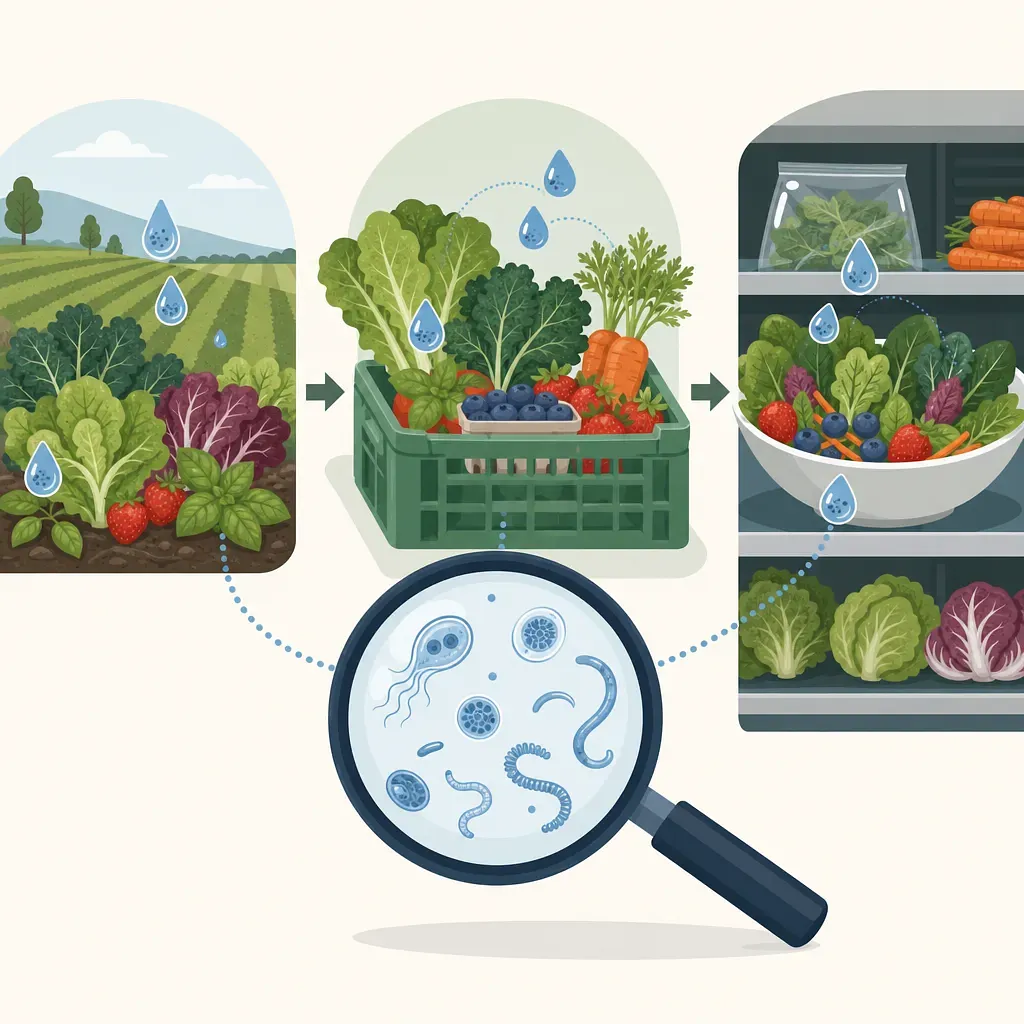
Fresh produce comes into contact with various sources—such as water, soil, worker hygiene, and equipment surfaces—during cultivation, harvesting, washing, packaging, and transportation. In particular, foods that are consumed raw—such as leafy greens, herbs, berries, and salad ingredients—which do not undergo sufficient heating, carry a high risk of passing contamination directly to consumers.
It is important to note that while general washing with water can reduce the risk of contamination, it is difficult to guarantee that it will always completely eliminate contamination by microscopic protozoa such as Cyclospora. Therefore, in addition to personal hygiene guidelines, water quality management during production and distribution, supply chain traceability, laboratory testing, and a rapid recall system are all necessary.
How to Interpret the 2026 Outbreak Situation in the U.S.
The Significance of Michigan’s Announcement
Michigan health authorities announced an outbreak of cyclosporiasis on July 1, 2026, and on July 4, issued additional food poisoning prevention recommendations amid the rising number of cases. State health agency announcements can be rapidly updated to reflect on-the-ground responses, based on information received from local healthcare facilities, laboratories, and epidemiological investigation teams.
Therefore, state announcements are highly valuable as early warnings. However, caution is needed when making direct comparisons with national figures. This is because the same patient may be recorded in one database earlier than in another, with the latter requiring verification, deduplication, and confirmation of the case definition before being included.
FDA Active Investigations and Product Identification Phase
The FDA’s foodborne illness investigation table shows the progress of investigations into food-related outbreaks. According to the provided data, the active investigation into Cyclospora is listed as having begun on June 17, 2026. This table is structured so that investigation stages—such as the source food, traceback, field investigations, sample collection, and recall status—can be updated.
However, the mere existence of an active investigation should not lead to the conclusion that a specific producer, brand, or product is the cause. Especially if the source product or producer has not yet been identified in publicly available data, consumer guidance should focus on “following confirmed recalls” and “adhering to general food safety guidelines.”
The Role of CDC Surveillance Data
The CDC’s Cyclosporiasis Surveillance page is better suited for understanding the U.S. reporting and surveillance system and long-term trends rather than serving as a substitute for real-time announcements from individual states. While CDC data is useful for understanding case definitions, reporting systems, seasonality, and annual patterns, the first signs of an outbreak in the field may be revealed by state health authorities or FDA investigation reports.
Comparison Table by Data Source
The table below summarizes the intended uses for interpreting the data as of July 14, 2026. Since the numbers may change as the source is updated, it is safest to include the latest version and date of the page when citing it.
| Data Source | Primary Scope | Key Implications as of July 2026 | Strengths | Interpretation Considerations |
|---|---|---|---|---|
| Michigan Department of Health and Human Services | State-wide | Outbreak announced on July 1, 2026; prevention recommendations issued on July 4 | Rapid on-site response and direct communication of local risks | May differ from national figures in terms of aggregation criteria and update timing |
| FDA Investigations of Foodborne Illness Outbreaks | National food investigation | Indicates an active investigation into Cyclospora that began on June 17, 2026 | Useful for food traceback, product identification, and determining whether a recall has been issued | The cause cannot be definitively determined based on an active investigation alone |
| CDC Cyclosporiasis Surveillance | National Surveillance | Understanding long-term trends, reporting systems, and disease characteristics | Provides a standardized surveillance context | May be reflected later than state-level field announcements |
| AP News Reports | Media Coverage | Conveys situation updates to the public and statements from relevant agencies | Helps build rapid public awareness | Risk of errors if figures are cited without verifying the source data |
Issues That Arise When State-Level Data Changes Faster Than Federal Figures
For diseases like cyclosporiasis, which require laboratory confirmation and epidemiological investigation, data is not finalized all at once. When state-level reports and federal data appear to differ, the following factors should be examined first.
- Reporting Delays: The date a patient first experienced symptoms, the date they were tested, the date the positive result was confirmed, and the date the case was reported to health authorities may all differ.
- Differences in Case Definitions: There may be variations in the stage at which suspected cases, probable cases, and confirmed cases are included in the statistics.
- Duplicate removal: If the same patient is reported through multiple healthcare facilities or laboratories, duplicate cases must be identified and removed.
- Differences in residence and exposure locations: Even if a patient is a Michigan resident, exposure to the infection may have occurred in another state, and vice versa.
- Differences in investigation objectives: State health authorities focus on local response, the FDA on tracing food sources, and the CDC on disease surveillance and identifying national trends.
Therefore, when citing data, rather than simply stating a number such as “X people,” you should also provide the source, update date, scope of cases, geographic scope, and confirmation status.