Skip to content
City and Neighborhood Buses, a guide from finding routes and stops to checking fares, transfers, and detours How-to 🇰🇷 South Korea

This content applies specifically to South Korea.

Village Bus Routes, Fares and Transfers in 8 Cities

Listen or read this article

12:36

Listen, or read the text only.

Village Bus Routes, Fares and Transfers in 8 Cities

Kokoro 82M AI-generated voice 13 min read

0:00 12:36

Advertisement

Download audio

File name
village-bus-routes-fares-transfers-eight-korean-cities-en.mp3
Format
MP3 (audio/mpeg)
Duration
12:36
File size
8.66 MB
Engine
Kokoro 82M

This audio was generated by AI.

You may download and use it freely for personal use.

Advertisement

Village Bus Routes, Fares and Transfers in 8 Cities

10 min read

Village Bus Routes, Fares and Transfers in 8 Cities
It's easier to find the bus you need if you include the local name, as in Gunwi 1, Maeul 720, or Sinbuk 1. Check card and cash fares in 8 cities and transfer rules that depend on when you get off the first bus or how often buses run on the next route.
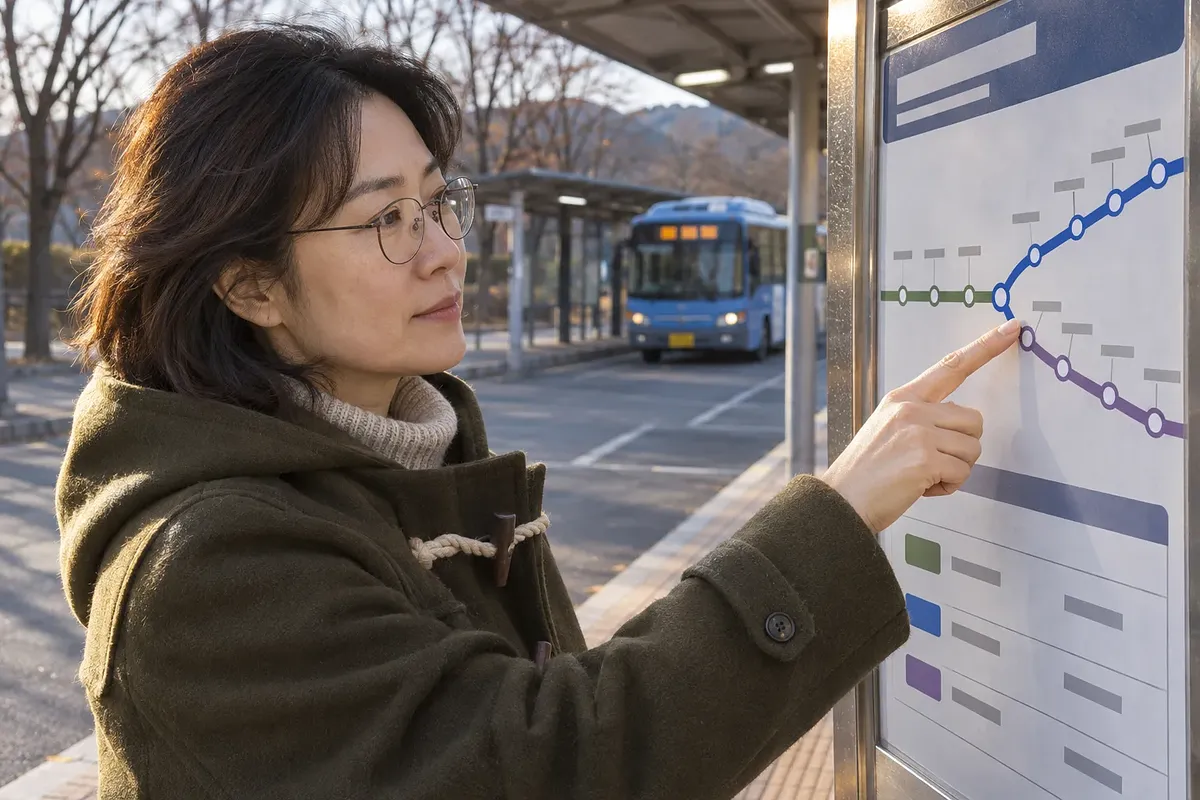
Under 'Find a Village Bus' on the left side of this site, select a city and enter a neighborhood name or route number.
Choose the direction that lists the stop where you get on before the stop where you get off.
Check when the first and last buses run and how often they come, then see when the bus is due at your stop and how long the ride between the two stops takes.
Check fares by age group and payment options for your route, and use the same transit card when you transfer.
Before you leave, check the city's bus information website for route changes and detour notices.
Enter a neighborhood name or route number in “Find a Neighborhood Bus” on the left side of this site. Select your direction of travel to see when the bus is expected at your stop. The standard fare is 500 won on Jeonju’s Baro On and 1,550 won by card on Chuncheon’s neighborhood buses. Transfer windows vary by city and by the route you take next.
Fares and transfer rules are based on local government and transit agency information checked on November 11, 2026.
How to check first and last neighborhood buses and expected arrivals at your stop
Check first and last buses by route, and check upcoming arrivals for the stop where you’ll board.
· Select your city in “Find a Neighborhood Bus” on the left. You can search by neighborhood name or by a route number that includes Korean characters, such as “군위1”. · Open the route’s list of stops and check that your destination comes after the stop where you’ll board. If several routes share the same number, check the direction name too. · Check the first and last bus times and how often buses run in your direction. If the first and last times are departures from the starting terminal, the bus will pass stops along the route at different times. · Select your boarding stop to check expected arrivals. To see how long the ride will take, select your boarding and destination stops. · Before leaving, check the city’s bus information website for notices about detours or service changes. Expected arrival times may change with road conditions.
Route names and bus information websites by city
In Incheon, you can search by number alone, but for routes such as Gwangju’s 마을720 or Chuncheon’s 신북1, including the Korean characters before the number makes it easier to find the right route.
City | Name or number to search | Official bus information website Incheon | 533, 534, 무의1 | Incheon Bus Information Daegu | 군위1 through 군위11. Check the direction even if the route number is the same | Daegu Bus Information System Gwangju | 마을720 | Gwangju Bus Service Information Daejeon | Yuseong-gu 마을1, 마을3, 마을5 | Daejeon Traffic Information Center Ulsan | Use the area name and number, as in 울주61. Check whether it’s a feeder, neighborhood, or Masil bus | Ulsan Traffic Management Center Sejong | As with Route 91 in Jeondong-myeon, look it up by town or township name and route number | Sejong Traffic Information System Chuncheon | Search by town or township name and number, as in 신북1 | Chuncheon Live Bus Jeonju | The public neighborhood bus service “Baro On.” Search by the name of your boarding stop | Jeonju Traffic Information Center
New address for Gwangju bus information
The new address for Gwangju Bus Service Information is bus.jeonnam-gwangju.go.kr. This is the address listed following the launch of Jeonnam-Gwangju Integrated Special City on July 1, 2026. If your old bookmark no longer works, use the Gwangju Bus Service Information link in the table above.
Public neighborhood buses and local bus operators
Jeonju Facilities Corporation operates Jeonju’s public neighborhood bus service, “Baro On”. Sejong Urban Transportation Corporation lists neighborhood bus routes by town and township. In Chuncheon, different companies serve different areas. For questions about buses toward Sinbuk, look up Maeil Tourism Co., Ltd. on the city’s transportation portal.
According to Ulsan’s December 2025 count, 6 companies operated 47 neighborhood buses on 21 routes. Ulsan counts its 10 Masil bus routes separately. In its transfer guide, Ulsan classifies Ulju61 as a feeder bus.
Neighborhood bus fares by transit card and cash
Find your route first, then check the adult, youth, or child column that applies to you. Each cell lists the transit card fare first and the published cash fare second, in won. If cash payments are restricted, follow the payment instructions on board.
City or route | Adult card / cash | Youth card / cash | Child card / cash | Fare reference Incheon 533 and 534 | 1,200 / 1,300 | 850 / 900 | 500 / 500 | Feeder fare, effective October 7, 2023 Incheon Muui1 | 1,500 / 1,600 | 1,050 / 1,100 | 600 / 600 | Main route fare, effective October 7, 2023 Daegu Gunwi | 1,500 / 1,700 | 850 / 1,000 | 400 / 500 | Updated by Gunwi County on May 8, 2026 Gwangju neighborhood buses | 1,250 / 1,400 | 800 / 1,000 | 400 / 500 | Checked November 11, 2026. Same fare as regular city buses Daejeon Yuseong-gu | 1,350 / 1,450 | 650 / 700 | 300 / 350 | Daejeon Bus Transportation Business Association, as of February 13, 2026 Ulsan neighborhood buses | 1,000 / 1,100 | 750 / 800 | Free / 500 | Checked November 11, 2026. Same fare as feeder buses Sejong neighborhood buses | 1,300 / cash restricted | 1,000 / cash restricted | Free / cash restricted | Checked November 11, 2026. Pay by bank transfer if necessary Chuncheon city and neighborhood buses | 1,550 / 1,700 | 1,210 / 1,360 | 700 / 850 | Chuncheon city notice, August 5, 2024 Jeonju Baro On | 500 / 500 | 500 / 500 | 500 / 500 | Held unchanged in the August 1, 2025 fare adjustment
Incheon runs cashless buses, so bring a transit card. In Sejong, children ride free only with a transit card registered for child fares. In Ulsan, children also ride free with a child transit card, and the cash fare is 500 won.
On August 1, 2025, Jeonju changed the cash fare for regular city buses to 1,700 won. Paying by transit card takes 50 won off that fare. On the same day, the Baro On fare was kept at 500 won.
Transfer windows and limits by city
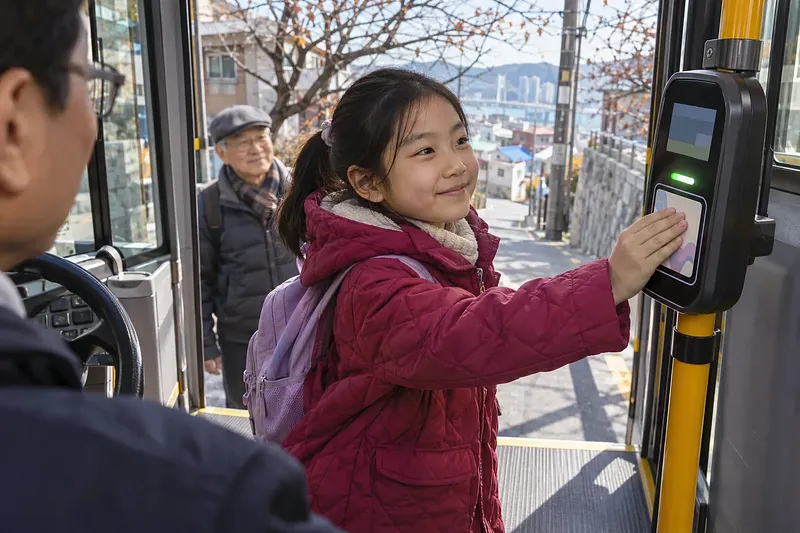
To transfer, tap your card when you get off and use the same card on your next ride. In Gwangju and Chuncheon, the window starts when you get off the first bus. In Daejeon, the window depends on how often the next route runs on weekdays on average.
City | Transfer window | Transfer limits and conditions Incheon | Within 30 minutes of getting off for trips covered by the Seoul metropolitan area’s integrated transfer system, or within 60 minutes from 9 p.m. to 7 a.m. the next day | Discounts on up to 4 transfers. Extra fares may apply depending on distance traveled and other factors Daegu Gunwi | Within 30 minutes of getting off the first bus, according to Gunwi County | Up to 2 transfers in the Daegu area. Free transfers include other Daegu bus routes, urban rail, and Gyeongsan and Yeongcheon city buses. The fare difference applies to express buses Gwangju | Within 30 minutes of getting off the first bus | Unlimited transfers between Gwangju city buses, the subway, and neighborhood buses. The fare difference when transferring from a neighborhood bus to a regular city bus is 0 won Daejeon Yuseong-gu | Within 30 minutes of getting off if the average weekday interval on the next route is at most 15 minutes, or within 60 minutes if it is at least 16 minutes | 3 transfers in total. Pay the fare difference if you transfer to a more expensive service Ulsan | Normally within 40 minutes of getting off the first bus. City-designated routes such as Ulju61 still have a 60-minute window | Unlimited transfers. The adult discount is based on the first bus fare and is capped at 1,500 won Sejong | Within 60 minutes of tapping your card at the reader when you get off | Up to 3 transfers between bus rapid transit (BRT), city buses, and neighborhood buses Chuncheon | Within 60 minutes of tapping your card at the reader when you get off the first bus | Unlimited transfers between city and neighborhood buses. The same route and the same vehicle are excluded Jeonju | The city bus fare adjustment notice lists 1 free transfer within 40 minutes of getting off | For trips using both Baro On and a city bus, the window depends on which bus you take first. Check with Jeonju’s Bus Policy Division
Chuncheon’s “Transfer Guide for Chuncheon City and Neighborhood Buses” specifies how the window is measured.
A new base fare applies once 60 minutes have passed since you got off the first bus you boarded.
Example of how to calculate a transfer fare
If you use a standard transit card to ride a neighborhood bus in Gunwi and then transfer to an express bus, you still pay the fare difference even if you meet the transfer conditions. Gunwi County’s fare table lists standard card fares of 1,500 won for neighborhood buses and 1,950 won for express buses. You pay the 450 won difference when you board the express bus.
Transfer from a Gunwi neighborhood bus to | If you meet the transfer conditions with a standard transit card | Total for both rides Another route on a regular Daegu city bus | 0 won extra | 1,500 won Daegu express bus | 450 won extra | 1,950 won
Why the same route number appears more than once in search results
The National Public Transportation Information Center (TAGO) lists separate entries for route variants with different directions and stops. Gunwi1 is also split into Sanggok-bound and Gyosuchon-bound services in the Gunwi County timetable. Even if the number is the same, check that the bus goes through your destination.
City | TAGO neighborhood bus entries, checked November 11, 2026 Incheon | 13 Daegu | 23, all variants of Gunwi1 through Gunwi11 Gwangju | 7 Daejeon | 3, Yuseong-gu routes 1, 3, and 5 Ulsan | 98 Sejong | 50 Chuncheon | 151 Jeonju | 122
Check with the public transit department at city hall or the district office for the local government’s official route count. You can give the bus operator the route number and direction and ask whether the bus is running that day. If you have trouble finding the right department, dial the area code followed by 120 to reach the city call center.
0:00 0:00
1 / 37

Advertisement

Download text

File name
village-bus-routes-fares-transfers-eight-korean-cities-en.txt
Format
TXT (text/plain)
Paragraphs
37

Downloads exactly what you see as a text file.

Please cite the source when quoting.

Advertisement

Large text

Makes the text larger and the colors clearer. Turn it on if the text feels too small.

Choose the direction in which your drop-off stop comes after your boarding stop.

Key points

  • Under 'Find a Village Bus' on the left side of this site, select a city and enter a neighborhood name or route number.
  • Choose the direction that lists the stop where you get on before the stop where you get off.
  • Check when the first and last buses run and how often they come, then see when the bus is due at your stop and how long the ride between the two stops takes.
  • Check fares by age group and payment options for your route, and use the same transit card when you transfer.
  • Before you leave, check the city's bus information website for route changes and detour notices.

Enter a neighborhood name or route number in “Find a Neighborhood Bus” on the left side of this site. Select your direction of travel to see when the bus is expected at your stop. The standard fare is 500 won on Jeonju’s Baro On and 1,550 won by card on Chuncheon’s neighborhood buses. Transfer windows vary by city and by the route you take next.

Fares and transfer rules are based on local government and transit agency information checked on November 11, 2026.

How to check first and last neighborhood buses and expected arrivals at your stop

Check first and last buses by route, and check upcoming arrivals for the stop where you’ll board.

  1. Select your city in “Find a Neighborhood Bus” on the left. You can search by neighborhood name or by a route number that includes Korean characters, such as “군위1”.
  2. Open the route’s list of stops and check that your destination comes after the stop where you’ll board. If several routes share the same number, check the direction name too.
  3. Check the first and last bus times and how often buses run in your direction. If the first and last times are departures from the starting terminal, the bus will pass stops along the route at different times.
  4. Select your boarding stop to check expected arrivals. To see how long the ride will take, select your boarding and destination stops.
  5. Before leaving, check the city’s bus information website for notices about detours or service changes. Expected arrival times may change with road conditions.
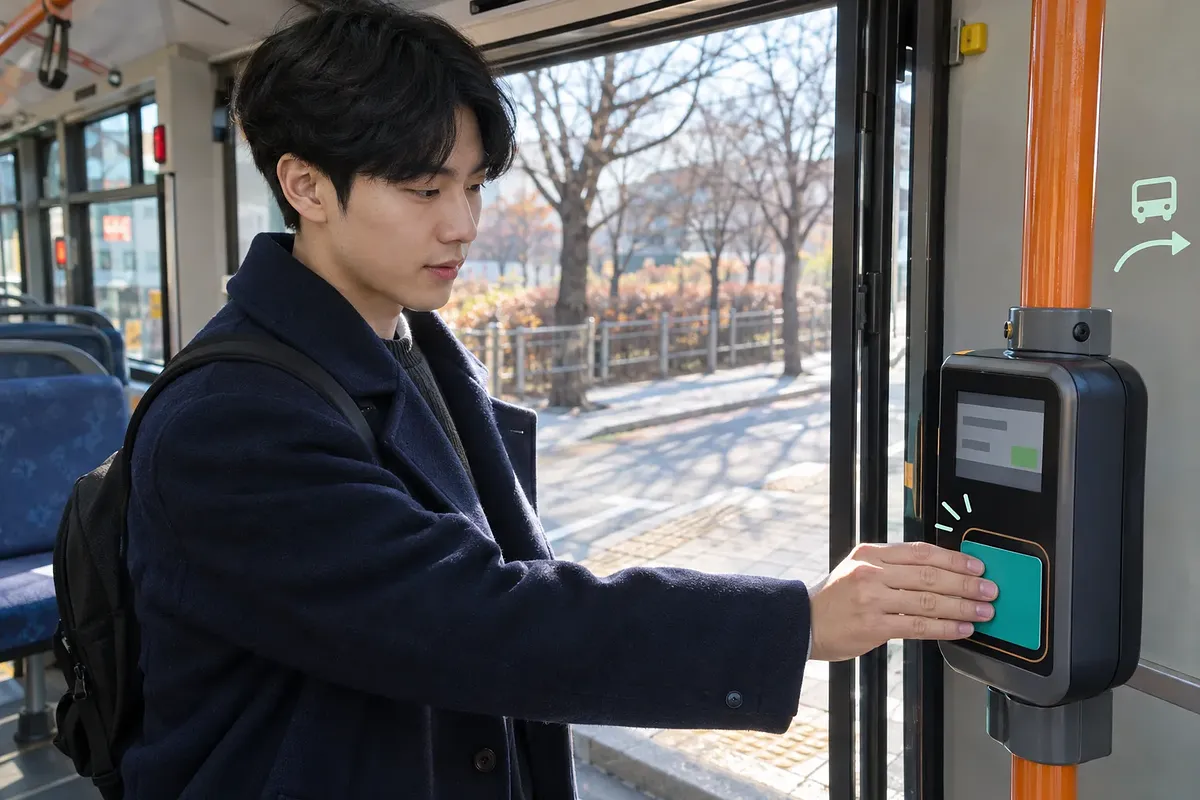
When you transfer, use the same transit card you used on the first bus.

Route names and bus information websites by city

In Incheon, you can search by number alone, but for routes such as Gwangju’s 마을720 or Chuncheon’s 신북1, including the Korean characters before the number makes it easier to find the right route.

City Name or number to search Official bus information website
Incheon 533, 534, 무의1 Incheon Bus Information
Daegu 군위1 through 군위11. Check the direction even if the route number is the same Daegu Bus Information System
Gwangju 마을720 Gwangju Bus Service Information
Daejeon Yuseong-gu 마을1, 마을3, 마을5 Daejeon Traffic Information Center
Ulsan Use the area name and number, as in 울주61. Check whether it’s a feeder, neighborhood, or Masil bus Ulsan Traffic Management Center
Sejong As with Route 91 in Jeondong-myeon, look it up by town or township name and route number Sejong Traffic Information System
Chuncheon Search by town or township name and number, as in 신북1 Chuncheon Live Bus
Jeonju The public neighborhood bus service “Baro On.” Search by the name of your boarding stop Jeonju Traffic Information Center

New address for Gwangju bus information

The new address for Gwangju Bus Service Information is bus.jeonnam-gwangju.go.kr. This is the address listed following the launch of Jeonnam-Gwangju Integrated Special City on July 1, 2026. If your old bookmark no longer works, use the Gwangju Bus Service Information link in the table above.

Public neighborhood buses and local bus operators

Jeonju Facilities Corporation operates Jeonju’s public neighborhood bus service, “Baro On”. Sejong Urban Transportation Corporation lists neighborhood bus routes by town and township. In Chuncheon, different companies serve different areas. For questions about buses toward Sinbuk, look up Maeil Tourism Co., Ltd. on the city’s transportation portal.

According to Ulsan’s December 2025 count, 6 companies operated 47 neighborhood buses on 21 routes. Ulsan counts its 10 Masil bus routes separately. In its transfer guide, Ulsan classifies Ulju61 as a feeder bus.

Neighborhood bus fares by transit card and cash

Find your route first, then check the adult, youth, or child column that applies to you. Each cell lists the transit card fare first and the published cash fare second, in won. If cash payments are restricted, follow the payment instructions on board.

City or route Adult card / cash Youth card / cash Child card / cash Fare reference
Incheon 533 and 534 1,200 / 1,300 850 / 900 500 / 500 Feeder fare, effective October 7, 2023
Incheon Muui1 1,500 / 1,600 1,050 / 1,100 600 / 600 Main route fare, effective October 7, 2023
Daegu Gunwi 1,500 / 1,700 850 / 1,000 400 / 500 Updated by Gunwi County on May 8, 2026
Gwangju neighborhood buses 1,250 / 1,400 800 / 1,000 400 / 500 Checked November 11, 2026. Same fare as regular city buses
Daejeon Yuseong-gu 1,350 / 1,450 650 / 700 300 / 350 Daejeon Bus Transportation Business Association, as of February 13, 2026
Ulsan neighborhood buses 1,000 / 1,100 750 / 800 Free / 500 Checked November 11, 2026. Same fare as feeder buses
Sejong neighborhood buses 1,300 / cash restricted 1,000 / cash restricted Free / cash restricted Checked November 11, 2026. Pay by bank transfer if necessary
Chuncheon city and neighborhood buses 1,550 / 1,700 1,210 / 1,360 700 / 850 Chuncheon city notice, August 5, 2024
Jeonju Baro On 500 / 500 500 / 500 500 / 500 Held unchanged in the August 1, 2025 fare adjustment

Incheon runs cashless buses, so bring a transit card. In Sejong, children ride free only with a transit card registered for child fares. In Ulsan, children also ride free with a child transit card, and the cash fare is 500 won.

On August 1, 2025, Jeonju changed the cash fare for regular city buses to 1,700 won. Paying by transit card takes 50 won off that fare. On the same day, the Baro On fare was kept at 500 won.

Transfer windows and limits by city

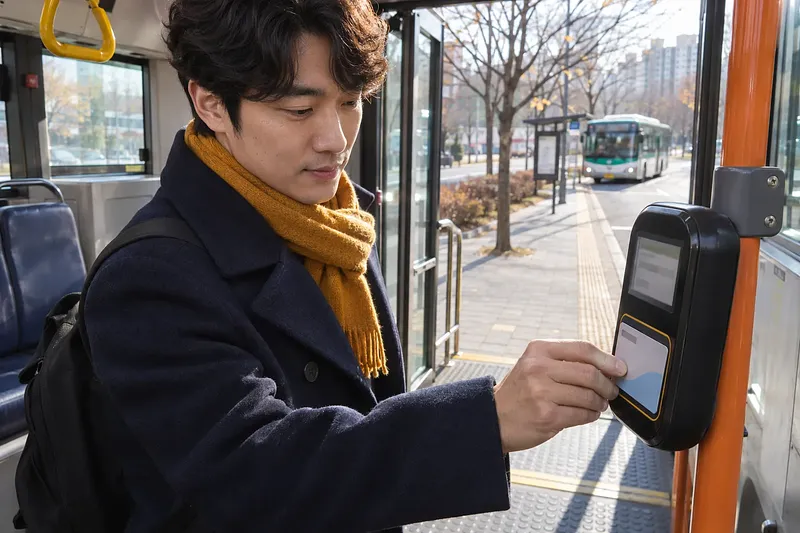
To transfer, tap your card when you get off and use the same card on your next ride. In Gwangju and Chuncheon, the window starts when you get off the first bus. In Daejeon, the window depends on how often the next route runs on weekdays on average.

City Transfer window Transfer limits and conditions
Incheon Within 30 minutes of getting off for trips covered by the Seoul metropolitan area’s integrated transfer system, or within 60 minutes from 9 p.m. to 7 a.m. the next day Discounts on up to 4 transfers. Extra fares may apply depending on distance traveled and other factors
Daegu Gunwi Within 30 minutes of getting off the first bus, according to Gunwi County Up to 2 transfers in the Daegu area. Free transfers include other Daegu bus routes, urban rail, and Gyeongsan and Yeongcheon city buses. The fare difference applies to express buses
Gwangju Within 30 minutes of getting off the first bus Unlimited transfers between Gwangju city buses, the subway, and neighborhood buses. The fare difference when transferring from a neighborhood bus to a regular city bus is 0 won
Daejeon Yuseong-gu Within 30 minutes of getting off if the average weekday interval on the next route is at most 15 minutes, or within 60 minutes if it is at least 16 minutes 3 transfers in total. Pay the fare difference if you transfer to a more expensive service
Ulsan Normally within 40 minutes of getting off the first bus. City-designated routes such as Ulju61 still have a 60-minute window Unlimited transfers. The adult discount is based on the first bus fare and is capped at 1,500 won
Sejong Within 60 minutes of tapping your card at the reader when you get off Up to 3 transfers between bus rapid transit (BRT), city buses, and neighborhood buses
Chuncheon Within 60 minutes of tapping your card at the reader when you get off the first bus Unlimited transfers between city and neighborhood buses. The same route and the same vehicle are excluded
Jeonju The city bus fare adjustment notice lists 1 free transfer within 40 minutes of getting off For trips using both Baro On and a city bus, the window depends on which bus you take first. Check with Jeonju’s Bus Policy Division

Chuncheon’s “Transfer Guide for Chuncheon City and Neighborhood Buses” specifies how the window is measured.

A new base fare applies once 60 minutes have passed since you got off the first bus you boarded.

Example of how to calculate a transfer fare

If you use a standard transit card to ride a neighborhood bus in Gunwi and then transfer to an express bus, you still pay the fare difference even if you meet the transfer conditions. Gunwi County’s fare table lists standard card fares of 1,500 won for neighborhood buses and 1,950 won for express buses. You pay the 450 won difference when you board the express bus.

Transfer from a Gunwi neighborhood bus to If you meet the transfer conditions with a standard transit card Total for both rides
Another route on a regular Daegu city bus 0 won extra 1,500 won
Daegu express bus 450 won extra 1,950 won

Why the same route number appears more than once in search results

The National Public Transportation Information Center (TAGO) lists separate entries for route variants with different directions and stops. Gunwi1 is also split into Sanggok-bound and Gyosuchon-bound services in the Gunwi County timetable. Even if the number is the same, check that the bus goes through your destination.

City TAGO neighborhood bus entries, checked November 11, 2026
Incheon 13
Daegu 23, all variants of Gunwi1 through Gunwi11
Gwangju 7
Daejeon 3, Yuseong-gu routes 1, 3, and 5
Ulsan 98
Sejong 50
Chuncheon 151
Jeonju 122

Check with the public transit department at city hall or the district office for the local government’s official route count. You can give the bus operator the route number and direction and ask whether the bus is running that day. If you have trouble finding the right department, dial the area code followed by 120 to reach the city call center.

Open the link

Opens in a new window.

Advertisement

Sign-in required

Sign in with your Google or Apple account to like, comment, and save highlights.

FAQ

Do Incheon village buses charge the same fare regardless of route number?

Routes 533 and 534 cost 1,200 won with a standard transit card. Muui 1 uses the trunk bus fare, so it costs 1,500 won with the same card.

Which bus should I choose in the search results for Gunwi 1?

Choose the route toward Sanggok or Gyosuchon that serves the stop where you want to get off. You can check the stops in each direction on the Gunwi County Office’s “Village Bus and Happy Bus” page.

Do I pay extra if I transfer from Gwangju village bus 720 to a regular city bus?

If you use the same transit card and meet Gwangju’s local transfer requirements within 30 minutes of getting off the first bus, the extra fare is 0 won. There is no limit on the number of transfers within that time.

Does the transfer window increase to 60 minutes if the bus is late in Daejeon?

Daejeon bases the transfer window on the average weekday interval between buses on the route you’re transferring to. If the interval is at most 15 minutes, the window is 30 minutes. If the interval is at least 16 minutes, the window is 60 minutes. The real-time wait displayed at the stop is not used to calculate it.

What card do seniors need to ride village buses for free in Ulsan?

Under the expanded rules as of July 1, 2025, Ulsan residents who are at least 75 years old must use an Ulsan Senior Transit Card in their own name. The limit is 60 free rides per month, not counting transfers. Before riding, check with the Ulsan city government’s Haeuli Call Center to see whether eligibility has been expanded further to include residents who are at least 65 years old.

Can I ride a Sejong village bus without a transit card?

Sejong restricts cash payments on buses and advises passengers to pay by bank transfer when there is no other option. To get the free child fare, bring a transit card registered for use by a child.

Does the 60-minute transfer window restart every time I transfer between village buses in Chuncheon?

In Chuncheon, the 60-minute window starts when you tap your card as you get off the first bus. Within that time, you can make unlimited free transfers as long as you switch to a different bus on a different route. Gyeongchun Line trains and ITX are not covered by this transfer policy.

Does the 50 won city bus discount for transit card users also apply to Jeonju’s Baroon service?

The Baroon fare is 500 won whether you pay by card or in cash. The 50 won card discount announced in the August 1, 2025 fare adjustment applies to city buses.

Can I use Incheon’s i-Silver Pass to ride a bus in 2026?

In a notice dated September 21, 2026, the Incheon city government said it had put the 2026 launch of the i-Silver Pass on hold. For updates on when it will launch, check the “i-Silver Pass” page on Incheon’s Transportation and Roads website.

Sources

Data formats

This content is available in several machine-friendly formats.

Data-only languages (machine translated, files only)

Indonesian JSON MD Portuguese JSON MD Chinese (Traditional) JSON MD Deutsch JSON MD

Verification

This article was drafted with AI and then reviewed and edited by a person.

Reviewed by 신익희 · 편집장 · 2026-11-26

Figures in this article were checked against the source material during generation. 1 correction(s) applied. · 2026-11-26

This translation has been cross-checked by AI. · 2026-11-26

Reuse & AI usage

Search indexing and AI citation with attribution are welcome. See the license policy for details.

Site license policy (commercial republishing requires permission) · License

Loading…

Loading…

Loading…

From Injoys

Request the content you want and take 70% of what it earns

Just leave the subject. We handle production, review, translation and distribution.

See how revenue sharing works

Comments