Utagawa Hiroshige Exhibition Phase 3: Prints and Admission
From November 25 to December 20, 2026, the Tokyo National Museum will display all the prints from Hiroshige's One Hundred Famous Views of Edo in Room A on the first floor of the main building. No advance reservation is required. Regular same-day tickets cost 1,500 yen at the main entrance, with a 100 yen discount through the official online ticket seller.
All the works on display will change on November 25, 2026 (Japan), and visitors can see all 120 prints from One Hundred Famous Views of Edo in one place during phase 3.
The featured print Asakusa Ricefields and Torinomachi Festival is listed as 3-049. The official list of works and the gallery label both show the same number.
During phase 3, last entry is at 16:30 on regular opening days and at 19:30 on Fridays and Saturdays.
During phase 3, the museum is closed every Monday and on Tuesday, December 15.
The discounted online price for a regular same-day ticket is 1,400 yen. Same-day tickets for university students cost 500 yen regardless of where they are purchased.
Phase 3 of the Utagawa Hiroshige (歌川広重) special exhibition runs from November 25 to December 20, 2026. All the works in One Hundred Famous Views of Edo (名所江戸百景) will be on view in Room A on the first floor of the Main Building at the Tokyo National Museum (東京国立博物館). No advance reservation is required.
The work count comes from the museum’s April 2026 announcement, and admission prices are based on its special exhibition guide for the same year.
Phase 3 schedule and last admission
All the works on display change on Wednesday, November 25 (Japan), the first day of Phase 3. Phase 2 ends on Monday, November 23 (Japan). The museum is closed on Tuesday, November 24, between the two phases.
Item | Visitor information for Phase 3 in 2026
Dates | Wednesday, November 25 to Sunday, December 20
Location | Room A, first floor of the Main Building, Tokyo National Museum
Regular opening days | 9:30 to 17:00, last admission at 16:30
Fridays and Saturdays | 9:30 to 20:00, last admission at 19:30
Phase 3 closure dates | Mondays November 30, December 7, and December 14, and Tuesday, December 15
Last admission is 30 minutes before closing Tokyo National Museum’s Korean-language special exhibition guide, “Opening Hours”
What is the Edo’s Best Angles exhibition?
“Edo’s Best Angles” is listed on the museum’s Korean-language page as “New Landscapes of the Edo Period.” The special exhibition marks the donation of 1,025 ukiyo-e prints from the collection of Susumu Uchiyama (内山晋). Each of the three phases presents one of Hiroshige’s landscape print series in full.
Phase | 2026 exhibition dates | Featured series
Phase 1 | September 29 to October 25 | The 53 Stations of the Tokaido (東海道五拾三次)
Phase 2 | October 27 to November 23 | The 69 Stations of the Kisokaido (木曽海道六拾九次)
Phase 3 | November 25 to December 20 | One Hundred Famous Views of Edo, listed by the museum in Korean as One Hundred Views of Famous Places in Edo
The “hundred views” in One Hundred Famous Views of Edo and the actual work count
According to the museum, 120 works were published in One Hundred Famous Views of Edo. That total includes one sheet listing the titles of the works in the series. It also includes one work by Hiroshige II.
Look at official exhibition numbers 3-076 and 3-077 together and you’ll see the same place depicted by both artists. No. 3-076 shows a paulownia grove in Akasaka (赤坂), depicted by Hiroshige in 1856. The next number shows the grove in evening rain, as depicted by Hiroshige II in 1859.
Phase 3 highlights and what to look for
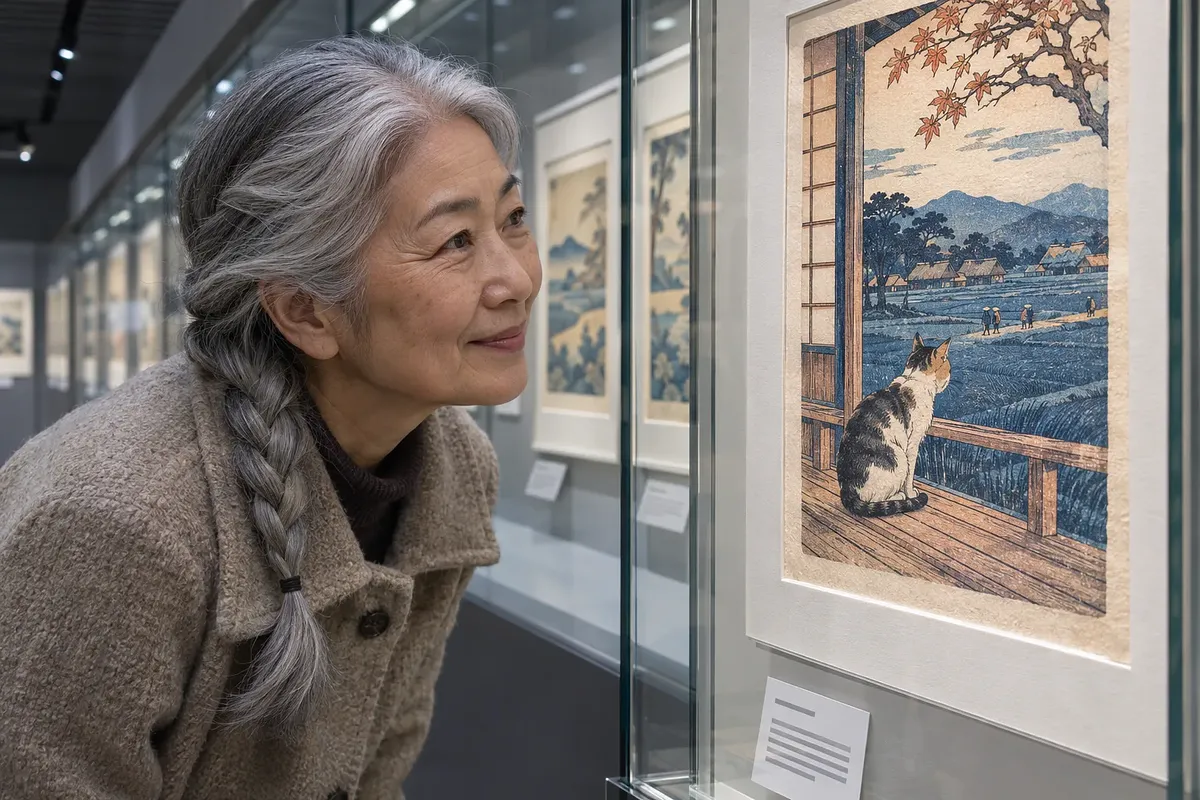
The museum chose “Asakusa Rice Fields and the Torinomachi Pilgrimage” (浅草田甫酉の町詣) as the featured print for Phase 3. In this 1857 work, a cat sits in the foreground, looking out a window. Follow its gaze past the window frame and you’ll see rice fields and pilgrims passing in the distance. Those tiny figures outside the window offer a clue to the title’s reference to the festival.
Exhibition no. | Work | What to look for
3-001 | Sunrise at Kanda Myojin Shrine | The sky over Edo as the day begins
3-049 | Asakusa Rice Fields and the Torinomachi Pilgrimage | The distance between the cat at the window and the pilgrims beyond the rice fields
3-069 | Plum Garden at Kameido | The garden visible beyond the plum tree that fills much of the foreground
3-090 | Fireworks at Ryogoku | Fireworks in the night sky over the river and the bridge below
How to find Phase 3 works in the museum’s list
Phase 3 works start on page 7 of the English list of works PDF. The numbers in the list match those on the gallery labels. The exhibition catalog sold at the museum uses a different numbering system.
· Open the PDF under “List of Works” on the museum’s English-language special exhibition page.
· Search the PDF for 3-001 to jump to the first work in Phase 3. To go straight to the featured print with the cat, search for 3-049.
· Check the English title, artist, and date of the work below the number. In the gallery, match the work to the same number on its label.
The museum makes the list of works available online. If you want a paper copy to use in the gallery, print the PDF before your visit.
Same-day ticket prices at the main gate and online
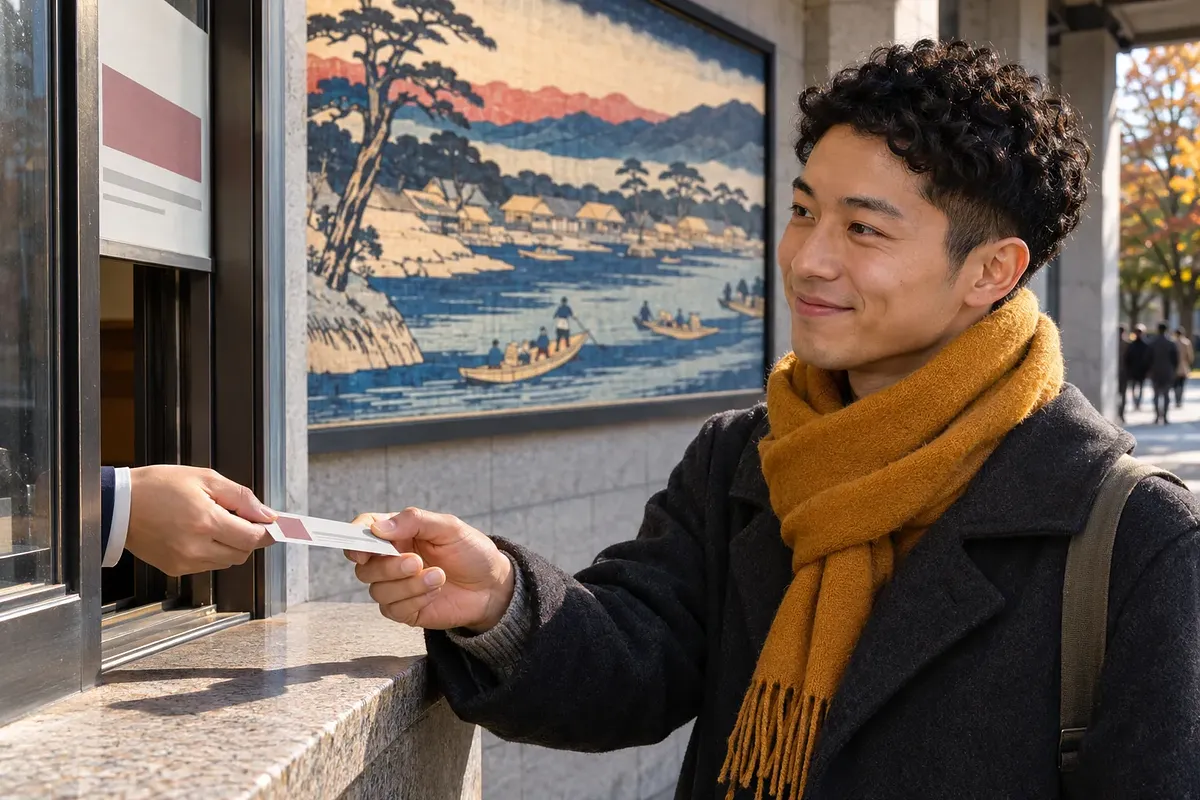
Same-day tickets for Phase 3 are available at the main gate ticket office and through Asoview! (アソビュー!), the museum’s designated online ticket seller. General admission tickets are 100 yen cheaper online. If the gallery is crowded, you may have to wait to get in even with an online ticket.
Where to buy | General admission (1 person) | University student (1 person) | How to buy
Main gate ticket office | 1,500 yen | 500 yen | Buy a special exhibition ticket at the main gate on the day of your visit
Asoview! | 1,400 yen | 500 yen | Use the same-day ticket button in the museum’s special exhibition guide
The online general admission price of 1,400 yen is 100 yen less than the museum’s listed price of 1,500 yen. There is no online discount for university students. Your special exhibition ticket also gives you access to the museum’s collection displays on the day of your visit.
Who qualifies for free admission
High school students and younger students, anyone less than 18 years old, and anyone at least 70 years old get in free. Visitors with disabilities and 1 accompanying caregiver also get in free. At entry, show documentation confirming that you qualify, such as proof of age or disability.
Students at schools in the museum’s Campus Members program also get in free. Tell the staff at the main gate ticket window that you attend a member school and show your student ID.
Getting from Ueno Station to Room A in the Main Building
From JR Ueno Station (上野駅), take the Park Exit for a walk of about 10 minutes to the museum. If you get off at Ueno Station on the Tokyo Metro instead, the museum puts the walk at about 15 minutes. Enter through the main gate, then go to Room A on the first floor of the Main Building.
Starting station | Listed walking time to the museum
JR Ueno Station Park Exit, JR Uguisudani Station (鶯谷駅) South Exit | About 10 minutes
Tokyo Metro Ueno Station on the Ginza and Hibiya lines, Nezu Station (根津駅) on the Chiyoda Line | About 15 minutes
Keisei Ueno Station (京成上野駅) | About 15 minutes