Injoys
Enterprise AI transformation, or AX, is not completed simply by distributing generative AI accounts to employees. To achieve tangible results, the environment must be structured so that AI can observe the state of the company’s operations, select permitted actions, and learn from execution outcomes.
What is needed here is a business world model. However, this expression is not yet a standard term used consistently across all companies and research institutions. Here, it refers to an operational environment model that represents an enterprise’s entities, relationships, rules, states, actions, and outcomes in a way that AI can reason about and validate.
Why the Benchmark for AX Is Shifting from Adoption Volume to ROI
During the initial adoption of generative AI, activity metrics such as the number of accounts, utilization rates, and the number of documents generated were commonly used. However, these metrics alone make it difficult to demonstrate increased revenue, reduced costs, shorter processing times, or lower risk.
In a forecast published in 2025, Gartner predicted that at least 40% of agentic AI projects would be canceled by the end of 2027 due to rising costs, unclear business value, and inadequate risk controls. RAND’s research on AI project failures also identifies data quality, problem definition, and the gap between organizational expectations and actual capabilities as major causes rather than the technology itself.
Failure rates cited in specific announcements or surveys vary in both the populations studied and the definitions of failure. Therefore, figures such as “88% failure” or “46% discontinued” should not be used as universal statistics for all AX projects when their sources and populations cannot be verified.
Why Conventional DX Approaches Do Not Work As-Is
Traditional business systems are static tools with relatively clear inputs and processing rules. AI agents, by contrast, are dynamic systems that repeat the following process.
- Observe documents, databases, APIs, or user requests.
- Interpret the current state and goals.
- Select tools or the next action.
- Execute tasks that affect external systems.
- Review the results and revise the plan.
If probabilistic agents are immediately given the same permissions as conventional systems, they may place incorrect orders, violate regulations, expose personal information, or make changes that are difficult to reverse. The scope of tool use, approval procedures, stop conditions, logs, and recovery mechanisms must therefore be designed together.
Differences Between Fine-Tuning, RAG, Harnesses, Loops, and World Models
These approaches do not replace one another; they are components that address different problems.
| Approach | Primary purpose | What it does well | Limitations when used alone |
|---|---|---|---|
| Fine-tuning | Adjust model behavior or output tendencies | Optimize specific formats, classification, tone, and repetitive tasks | Difficult to continuously reflect current internal knowledge and changing rules |
| RAG | Retrieve external knowledge at execution time | Provide current documents, manuals, examples, and evidence | Does not guarantee that retrieved information is applicable to the current state |
| Harness engineering | Build the execution infrastructure around the model | Tool integration, memory, permissions, observability, and error handling | If business semantics and policies are defined incorrectly, even a sophisticated harness will automate the wrong work |
| Loop engineering | Design repeated observation, planning, execution, and evaluation | Retries, self-correction, human approval, and outcome feedback | Weak termination conditions can increase costs and cause repeated errors |
| Business world model | Specify the enterprise environment and state transitions | Feasibility, policy compliance, impact tracking, and simulation | Requires ongoing participation from domain experts to build and maintain |
Fine-tuning itself cannot be broadly dismissed as wasteful. It is useful for internalizing stable task formats or repetitive behaviors in a model. However, if frequently changing facts such as pricing policies, approval limits, and inventory status are stored only in model weights, updating and auditing them becomes difficult. Such information is generally better managed in a retrieval layer, rules layer, or operational database.
Components of a Business World Model
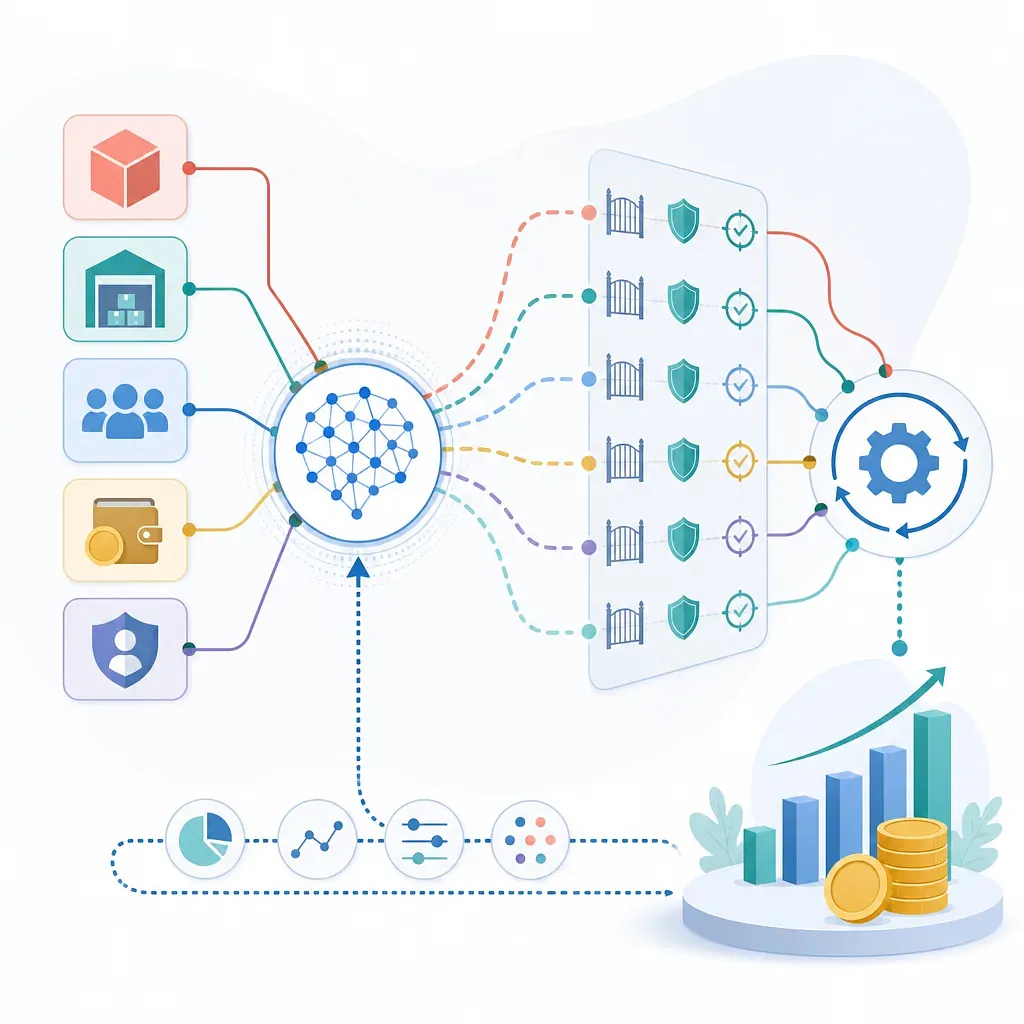
A good world model differs from a knowledge repository that simply collects large numbers of documents. It must represent what exists within the company, what state it is in, who can do what, and how the state changes after an action.
| Component | Question | SCM and promotion example |
|---|---|---|
| Entities | What exists? | Products, customer segments, regions, warehouses, channels, campaigns |
| Relationships | How are entities connected? | Suppliers by product, sales channels by region |
| State | What is currently true? | Inventory levels, sales prices, contract status, remaining budget |
| Actions | What changes can be executed? | Price changes, purchase orders, advertising, campaign termination |
| Transition conditions | How does the state change after an action? | Available budget decreases and expected inbound inventory increases after purchase-order approval |
| Constraints | What is prohibited or restricted? | Minimum margin, discount cap, restrictions on personal information use |
| Permissions | Who approves what? | Team leader or executive approval by discount-rate range |
| Goals | What is being optimized? | A combination of margin, inventory turnover, and stockout risk rather than revenue alone |
| Observations | How are outcomes verified? | Orders, returns, advertising spend, actual margins, customer complaints |
This structure can be implemented using various technologies, including ontologies, knowledge graphs, rules engines, state stores, process models, simulators, and policy code. It does not have to be a single massive model or a specific product.
How a Neuro-Symbolic Architecture Works
Neuro-symbolic AI combines the pattern recognition and generation capabilities of neural networks with explicit symbolic and logical representations. In an enterprise world model, responsibilities can be divided between the two layers as follows.
Neural Layer: Candidate Generation and Uncertainty Handling
LLMs and predictive models are well suited to interpreting unstructured documents, forecasting demand, and generating diverse execution scenarios. For example, they can propose multiple promotional candidates by combining products, regions, prices, advertising spend, and channel fees.
However, even if generated candidates appear factual, they may violate actual inventory, contracts, or approval policies. Neural outputs should be treated not as execution commands but as candidates pending validation.
Symbolic Layer: Fixed Rules and Feasibility Validation
The symbolic layer checks explicit conditions such as the following.
- Is the expected margin after the discount at least the company’s lower threshold?
- Does the company have the contractual authority to sell the product in that region?
- Is there any campaign budget remaining?
- Is the purpose of using customer data within the scope of consent?
- Can the original state be restored if execution fails?
- Has the required human approval been obtained?
Passing the rule checks indicates policy compliance, but it does not automatically indicate the probability of achieving business results. To provide figures such as “90% confidence,” a calibration process is needed to adjust probabilities by comparing past predictions with actual outcomes.
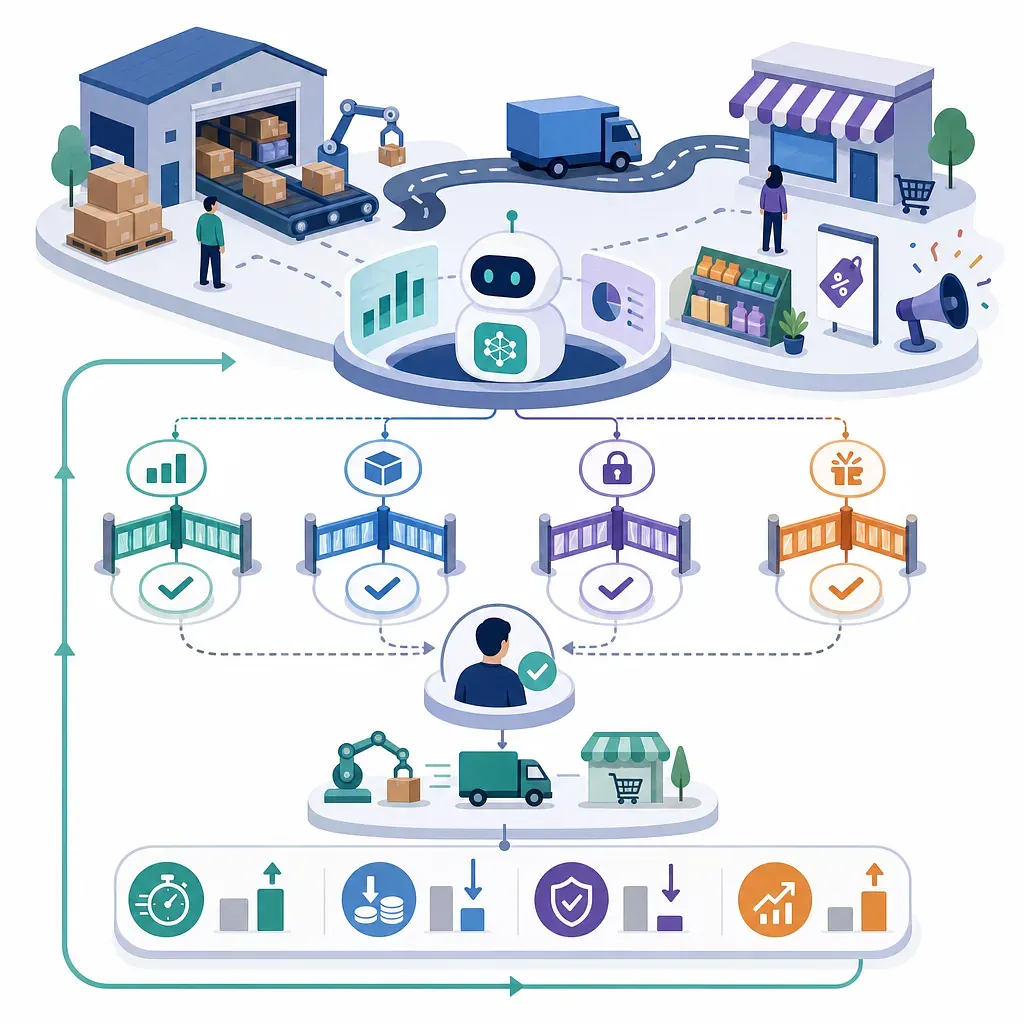
Closed-Loop Execution for SCM Promotion Planning
1. State Observation
The system reads inventory, supply schedules, sales performance, prices, margins, advertising spend, and channel fees. It also records the reference time and source of the data.
2. Candidate Generation
The neural model creates multiple promotional candidates by considering revenue and margin, inventory depletion, stockout probability, and other factors. If simulations are used, assumptions such as demand distributions and price elasticity must be specified.
3. Policy Validation
The symbolic layer checks discount caps, minimum margins, inventory constraints, contract terms, and approval authority. Candidates that violate these conditions are discarded or modified to remain within permitted limits.
4. Risk-Based Approval
Easily reversible actions, such as drafting recommendation copy, can be automated. In contrast, high-impact actions such as price changes, bulk purchase orders, and customer contact require human approval. Approval levels can vary depending on the amount, number of customers affected, and reversibility.
5. Execution and Tracking
Before execution, the expected revenue, margin, cost, and risk range of the selected campaign are stored. After execution, they are compared with actual outcomes to track errors and policy violations.
6. Termination and Learning
If a loss limit, deviation from the forecast range, or data anomaly is detected, the system automatically stops or escalates the task to a person. Causes of failure are categorized as data errors, assumption errors, missing rules, model errors, or changes in the external environment, and the findings are applied to subsequent executions.