Skip to content
Injoys
How-to

Should You Leave an Inverter Air Conditioner On? Guidelines by Time Away

Leaving an inverter air conditioner on the entire time you are away is not always economical. This explains why raising the set temperature is better for short absences while turning the unit off becomes more advantageous the longer you are away, along with criteria for deciding.

Views 24 10 min read KO EN JA ES

Listen or read this article

Listen, or read the text only.

Should You Leave an Inverter Air Conditioner On? Guidelines by Time Away

Kokoro 82M AI-generated voice

0:00 13:35

Download audio

File name
inverter-air-conditioner-away-time-operation-guide-en.mp3
Format
MP3 (audio/mpeg)
Duration
13:35
File size
9.33 MB
Engine
Kokoro 82M

This audio was generated by AI.

You may download and use it freely for personal use.

Should You Leave an Inverter Air Conditioner On? Guidelines by Time Away

11 min read

Should You Leave an Inverter Air Conditioner On? Guidelines by Time Away
Leaving an inverter air conditioner on the entire time you are away is not always economical. This explains why raising the set temperature is better for short absences while turning the unit off becomes more advantageous the longer you are away, along with criteria for deciding.
Inverter models regulate compressor output, while fixed-speed models mainly maintain the temperature by cycling the compressor on and off.
Even after reaching the set temperature, power consumption may not fall sufficiently if the cooling load remains high due to extreme heat, sunlight, humidity, ventilation, or other factors.
Raising the set temperature is convenient for short absences, but turning off the power is generally more advantageous for long absences.
Do not conclude that continuous operation always saves energy based only on the high output at the moment the unit restarts.
Electricity consumption should be calculated as the sum of actual power consumption as it changes over time, not simply by multiplying rated power consumption by operating time.
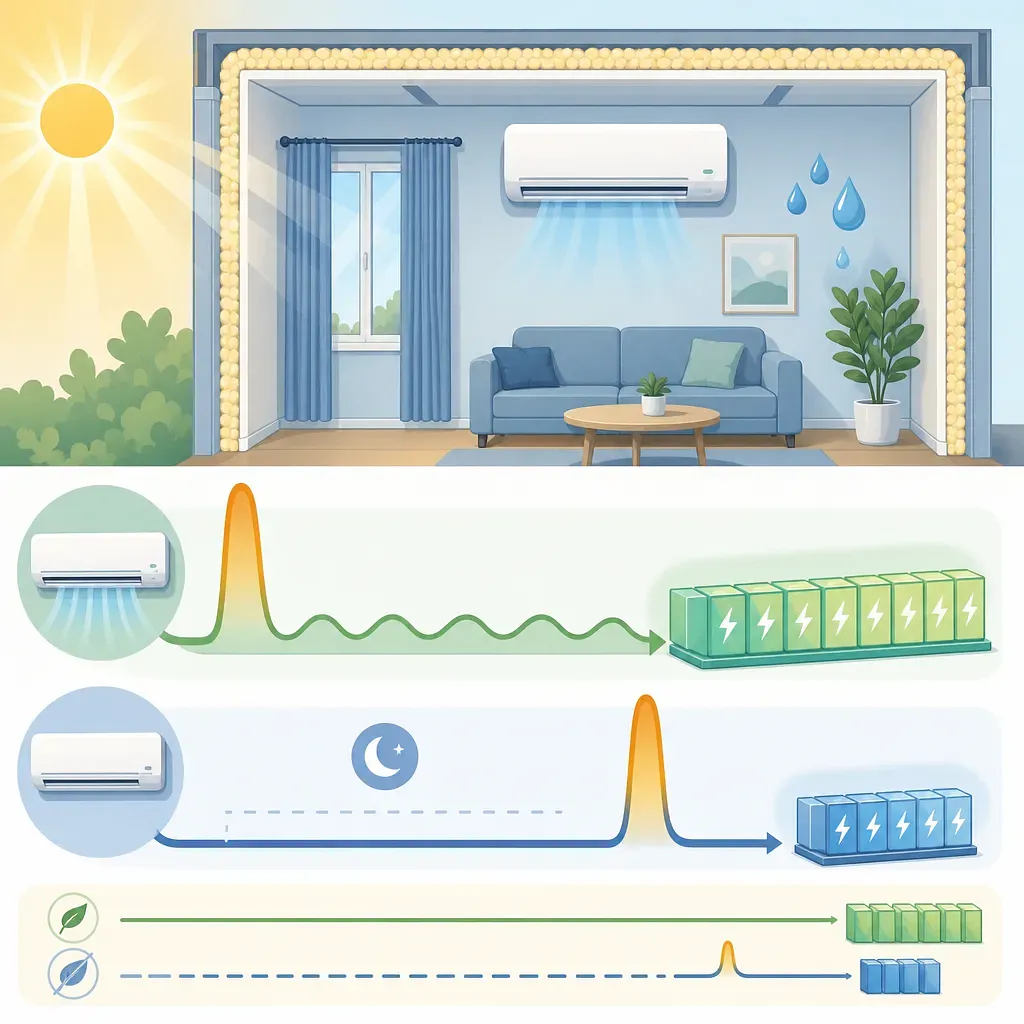
The claim that leaving an inverter air conditioner running continuously reduces electricity bills is true only under certain conditions. Because an inverter model can lower its output after the room has cooled sufficiently, it may be more efficient during a short absence than turning it off and then cooling the room at high output again. However, it continues to consume electricity even when operating at low output, so if you will be away for a long time, it is generally more advantageous to turn it off or raise the set temperature substantially.
The key is not to apply a single time threshold to every home, but to consider the length of the absence, heat entering the room, humidity, the home's insulation performance, and actual electricity consumption together.
How Inverter and Fixed-Speed Models Differ
The compressor that circulates the refrigerant accounts for a large share of an air conditioner's electricity consumption. The two types differ in how they control this compressor.
Category | Inverter model | Fixed-speed model Compressor control | Adjusts rotational speed and cooling capacity in multiple stages or continuously | Generally operates at a fixed output and stops when necessary Before reaching the set temperature | Can cool quickly at high output | Cools at a fixed output After reaching the set temperature | Can switch to low output to maintain the temperature | Tends to repeatedly start and stop the compressor Part-load efficiency | Advantageous when capacity and conditions are appropriate | May start and stop frequently Changes in power | Can vary widely over time | Changes are relatively large depending on whether the compressor is running
An inverter model does not always keep the compressor operating at low output. If the cooling load is lower than its minimum output, the compressor may stop and then restart. Conversely, if the load is high, it may continue using high output even after reaching the set temperature.
Conditions Under Which Power Decreases After Reaching the Set Temperature
The fact that the indoor temperature has reached the set point does not necessarily mean that power consumption will decrease significantly. For the air conditioner to maintain the temperature at low output, its cooling capacity must be sufficient to offset the heat entering the room.
Conditions that make power consumption more likely to decrease include the following:
· Windows and doors are closed, with little outside air entering. · Strong sunlight has been reduced with shades or curtains. · The filter and heat exchanger are clean, allowing air to flow smoothly. · The product has a cooling capacity appropriate for the size of the space. · There are not many heat-producing devices indoors, such as cooking appliances, computers, and lights. · Ventilation around the outdoor unit is unobstructed.
Conversely, extreme heat, intense sunlight through west-facing windows, frequently opened doors, high humidity, insufficient product capacity, and dirty filters increase the cooling load. Under these conditions, even an inverter model may not be able to reduce its output sufficiently, diminishing the potential savings from continuous operation.
Operating Guidelines by Length of Absence
The following table provides ranges that can be used when beginning an experiment in an ordinary household. These are not absolute thresholds for savings, and results will vary depending on insulation, solar heat gain, humidity, product capacity, and the electricity rate structure.
Expected length of absence | Operating method to consider first | Reasoning 30 minutes or less | Leave it as is or raise the set temperature by about 1 degree | The room will soon be occupied again, and the indoor temperature may not change much 30 minutes–2 hours | Compare raising the set temperature by about 1–3 degrees with turning it off | The more advantageous method varies in this range depending on how quickly heat enters the home 2–4 hours | Consider turning it off first; if humidity, pets, or other conditions are a concern, maintain a higher temperature | The electricity consumed by maintaining the temperature begins to accumulate substantially At least 4 hours or all day | Turn it off unless there is a special reason to maintain the indoor environment | There is little need to keep an unoccupied space at a low temperature for a long time
For example, in a well-insulated home with little sunlight, the temperature rises slowly even after the air conditioner is turned off, so turning it off may be advantageous even for a relatively short absence. Conversely, a top-floor or west-facing space with large windows may heat up quickly and take a long time to become comfortable after you return. In this case, the time needed to restore a comfortable temperature should be considered along with the savings.
If pets, older adults, medications, or temperature-sensitive items must be protected even while you are away, maintaining a safe indoor environment takes priority over cost. Instead of turning the air conditioner off completely, consider using a higher set temperature appropriate for safety and checking a remote thermometer.
Is It Wasteful If Restarting Uses a Lot of Power?
Immediately after restarting, the compressor operates at high output, so instantaneous power consumption may be high. However, electricity bills are calculated primarily based not on a single high instantaneous reading, but on the total electrical energy consumed over a period of time.
When cooling is turned off, the indoor temperature approaches the outdoor temperature, reducing the temperature difference between indoors and outdoors. In general, a smaller temperature difference also reduces the rate at which heat enters from outside. Although the heat accumulated in the walls, furniture, and air must be removed again after you return, this recooling period alone does not necessarily consume more energy than maintaining a low temperature throughout your absence.
The following two measurements must therefore be distinguished:
· Power: The rate at which a device uses energy at a particular moment, usually expressed in kW. · Electrical energy: The accumulated power used over a period of time, usually expressed in kWh, and the primary basis for calculating charges.
It is not appropriate to conclude that continuous operation over a long period always saves energy simply because power is high at the moment of restarting.
How to Check Whether a Product Is an Inverter Model
It is difficult to determine conclusively from appearance alone whether a product is an inverter model. The safest approach is to check in the following order.
· Find the exact model name on the nameplate of the indoor or outdoor unit. · Check the model name, cooling capacity, and power consumption information shown on the energy-efficiency label. · Look for terms such as 인버터, 가변속, variable speed, or variable frequency in the manufacturer's official product specifications or user manual. · If the label does not clearly state whether the product is an inverter model, use the model name to look up official information from the manufacturer. · For secondhand or older products, also verify that the indoor and outdoor unit models are compatible with each other.
The format of energy labels varies by country and product category, and not every label explicitly states in words whether the product is an inverter model. Use the label as a starting point for identifying the model and checking efficiency and power-consumption information, and make the final determination using the official specifications.
Why You Should Not Calculate the Monthly Bill Using Rated Power Consumption Alone
Multiplying rated power consumption by the number of hours used per day and the number of days used can provide an approximate upper limit or a figure for comparison, but it does not accurately represent the actual consumption of an inverter air conditioner.
The basic formula is as follows.
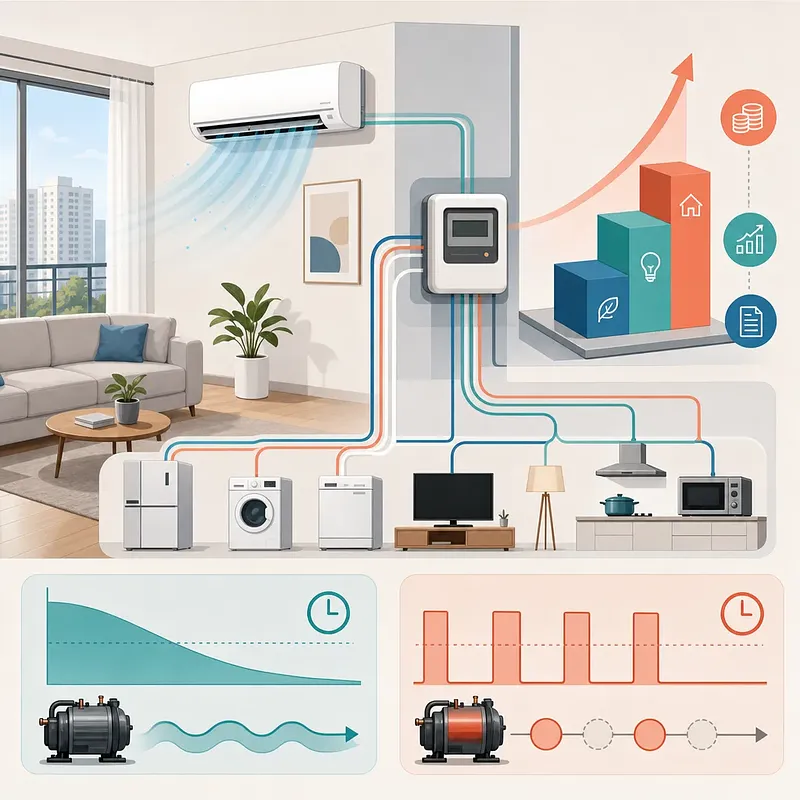
Electrical energy (kWh) = the total of power consumption (kW), which varies over time, across the entire period of use
For example, using a product with rated power consumption of 1 kW for 8 hours a day does not mean that it consumes exactly 8 kWh every day. It uses high output during initial cooling, then may operate at low output or stop the compressor. Conversely, if its capacity is too small for the space or heat gain is high, it may continue operating near the rated level for a long time.
There are also other reasons why estimating a monthly electricity bill is difficult.
· The weather and the indoor-outdoor temperature difference vary each day. · Removing humidity also requires energy. · Consumption by fans, the indoor-unit fan, and standby power is also included. · Electricity rates, tiers, taxes, and surcharges vary by region and contract. · The annual cost shown on the product may be a comparison metric based on standardized assumptions and does not guarantee the actual amount billed.
For a more accurate monthly cost, check the actual accumulated kWh and then apply the relevant rate structure.
How to Measure the Savings Threshold for Your Home
The most reliable benchmark is electricity consumption measured directly in the same home.
· Choose days with similar temperatures and sunlight conditions. · On one occasion, maintain a higher set temperature during a short absence. · On another day, turn the air conditioner off for the same amount of time, then return and cool the room to the original temperature. · Compare the accumulated kWh from the start of the absence until the room returns to the original set temperature. · Record the outdoor temperature, sunlight, length of absence, set temperature, and recovery time after returning.
You can use the metering function of the air conditioner's dedicated circuit, energy records from the manufacturer's app, or a suitable power meter. Ordinary plug-in meters may not meet the air conditioner's voltage, current, grounding, and capacity requirements, so they should not be connected without proper verification. For permanently wired products, it is safest to have measurements performed by a qualified professional.
Practical Operating Principles for Improving Efficiency
· Setting the temperature excessively low after returning does not make every product cool proportionally faster. Set it to the desired temperature and avoid excessive cooling. · Before deciding whether to turn it off or leave it running just before going out, block solar heat gain with curtains or shades. · Clean the filter according to the schedule in the product manual. · Do not leave windows and doors open unnecessarily while cooling. · Circulating air with a fan or air circulator can lower the perceived temperature and reduce temperature differences within the space. · If you know your sleeping, departure, and return times, use timer, energy-saving, and temperature-raising functions. · Determine the absence-time threshold for your home based on actual kWh measured repeatedly.
Conclusion
The advantage of an inverter air conditioner is that it can reduce its output to the level needed after reaching the set temperature. Because of this characteristic, continuing to run it or raising the set temperature slightly may be reasonable during a short absence. However, low-output operation still continuously consumes electricity, so the longer the absence, the more advantageous turning it off becomes.
There is no exact minute-by-minute threshold that applies to every household. Use ranges such as 30 minutes, 2 hours, and 4 hours as initial guidelines, but the most accurate approach is to establish a threshold suited to each home by measuring actual accumulated electricity consumption and the cooling recovery time after returning.
0:00 0:00
1 / 50

Download text

File name
inverter-air-conditioner-away-time-operation-guide-en.txt
Format
TXT (text/plain)
Paragraphs
50

Downloads exactly what you see as a text file.

Please cite the source when quoting.

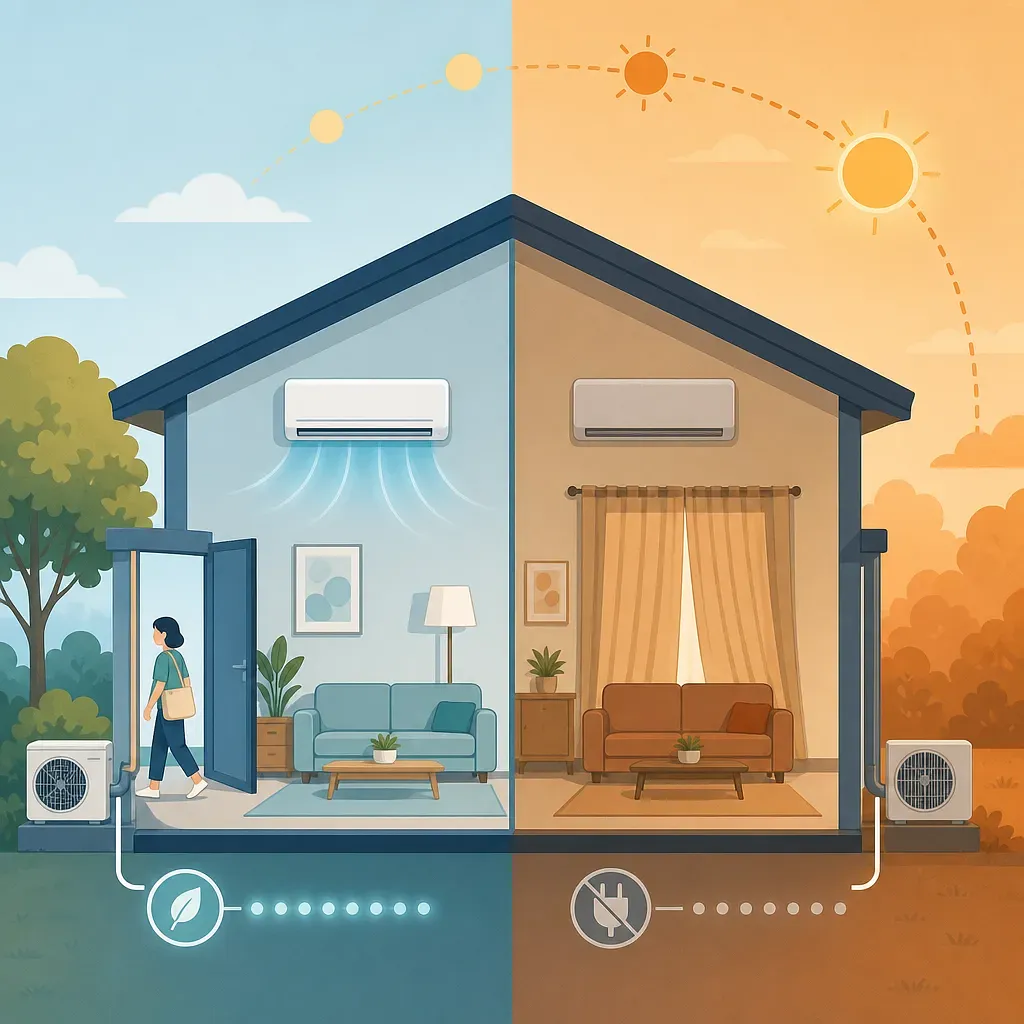
The graphic compares leaving the AC running with turning it off while away.

Key points

  • Inverter models regulate compressor output, while fixed-speed models mainly maintain the temperature by cycling the compressor on and off.
  • Even after reaching the set temperature, power consumption may not fall sufficiently if the cooling load remains high due to extreme heat, sunlight, humidity, ventilation, or other factors.
  • Raising the set temperature is convenient for short absences, but turning off the power is generally more advantageous for long absences.
  • Do not conclude that continuous operation always saves energy based only on the high output at the moment the unit restarts.
  • Electricity consumption should be calculated as the sum of actual power consumption as it changes over time, not simply by multiplying rated power consumption by operating time.

The claim that leaving an inverter air conditioner running continuously reduces electricity bills is true only under certain conditions. Because an inverter model can lower its output after the room has cooled sufficiently, it may be more efficient during a short absence than turning it off and then cooling the room at high output again. However, it continues to consume electricity even when operating at low output, so if you will be away for a long time, it is generally more advantageous to turn it off or raise the set temperature substantially.

The key is not to apply a single time threshold to every home, but to consider the length of the absence, heat entering the room, humidity, the home's insulation performance, and actual electricity consumption together.

How Inverter and Fixed-Speed Models Differ

The compressor that circulates the refrigerant accounts for a large share of an air conditioner's electricity consumption. The two types differ in how they control this compressor.

Category Inverter model Fixed-speed model
Compressor control Adjusts rotational speed and cooling capacity in multiple stages or continuously Generally operates at a fixed output and stops when necessary
Before reaching the set temperature Can cool quickly at high output Cools at a fixed output
After reaching the set temperature Can switch to low output to maintain the temperature Tends to repeatedly start and stop the compressor
Part-load efficiency Advantageous when capacity and conditions are appropriate May start and stop frequently
Changes in power Can vary widely over time Changes are relatively large depending on whether the compressor is running

An inverter model does not always keep the compressor operating at low output. If the cooling load is lower than its minimum output, the compressor may stop and then restart. Conversely, if the load is high, it may continue using high output even after reaching the set temperature.

Conditions Under Which Power Decreases After Reaching the Set Temperature

The fact that the indoor temperature has reached the set point does not necessarily mean that power consumption will decrease significantly. For the air conditioner to maintain the temperature at low output, its cooling capacity must be sufficient to offset the heat entering the room.

Conditions that make power consumption more likely to decrease include the following:

  • Windows and doors are closed, with little outside air entering.
  • Strong sunlight has been reduced with shades or curtains.
  • The filter and heat exchanger are clean, allowing air to flow smoothly.
  • The product has a cooling capacity appropriate for the size of the space.
  • There are not many heat-producing devices indoors, such as cooking appliances, computers, and lights.
  • Ventilation around the outdoor unit is unobstructed.

Conversely, extreme heat, intense sunlight through west-facing windows, frequently opened doors, high humidity, insufficient product capacity, and dirty filters increase the cooling load. Under these conditions, even an inverter model may not be able to reduce its output sufficiently, diminishing the potential savings from continuous operation.

Operating Guidelines by Length of Absence

The following table provides ranges that can be used when beginning an experiment in an ordinary household. These are not absolute thresholds for savings, and results will vary depending on insulation, solar heat gain, humidity, product capacity, and the electricity rate structure.

Expected length of absence Operating method to consider first Reasoning
30 minutes or less Leave it as is or raise the set temperature by about 1 degree The room will soon be occupied again, and the indoor temperature may not change much
30 minutes–2 hours Compare raising the set temperature by about 1–3 degrees with turning it off The more advantageous method varies in this range depending on how quickly heat enters the home
2–4 hours Consider turning it off first; if humidity, pets, or other conditions are a concern, maintain a higher temperature The electricity consumed by maintaining the temperature begins to accumulate substantially
At least 4 hours or all day Turn it off unless there is a special reason to maintain the indoor environment There is little need to keep an unoccupied space at a low temperature for a long time

For example, in a well-insulated home with little sunlight, the temperature rises slowly even after the air conditioner is turned off, so turning it off may be advantageous even for a relatively short absence. Conversely, a top-floor or west-facing space with large windows may heat up quickly and take a long time to become comfortable after you return. In this case, the time needed to restore a comfortable temperature should be considered along with the savings.

If pets, older adults, medications, or temperature-sensitive items must be protected even while you are away, maintaining a safe indoor environment takes priority over cost. Instead of turning the air conditioner off completely, consider using a higher set temperature appropriate for safety and checking a remote thermometer.

Is It Wasteful If Restarting Uses a Lot of Power?

Immediately after restarting, the compressor operates at high output, so instantaneous power consumption may be high. However, electricity bills are calculated primarily based not on a single high instantaneous reading, but on the total electrical energy consumed over a period of time.

When cooling is turned off, the indoor temperature approaches the outdoor temperature, reducing the temperature difference between indoors and outdoors. In general, a smaller temperature difference also reduces the rate at which heat enters from outside. Although the heat accumulated in the walls, furniture, and air must be removed again after you return, this recooling period alone does not necessarily consume more energy than maintaining a low temperature throughout your absence.

The following two measurements must therefore be distinguished:

  • Power: The rate at which a device uses energy at a particular moment, usually expressed in kW.
  • Electrical energy: The accumulated power used over a period of time, usually expressed in kWh, and the primary basis for calculating charges.

It is not appropriate to conclude that continuous operation over a long period always saves energy simply because power is high at the moment of restarting.

How to Check Whether a Product Is an Inverter Model

It is difficult to determine conclusively from appearance alone whether a product is an inverter model. The safest approach is to check in the following order.

  1. Find the exact model name on the nameplate of the indoor or outdoor unit.
  2. Check the model name, cooling capacity, and power consumption information shown on the energy-efficiency label.
  3. Look for terms such as 인버터, 가변속, variable speed, or variable frequency in the manufacturer's official product specifications or user manual.
  4. If the label does not clearly state whether the product is an inverter model, use the model name to look up official information from the manufacturer.
  5. For secondhand or older products, also verify that the indoor and outdoor unit models are compatible with each other.

The format of energy labels varies by country and product category, and not every label explicitly states in words whether the product is an inverter model. Use the label as a starting point for identifying the model and checking efficiency and power-consumption information, and make the final determination using the official specifications.

Why You Should Not Calculate the Monthly Bill Using Rated Power Consumption Alone

Multiplying rated power consumption by the number of hours used per day and the number of days used can provide an approximate upper limit or a figure for comparison, but it does not accurately represent the actual consumption of an inverter air conditioner.

The basic formula is as follows.

Electrical energy (kWh) = the total of power consumption (kW), which varies over time, across the entire period of use

For example, using a product with rated power consumption of 1 kW for 8 hours a day does not mean that it consumes exactly 8 kWh every day. It uses high output during initial cooling, then may operate at low output or stop the compressor. Conversely, if its capacity is too small for the space or heat gain is high, it may continue operating near the rated level for a long time.

There are also other reasons why estimating a monthly electricity bill is difficult.

  • The weather and the indoor-outdoor temperature difference vary each day.
  • Removing humidity also requires energy.
  • Consumption by fans, the indoor-unit fan, and standby power is also included.
  • Electricity rates, tiers, taxes, and surcharges vary by region and contract.
  • The annual cost shown on the product may be a comparison metric based on standardized assumptions and does not guarantee the actual amount billed.

For a more accurate monthly cost, check the actual accumulated kWh and then apply the relevant rate structure.

How to Measure the Savings Threshold for Your Home

The most reliable benchmark is electricity consumption measured directly in the same home.

  1. Choose days with similar temperatures and sunlight conditions.
  2. On one occasion, maintain a higher set temperature during a short absence.
  3. On another day, turn the air conditioner off for the same amount of time, then return and cool the room to the original temperature.
  4. Compare the accumulated kWh from the start of the absence until the room returns to the original set temperature.
  5. Record the outdoor temperature, sunlight, length of absence, set temperature, and recovery time after returning.

You can use the metering function of the air conditioner's dedicated circuit, energy records from the manufacturer's app, or a suitable power meter. Ordinary plug-in meters may not meet the air conditioner's voltage, current, grounding, and capacity requirements, so they should not be connected without proper verification. For permanently wired products, it is safest to have measurements performed by a qualified professional.

Practical Operating Principles for Improving Efficiency

  • Setting the temperature excessively low after returning does not make every product cool proportionally faster. Set it to the desired temperature and avoid excessive cooling.
  • Before deciding whether to turn it off or leave it running just before going out, block solar heat gain with curtains or shades.
  • Clean the filter according to the schedule in the product manual.
  • Do not leave windows and doors open unnecessarily while cooling.
  • Circulating air with a fan or air circulator can lower the perceived temperature and reduce temperature differences within the space.
  • If you know your sleeping, departure, and return times, use timer, energy-saving, and temperature-raising functions.
  • Determine the absence-time threshold for your home based on actual kWh measured repeatedly.

Conclusion

The advantage of an inverter air conditioner is that it can reduce its output to the level needed after reaching the set temperature. Because of this characteristic, continuing to run it or raising the set temperature slightly may be reasonable during a short absence. However, low-output operation still continuously consumes electricity, so the longer the absence, the more advantageous turning it off becomes.

There is no exact minute-by-minute threshold that applies to every household. Use ranges such as 30 minutes, 2 hours, and 4 hours as initial guidelines, but the most accurate approach is to establish a threshold suited to each home by measuring actual accumulated electricity consumption and the cooling recovery time after returning.

Images

The graphic compares leaving the AC running with turning it off while away.
The diagram compares energy use from continuous operation with turning the inverter AC off and restarting it.

FAQ

Is it cheaper to leave an inverter air conditioner on all day?

Not always. For short outings, maintaining the temperature at low output can be convenient and efficient, but low output still consumes electricity, so usage accumulates when cooling an unoccupied space for a long time. Unless there is a specific reason to maintain the temperature, it is generally more advantageous to turn it off as the length of the outing increases.

Should I turn off the air conditioner when going out for a few hours?

There is no exact cutoff time that applies to every home. As an initial guideline, you can leave it running or raise the temperature slightly for up to 30 minutes, compare both approaches for 30 minutes to 2 hours, and first consider turning it off for 2–4 hours or longer. You should also consider insulation, sunlight, humidity, and the time needed to restore the temperature after returning home.

If turning the air conditioner back on uses a lot of electricity, isn't it better to leave it running?

Power consumption may be high immediately after restarting, but electricity charges are mainly determined by the kWh accumulated over time. You need to compare the amount of electricity required to cool the space again with the amount used to maintain the temperature throughout the outing, so you cannot conclude from instantaneous power consumption alone that continuous operation is cheaper.

Does an inverter air conditioner's power consumption always decrease significantly once it reaches the set temperature?

It does not always decrease. If it is extremely hot outside, there is a lot of sunlight or outdoor air infiltration, or the unit lacks sufficient capacity, high output may still be required continuously to maintain the set temperature. A dirty filter and poor ventilation around the outdoor unit can also increase power consumption.

How can I check whether my air conditioner is an inverter model?

Check the model number on the nameplate and energy label of the indoor or outdoor unit, then look it up in the manufacturer's official specifications or user manual. Check for terms such as inverter, variable-speed, or variable speed, and do not immediately assume it is a fixed-speed model simply because the label does not include related wording.

Can I determine the electricity cost by multiplying the rated power consumption by the operating time?

You can obtain a rough comparison, but it is difficult to calculate the actual cost accurately. The output of an inverter model changes continuously according to the cooling load, while the weather, humidity, insulation, and rate tier also affect the result. You need to check the actual accumulated kWh and apply the applicable rate structure.

Will setting the temperature very low after returning home cool the room faster?

Many air conditioners already operate at high output when the difference between the current and target temperatures is large, so setting the temperature excessively low does not make the cooling speed increase proportionally. Instead, the temperature may fall below what is needed, wasting electricity and causing discomfort, so it is reasonable to set it to the desired final temperature.

Should I turn off the air conditioner when going out for a long time even on humid days?

From an energy-saving perspective alone, turning it off for a long time may be advantageous, but if there are concerns about condensation, mold, stored items, or pets, humidity control may take priority. In that case, consider using a higher temperature setting or dehumidification mode instead of turning it off completely, and decide after measuring the actual temperature, humidity, and electricity consumption.

Sources

Data formats

This content is available in several machine-friendly formats.

Data-only languages (machine translated, files only)

Indonesian JSON MD Portuguese JSON MD Chinese (Traditional) JSON MD Deutsch JSON MD

Reuse & AI usage

Search indexing and AI citation with attribution are welcome. See the license policy for details.

CC BY · License

Corrections · Improvements · Feedback Let us know what's wrong or could be better and we'll review it. No login required.

Comments (0)

Sign-in required

Sign in with your Google account to like and comment.

Be the first to comment.

Related content