Why Office-Apartment Brokerage Commissions Are Higher Than Those for Residential Properties, and How They Are Calculated
Even if an officetel is actually occupied by residents, under the real estate brokerage commission system, it is generally treated as a property other than a residential unit, and thus may be subject to higher commission rates than residential properties. However, for officetels that meet certain requirements—such as having an exclusive floor area of 85 square meters or less—a maximum commission rate of 0.4% for leases and 0.5% for sales and exchanges applies.
Since officetels are classified as commercial facilities under the Building Act, the standard commission schedule for residential properties does not apply to them.
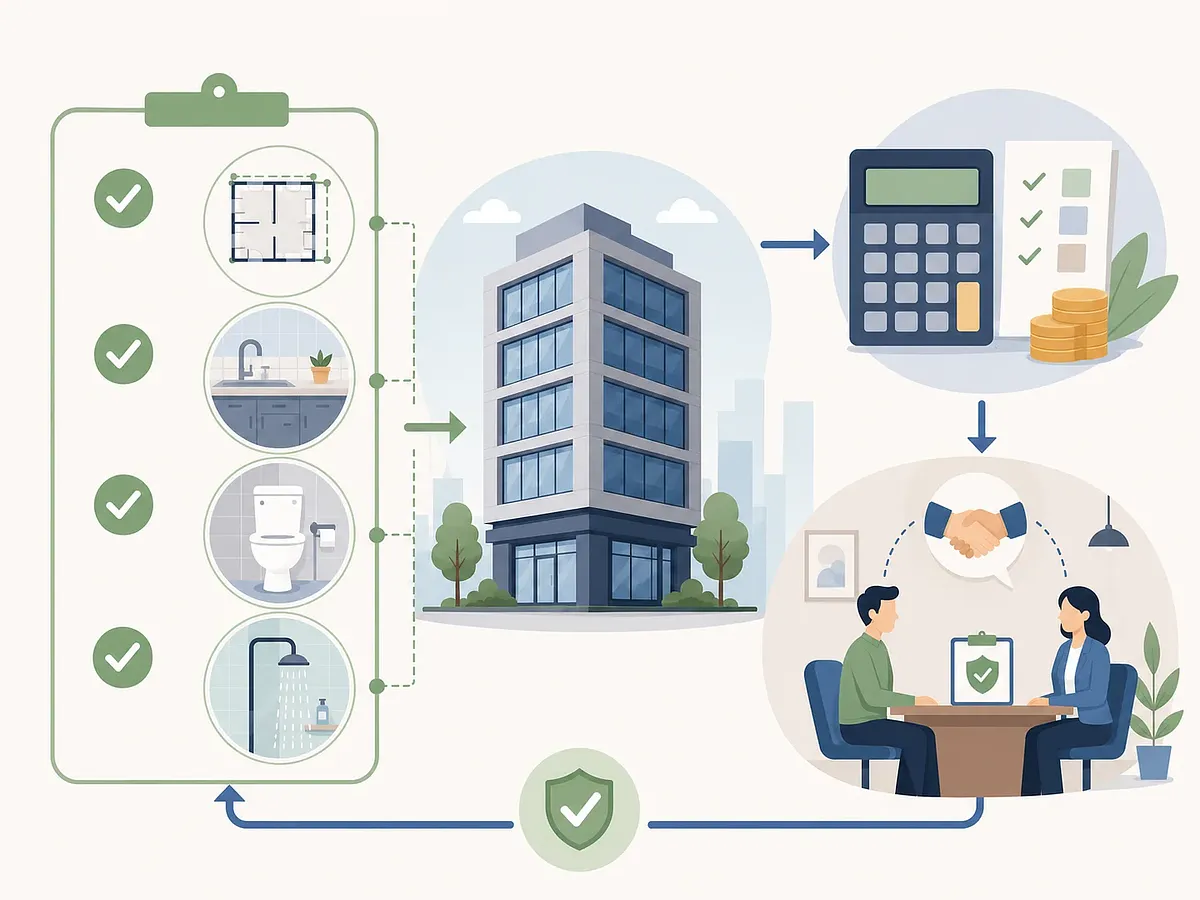
Officetels with a usable floor area of 85 square meters or less that are equipped with a private kitchen, a private flush toilet, and bathing facilities are subject to a separate officetel tax rate.
The maximum tax rates for officetels that meet residential requirements are 0.5% for sales and exchanges, and 0.4% for leases and other transactions.
Officetels that do not meet the requirements are considered non-residential properties for brokerage purposes, and the brokerage fee may be negotiated within 0.9% of the transaction amount.
Since 0.4% is not a fixed rate that must be paid but rather a statutory maximum rate, the amount of the brokerage commission must be negotiated and confirmed before signing the contract.
When signing a lease for an officetel, people are sometimes surprised to find that the brokerage fee is higher than for apartments or villas, even though it feels just like a “home.” The correct legal term is not “brokerage fee” but “brokerage compensation,” and the key reason for this difference is that officetels are not treated the same as general residential properties under the brokerage compensation system.
Key Conclusion
The reason officetel brokerage fees may seem expensive is that, in principle, officetels are not classified as residential properties but fall under the category of non-residential properties subject to brokerage. However, there are separate, reduced rates for officetels below a certain size that are actually used for residential purposes.
Category | Application Conditions | Maximum Rate for Leases, etc. | Maximum Rate for Sales and Exchanges
Officetels Meeting Residential Requirements | Exclusive floor area of 85㎡ or less and meeting certain facility requirements | 0.4% | 0.5%
Officetels Not Meeting Requirements | Do not meet the above requirements | Negotiable within 0.9% | Negotiable within 0.9%
Housing | Subject to the housing brokerage fee schedule in city or provincial ordinances | Differentiated by transaction amount bracket | Differentiated by transaction amount bracket
It is important to note that 0.4% is not a “fixed rate that must be paid unconditionally,” but rather a “maximum rate that cannot be exceeded.” The actual brokerage commission is determined through negotiation between the client and the licensed real estate broker within this cap.
Why Can Officetels Have Higher Brokerage Fees Than Residential Properties?
1. Officetels Are Classified Differently from Residential Properties, Regardless of Actual Occupancy
Even if an officetel has a bed, kitchen, and bathroom and is actually occupied by people, it is not automatically subject to the same brokerage fee schedule as general residential properties under the law. The Enforcement Rules of the Licensed Real Estate Broker Act distinguish between brokerage fees for residential properties and those for non-residential properties.
For this reason, officetels are first classified as “non-residential properties,” and a separate officetel rate is applied only if they meet certain requirements.
2. If Residential Requirements Are Not Met, a Rate of Up to 0.9% May Apply
The 0.4% rental commission rate does not always apply simply because the property is being used for residential purposes. To qualify for the separate officetel rate under the law, all of the following requirements must be met:
· The exclusive floor area must be 85 square meters or less
· It must have a private, built-in kitchen equipped with water and sewerage facilities
· It must have a private flush toilet
· It must have bathing facilities
· A configuration where the bathing facilities are included within the private flush toilet may also be recognized
If these requirements are not met, the property is considered a non-residential brokerage subject, and the brokerage commission is negotiated within 0.9% of the transaction amount. In this case, the rate may feel significantly higher than the residential lease rate.
Brokerage Commission Rates for Residential Officetels
The upper limits for brokerage commissions on officetels that meet the requirements are as follows:
Transaction Type | Upper Limit Rate | Meaning
Sale/Exchange | 0.5% | Up to 0.005 × transaction amount
Lease (Jeonse, monthly rent, etc.) | 0.4% | Up to 0.004 × transaction amount
The phrase “up to” is important here. The maximum rate simply indicates the upper limit that a broker may charge; it does not mean that the exact percentage must be paid. A 2026 legal interpretation by the Ministry of Government Legislation also held that brokers must consult with the client when determining brokerage fees for officetels that meet residential requirements.
How to Calculate Brokerage Fees for Officetel Monthly Rent Leases
For monthly rent leases, the transaction amount is calculated not just based on the security deposit, but by multiplying the monthly rent by a certain factor.
Basic Formula
· General monthly rent transaction amount = Security deposit + Monthly rent × 100
· If the calculated amount is less than 50 million won = Security deposit + Monthly rent × 70
· Maximum brokerage commission = Transaction amount × Applicable maximum rate
If the officetel lease meets residential requirements, simply multiply the calculated transaction amount by 0.4%.
Calculation Example: Security Deposit 30 million won, Monthly Rent 700,000 won
Item | Calculation
Security Deposit | 30,000,000 won
Annualized Monthly Rent | 700,000 won × 100 = 70,000,000 won
Transaction Amount | 30,000,000 won + 70,000,000 won = 100,000,000 won
Maximum Commission Rate for Residential Officetel Leases | 0.4%
Maximum Brokerage Fee | 100,000,000 KRW × 0.004 = 400,000 KRW
Therefore, for a residential officetel lease agreement with a security deposit of 30 million won and a monthly rent of 700,000 won, the maximum brokerage fee is 400,000 won. Since this is a maximum limit, the actual amount charged can be negotiated before signing the contract.
Why is there a difference compared to a residential home under the same conditions?
For example, in Seoul, the maximum commission rate for residential leases in the transaction amount range of 100 million won or more but less than 600 million won is 0.3%. Since the transaction amount in the example above is 100 million won, the maximum brokerage commission for a residential property in Seoul would be 300,000 won.
On the other hand, if an officetel with the same security deposit and monthly rent meets residential requirements, the 0.4% cap rate for officetel leases applies, resulting in a cap of 400,000 won. This difference arises because the starting points for brokerage fee regulations differ, even when the same space is used for residential purposes.
Example | Transaction Amount | Applicable Cap Rate | Maximum Brokerage Fee
Example of a residential lease in Seoul | 100 million won | 0.3% | 300,000 won
Officetel Lease Meeting Residential Requirements | 100 million won | 0.4% | 400,000 won
Officetel Not Meeting Residential Requirements | 100 million won | Within 0.9% | Negotiable, up to 900,000 won
However, since real estate brokerage commissions for residential properties may vary depending on local ordinances and transaction price brackets, you must check the latest rate tables for the relevant city or province when signing an actual contract.
Checklist to Review Before Signing a Contract
To verify whether the brokerage commission for an officetel is being charged excessively, it is recommended to follow the steps below.
· Verify the designated use in the Building Registry: Confirm whether it is an officetel or another type of business facility or neighborhood commercial facility.
· Verify the exclusive floor area: Check whether the exclusive floor area is 85 square meters or less, not the gross floor area.
· Verify facility requirements: Confirm that the unit has a private built-in kitchen, a private flush toilet, and bathing facilities.
· Calculate the transaction amount: For monthly rent, first apply the formula: security deposit + monthly rent × 100.
· Apply the Maximum Rate: For officetel leases that meet residential requirements, calculate the maximum rate based on 0.4%; for sales and exchanges, use 0.5%.
· Confirm the Agreed-Upon Amount: Since the maximum rate is the upper limit, clearly agree on the actual amount to be paid before signing the contract.
· Verify the Property Verification and Explanation Document: Confirm that the brokerage commission amount and the basis for its calculation are listed correctly on the document and receipt.
Common Points of Confusion
Does living in a property automatically mean the residential rate applies?
No. The residential brokerage fee schedule does not apply based solely on whether you actually live there. For officetels, separate officetel rate requirements must be considered.
Is 0.4% a non-negotiable amount?
No. 0.4% is the maximum rate applied to officetels that meet residential requirements in transactions such as leases. This means the rate cannot exceed the statutory cap, but it does not mean you must pay the full 0.4%.
Are jeonse (lump-sum deposit leases) included in “rental agreements, etc.”?
Generally, jeonse and monthly rent leases—as opposed to sales or exchanges—fall under “rental agreements, etc.” Jeonse and monthly rent for officetels that meet residential requirements are calculated based on the 0.4% cap.
Summary
The reason officetel brokerage fees may seem higher than those for residential homes is not simply because brokers are trying to charge more. Under the system, officetels are classified differently from residential homes, and a separate, reduced rate applies only if certain requirements are met.
Tenants should verify the following: “Is the exclusive floor area 85 square meters or less?” “Does it meet the requirements for a dedicated kitchen, toilet, and bathing facilities?” “Has the monthly rent amount been calculated correctly?” and “Is the agreed-upon amount within the cap rate?” By verifying these four points, you can relatively clearly determine why the officetel brokerage fee was set at that amount and whether there has been any overcharging.
 Injoys