Injoys
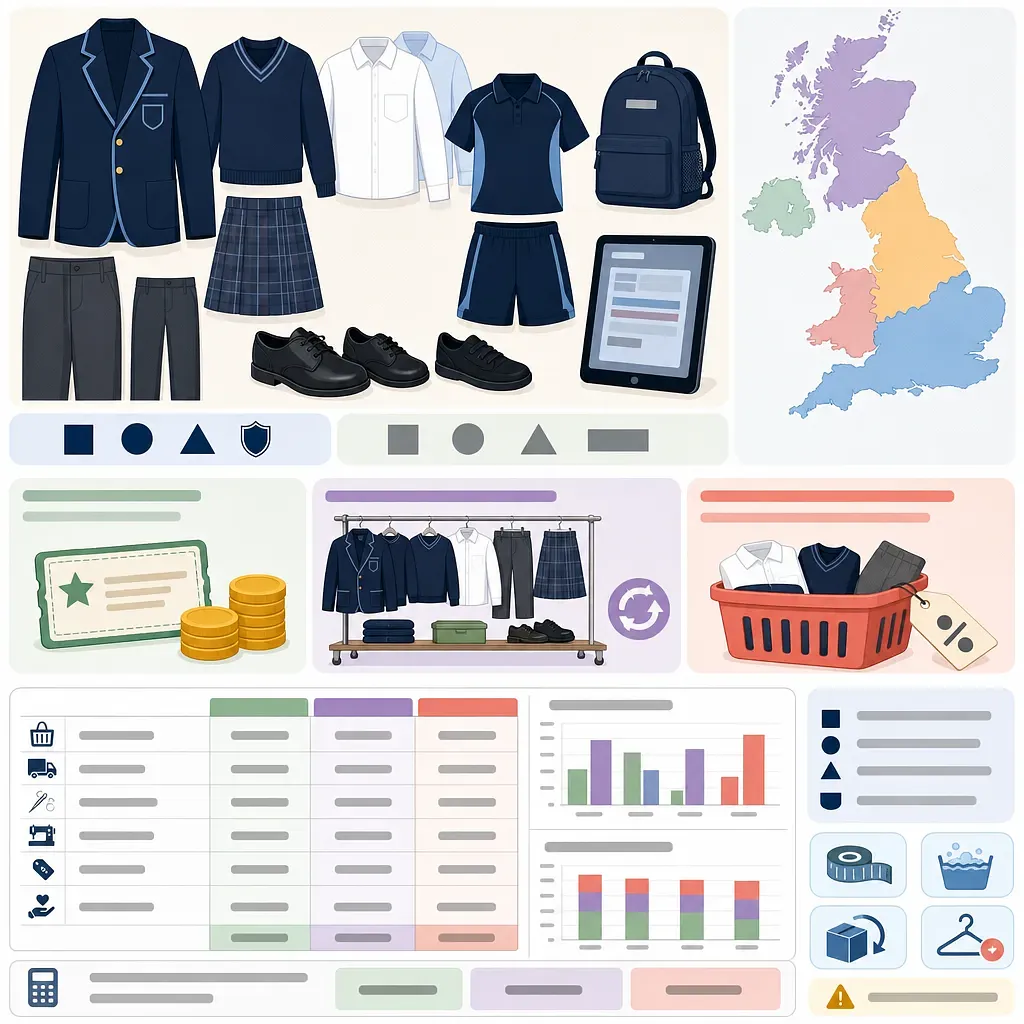
School uniform cost support in the UK is not a single scheme applied uniformly nationwide. The support available and the amount families actually pay vary depending on where they live, their child’s year group, the benefits the household receives, eligibility for free school meals, and school policy.
Therefore, rather than looking for the cheapest retailer first, it is more efficient to proceed in this order: check eligibility for support → separate items required by the school → check second-hand stock → compare prices for new items. The amounts and discounts below are not fixed nationwide prices, so check the relevant local authority’s and retailer’s 2026/27 guidance again before applying.
Comparison of School Uniform Cost Support Across the UK’s Four Nations
| Nation | Basic structure | Where to check | Key features and limitations |
|---|---|---|---|
| England | Local authorities may offer grants or vouchers at their discretion | Search by postcode on GOV.UK, then check the relevant council’s guidance | This is not a nationwide grant. Some councils offer support, while others may have no scheme or only a short application window. |
| Wales | School Essentials Grant | Welsh Government and local authorities | Supports essential school costs for low-income households, including uniforms, shoes, PE kits, and bags. Amounts vary by year group and eligibility, and some eligible pupils may receive up to around £200. |
| Scotland | School Clothing Grant | Council for the area where the household lives | Local authorities assess applications and make payments. Even where a minimum level applies, the actual amount, automatic renewal arrangements, and application schedule may vary by council. |
| Northern Ireland | Uniform Grant | Education Authority’s EA Connect | Income and benefit criteria linked to free school meals may be used. The payment structure may vary depending on the pupil’s school stage and whether PE kit support applies. |
The “up to £200” mentioned in articles or on social media does not mean that every UK household can receive a nationwide flat-rate payment. It may refer to support for certain year groups in Wales or schemes run by particular local authorities, so the location, year group, and eligibility criteria must be read together.
What to Check When Reviewing Local Support
- Check whether applications are based on the household’s place of residence, rather than the location of the child’s school.
- Check which benefits, such as Universal Credit or Child Tax Credit, are used to determine eligibility in addition to income thresholds.
- Review the opening and closing dates and whether a new application is required for each school year.
- Check whether support is paid as cash, as a voucher for designated retailers, or through the school.
- Check whether approval is only available before purchase or whether receipts for items already purchased are accepted.
- Check whether shoes, PE kits, bags, coats, or equipment are covered in addition to uniforms.
Why Branded and Generic Uniform Items Should Be Separated First
Uniform budgets can vary significantly depending on the designated items bearing the school logo. Check the latest uniform policy and year-specific supply list issued by the school, then divide items into three categories.
| Category | Examples | Typical purchasing strategy |
|---|---|---|
| Designated logo required | Blazer, jumper, PE top | Compare prices at the school’s second-hand shop and approved retailers first. |
| Only colour and style specified | White shirts, grey trousers, skirts, socks | Compare multipacks from supermarkets and large retailers. |
| Recommended or optional | Logo coat, additional PE kit, specific bag | Ask the school whether existing items may be used before buying. |
In England, rules limiting the number of branded uniform items that schools may require will apply from September 2026. Check the school’s latest published policy for the basic cap and how ties are treated. The limit does not mean that schools must require families to purchase the maximum number of items, nor does it mean that non-logo items in specified colours automatically become free.
If the school’s list is unclear, it is safest to ask the following questions in writing.
- Which items must have a logo?
- Can plain items in the same colour and style be used?
- Must PE kits and outerwear also come from designated suppliers?
- Does the school or parent association run second-hand sales or swap events?
- Are temporary substitutes allowed if stock is unavailable at the start of term?
Comparing New-Item Sales, Second-Hand Uniforms, and Financial Support
| Option | Expected cost level | Advantages | Limitations | Best suited to |
|---|---|---|---|---|
| Local authority or education body support | Lowest | If approved, it can directly reduce essential spending. | Eligibility and application periods are restricted, and purchases may be required before payment is received. | Households likely to meet low-income criteria or specified benefit requirements |
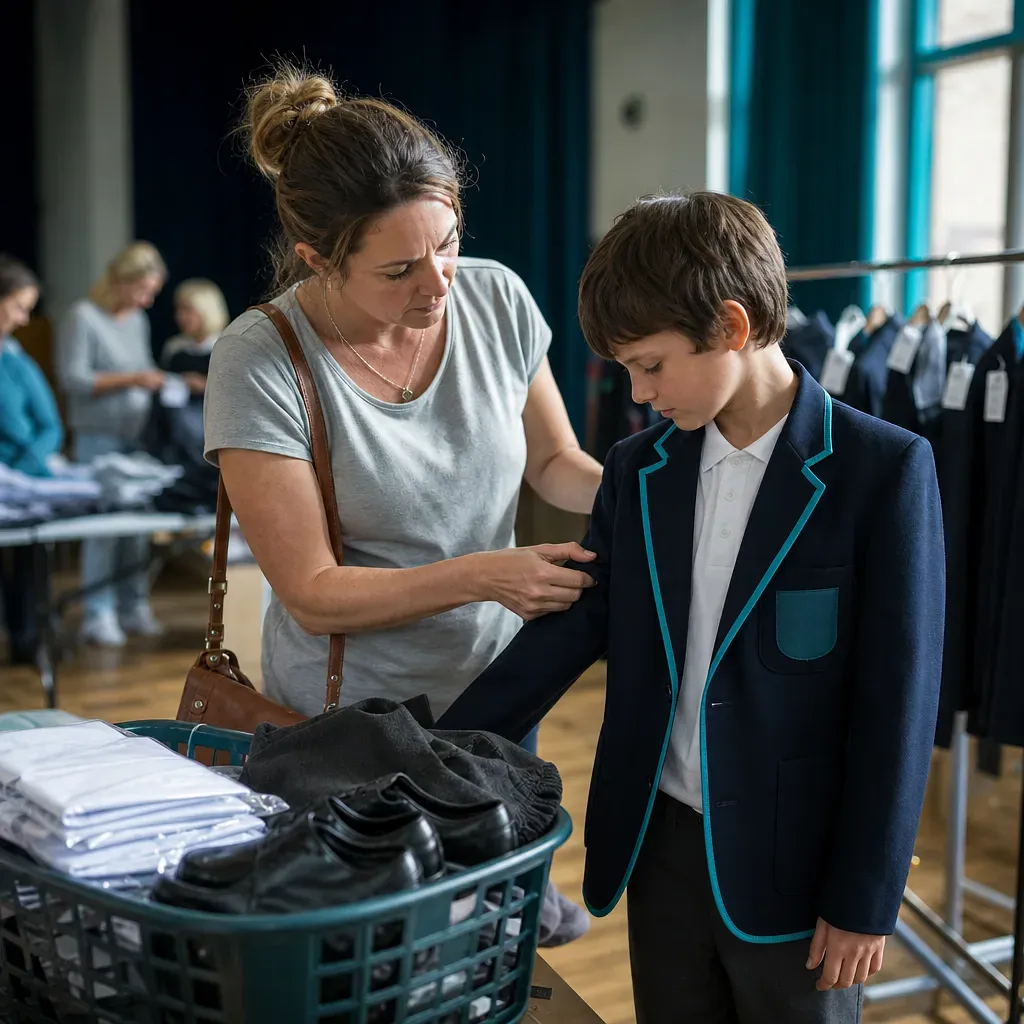
| School second-hand shop or swap event | Very low | Logo items are often easy to find cheaply, and compliance with school specifications is clear. | Sizes and quantities are limited, and the condition of items varies. | Pupils who grow quickly or need spares |
| Local giveaway groups or charity uniform shops | Free–low | It may be possible to obtain basic uniform items and bags together. | School logos and sizes may not match. | Households with enough time to check multiple sources |
| Basic uniforms from supermarkets or large retailers | Low–medium | Multipacks of plain items such as shirts, trousers, and skirts are easy to buy. | They may not replace logo items designated by the school. | Households whose schools allow a wide range of generic items and that need several of each item |
| August uniform sales | Medium | New items can be bought below full price, with a relatively broad selection. | Popular sizes sell out quickly, and some items are excluded from discounts. | Households that know the required sizes and can check the returns policy |
| School-approved supplier | High | There is less risk of breaching the rules, and logos and colours are accurate. | Embroidery, delivery, and sole-supplier arrangements can increase costs. | Households that must buy designated items or cannot find second-hand stock |
Financial support and second-hand uniforms are not mutually exclusive choices. A mixed strategy—using support to buy shoes or essential logo items while sourcing shirts and trousers second-hand or from general retailers—is usually more flexible.
How to Compare August 2026 School Uniform Sales
A roundup of school uniform sales published in August 2026 included promotions from major retailers, such as M&S’s 20% discount starting on August 20. However, sale periods, eligible sizes, online or in-store availability, and exclusions for branded products may change at any time. Decisions should be based on the final price at checkout and the returns policy.
Aldi, Lidl, Asda, Tesco, Sainsbury’s, and M&S differ in price range and sales format, so comparing only individual item prices may overlook the actual total basket cost.
What to Compare Using the Same Basket
- Price per shirt in packs of 3 or 5
- Adjustable waists and fabric durability for trousers and skirts
- Whether jumpers and cardigans retain their shape after washing
- Shoe delivery charges and whether free returns are available
- Whether a discount is online-only or also applies in stores
- Click-and-collect fees and available collection dates
- Whether discount codes can be combined
- Costs for name labels, logo embroidery, and shortening hems
Waiting until the end of August may bring further discounts, but it also increases the risk that popular sizes will sell out. Buying essential shoes and one pair of trousers first, then waiting for further discounts on spares or items intended to allow for growth, reduces this risk.