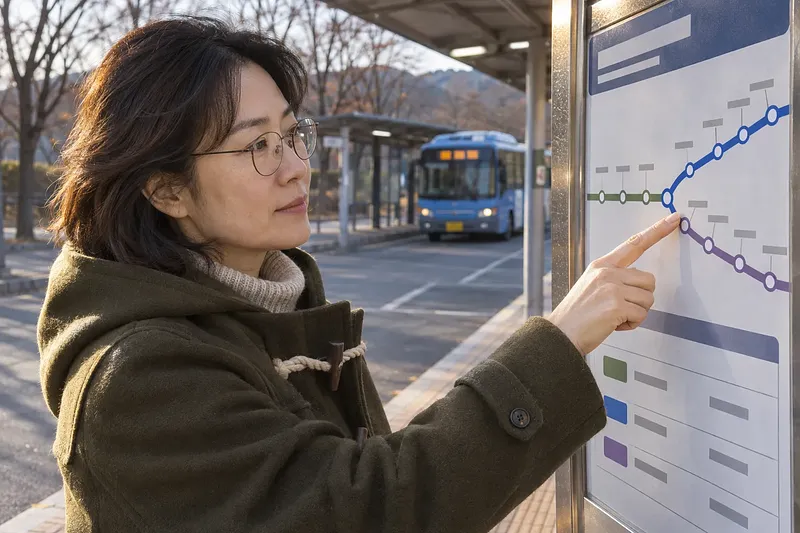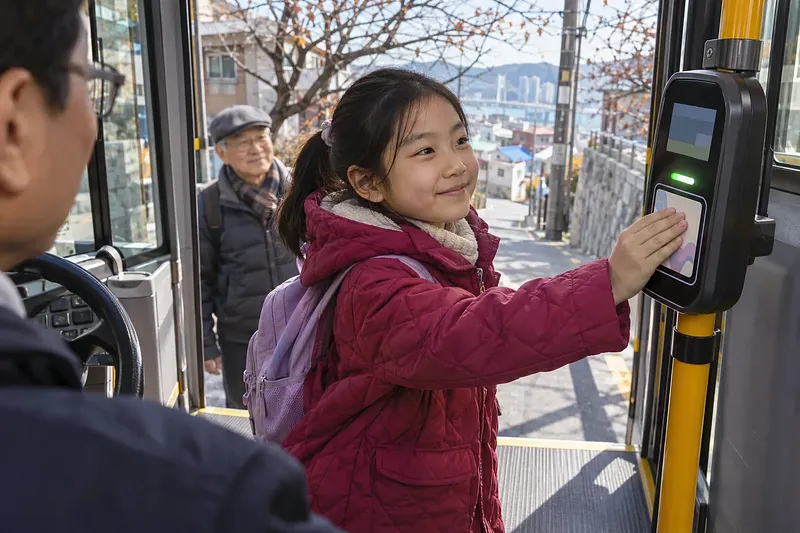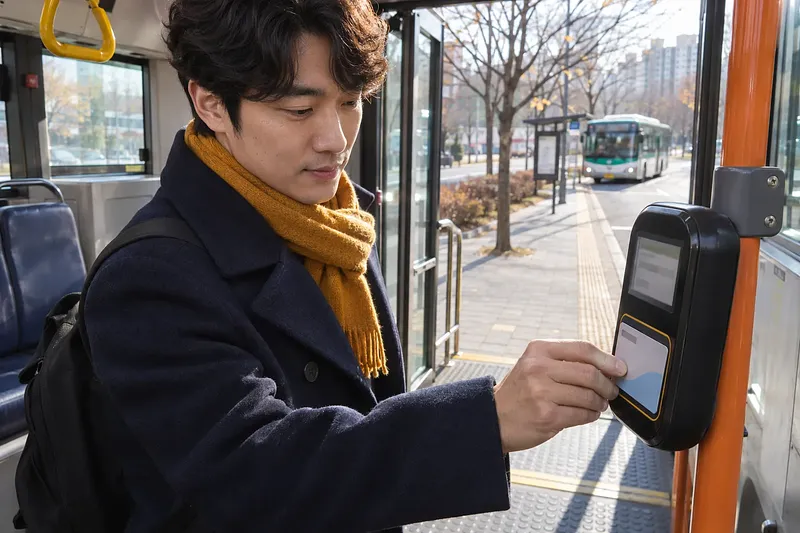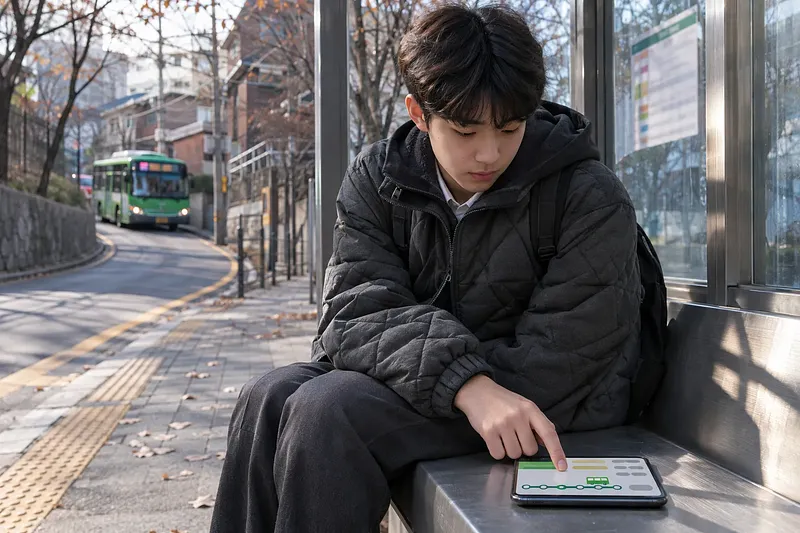
To take a village bus in Seoul, use “Find a Village Bus” on the left side of this site to search by neighborhood or route number. Select the stop where you’ll board to see when the next bus will arrive. When you get off, tap the same transit card you used to board.
The service and fare figures are based on information from the Seoul Metropolitan Government and its district offices checked on November 11, 2026.
How to read first and last bus times and service intervals
The first and last bus times on a route schedule show when those buses leave the starting stop. Seoul lists the last bus on Dongdaemun A01 based on its departure from Janghanpyeong Station. If you’re boarding at a stop along the route, check when the bus will reach that stop.
- In “Find a Village Bus,” search by neighborhood or route number to find the route you’ll take.
- Check where the first and last buses depart and which day of the week you’ll travel. Seongdong-gu’s village bus service table is based on weekday service.
- The service interval is the time between consecutive buses. If a minimum and maximum are listed, the time between buses varies within that range.
Loop routes and routes split by time of day
On loop routes, check the order of the stops. On routes split by time of day, check the route number down to the last digit. Of the 247 routes checked in Seoul’s bus information system on November 11, 2026, 12 started and ended at the same stop. If the same station name appears at both ends, here’s what to check.
| Route examples | What to check before boarding |
|---|---|
| Seocho 02, which loops back to Seoul National University of Education Station, and Mapo 05, which loops back to Hongik University Station | Check the route map to make sure the stop where you’ll get off comes after the one where you’ll board. |
| Mapo 18-1 and Mapo 18, which cover the same stretch at different times of day | Mapo 18-1 runs in the morning, and Mapo 18 runs after that. Check the hours of service for the day you plan to ride. |
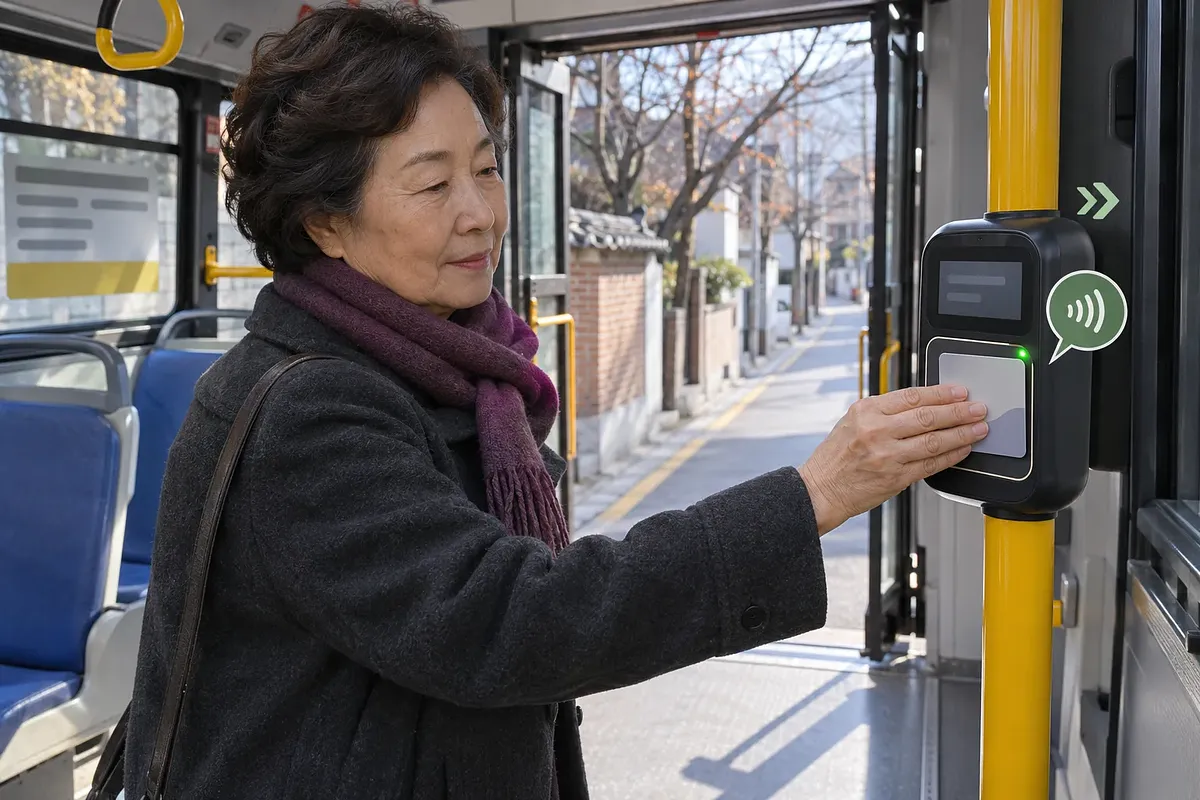
Wait until the bus comes to a complete stop, then tap out with the same card you used to board.
Wait times and travel times between stops
The bus arrival estimate shows how long you’ll wait at the stop, while the travel time shows roughly how long it’ll take to reach your destination once you board. Add the two to estimate when you’ll reach your meeting place. Allow separately for the walk to the stop.
- Open “Find a Village Bus” on this site on your phone, and check the route number and direction in the arrival information for the stop where you’ll board.
- On the same route, select where you’ll board as the departure stop and where you’ll get off as the arrival stop.
- Check how long the ride takes between the two stops. Travel time varies with traffic, so check when the bus will arrive again just before you leave.
Stops without electronic displays
If your stop doesn’t have a bus information terminal (BIT), you can check when the bus will arrive on your phone. You can also look up the stop in the bus information section of Seoul’s “Seoul Public Transportation” site. On the display at the stop, check the route number shown next to “Arriving soon.”
When Seoul made its announcement on July 3, 2025, 2,466 village bus stops had terminals. Another 3,169 stops had none, so 43.8% of stops had terminals at the time. The 49.4% Seoul cited was its target for when that year’s replacement and installation work was complete.
How to check for a low-floor bus when using a wheelchair or stroller
If you need a low-floor bus, give the bus operator the route number, your boarding stop, and the time you plan to travel, and ask when one will run. A low-floor bus has a lowered floor to make it easier for passengers to get on and off. How you check in advance when low-floor buses run on a particular route varies by area and operator.
Since January 19, 2023, village bus operators have also been required to introduce low-floor buses when replacing existing buses with new ones. The requirement is set out in Article 14(7) of the Act on Promotion of the Transportation Convenience of Mobility Disadvantaged Persons. The district office posts notices for routes that have been granted an exemption because introducing low-floor buses would be difficult.
- On January 19, 2026, Seodaemun-gu announced that 9 of its 17 routes, including split routes, had been granted exemptions. Reasons included steep grades, narrow roads, and stretches where buses have trouble turning or passing each other.
- Seocho-gu’s January 31, 2023 notice also lists routes that were granted exemptions because they lacked electric charging facilities. Check with the district office’s Transportation Administration Division for the latest notice on the route you plan to take.
Seoul’s January 2026 fleet table lists 1,626 village buses, including spare vehicles. Adding up the low-floor buses across the vehicle types in the table gives a total of 337. Of the 397 electric buses, 334 are low-floor buses, so look for the “Low floor” label when checking which bus you’ll take.
How to board and get off safely on hills and in narrow alleys
On hills, hold on to a handhold while the bus is moving, and wait until it comes to a complete stop before standing up to get off. At stops in narrow alleys, take a step back from the edge of the road as the bus pulls in. Seoul shared the following safety announcement in “Improved Bus Information Terminals Make It Easier to Check Arrivals”:
The bus is pulling in. Please take one step back.
- Wait until the bus has come to a complete stop and the doors have opened before boarding.
- Tap your transit card on the boarding reader. If you’re standing, hold on to a handhold in case the bus pulls away or turns.
- Press the stop button before you reach your stop. If you’re sitting, wait until the bus has stopped before getting up.
- Tap the same card on the exit reader, then watch your step and check for vehicles passing through the alley before getting off.
Tapping off and how long you can ride on the base fare
If you don’t tap your card when you get off, you lose the transfer discount from that leg onward. The next time you board, your previous ride is treated as a separate trip. If any part of the previous base fare is still unpaid, you’ll pay it when you next board.
| Time limit | How it’s measured | Seoul transit card guidance |
|---|---|---|
| Maximum ride time on the base fare | From when you board a vehicle until you get off | If you exceed the maximum ride time, you’ll be charged the base fare again when you get off. |
| Transfer window | From when you get off one service until you board the next | Within 30 minutes of getting off. If you next board between 9 p.m. and before 7 a.m. the following day, the window is 60 minutes. |
Seoul’s February 2, 2026 transfer guide lists a maximum ride time of 1 hour for village buses. In the same guide, the limit is 5 hours each for the subway and city buses. On June 30, Seoul announced that it would extend the village bus limit to 2 hours starting in July 2026. Before you ride, call Seoul’s Dasan Call Center (02-120) to confirm the exact date the change takes effect.
Even if you board within the transfer window, the transfer discount doesn’t apply to the same route or the same vehicle. If you take a village bus outside Seoul, ask the local government or bus operator about the maximum ride time. The self-driving village buses Seoul announced in October 2025 required passengers to tap on and off even during the free trial service.