Gyeonggi-do Bus Fares 2026 and Seat Reservations
Gyeonggi-do bus base fares and distance surcharges vary by route type. This guide walks you through the steps, from looking up routes to reserving seats with MiRi, using cashless buses, and registering for The Gyeonggi Pass.
Search for the route number you plan to use in the subway and bus route finder on the left side of this site.
Check the bus type, latest fares, and whether cash is accepted, and have a transit card ready.
To use a reserved-seat bus, register your transit card in MiRi and reserve a seat on your route.
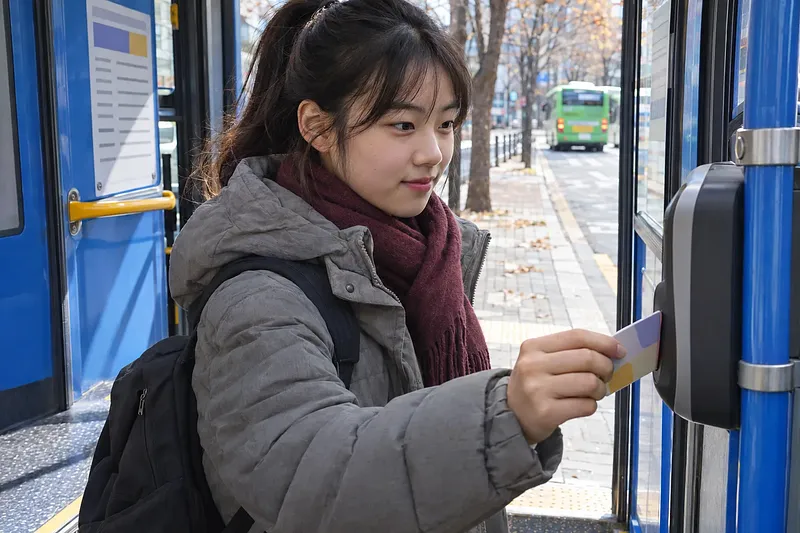
Tap your transit card when boarding and getting off, and use the card registered in the app on reserved-seat buses.
If you are eligible for The Gyeonggi Pass, sign up and register your card on the official K-Pass website or app.
To use buses in Gyeonggi-do, look up your route number and have a transit card ready. Reserve seats on Gyeonggi Pyeonha G Bus through MiRi. Residents with a Gyeonggi-do address who are at least 19 should also check the refund conditions for The Gyeonggi Pass.
This article is based on information checked on November 9, 2026, and the effective dates of the respective official notices.
Steps for Using Buses in Gyeonggi-do
Before leaving, check the type of bus route you will use. Buses heading to the same destination may serve different stops. You also need to check each route's reservation requirements and whether it accepts cash.
· Search for the route number in the subway and bus route finder on the left side of this site.
· Check the first and last buses, service frequency, and estimated arrivals at your stop.
· Check the route type and current fare, then have your transit card ready.
· If the bus requires a reservation, select the date and departure in the reservation app.
· Tap your card when boarding and getting off, and complete card registration if you qualify for refunds.
Check service information again just before traveling. Official information is also available through Gyeonggi Bus Information. If fare or service information differs, contact the Gyeonggi-do Call Center at 031-120 or the bus operator.
Comparing Regular, Seated, Direct Seated, and M Buses
Identify the bus type by the route information and vehicle markings rather than its color. Regular and seated buses stop at each stop along the route. Direct seated buses and M buses follow different rules for stops.
Type | Operating and management rules | What to check before traveling
Regular | Licensed by the mayor or county head; stops at each stop | Your destination stop and travel distance
Seated | Licensed by the mayor or county head; an urban seated bus that stops at each stop | Whether it is a seated bus route
Direct seated | Licensed by the mayor, county head, or chair of the Metropolitan Transport Commission | Whether it serves intermediate stops
Gyeonggi circular | Listed as a separate type in Gyeonggi-do's fare guide | The route's stops and distance-based fares
Metropolitan express M bus | Licensed by the chair of the Metropolitan Transport Commission; uses expressways and other roads | Limited boarding and drop-off stops
Local community bus | Registered with the mayor or county head; fares set by each city or county | The responsible city or county and the route's fare
Direct seated buses may adjust the number of stops when operating across at least two cities or provinces. The adjustment is limited to at most half of the total number of stops. Even if a bus is heading toward your destination, check whether it serves your intended stop.
M buses serve stops within 7.5km of the starting and ending points. The limit is 6 stops. After service starts, 2 stops may be added at the starting end if needed. Detailed rules are available in the Gyeonggi-do bus fare guide.
Fare Adjustment Effective October 25, 2025
Gyeonggi-do urban bus fares were adjusted starting with the first buses on October 25, 2025. Regular and seated bus fares each rose by 200 won. Direct seated and Gyeonggi circular bus fares each rose by 400 won. The effective date and increases are based on the Gyeonggi-do fare adjustment press release.
The standard base fares in Gyeonggi-do's fare table are as follows. These amounts took effect on October 25, 2025. Distance-based charges for the route may be added to the actual amount paid.
· Regular: 1,650 won by transit card and 1,700 won in cash.
· Seated: 2,650 won by transit card and 2,700 won in cash.
· Direct seated: listed as 3,200 won for both transit cards and cash.
· Gyeonggi circular: 3,450 won by transit card and 3,500 won in cash.
· Metropolitan express: listed as 3,200 won for both transit cards and cash.
The cash fare for direct seated buses follows Gyeonggi-do's official table. If you are quoted a different amount, check with the bus operator. Even if a cash fare is listed, cashless routes do not accept cash.
Local community bus fares vary by city and county. Gyeonggi-do's February 2026 guide lists base fares for a single ride at 1,350 to 1,650 won. Check the latest fare for your route in this site's subway and bus route finder.
Early-Morning Discounts and Child and Youth Fare Conditions
The early-morning discount applies to your first boarding with a transit card before 6:30 a.m. It does not apply again to each bus you transfer to. As of October 25, 2025, the standard early-morning fare for regular buses is 1,450 won.
Urban bus passengers using transit cards before 06:30. Applies only to the first bus boarded. Source: Gyeonggi-do, “Bus Fares,” early-morning discount guidance
For age-based discounts, check the card's real-name registration requirements. Different age ranges apply to youths and children. Separate free-ride rules apply to young children accompanied by a guardian.
· Youths: holders of real-name-registered middle and high school student cards, ages 13 to 18.
· Children: holders of real-name-registered child cards, ages 6 to 12.
· Young children: up to 3 children under 6 ride free when accompanied by a guardian.
· If more than 3 young children accompany a guardian, the child fare applies to each additional child.
Fare Conditions for Single Rides and Transfers
Check distance surcharges separately for single rides and transfers. The base distance is the distance covered by the base fare. Transferring does not eliminate distance surcharges.
When Taking Only One Bus
Regular buses charge the base fare for up to 10km. Beyond 10km, 100 won is added for every 5km up to 40km. Only 100 won is added for the section beyond 40km.
Single rides on seated and direct seated buses use a flat base fare. Gyeonggi circular and M buses apply distance-based fares even for single rides. Both types charge the base fare for up to 30km.
Gyeonggi circular and M buses add 100 won for every 5km beyond 30km, up to 60km. Only 100 won is added for the section beyond 60km. These rules are available in Gyeonggi-do's bus fare guide. (Verified figures: base distance 30km; 100 won per 5km beyond that, up to 60km; an additional 100 won for the section beyond 60km · Source: gg.go.kr · Checked on 2026-11-16)
When Transferring to Another Form of Transport
The base distance for transfer fares varies by bus type. Beyond the base distance, 100 won is added for every 5km. Do not assume that the surcharge cap for a single regular bus ride also applies to transfers.
· Regular and local community buses: the base distance for transfers is 10km.
· Seated, direct seated, Gyeonggi circular, and M buses: the base distance for transfers is 30km.
· Journeys combining different types: check based on the entire journey.
Tap the same transit card when boarding and getting off. You also need to check the detailed conditions for transfer times and the forms of transport used. For the exact fare on a combined journey, contact the bus operator or the Gyeonggi-do Call Center.
How to Reserve a Seat on Gyeonggi Pyeonha G Bus
Gyeonggi Pyeonha G Bus is a commuter bus service with all seats reserved through MiRi. Gyeonggi-do and its cities and counties design and operate the routes. The service makes 4 to 6 stops around the starting and ending points.
On October 8, 2026, 5 new routes started service. The added areas are Pyeongtaek, Yangju, Hwaseong, and Uiwang. According to information checked on November 9, 2026, the service has 29 routes in total.
· Check your route on the official Gyeonggi Pyeonha G Bus website.
· Install the MiRi app and create an account.
· Register the transit card you will actually use to board in the app.
· Add the stated reservation deposit of 3,450 won.
· Select your route and departure time, then reserve an available seat.
· At your reserved stop, tap the transit card registered in the app.
The listed fare per ride is 3,450 won. Distance-based fares and Seoul metropolitan area transfer discounts apply. Your reservation deposit is returned when you tap your registered card.
The official website warns that you may be unable to board if you use a different card. Your deposit may also not be returned. Check MiRi separately for boarding and drop-off locations on morning and evening commuter services.
Comparing Gyeonggi Pyeonha G Bus and MTC Reservation Buses
The Metropolitan Transport Commission's metropolitan bus seat reservation system also provides instructions for using MiRi. However, its operating conditions are not all the same as those of Gyeonggi Pyeonha G Bus. First, check whether boarding is limited to reservation holders or also open to passengers without reservations.
Category | Gyeonggi Pyeonha G Bus | MTC metropolitan bus seat reservation system
Service type | Reserved commuter buses designed by Gyeonggi-do and its cities and counties | Reservations offered on designated metropolitan bus departures
Reservation method | All seats reserved through MiRi | MiRi guidance provided; check each route's reservation method
Boarding without a reservation | Use is based on all seats being reserved | On mixed services, reservation holders have priority; other passengers may use remaining seats
What to check before traveling | Reservation card and boarding and drop-off locations | Eligible departures and whether the service is reservation-only or mixed
The MTC announced an expansion of the reservation system starting August 11, 2025. That expansion covered mixed services carrying passengers both with and without reservations. This is confirmed in KDI policy materials containing the MTC announcement.
Instructions for using MiRi appear in the Ministry of Land, Infrastructure and Transport's July 30, 2025 guidance. Check the app for routes currently available for reservation. Do not use the route count from a past expansion announcement as the current operating total.
· Search the app for your route and travel date.
· Check available departures and boarding stops.
· Read the displayed deposit amount and cancellation and no-show conditions, then book.
· Use your registered transit card when boarding.
What to Do Without a Card on a Cashless Bus
On cashless buses, you must pay with a transit card. If your card is lost or malfunctions, use the payment instruction sheet available on the bus. You can pay by bank transfer following the instructions.
Gyeonggi-do announced that cashless service would expand to 80 routes from April 1, 2026. This covers 41 metropolitan bus routes and 39 urban bus routes. These figures come from the March 10, 2026 expansion announcement.
· Before boarding, check the cashless bus notices on the vehicle or at the stop.
· Have a transit card ready that can make payments normally.
· If your card is lost or malfunctions, ask the driver for a payment instruction sheet.
· Check the account and payment method on the sheet, then make the transfer.
The 80 routes were those covered by the expansion announcement at the time. Check with your bus operator for the actual status in November 2026. This does not mean that all buses in Gyeonggi-do refuse cash.
How to Register for The Gyeonggi Pass Refunds
The Gyeonggi Pass is for people with a Gyeonggi-do address who are at least 19. It adds Gyeonggi-do benefits to the K-Pass and Modu Card system. After receiving a card, you must also create an account and register the card.
In 2026, refund amounts under the different methods are compared, and the more favorable one is applied. The system compares a percentage-based refund with a refund of spending above a threshold. Gyeonggi-do's basic guidance requires at least 15 public transport rides per month.
· Obtain a K-Pass-compatible card.
· Create an account on the official K-Pass website or app.
· Register your card number and complete address verification.
· Use public transport with your registered card.
· Check your travel history and the refund applied.
Gyeonggi-do warns that fake registration websites and apps steal personal information. Create your account and register your card through the official K-Pass website or app. This warning and these steps are stated in Gyeonggi-do's 2026 guide to The Gyeonggi Pass.
The percentage-based refund rate for young adults ages 19 to 39 is 30%. Do not treat this rate alone as determining your final refund. You need to check the final calculation after comparison with the Modu Card method.
The Modu Card guide for Gyeonggi-do states that separate conditions apply to Goyang residents. From January 1, 2026, they are excluded from The Gyeonggi Pass's additional benefits. The basic Modu Card benefits remain unchanged. Check the Modu Card guide for Gyeonggi-do for conditions based on your address.
What Changed Under the Urban Bus Public Management System
The urban bus public management system strengthens Gyeonggi-do's public oversight of route operations. It took effect on January 1, 2024. Each route is evaluated annually. Renewal decisions are made every 3 years.
Evaluation criteria relevant to passengers include safety and service. Compliance with scheduled trip counts and last-bus times is also assessed. Gyeonggi-do's February 24, 2025 announcement reported the following results.
· Evaluation scope: 315 routes and 2,142 buses covered by the system in 2024.
· Complaints: down 27% in 2024 compared with 2023 among the services evaluated.
· Traffic accidents: down 32% over the same comparison period.
· Service management: compliance with scheduled trip counts and last-bus times improved.
In January 2025, the system covered 339 routes and 2,255 buses. The plan was to bring 1,649 routes and 6,187 buses into the system by 2027. These figures distinguish between actual coverage and plans at the time.
The number of buses brought into the system as of 2026 needs to be checked separately. Do not predict a route's service frequency based only on whether it is under public management. Check actual first and last buses and service frequency in this site's subway and bus route finder.
Common Mistakes When Using Buses in Gyeonggi-do
It is easy to get confused if you treat fare categories, reservations, and refund programs as the same thing. “Seated” refers to a bus type. Seat reservations are a way of using a specific service or departure.
· Do not assume that a seated bus has reserved seats simply because of its type.
· Do not treat an M bus's base fare as the final fare for your entire journey.
· Do not apply the early-morning discount to cash payments or every bus you transfer to.
· After reserving Gyeonggi Pyeonha G Bus, make sure you do not board with a different transit card.
· If you have obtained a K-Pass card, also check that you have created an account and registered the card.
· Do not confuse Goyang residents' exclusion from additional benefits with the end of their basic benefits.