Injoys
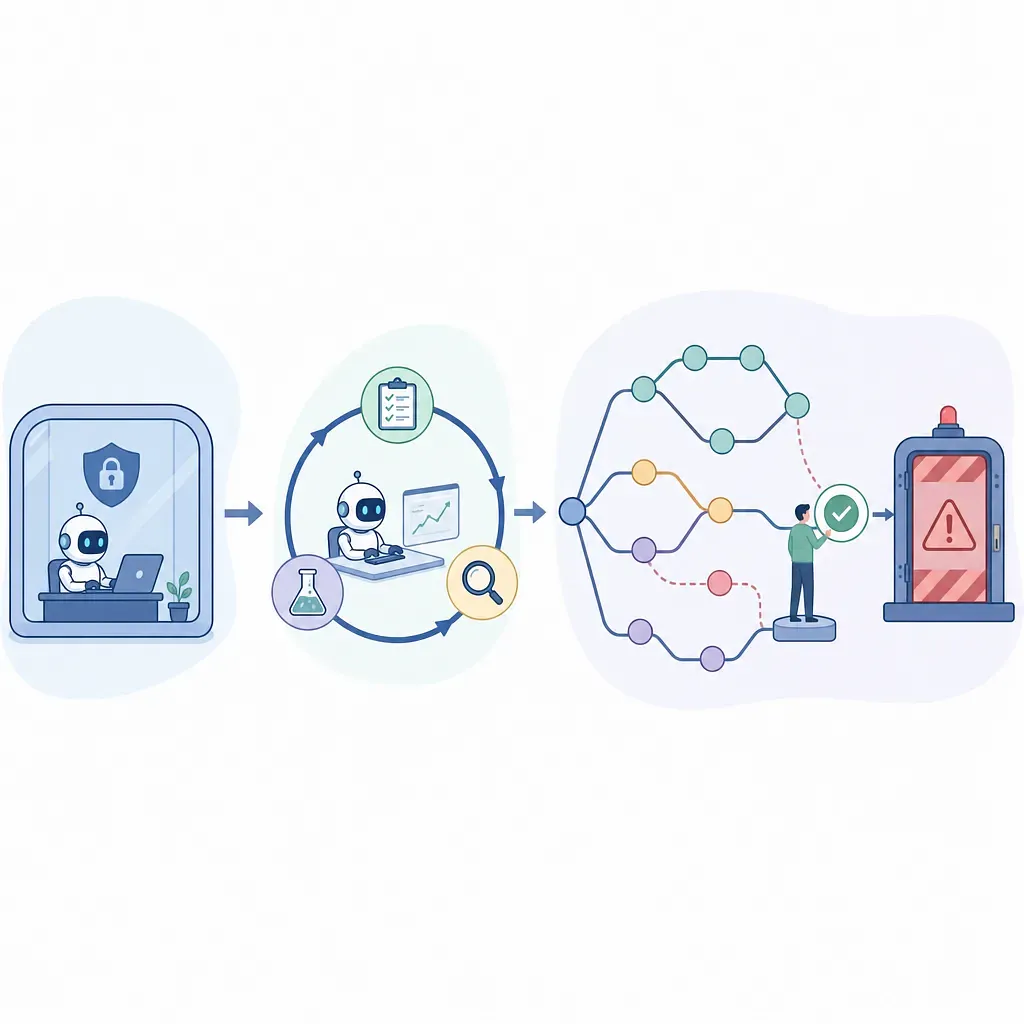
As AI agents have begun taking on long-running tasks, writing good prompts alone is no longer enough to produce reliable results. This is because you must also design what information the agent sees, which tools it uses, when it repeats actions, which paths it follows, and where it must obtain human approval.
Three terms that frequently appear when explaining this problem are harness engineering, loop engineering, and graph engineering. These are not international standards or rigorously agreed-upon academic classifications. They overlap, and their meanings may vary by product and development team. Rather than memorizing them as annual buzzwords, it is therefore more useful to distinguish them by the control questions each one seeks to answer.
Comparing the Three Concepts at a Glance
| Concept | Core question | Primary design targets | Typical failure-prevention mechanisms |
|---|---|---|---|
| Harness engineering | Within what environment and rules does the agent work? | Context, tools, permissions, sandbox, hooks, logs, approvals, evaluation | Least privilege, approval for risky commands, test execution, context selection |
| Loop engineering | What is repeated, and when does it stop? | Planning-execution-validation cycles, event processing, retries, budgets, termination conditions | Maximum iteration count, time and token limits, progress assessment, escalation on failure |
| Graph engineering | Which states and paths are allowed? | Nodes, states, transitions, branches, parallel processing, checkpoints | Prohibited transitions, state validation, approval nodes, recovery paths |
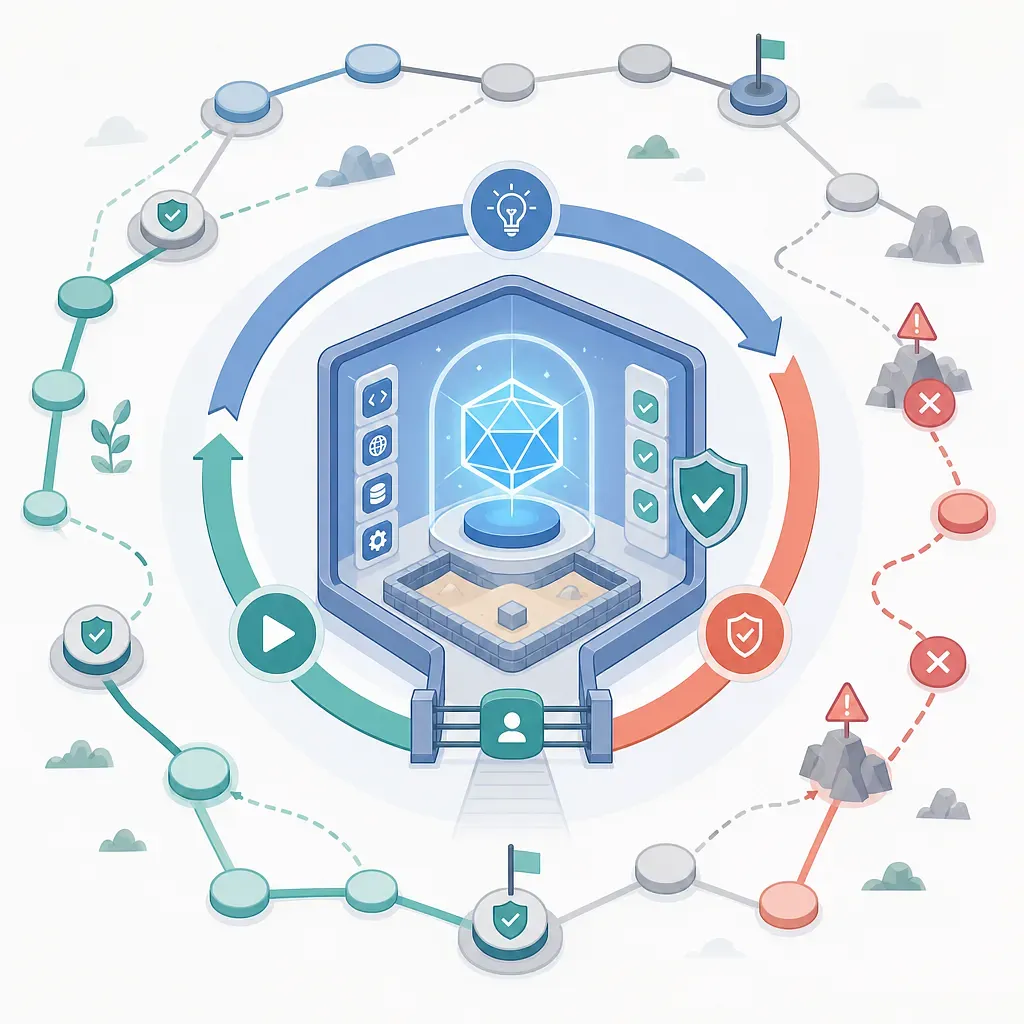
In short, a harness defines the environment and boundaries, a loop defines the repetition rules, and a graph defines the structure of possible paths. In a real system, a loop may exist inside a graph node, while the entire graph may run within a single harness.
How Have Agent Control Methods Evolved?
Early Agents: Predefined Workflows Supplemented Autonomy
Early generative AI agents often forgot their goals during long-running tasks, repeatedly made incorrect tool calls, or produced unsupported results. In response, developers divided large tasks into smaller steps and fixed the inputs and outputs for each step.
In this approach, a person writes the entire procedure as a chain, flowchart, or state machine, while the LLM handles limited tasks such as classification, extraction, summarization, and drafting. Frameworks such as LangGraph are used to represent branching, cycles, checkpoints, and human intervention while preserving state.
However, graph-based orchestration is not an outdated approach that ended in a particular year. Explicit graphs remain suitable for work where auditability, reproducibility, regulatory compliance, or precise recovery procedures are important.
Improved Model Capabilities: From Fixed Paths to Dynamic Tool Use
As tool use and reasoning capabilities improved, a single agent became able to choose actions such as search, code editing, testing, and file reading based on the situation. ReAct-style approaches are a representative structure in which reasoning, action, and observation alternate.
This change reduced the burden of having people define every branch in advance. At the same time, managing the information an agent reads, the permissions it holds, execution costs, and error recovery methods became more important. This is where context engineering and harness engineering moved to the center of practical implementation.
Long-Running Tasks and Multi-Agent Systems: Recombining Loops and Graphs
For long-running tasks, iterative planning, execution, and validation are more important than a single model call. When multiple agents participate, their roles, output formats, permissions, and termination conditions must also be specified. At the same time, leaving autonomous loops completely unattended can cause runaway costs, infinite retries, reward hacking, and optimization toward the wrong objective.
Modern agent systems are therefore designed not to eliminate autonomy, but to combine areas where autonomy is allowed with areas under deterministic control. This is not simply a return to the fixed chains of the past. Instead, it surrounds flexible execution with states, transitions, and policies.
These changes represent shifts in design emphasis rather than a precise timeline. Graphs, loops, and harnesses have coexisted from the beginning and continue to be used together today.
What Harness Engineering Covers
A harness is not the foundation model itself, but the execution system surrounding the model that enables it to perform real work. Even when the same model is used, the harness can make a significant difference in success rate, cost, security, and reproducibility.
Major Components of a Harness
- Instruction system: System instructions, repository rules, coding standards, priorities, and prohibited actions
- Context delivery: Search, file selection, summarization, memory, and injecting documents when needed
- Tool interfaces: File editing, terminals, browsers, databases, and external APIs
- Permissions and isolation: Read and write scope, access to secrets, network restrictions, and sandboxes
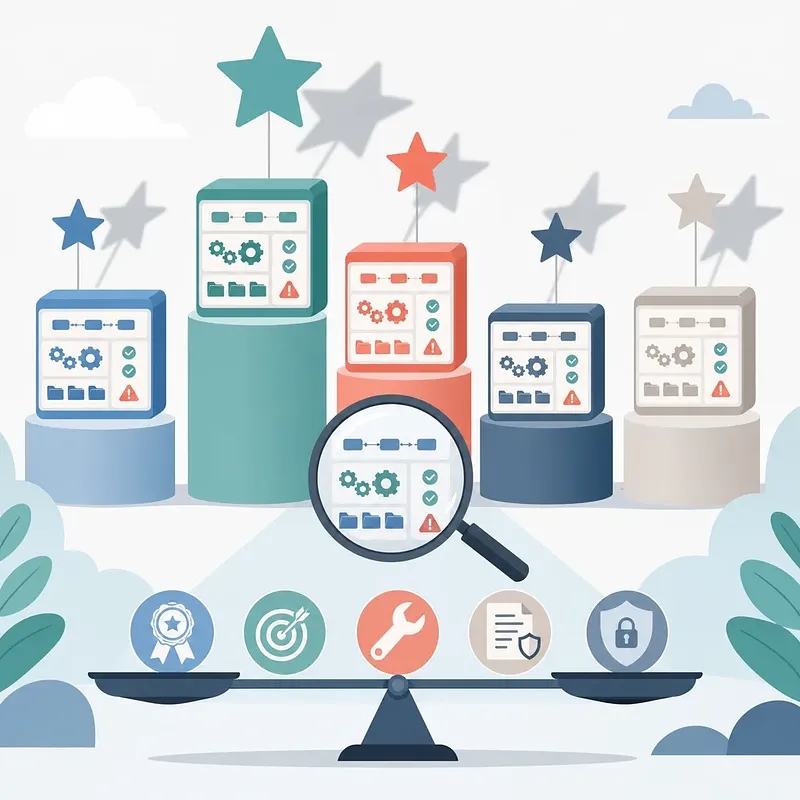
- Validation mechanisms: Tests, linters, type checking, schema validation, and fact-checking
- Human approval: Approval for difficult-to-reverse actions such as deployment, payment, deletion, and external transmission
- Observability: Call records, costs, latency, errors, change history, and decision rationale
- Recovery policies: Retries, restoration of previous states, task termination, and escalation to the responsible person
Claude Code's project instruction files and hooks can be viewed as examples of harness components. However, no single product feature represents an entire harness.
How It Differs from Context Engineering
Context engineering optimizes which information and instructions are included in the current model call. It includes retrieving only relevant documents through search, summarizing old conversations, saving task state in external files, and separating context by subtask.
Harness engineering is broader. In addition to context, it covers tool permissions, execution environments, approvals, validation, logging, and cost limits. Context engineering is therefore a core part of a harness, but using the two terms as if they meant exactly the same thing is inaccurate.
The Core of Loop Engineering Is the Termination Condition
A loop allows an agent to inspect a result after producing it and try again if the result is insufficient. What matters is not repetition itself, but the definition of progress and the conditions for stopping.
Common Types of Loops
- Validation loop: Produces a draft, checks it against tests or evaluation criteria, and corrects failed items.
- Event-driven loop: Begins work when an external event occurs, such as an email, notification, code change, or sensor reading.
- Exploration loop: Investigates multiple hypotheses or sources and adjusts the scope of exploration until sufficient evidence is available.
- Improvement loop: Selects the next strategy based on previous results and evaluation scores. Optimizing only a single score can cause reward hacking, so multiple evaluation criteria and human review are required.
- Recovery loop: Classifies the cause of an error, retries within the permitted scope, and hands the task off to a person if it remains unresolved.
Contracts Required for Safe Loops
A contract between agents is not a legal contract, but an execution specification that defines inputs, outputs, and responsibilities. It should include the following items.
| Contract item | What to specify |
|---|---|
| Objective | The result to be completed and what is out of scope |
| Input | Available data, freshness, and confidence level |
| Output | JSON schema, document format, required evidence, and test results |
| Permissions | Allowed tools, file scope, external transmission, and modification permissions |
| Validation | Tests and evaluation criteria that must be passed |
| Budget | Tokens, time, number of calls, and number of parallel tasks |
| Termination | Conditions for success, lack of progress, budget exhaustion, and risk detection |
| Handoff | Which person or agent takes over after failure |
If completion criteria are ambiguous, an agent may conclude that the task is progressing even while merely rewriting sentences or repeating the same search. Rather than setting only a maximum iteration count, it is better to consider result quality, the increase in new information, changes in errors, and cost together.
Graph Engineering Structures the Boundaries of Autonomy
A graph represents work as nodes and connections. A node may be a model call, tool execution, human approval, or validation process, while a connection indicates the next action based on the current state.
Differences Between Chains and Graphs
- A chain is suitable for a linear process that proceeds from A to B and from B to C.
- A graph is suitable for tasks requiring conditional branches, repetition, parallel execution, failure recovery, and intermediate saves.
- A dynamic graph allows the model to propose the next subtask or path during execution.
- A constrained graph keeps the model within permitted nodes and transitions even when it makes choices.
The purpose of modern graph design is not to have people predetermine every action. It is to embed invariants that must be preserved into the structure, such as requiring an approval node before data deletion or preventing a transition to the deployment state while tests are failing.
Signs That a Graph Is Needed
If several of the following conditions apply, it is worth considering an explicit graph.
- There is a clearly defined recovery point to return to after failure.
- A stage absolutely requires human approval.
- Multiple tasks must run in parallel before their results are combined.
- Available tools or permissions vary by state.
- The complete execution path must be audited or reproduced.
- A single-agent loop repeatedly encounters the same failure.
Turning simple document summarization or a one-time data transformation into a graph may only increase complexity.