
Skip to content
Injoys
AI Data

Graph Engineering: Design Principles for Structuring AI Agent Workflows

Graph engineering is an approach that divides complex AI tasks into nodes and transition rules while explicitly designing state, validation, failure recovery, and user approval. The key is to distinguish the roles of code, models, and humans rather than entrusting every step to AI.

Listen or read this article

15:10

Listen, or read the text only.

Graph Engineering: Design Principles for Structuring AI Agent Workflows

Kokoro 82M AI-generated voice

0:00 15:10

Advertisement

Download audio

File name
graph-engineering-ai-agent-workflow-guide-en.mp3
Format
MP3 (audio/mpeg)
Duration
15:10
File size
10.4 MB
Engine
Kokoro 82M

This audio was generated by AI.

You may download and use it freely for personal use.

Graph Engineering: Design Principles for Structuring AI Agent Workflows

11 min read

Graph Engineering: Design Principles for Structuring AI Agent Workflows
Graph engineering is an approach that divides complex AI tasks into nodes and transition rules while explicitly designing state, validation, failure recovery, and user approval. The key is to distinguish the roles of code, models, and humans rather than entrusting every step to AI.
Graph engineering designs the path, state, branches, iterations, and termination conditions of an entire task, rather than focusing on a single model response.
Nodes perform tasks, edges define paths, state passes data between steps, and conditions select the next path.
Routing, parallel execution, generator–evaluator loops, and user approval are common agent graph patterns.
It is advantageous to assign deterministic tasks such as format validation and numerical comparison to code, ambiguous interpretation to AI, and high-risk decisions to humans.
An operational graph requires a state schema, retry limits, prevention of duplicate execution, observability, permission boundaries, and a cost budget.
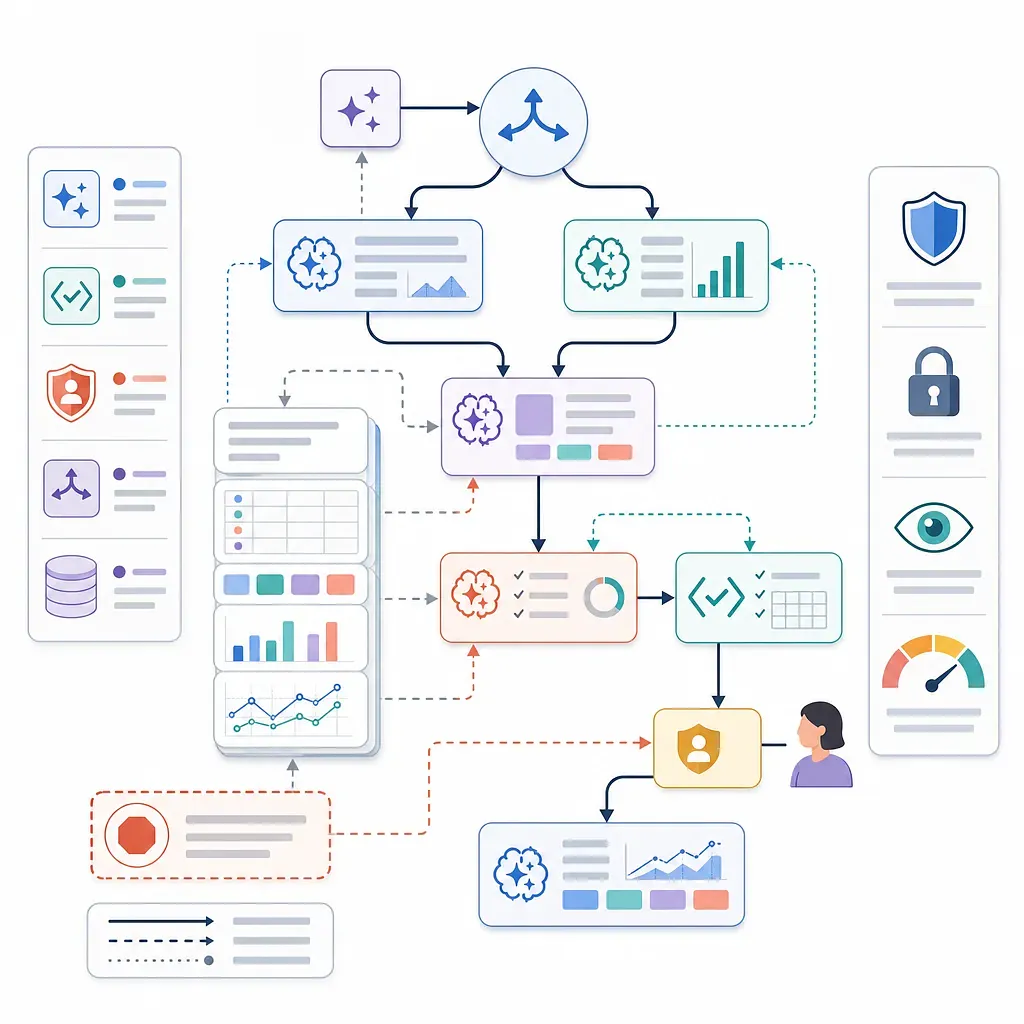
Graph Engineering is an approach that focuses on designing the sequence and conditions under which multiple tasks and tools are executed, rather than merely improving the response quality of a single AI model. Representing complex work as nodes and connections makes it possible to separately manage each stage’s inputs and outputs, causes of failure, retry paths, and human approval points.
However, this expression is not yet a single standard term agreed upon across the industry. It is more accurate to understand it as a practical concept encompassing agent workflow design, graph-based orchestration, and multi-agent control.
Why Graphs Emerged in AI Engineering
The design concerns of AI applications have expanded as follows. Rather than formal stages of development that every organization follows identically, these are complementary design layers.
Layer | Key Question | Primary Design Targets Prompt engineering | How should the model be instructed? | Instructions, examples, output formats Context engineering | What information should be assembled for decision-making? | Search results, memory, tool results, system rules Loop engineering | How should planning, execution, verification, and revision be repeated? | Repetition conditions, evaluation criteria, termination conditions Graph engineering | Through which paths should multiple tasks and decision-makers be connected? | Nodes, transitions, state, branching, parallelization, approvals
Prompts and context remain necessary within graphs. Loops can also be represented as cyclic edges in a graph. Graph engineering is therefore not a technology that replaces earlier techniques, but rather a higher-level design perspective that arranges them within an execution structure.
Components of Graph Engineering
Nodes
A node is a unit of work with one clearly defined responsibility. In addition to LLM calls, ordinary code such as database queries, search API calls, format validation, calculations, and waiting for user approval can also serve as nodes.
A good node has clear inputs and outputs and can be tested independently. Narrowly scoped responsibilities such as collect recent materials for the specified industry, remove duplicate sources, and check evidence for each claim are more useful for debugging than a broad name such as market research.
Edges
An edge is a transition from one node to the next. There are fixed edges that always move to the same next stage, conditional edges that inspect the state and select a path, and branching edges that start multiple tasks simultaneously.
State
State is data shared while the graph is running. It may include user requests, intermediate outputs, search sources, error codes, approval results, and iteration counts.
State differs from a simple conversation history. Schemas and rules must define which fields are required, who may modify them, how parallel results are merged, and when sensitive information is deleted.
Conditions
A condition is a rule for selecting the next path. Deterministic conditions such as are there at least three sources can be evaluated in code. By contrast, conditions requiring semantic judgment, such as does the evidence sufficiently support the conclusion, may require model evaluation or human review.
Why It Is Easier to Control Than a Single Agent
When one agent is assigned research, analysis, writing, and verification, it is difficult to identify the cause when the result is wrong. This is because planning errors, missing search results, tool-call failures, and unsupported generation are mixed together in a single execution record.
Breaking work down into a graph makes it possible to manage the following items stage by stage.
· Restrict the tools and data access permissions allowed for each node. · Store intermediate outputs and evaluate them independently. · Re-run only failed nodes to reduce cost and time. · Obtain human approval immediately before important external actions. · Track execution paths, latency, token usage, and errors.
However, simply creating more nodes does not automatically improve reliability. If state transfer is inaccurate or evaluation criteria are ambiguous, errors may be amplified across multiple stages.
Common Graph Usage Patterns
Router Pattern
A router selects different paths based on the request type or level of risk. For example, refund inquiries can be sent to a policy search node, while technical issues can be sent to a diagnostic node.
Code is appropriate when routing criteria are simple keywords or account status. Model classification can be used when context must be interpreted, but safeguards are needed to send requests to a default path or human review when confidence is low.
Parallel Execution Pattern
Tasks that do not depend on one another are performed simultaneously and then combined at an aggregation node. A typical example is conducting market, customer, and competitor research in parallel.
Parallelization can reduce latency, but it increases the number of calls and immediate cost. If results modify the same state field simultaneously, conflict resolution rules and the merge order must also be defined.
Generator-Evaluator Pattern
A generator creates a draft, and an evaluator decides whether to pass, revise, or rewrite it according to defined criteria. Because the evaluation result returns to the generator, a loop is formed within the graph.
If the evaluator is also an LLM, it can make incorrect judgments. Where possible, it should be supplemented with deterministic validation such as schema checks, test execution, and citation URL verification, and a maximum iteration count must be set to prevent infinite loops.
User Approval Pattern
Execution is paused before actions that are difficult to reverse or carry significant responsibility, such as changing external systems, sending messages, making payments, or deploying, so that human judgment can be obtained. Rather than showing only the final result, it is safer for the approval screen to also present the action to be performed, the data used, the expected impact, and the rollback method.
Manager-Specialist Pattern
A manager node breaks down the work, assigns it to specialist nodes for search, analysis, writing, and other tasks, and then aggregates the results. Role separation is useful, but increasing the number of agents should not become a goal in itself. For fixed procedures, an explicit workflow may be more predictable.
Principles for Dividing the Roles of AI, Code, and Humans
Nature of Task | Preferred Means | Examples Clear rules that must produce identical results | General code | Counting items, comparing dates, JSON schema validation Judgments involving the meaning and ambiguity of natural language | AI model | Intent classification, summarization, drafting, qualitative evaluation Decisions requiring accountability, ethics, or high-risk judgment | Human | Approval of external communications, granting exceptions, approval of high-risk actions
Using an LLM when the rules are clear unnecessarily increases cost, latency, and nondeterminism. Conversely, fixing every judgment as a code rule makes it difficult to handle real-world inputs with varied expressions. A good graph combines the strengths of all three approaches and validates inputs and outputs at each boundary.
The Difference Between Knowledge Graphs and Graph Engineering
The two concepts can be related, but they are not the same.
· A knowledge graph is a data representation that structures entities such as people, organizations, documents, and concepts, along with their relationships. · An agent execution graph represents the sequence and conditions under which tasks are executed. · Graph engineering can refer to the practice of designing the structure, state, control, validation, and operational methods of execution graphs.
Knowledge graph search can be connected as a node, but graph engineering does not necessarily require a knowledge graph. Conversely, building a knowledge graph does not automatically create an agent workflow with retry and approval paths.
Hidden Design Elements That Determine Operational Quality
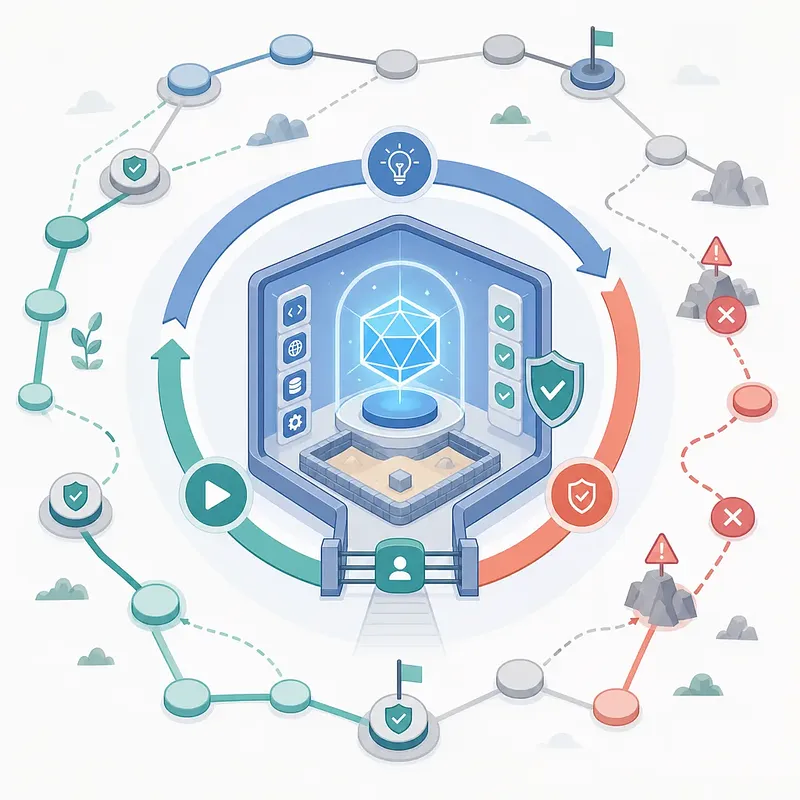
A graph diagram alone does not complete a production system. The factors that determine actual reliability are execution semantics and operational contracts.
State Contracts and Version Management
The input and output schemas, required fields, data sources, and update permissions for each node must be defined. Compatibility between state schemas and workflow versions must also be managed so that executions that were already paused can resume after the graph is changed.
Failure Recovery and Idempotency
Re-running a node after a network error may cause duplicate emails or payments. Tasks with external side effects require idempotency keys, pre-execution checks, compensating actions, or a deduplication store.
Not all failures are the same. Paths must be distinguished by error type—for example, retrying temporary API errors, returning invalid input to the user, and immediately stopping in the event of a policy violation.
Termination Conditions and Cost Budgets
Generator-evaluator loops must have maximum iteration counts, time limits, and token or cost caps. Conditions are also needed to terminate the loop or hand it off to a human when quality improvements are marginal.
The graph’s total cost must be calculated to include not only the cost of individual model calls, but also retries, parallel calls, state storage, external tools, and observability systems.
Observability and Evaluation
Operational records must capture which nodes and models were executed, which paths were selected, and what the inputs, outputs, and errors were. However, masking and retention periods must be applied so that personal information, credentials, and sensitive business data are not stored directly in logs.
Evaluation does not end with the final response score. Metrics for individual nodes and paths—such as routing accuracy, tool success rate, evidence sufficiency rate, risk detection rate before approval, and average retry count—must also be measured to identify bottlenecks.
Security and Permission Boundaries
Prompt injection must be considered, including instructions in retrieved documents or user input that attempt to alter system rules. Tool arguments generated by the model must be validated before execution, and each node should be granted only the minimum permissions required to perform its work. Separating read, write, delete, and external sending permissions can reduce the risk that an error in one node escalates into a system-wide incident.
When Graph Engineering Is Appropriate
The value of a graph structure increases as more of the following conditions overlap.
· Different specialized processing paths are required depending on the input. · Independent tasks can be executed in parallel. · When a particular stage fails, execution must return to a predefined point. · Intermediate outputs must be validated or audited. · Approval is required before modifying an external system. · Execution is long-running and must be resumed after interruption or preserve state. · Permissions and data access scopes must be separated by tool.
For simple summarization, one-time classification, or short question answering, a single model call or a short sequential pipeline is better. If the burden of state management, testing, observability, and deployment introduced by a graph exceeds the benefits, it is overengineering.
Design Review Checklist
· Define the final output and success criteria in measurable terms. · Limit each node to one responsibility and testable inputs and outputs. · Implement clear rules in code and minimize the scope of LLM judgment. · Define the state schema and rules for merging parallel results. · Distinguish retryable errors from errors that require immediate termination. · Set upper limits for iteration counts, execution time, and cost. · Add safeguards against duplicate execution to nodes with external side effects. · Place human approval and sufficient explanation before high-risk actions. · Establish logs and evaluation metrics for each node and path, along with privacy protection rules. · Reconfirm whether the same reliability can be achieved with a simpler structure.
Key Takeaways
If a single agent is like assigning multiple tasks at once to one capable employee, graph engineering is closer to designing organizational roles, work handoff paths, review procedures, and approval chains.
The key is not the number of agents, but a controllable structure. It must be clear at which stages AI makes judgments, where code performs validation, and when humans make accountable decisions. With state contracts, failure recovery, observability, permission controls, and cost limits in place, a graph can move beyond a simple diagram and become an operable AI system.
0:00 0:00
1 / 74

Advertisement

Download text

File name
graph-engineering-ai-agent-workflow-guide-en.txt
Format
TXT (text/plain)
Paragraphs
74

Downloads exactly what you see as a text file.

Please cite the source when quoting.

Large text

Makes the text larger and the colors clearer. Turn it on if the text feels too small.

An engineer examines an AI agent workflow composed of interconnected nodes and paths.

Key points

  • Graph engineering designs the path, state, branches, iterations, and termination conditions of an entire task, rather than focusing on a single model response.
  • Nodes perform tasks, edges define paths, state passes data between steps, and conditions select the next path.
  • Routing, parallel execution, generator–evaluator loops, and user approval are common agent graph patterns.
  • It is advantageous to assign deterministic tasks such as format validation and numerical comparison to code, ambiguous interpretation to AI, and high-risk decisions to humans.
  • An operational graph requires a state schema, retry limits, prevention of duplicate execution, observability, permission boundaries, and a cost budget.

Graph Engineering is an approach that focuses on designing the sequence and conditions under which multiple tasks and tools are executed, rather than merely improving the response quality of a single AI model. Representing complex work as nodes and connections makes it possible to separately manage each stage’s inputs and outputs, causes of failure, retry paths, and human approval points.

However, this expression is not yet a single standard term agreed upon across the industry. It is more accurate to understand it as a practical concept encompassing agent workflow design, graph-based orchestration, and multi-agent control.

Why Graphs Emerged in AI Engineering

The design concerns of AI applications have expanded as follows. Rather than formal stages of development that every organization follows identically, these are complementary design layers.

Layer Key Question Primary Design Targets
Prompt engineering How should the model be instructed? Instructions, examples, output formats
Context engineering What information should be assembled for decision-making? Search results, memory, tool results, system rules
Loop engineering How should planning, execution, verification, and revision be repeated? Repetition conditions, evaluation criteria, termination conditions
Graph engineering Through which paths should multiple tasks and decision-makers be connected? Nodes, transitions, state, branching, parallelization, approvals

Prompts and context remain necessary within graphs. Loops can also be represented as cyclic edges in a graph. Graph engineering is therefore not a technology that replaces earlier techniques, but rather a higher-level design perspective that arranges them within an execution structure.

Components of Graph Engineering

Nodes

A node is a unit of work with one clearly defined responsibility. In addition to LLM calls, ordinary code such as database queries, search API calls, format validation, calculations, and waiting for user approval can also serve as nodes.

A good node has clear inputs and outputs and can be tested independently. Narrowly scoped responsibilities such as collect recent materials for the specified industry, remove duplicate sources, and check evidence for each claim are more useful for debugging than a broad name such as market research.

Edges

An edge is a transition from one node to the next. There are fixed edges that always move to the same next stage, conditional edges that inspect the state and select a path, and branching edges that start multiple tasks simultaneously.

State

State is data shared while the graph is running. It may include user requests, intermediate outputs, search sources, error codes, approval results, and iteration counts.

State differs from a simple conversation history. Schemas and rules must define which fields are required, who may modify them, how parallel results are merged, and when sensitive information is deleted.

Conditions

A condition is a rule for selecting the next path. Deterministic conditions such as are there at least three sources can be evaluated in code. By contrast, conditions requiring semantic judgment, such as does the evidence sufficiently support the conclusion, may require model evaluation or human review.

Why It Is Easier to Control Than a Single Agent

When one agent is assigned research, analysis, writing, and verification, it is difficult to identify the cause when the result is wrong. This is because planning errors, missing search results, tool-call failures, and unsupported generation are mixed together in a single execution record.

Breaking work down into a graph makes it possible to manage the following items stage by stage.

  • Restrict the tools and data access permissions allowed for each node.
  • Store intermediate outputs and evaluate them independently.
  • Re-run only failed nodes to reduce cost and time.
  • Obtain human approval immediately before important external actions.
  • Track execution paths, latency, token usage, and errors.

However, simply creating more nodes does not automatically improve reliability. If state transfer is inaccurate or evaluation criteria are ambiguous, errors may be amplified across multiple stages.

Common Graph Usage Patterns

Router Pattern

A router selects different paths based on the request type or level of risk. For example, refund inquiries can be sent to a policy search node, while technical issues can be sent to a diagnostic node.

Code is appropriate when routing criteria are simple keywords or account status. Model classification can be used when context must be interpreted, but safeguards are needed to send requests to a default path or human review when confidence is low.

Parallel Execution Pattern

Tasks that do not depend on one another are performed simultaneously and then combined at an aggregation node. A typical example is conducting market, customer, and competitor research in parallel.

Parallelization can reduce latency, but it increases the number of calls and immediate cost. If results modify the same state field simultaneously, conflict resolution rules and the merge order must also be defined.

Generator-Evaluator Pattern

A generator creates a draft, and an evaluator decides whether to pass, revise, or rewrite it according to defined criteria. Because the evaluation result returns to the generator, a loop is formed within the graph.

If the evaluator is also an LLM, it can make incorrect judgments. Where possible, it should be supplemented with deterministic validation such as schema checks, test execution, and citation URL verification, and a maximum iteration count must be set to prevent infinite loops.

User Approval Pattern

Execution is paused before actions that are difficult to reverse or carry significant responsibility, such as changing external systems, sending messages, making payments, or deploying, so that human judgment can be obtained. Rather than showing only the final result, it is safer for the approval screen to also present the action to be performed, the data used, the expected impact, and the rollback method.

Manager-Specialist Pattern

A manager node breaks down the work, assigns it to specialist nodes for search, analysis, writing, and other tasks, and then aggregates the results. Role separation is useful, but increasing the number of agents should not become a goal in itself. For fixed procedures, an explicit workflow may be more predictable.

Principles for Dividing the Roles of AI, Code, and Humans

Nature of Task Preferred Means Examples
Clear rules that must produce identical results General code Counting items, comparing dates, JSON schema validation
Judgments involving the meaning and ambiguity of natural language AI model Intent classification, summarization, drafting, qualitative evaluation
Decisions requiring accountability, ethics, or high-risk judgment Human Approval of external communications, granting exceptions, approval of high-risk actions

Using an LLM when the rules are clear unnecessarily increases cost, latency, and nondeterminism. Conversely, fixing every judgment as a code rule makes it difficult to handle real-world inputs with varied expressions. A good graph combines the strengths of all three approaches and validates inputs and outputs at each boundary.

The Difference Between Knowledge Graphs and Graph Engineering

The two concepts can be related, but they are not the same.

  • A knowledge graph is a data representation that structures entities such as people, organizations, documents, and concepts, along with their relationships.
  • An agent execution graph represents the sequence and conditions under which tasks are executed.
  • Graph engineering can refer to the practice of designing the structure, state, control, validation, and operational methods of execution graphs.

Knowledge graph search can be connected as a node, but graph engineering does not necessarily require a knowledge graph. Conversely, building a knowledge graph does not automatically create an agent workflow with retry and approval paths.

Hidden Design Elements That Determine Operational Quality

A graph diagram alone does not complete a production system. The factors that determine actual reliability are execution semantics and operational contracts.

State Contracts and Version Management

The input and output schemas, required fields, data sources, and update permissions for each node must be defined. Compatibility between state schemas and workflow versions must also be managed so that executions that were already paused can resume after the graph is changed.

Failure Recovery and Idempotency

Re-running a node after a network error may cause duplicate emails or payments. Tasks with external side effects require idempotency keys, pre-execution checks, compensating actions, or a deduplication store.

Not all failures are the same. Paths must be distinguished by error type—for example, retrying temporary API errors, returning invalid input to the user, and immediately stopping in the event of a policy violation.

Termination Conditions and Cost Budgets

Generator-evaluator loops must have maximum iteration counts, time limits, and token or cost caps. Conditions are also needed to terminate the loop or hand it off to a human when quality improvements are marginal.

The graph’s total cost must be calculated to include not only the cost of individual model calls, but also retries, parallel calls, state storage, external tools, and observability systems.

Observability and Evaluation

Operational records must capture which nodes and models were executed, which paths were selected, and what the inputs, outputs, and errors were. However, masking and retention periods must be applied so that personal information, credentials, and sensitive business data are not stored directly in logs.

Evaluation does not end with the final response score. Metrics for individual nodes and paths—such as routing accuracy, tool success rate, evidence sufficiency rate, risk detection rate before approval, and average retry count—must also be measured to identify bottlenecks.

Security and Permission Boundaries

Prompt injection must be considered, including instructions in retrieved documents or user input that attempt to alter system rules. Tool arguments generated by the model must be validated before execution, and each node should be granted only the minimum permissions required to perform its work. Separating read, write, delete, and external sending permissions can reduce the risk that an error in one node escalates into a system-wide incident.

When Graph Engineering Is Appropriate

The value of a graph structure increases as more of the following conditions overlap.

  • Different specialized processing paths are required depending on the input.
  • Independent tasks can be executed in parallel.
  • When a particular stage fails, execution must return to a predefined point.
  • Intermediate outputs must be validated or audited.
  • Approval is required before modifying an external system.
  • Execution is long-running and must be resumed after interruption or preserve state.
  • Permissions and data access scopes must be separated by tool.

For simple summarization, one-time classification, or short question answering, a single model call or a short sequential pipeline is better. If the burden of state management, testing, observability, and deployment introduced by a graph exceeds the benefits, it is overengineering.

Design Review Checklist

  1. Define the final output and success criteria in measurable terms.
  2. Limit each node to one responsibility and testable inputs and outputs.
  3. Implement clear rules in code and minimize the scope of LLM judgment.
  4. Define the state schema and rules for merging parallel results.
  5. Distinguish retryable errors from errors that require immediate termination.
  6. Set upper limits for iteration counts, execution time, and cost.
  7. Add safeguards against duplicate execution to nodes with external side effects.
  8. Place human approval and sufficient explanation before high-risk actions.
  9. Establish logs and evaluation metrics for each node and path, along with privacy protection rules.
  10. Reconfirm whether the same reliability can be achieved with a simpler structure.

Key Takeaways

If a single agent is like assigning multiple tasks at once to one capable employee, graph engineering is closer to designing organizational roles, work handoff paths, review procedures, and approval chains.

The key is not the number of agents, but a controllable structure. It must be clear at which stages AI makes judgments, where code performs validation, and when humans make accountable decisions. With state contracts, failure recovery, observability, permission controls, and cost limits in place, a graph can move beyond a simple diagram and become an operable AI system.

Sign-in required

Sign in with your Google account to like, comment, and save highlights.

Images

An engineer examines an AI agent workflow composed of interconnected nodes and paths.
The diagram shows a structured AI agent workflow spanning data processing, validation, security, and human approval.

FAQ

What is graph engineering?

It is an approach that divides complex AI tasks into nodes and explicitly designs the paths between tasks, shared state, branching conditions, loops, and approval procedures. Rather than being a single standard term agreed upon across the industry, it is closer to a practical expression used to describe graph-based agent orchestration.

How is graph engineering different from prompt engineering?

Prompt engineering deals with what instructions and examples to provide for individual model calls. Graph engineering deals with the sequence and conditions for connecting multiple model calls, code, tools, and human judgment. Prompts continue to be used within each node that makes up the graph.

Are graph engineering and knowledge graphs the same concept?

No. A knowledge graph is data that structures entities and relationships, while an agent execution graph represents task sequences and control flow. Knowledge graph retrieval can be used as a node in an execution graph, but neither is a prerequisite for the other.

Do all nodes need to be AI agents?

No. For tasks with clear-cut results, such as calculating quantities, comparing dates, and checking formats, conventional code is faster, cheaper, and more predictable. A suitable approach is to assign natural language interpretation and qualitative judgment to AI, and decisions that carry significant responsibility or are difficult to reverse to humans.

How does a generator-evaluator loop prevent infinite repetition?

The maximum number of iterations, time and cost limits, and passing criteria must be defined in advance. Termination conditions are also needed to return the previous best result or route it to human review if repeated iterations do not improve quality or confidence in the evaluation is low.

Are multi-agent systems always better than a single agent?

No. As the number of roles increases, so do call costs, state transfer errors, latency, and debugging overhead. A multi-agent architecture should be chosen only when separating specialized roles contributes to actual quality or access control, while fixed procedures may be better handled with conventional code workflows.

What should be stored in the graph's state?

The principle is to store only the data needed for the next step, such as the user request, validated intermediate results, sources, error types, iteration count, and approval status. The format and modification permissions for each field should be defined, and credentials or unnecessary personal information should either not be stored or be masked.

What should be considered when retrying a failed node?

First, determine whether the error is temporary, whether the input itself is invalid, or whether the process must be stopped due to policy. Tasks with external side effects, such as sending emails, processing payments, or modifying data, should use idempotency keys and duplicate execution checks.

What tasks do not require graph engineering?

It is generally unnecessary for tasks that can be handled with a single call, such as simple summarization, brief question answering, or one-time classification. If the state management and operational costs introduced by adding a graph outweigh the improvements in quality, control, or recoverability, it is better to maintain a simple structure.

Sources

Data formats

This content is available in several machine-friendly formats.

Data-only languages (machine translated, files only)

Indonesian JSON MD Portuguese JSON MD Chinese (Traditional) JSON MD Deutsch JSON MD

Verification

Figures in this article were checked against the source material during generation. · 2026-08-21

This translation has been cross-checked by AI. · 2026-08-21

Reuse & AI usage

Search indexing and AI citation with attribution are welcome. See the license policy for details.

CC BY · License

Loading…

Loading…

Related content

From Injoys

Request the content you want and take 70% of what it earns

Just leave the subject. We handle production, review, translation and distribution.

See how revenue sharing works

Comments