Grok 4.6 Performance and API Pricing: How 500K Tokens Reshape Cost Competition
At launch, Grok 4.6 was assessed as scoring similarly to top-tier models on the Artificial Analysis Intelligence Index while offering lower API pricing than the models compared. However, its surcharge for requests exceeding 200,000 tokens, task-specific quality, and retry rate must all be considered to determine its actual cost advantage.
At launch, Grok 4.6 scored 61 on the Artificial Analysis Intelligence Index, placing it close to the top-tier models.
According to comparative data, its list API price is less than half that of GPT-5.6 Sol and Claude Opus 5, but actual costs vary with the ratio of input to output tokens and surcharges for long inputs.
The maximum context of 500,000 tokens may be useful for large code repositories, long collections of documents, and extended agent tasks.
Requests exceeding 200,000 tokens may be charged at twice the rate, so document retrieval and context compression should be designed together.
A model's accuracy, reliability, and tool-use capabilities should not be judged solely by a small score difference on a single aggregate benchmark.
The core competitive advantage of Grok 4.6, released by xAI on August 12, 2026, lies not simply in achieving the highest score but in the combination of top-tier performance and a low standard API price. In comparison materials available at launch, its key features were an Artificial Analysis Intelligence Index score of 61, a maximum context of 500,000 tokens, and a price less than half that of competing models.
However, the statement “the same performance at half the price” holds true only under limited comparison conditions. Benchmark scores continue to change, while actual charges are also affected by the mix of input and output tokens, surcharges for more than 200,000 tokens, retries, tool calls, and operational stability.
Key Figures to Check for Grok 4.6
The following table interprets the comparison materials presented at launch. Scores and model configurations may change as evaluators update their assessments, and names such as “GPT-5.6 Sol” may refer to an evaluation item or configuration name in the relevant comparison table, so they should not be assumed to be identical to official API model identifiers.
Item | Figure Related to Grok 4.6 | Points to Note When Interpreting
Release date | August 12, 2026 | Actual availability may vary by region and stage of API rollout
Artificial Analysis Intelligence Index | 61 points | A composite metric combining multiple evaluations that does not represent quality across every task
Scores of comparison targets | GPT-5.6 Sol 61 points, top-tier Claude 62–63 points | A difference of 1–2 points may not translate directly into a noticeable difference in real-world work
Maximum context | 500,000 tokens | Closer to the range of information that can be referenced in a single request than to the model’s permanent memory
Long-request pricing | A 2x rate may apply when exceeding 200,000 tokens | The xAI documentation at the time of the call should be checked for the exact threshold and input/output rates
Relative API price | Presented as less than half that of the comparison targets | Assumes the same token usage and publicly listed prices and differs from total cost of ownership
The Artificial Analysis Intelligence Index is a metric intended to compare models’ overall reasoning capabilities by combining multiple benchmarks. It is useful for seeing a model’s relative position at a glance, but it has the limitation of compressing individual capabilities—including coding, mathematics, long-form analysis, factuality, and tool use—into a single number.
What a Top-Tier Rating Means and Its Limitations
The fact that its score of 61 matched that of a comparison target can be viewed as a sign that Grok 4.6 belonged to the frontier-model competitive group at the time of its release. However, a tie in the composite score does not mean identical performance across every task.
Why Results Vary by Task
· Coding: Sequential tasks such as exploring repositories, modifying code, and running tests differ from short coding problems.
· Long-form analysis: In addition to context capacity, the ability to accurately retrieve information located in the middle of a document is important.
· Fact-checking: Fluent answers and factual accuracy are separate evaluation criteria.
· Tool use: The ability to reliably handle search, function calls, terminals, and external APIs may not be fully reflected in general reasoning scores.
· Multilingual capabilities: Even if a model scores highly on English-centered evaluations, its ability to understand and generate Korean documents must be tested separately.
A difference of 1–2 points is small enough that rankings may reverse when the evaluation sample or scoring method changes. Therefore, rather than concluding from Claude’s 62–63 points and Grok 4.6’s 61 points that one model is superior in every situation, it is safer to compare them directly using the same work samples.
Why Actual Costs Differ Even When the API Price Is Half
The standard API price is only the starting point for choosing a model. In practice, costs are generally calculated as follows.
Estimated model cost = input token cost + output token cost + long-context surcharge + retry cost + additional feature cost
Total cost of ownership can then be calculated by adding the costs of model integration, monitoring, data cleaning, and human review.
Conditions to Align Before Comparing Price Tables
· Compare input and output token rates separately.
· Check whether cached input receives a separate discount.
· Confirm whether the surcharge for the range exceeding 200,000 tokens applies to the entire input.
· Include the cost of tool calls such as web search, code execution, and file processing.
· Measure the average number of retries required to reach the same quality level.
· Consider waiting costs caused by processing speed and request limits.
For example, even if Grok 4.6’s headline rate is half that of a competing model, the price difference in that range may narrow significantly if a 2x rate applies to long requests. Conversely, if it has a high first-response success rate for short or medium-length requests, the actual savings may exceed the difference in listed prices.
Tasks That Benefit from a 500,000-Token Context
A token is a unit used by a model to process text and code. A Korean character does not always correspond one-to-one with a token, and the ratio also varies depending on document format, numbers, and code. Therefore, it is not appropriate to convert 500,000 tokens precisely into a specific number of books.
A large context may be useful for the following tasks.
· Cross-referencing multiple contracts and policy documents
· Tracking related files and dependencies in a large code repository
· Analyzing lengthy consultation records or incident logs
· AI agents that maintain multistep plans and execution records
· Reviewing papers, reports, and data documentation all at once
However, being able to place information in the context is different from accurately finding and using it. In long inputs, key information may become buried, or conflicting instructions may be included. Internal evaluations near the maximum length should include retrieval rates for information at the beginning, middle, and end of documents, citation accuracy, and compliance with instruction priority.
Impact on AI Agents
AI agents repeatedly plan, call tools, verify results, and make corrections. In this process, a broad context helps retain records of previous steps, tool outputs, and task rules for longer.
However, an agent’s success rate is not determined by context size alone. The following factors are also important.
· Function-calling accuracy in selecting the correct tools and arguments
· Recovery ability to recognize failures and try another method
· Ability to maintain goals and constraints during long-running tasks
· Security against following malicious instructions contained in external documents
· Cost controls that limit duplicate calls and unnecessary token consumption
Grok 4.6’s 500,000-token context therefore provides a favorable foundation for agents, but it is not a single metric that guarantees real-world automation performance.
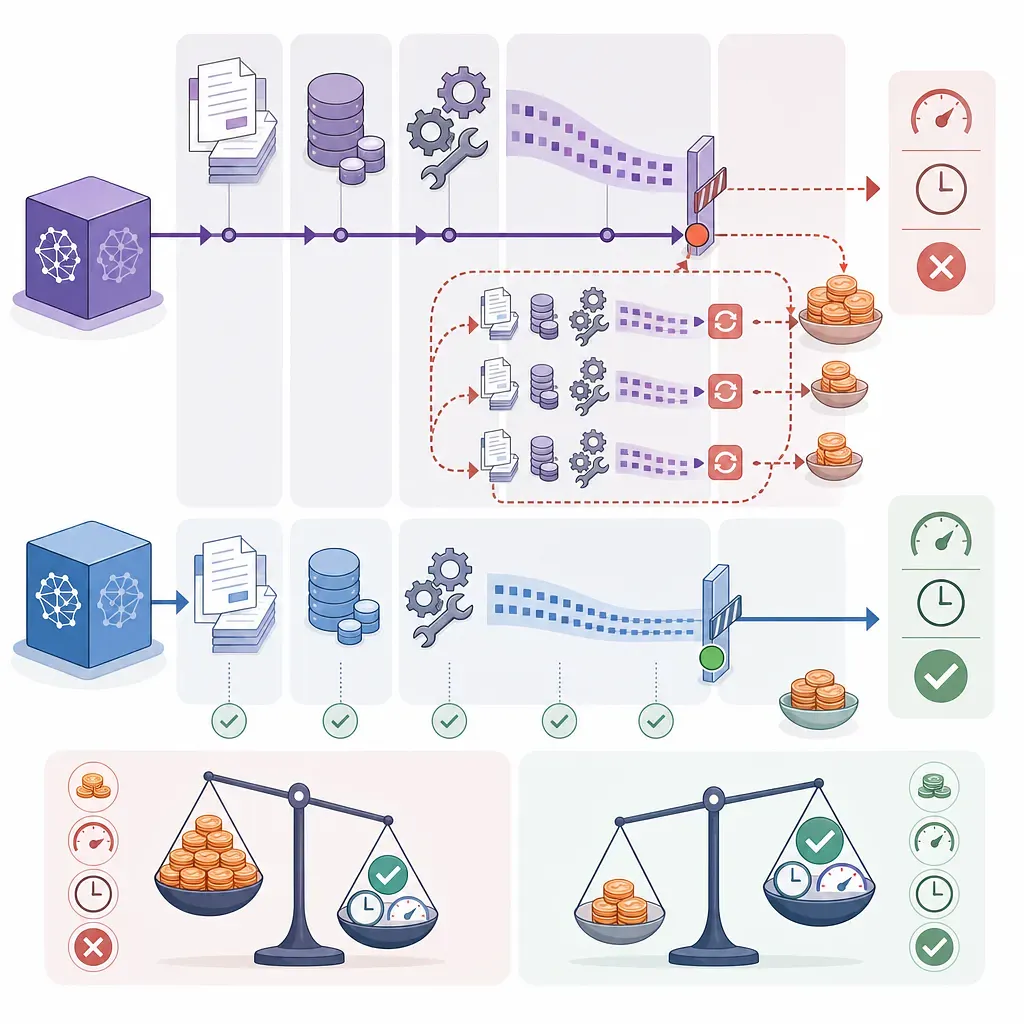
An Easily Overlooked Variable: Cost per Successful Task
A perspective frequently omitted from model price comparisons is not the “price per 1 million tokens,” but the cost per successfully completed task. Measuring the following metrics together provides a more accurate view of a model’s cost-effectiveness.
Metric | Calculation or Verification Method | Why It Matters
First-attempt success rate | Tasks passed without revision ÷ total tasks | Determines retry tokens and review time
Cost per successful task | Total API cost ÷ number of successful tasks | Enables a fair comparison of models with different quality levels
Latency | Time from request to completed response | Affects real-time services and developer productivity
Human revision time | Time required to bring the output to a usable standard | Reveals labor costs hidden by low API prices
Long-context retrieval accuracy | Percentage of required information accurately found in long inputs | Demonstrates the practical value of a large context
Agent completion rate | Percentage of tool-based tasks completed through to the goal | Evaluates costs caused by repeated calls
Under this approach, an expensive model may be cheaper because of its high success rate, while an inexpensive model may substantially reduce overall costs by providing sufficient quality. Because task types differ by organization, internal evaluation results are more important than public rankings.
How to Conduct a Comparative Evaluation Before Adoption
To compare Grok 4.6 with an existing GPT- or Claude-based system, representative tasks drawn from actual work should be used.
· Prepare 30–100 real tasks with personal and confidential information removed.
· Apply the same system instructions, tools, and output formats to all models.
· Record accuracy, completeness, latency, input and output tokens, and the number of retries.
· Have people evaluate the results with the model names concealed.
· Calculate costs separately for short requests and requests exceeding 200,000 tokens.
· For work where a single error could have a major impact, review the worst failure cases rather than relying on average scores.
· Check the latest official price table and terms of service before selecting the production model.
In a market where prices change frequently, it is better to rerun the same evaluation set regularly rather than stopping after a single comparison.
Security and Operational Considerations
When selecting a model, enterprises should examine data-processing terms in addition to benchmarks and prices.
· Whether API inputs and outputs are used for model training
· How long request data and logs are retained
· Whether the data-processing region can be selected
· Whether access control, audit logs, and key-management capabilities are provided
· What the throughput limits and compensation standards for outages are
· Whether model versions can be pinned or advance notice of changes can be received
Putting large amounts of material into a long context also increases the impact of a data leak. Only necessary documents should be retrieved and provided, sensitive information should be masked, and the tool permissions available to agents should be minimized.
How Grok 4.6 Reflects Changes in the AI Market
The significance of Grok 4.6 lies less in whether it ranked first on a particular benchmark than in the growing downward pressure on the price of frontier-level performance. As score differences between models narrow, competition shifts toward the following factors.
· Price per token and cache discounts
· Practical effectiveness of long contexts
· Response speed and stable throughput
· Coding and agent tool ecosystems
· Enterprise security and data control
· Accuracy in specific industries and languages
For users, this is a positive change that expands choice and lowers costs. On the other hand, migrating a system based only on publicly listed prices may fail to deliver the expected savings because of retries, quality review, and migration costs. Grok 4.6 shows that the competition to find “the lowest-total-cost model that meets the required quality” has become more important than the competition to find “the cheapest model.”
 Injoys