Injoys
The claim that “OpenAI and Anthropic incur costs every time they answer, while Google makes money from ads every time it answers” frequently appears in discussions of Google’s AI business. This framing clearly illustrates that the three companies have different starting points, but it should not be taken as an accounting fact.
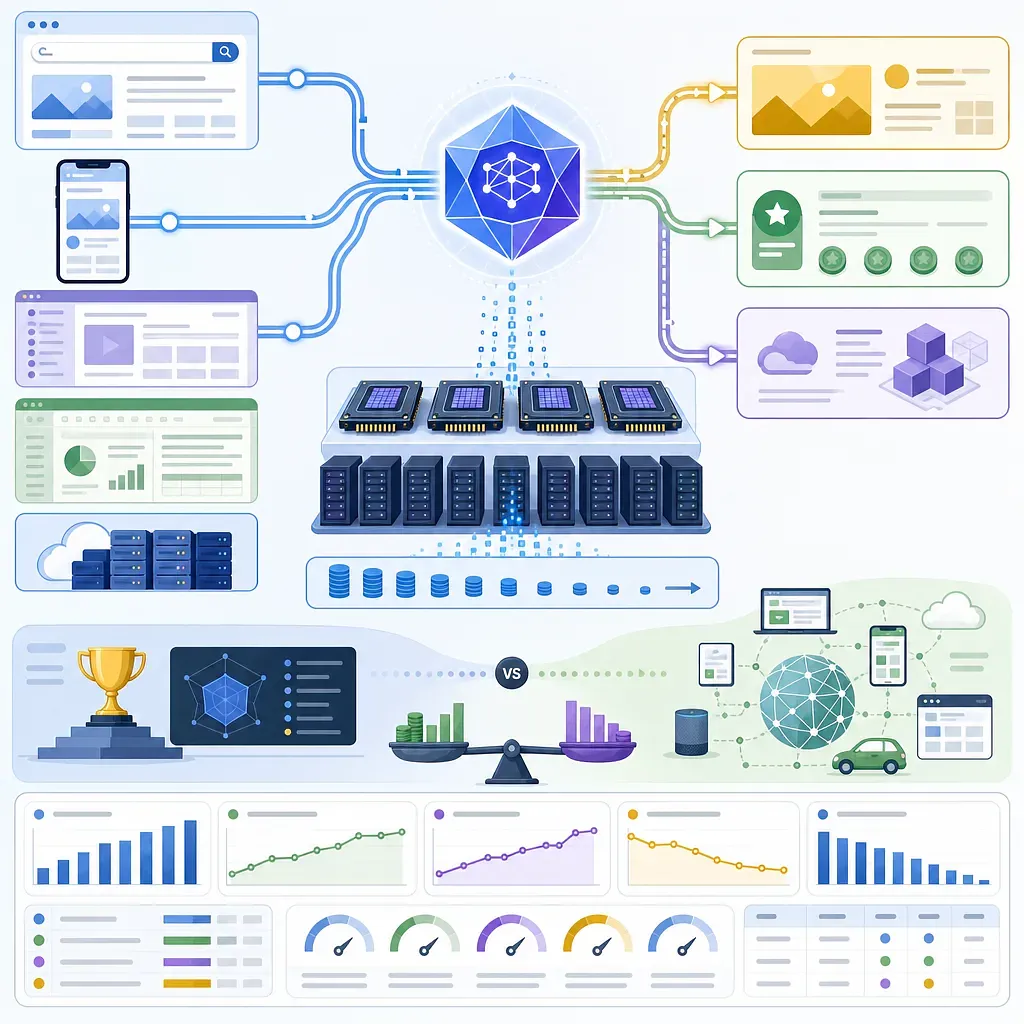
All three companies incur computing costs when running models, and all three generate revenue from APIs, subscriptions, enterprise contracts, and other sources. Google’s real distinction is not whether it incurs costs, but rather its ability to connect its existing product distribution network, advertising business, Google Cloud, and proprietary TPUs within a single economic structure.
Facts and Interpretations That Must First Be Corrected
The claims provided mix models from different points in time, dynamic rankings, and unverified personnel information. Using them as-is would lead to an oversimplified interpretation of Google’s strategy.
| Claim | What Must Be Verified | More Accurate Interpretation |
|---|---|---|
| Anthropic had a 42% share of coding spending in a particular survey | The sample, survey date, definition of “spending,” and respondent group must be checked | A VC survey may show purchasing trends among a sample of companies, but it does not represent global coding AI market share |
| Gemini was outside OpenRouter’s top 10 | OpenRouter rankings continually change based on the period, model, pricing, promotions, and routing demand | It is a usage signal at a particular point in time, not an overall ranking of developer adoption or product revenue |
| The launch of Gemini 1.5 Pro was postponed indefinitely | Gemini 1.5 Pro was announced last May, but its launch was postponed indefinitely | Using a description of a past launch delay as evidence for the current strategy creates a chronological mismatch |
| Gemini 1.5 Flash is Google’s latest model | 1.5 Flash is the product name of a particular generation | Directly comparing models from different generations with the latest competing models distorts the conclusion |
| Noam Shazeer left for OpenAI | Shazeer left Google for OpenAI | Talent movement matters, but the destination company and timing must be distinguished accurately |
| The departures of Jeff Dean and John Jumper prove a strategic shift | Major personnel claims must be verified through company announcements or public records from the individuals involved | Unverified personnel information should not be used as evidence of organizational strategy |
| Google separated training and inference starting with its sixth-generation TPU | Trillium is a TPU used for both training and inference, and Google later announced Ironwood, an inference-focused TPU | Starting with its sixth-generation TPU, Google began clearly separating designs for training and inference |
| Gemini Spark is Google’s flagship agent | The exact official product name and launch status must be verified | Official products must be distinguished from research projects and pre-announcement names |
Accordingly, Google has stopped overspending in an effort to force its way into first place in performance and is focusing on which models should be assigned to which tasks to improve the profitability of its services as a whole.
Why Coding AI Performance Matters—and Its Limits
Coding is a useful domain for evaluating the practical value of AI models. Software tasks require interpreting requirements, generating code, running tests, fixing errors, calling tools, and managing long-term context. Some of these capabilities can also transfer to AI agent tasks such as browser operation and document processing.
However, the proposition that “the model that is best at coding is best at every task” does not hold. Coding benchmarks may not adequately reflect the following factors:
- Complex permissions and dependencies in actual enterprise repositories
- Security vulnerabilities and licensing issues
- Accumulated errors during long-running tasks
- Connections with non-coding data such as email, documents, search, and video
- Response latency, uptime, and regional availability
- Input and output token prices and cache discounts
- Administrative features, audit logs, and data retention policies
When evaluating the developer tools market, benchmark scores should be considered alongside actual task completion rates, developers’ correction time, failure rates, costs, and the size of enterprise contracts.
Comparing the Revenue Structures of Google and AI-Focused Companies
Google, OpenAI, and Anthropic all spend money on model inference. The difference lies in the number of channels through which they can recover those costs and the impact on their existing businesses.
| Category | AI-Focused Companies Such as OpenAI and Anthropic | |
|---|---|---|
| Main distribution channels | Search, Android, Chrome, Workspace, YouTube, Google Cloud | Proprietary apps, APIs, enterprise contracts, partner platforms |
| Main revenue sources | Search and video advertising, Cloud usage fees, Workspace and AI subscriptions, APIs | Consumer and enterprise subscriptions, APIs, enterprise contracts, and partnerships |
| Infrastructure | Owns proprietary TPUs and data centers while also using external supply chains | Relatively more dependent on cloud and semiconductor partners |
| Opportunity from AI adoption | Can increase the frequency and value of existing service usage | Can convert new AI demand directly into revenue |
| Key risks | AI answers may cannibalize existing search clicks and the advertising economy | High training and inference costs, price competition, and dependence on distribution networks |
OpenAI and Anthropic do not merely incur costs every time they generate an answer. APIs are generally billed based on usage, while paid subscriptions and enterprise contracts also generate revenue. Conversely, Google incurs inference costs when it provides AI responses to free users.
Ultimately, the difference is not “cost versus revenue,” but which services and revenue sources a company can connect to each user it acquires.
Google’s Core Assets Extend Beyond Models
Product Distribution Network
Google does not need to distribute Gemini features solely through a standalone chatbot app. It can add them to existing user touchpoints such as Search, Gmail, Docs, Android, Chrome, and Google Cloud. This reduces the customer acquisition costs required to drive new app installations and establish new habits.
However, being included by default does not necessarily lead to sustained use. If users do not trust the results or conclude that the feature is slower than their existing workflows, they may disable it or use competing services alongside it.
Proprietary AI Infrastructure
Google designs its own TPUs and jointly operates data centers, networks, models, and cloud services. This vertical integration provides the advantage of jointly optimizing hardware and software for specific tasks.
Especially at the scale of major services, reducing computation per response, latency, and power consumption may have a greater impact on total costs than marginally improving model performance. However, no conclusion that proprietary chips are always the least expensive can be reached without considering actual utilization rates, development costs, depreciation, and external GPU prices together.
Model Portfolio and Routing
Using the largest model for every question is not economical. A more efficient approach is to have smaller models handle simple classification or summarization tasks while routing only complex reasoning or coding tasks to larger models.
The quality of this strategy depends on three factors:
- Whether request difficulty is classified accurately
- Whether the boundaries of tasks that smaller models can safely handle are defined properly
- Whether failures are escalated quickly to a more capable model or a person
Accordingly, placing small, fast models at the forefront can be viewed not as evidence that Google has abandoned the development of top-tier models, but as a portfolio strategy for handling large-scale traffic.