Injoys

Open-weight models are becoming small and efficient enough to run quickly even on personal computers and smartphones. However, that does not mean we can conclude that most high-performance AI inference will shift from data centers to personal devices over the long term. While local models advance, state-of-the-art data center models, accelerators, and inference software are advancing as well.
The key question is not, “Can a future laptop run today’s state-of-the-art model?” We need to compare which of the local and data center models available at the same point in time can complete the desired task more accurately and economically.
Four Concepts That Must First Be Distinguished
Discussions about local AI often conflate how a model is released, its size, and where it runs. The following concepts are separate dimensions.
| Concept | Meaning | What It Does Not Necessarily Mean |
|---|---|---|
| Open-weight | A model whose trained weights can be downloaded and run | Open-source AI whose training data and complete training code are also public |
| Small model | A model with relatively few parameters and low computational requirements | A model that runs only on personal devices |
| Local/on-device inference | Runs close to the user, such as on a smartphone, laptop, or workstation | An execution method that is always inexpensive or environmentally friendly |
| Self-hosting | Runs on servers or in a private data center controlled by an organization | Running on a personal device |
Open-weight models are provided with licenses that grant rights to distribute and modify them, but the scope of permitted use and redistribution terms vary by model. The fact that the weights are public should not be taken to mean that the training data, training procedures, and source code are all public as well.
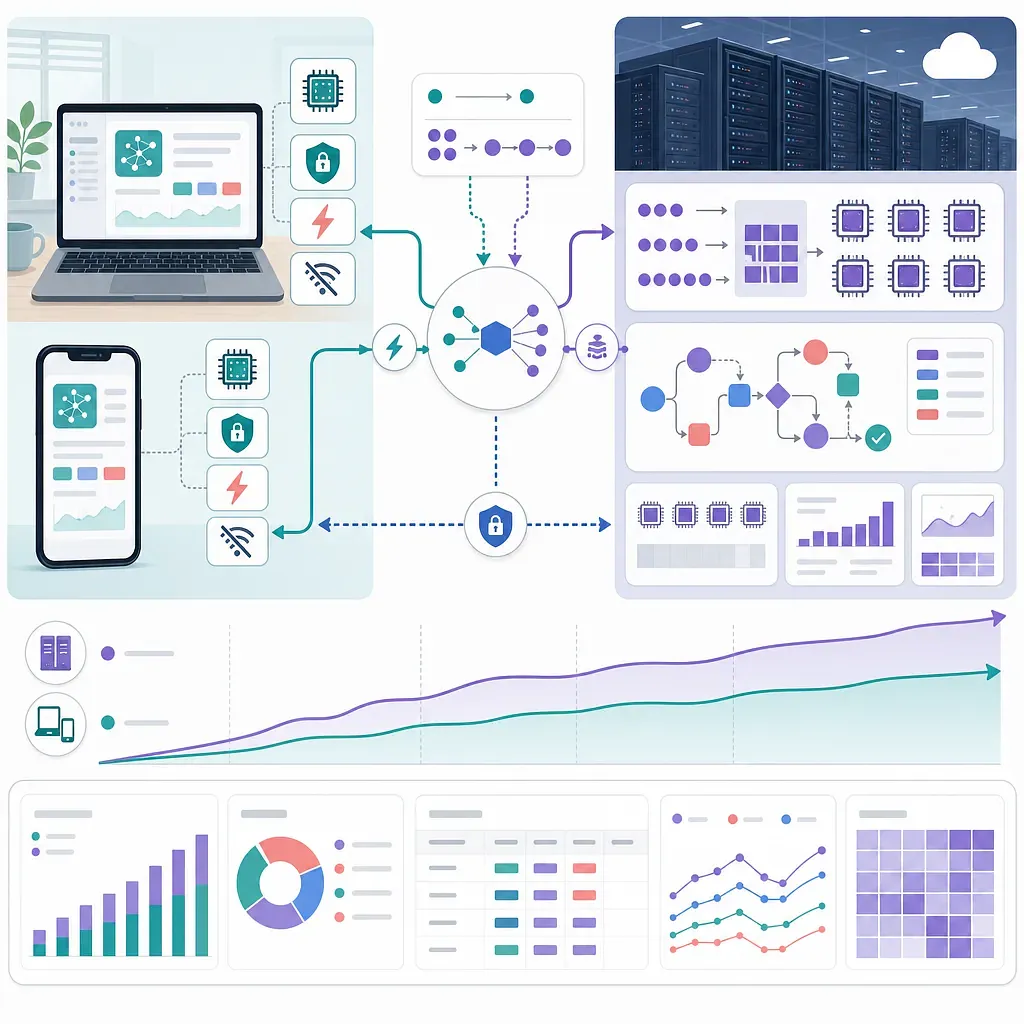
The “local versus cloud” binary is also insufficient. There are many execution locations between personal devices and large public clouds, including internal enterprise GPU servers, telecom edge servers, and private clouds.
Future Local Models Will Compete With Future Data Center Models
Advances in model compression, quantization, knowledge distillation, and inference engine optimization may make it possible for future personal devices to deliver performance that currently requires server-class equipment. But this does not mean that local models will catch up with the state-of-the-art models of that time.
The following data center capabilities are also advancing:
- Larger models and new architectures such as mixture-of-experts models
- High-bandwidth memory and high-speed interconnects between accelerators
- Inference systems that use long contexts and external tools
- Serving optimizations such as batching, cache management, quantization, and speculative decoding
- Compound systems combining multiple models with search and code execution tools
The basis of comparison should therefore be relative performance rather than absolute performance. Even if laptops can run powerful models at today’s level several years from now, data center systems available at that same time will likely be able to handle longer tasks, larger contexts, and more tool calls.
Of course, there is no guarantee that this gap will persist permanently. If performance gains in large models slow down or small models cross the quality threshold for most practical work, local execution could become much more competitive.
As User Expectations Grow, the Standard for a “Good Enough Model” Also Shifts
Typical tasks for early generative AI included answering short questions, writing sentences, summarizing, and generating code snippets. Users now demand longer-running tasks such as:
- Reading an entire codebase and consistently modifying multiple files
- Running tests, tracing the causes of failures, and making further corrections
- Researching multiple sources and comparing conflicting evidence
- Using multiple tools, such as browsers, databases, and terminals, in sequence
- Completing long-term plans while remembering intermediate results
For short and simple requests, small differences in quality may not be very noticeable. But in multi-step AI agent tasks, errors at each step accumulate. Relatively weak models are more likely to lose track of goals or constraints, choose the wrong tools, or repeat the same failures.
For this reason, users may choose a model with a higher likelihood of completing a task within their budget and latency requirements rather than merely one that can run. Even a model that was once outstanding may feel frustrating for complex work after users have experienced a more reliable model.
There is also an effect in the opposite direction. If quality improvements beyond a certain level make almost no difference to actual work outcomes, an inexpensive small model is a reasonable choice. Ultimately, model selection should be evaluated based on completion rates for one’s own tasks, the number of retries, and review time rather than benchmark scores.
The Structural Advantages Data Centers Have in Inference Costs
Batching Spreads the Cost of Reading Model Weights Across Multiple Requests
To generate tokens, an LLM must repeatedly access large weights and intermediate states in GPU memory. In particular, decoding with small batches can be heavily constrained by memory bandwidth as well as computational capacity.
Data centers can group requests from multiple users or use continuous batching to process multiple tokens with a single access to the weights. When many requests continue to arrive, a new request can take the place of one that has finished, reducing accelerator idle time.
Because individual users generate few simultaneous requests, it is difficult for them to achieve this effect at the same scale. However, indiscriminately increasing batch size raises time to first token and per-request response times, while also requiring more KV cache memory. The data center advantage lies not in batching itself but in the ability to coordinate many requests around latency targets.
Dedicated Accelerators and System Configurations Are Different
Consumer GPUs can also provide excellent performance for local inference. However, large data centers can generally use greater accelerator memory capacity, higher memory bandwidth, high-speed interconnects between accelerators, and server-grade networks. These differences become important when distributing large models across multiple systems or processing long contexts.
This does not mean that data center GPUs are more economical than consumer GPUs under all conditions. If a small model is used intermittently and suitable equipment is already available, the cash outlay for local execution may be low. Conversely, if high throughput must be sustained or resources are shared among multiple users, the advantages of server hardware and specialized serving software become greater.
Utilization Changes Total Cost
Treating inference costs as zero merely because the purchase price of a local GPU has already been paid understates the economic cost. Total cost includes:
- Purchase costs for GPUs, memory, storage devices, and power supplies
- Depreciation or opportunity cost over the equipment’s useful life
- Electricity and cooling costs during inference
- Time spent on installation, updates, incident response, and security management
- Low utilization while the equipment sits idle
Data center services also incorporate accelerators, networking, electricity, labor, and provider margins into their fees. Whether local execution or an API is less expensive therefore depends on usage volume, model size, whether equipment is already owned, electricity rates, response speed, and operations staffing.
Estimates showing efficiency differences of dozens of times in a particular environment should not be treated as universal ratios for every environment. Results can vary substantially with batch size, input and output length, model architecture, quantization level, hardware, and latency targets.
Small Models and Local Execution Are Not the Same Choice
Small models may be sufficient for simple classification, structured information extraction, short summaries, command routing, and basic proofreading. However, choosing a small model does not mean it must run on the user’s device.
Small models can also achieve high utilization by batching large volumes of requests in a data center. Conversely, a large open-weight model that an organization needs to control can run on its own servers. It is more accurate to divide the decision into two stages.
- Choose the model size and type that meet the quality and functionality required for the task.
- Choose the execution location that fits latency, cost, security, and operational conditions.
Conflating these two stages can lead to incorrect conclusions such as “small models are efficient, so local execution is efficient” or “a large model is needed, so a public cloud must be used.”
Conditions Where Local AI Has a Clear Advantage
Interfaces Where Low Latency Is Essential
In voice conversations, keyboard correction, camera processing, and real-time control, network round-trip times and connection variability can significantly affect the user experience. A small local model can handle wake-word detection, voice preprocessing, simple commands, and immediate feedback.
Environments With No Internet or Unreliable Connectivity
On aircraft, ships, disaster sites, in remote areas, and on equipment in transit, offline operation itself is a core capability. Even if a data center model offers higher quality, it is not an option if a connection is unavailable.
Environments Where Personal or Confidential Information Cannot Be Sent Externally
Healthcare, finance, defense, research and development, legal work, and internal corporate data may be subject to regulations and contracts that restrict transmission to external APIs. Local or self-hosted models offer the value of direct control over data boundaries.
However, “local” does not automatically mean secure. Device theft, malware, access-control errors, logs and temporary files, and model supply-chain issues still need to be managed. Security levels in public clouds also vary depending on encryption, retention periods, regional options, and contractual terms.
When Direct Model Control and Experimentation Are Required
Open-weight models are useful for researchers analyzing internal behavior and for developers modifying quantization, fine-tuning, and inference engines. Self-hosting also becomes more valuable when fixed model versions, detailed logging, reproducibility, or custom deployments unavailable through an API are required.