Injoys
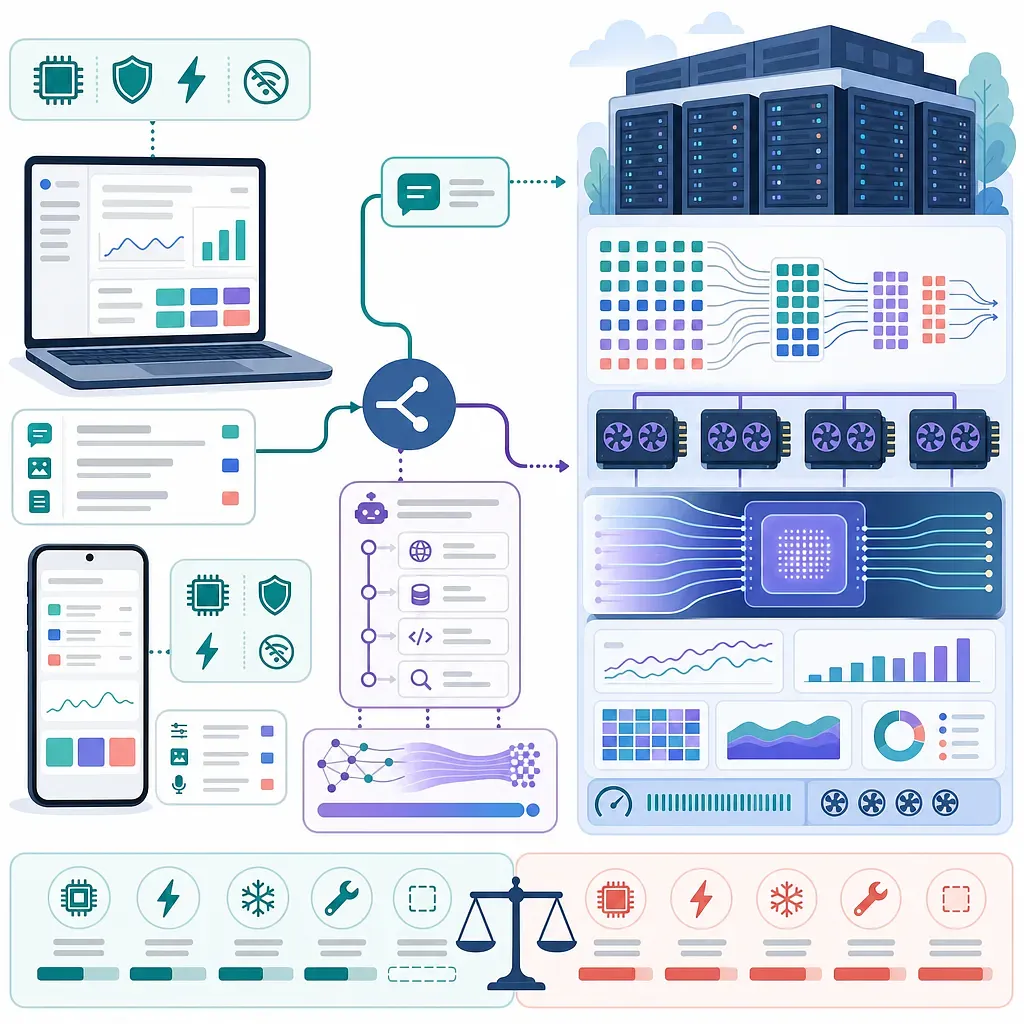
As open-weight models and small language models advance rapidly, predictions that all AI will eventually run on PCs or smartphones continue to surface. Local execution has clear advantages: it reduces API fees, avoids sending sensitive data outside, and works without an internet connection.
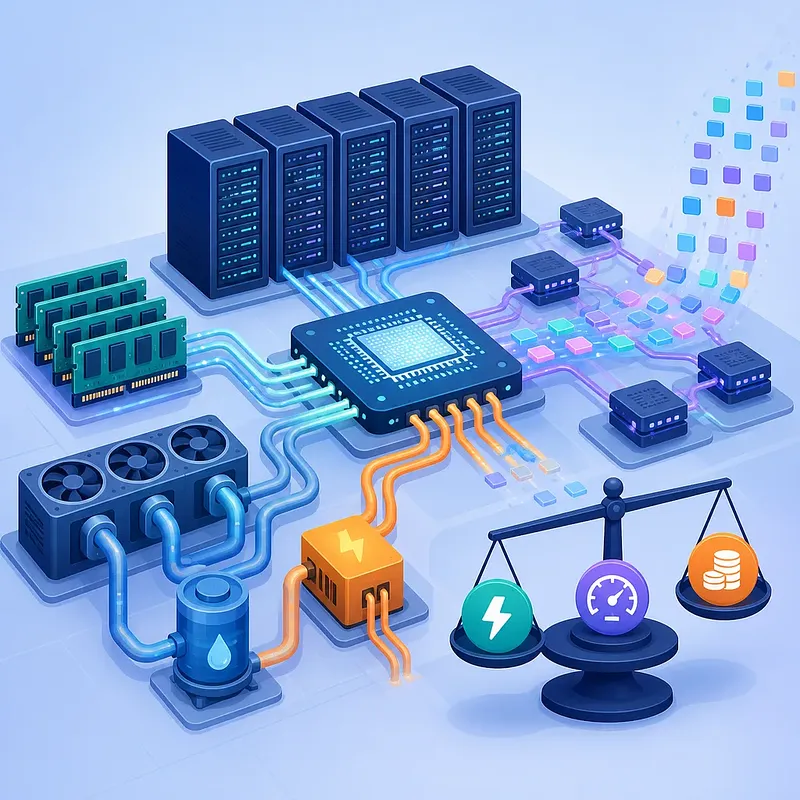
However, the growth of local AI and the decline of data center AI are not the same proposition. Even if AI running on personal devices increases significantly, data centers are likely to remain the center of inference in terms of total compute and complex tasks. This is because not only model size but also performance competition, user demand, batching, hardware utilization, and total cost of ownership all come into play.
Three Concepts to Distinguish First
Different dimensions are often conflated in discussions of local AI.
| Category | Meaning | Opposite Concept |
|---|---|---|
| Open weight | A model whose trained weights can be downloaded and used within the scope of a specified license | A model whose weights are not publicly available |
| Local·on-device inference | Running directly on a PC, smartphone, vehicle, or internal company equipment | Running in an external data center |
| Self-hosting | Operating a model on a server or in a data center selected by the user | Using the model provider’s API |
Open weight does not necessarily mean local. A company can serve an open-weight model on a rented GPU cluster or in its own data center. Conversely, a device manufacturer can install a non-public small model on a smartphone.
The real question, therefore, is not “Are public models advancing?” but “In which compute environment is it more advantageous to process each task in terms of performance, cost, privacy, and operations?”
Open weight also does not automatically mean fully open source. Because the conditions governing use, redistribution, and derivative models vary by model license, the applicable license must be reviewed separately before commercial deployment.
Future Local Models Can Catch Up With Today’s Best Models
Advances in quantization, knowledge distillation, pruning, inference engine optimization, and dedicated NPUs make it possible to handle the same level of tasks with less memory and power. It is entirely reasonable to expect that some capabilities requiring servers today may move to laptops or smartphones in a few years.
However, the basis of comparison is not fixed. While future local models become comparable to today’s best models, data center models may also advance in the following directions.
- More complex reasoning and planning
- Processing longer contexts and large-scale search results
- Multimodal tasks combining images, audio, and video
- Reliable use of multiple tools and external systems
- Reasoning that uses multiple agents or candidate paths
- The ability to detect and recover from errors during long tasks
Therefore, the proposition that “today’s best performance can someday be implemented locally” differs from the proposition that “the best performance available at that time can also be implemented locally.” The former is likely to be realized through technological efficiency improvements, but the latter may remain difficult as long as the power, memory, networking, and accelerator scale offered by data centers continue to advance as well.
The Standard for Performance That Is Good Enough for Users Is Also Rising
Representative tasks for early generative AI included answering questions, summarizing short documents, drafting emails, and generating simple code. Small local models can also handle these tasks usefully.
AI agents, by contrast, read entire code repositories, modify multiple files, run tests, and repeatedly perform searches and call external tools. Research agents must work for extended periods while comparing multiple sources and preserving intermediate results. Business automation agents must handle permissions, databases, and internal company systems.
Errors at each step accumulate during long tasks. Even if the success rate of an individual step is high, the probability of completing the overall task successfully can drop substantially when dozens of judgments and tool calls must be performed in sequence. For this reason, users come to evaluate the following capabilities rather than merely the quality of a single answer.
- Does it maintain goals and constraints over long periods?
- Does it diagnose and recover from failed tool calls?
- Does it avoid presenting unverified content as fact?
- Does it consistently understand the broader context of code and documents?
- Does it reduce the number of times human intervention is required?
If a stronger model reduces rework and supervision time, the total cost of the work may be lower even if its price per token is higher. Conversely, an inexpensive local model may be more reasonable for short, repetitive tasks. Ultimately, the selection criteria are not just the model’s price but the cost of each completed task and the risk of failure.
The Key Advantages of Data Centers Are Batching and Resource Sharing
Token generation by large language models depends heavily on repeatedly reading model weights from accelerator memory. When only a single request is processed, some of the capacity of massively parallel computing devices and memory bandwidth may remain underutilized.
Serving systems group requests from different users into batches and perform matrix operations. This makes it possible to process multiple requests together in a single computation process, increasing compute density and throughput. Continuous batching, which removes completed requests and adds new ones, is a core technology for improving utilization in real-world services where input and output lengths vary.
Batching does not completely eliminate costs in proportion to the number of requests. Each request has tokens and a KV cache that must be computed, and larger batches also increase memory usage and latency. Operators must balance the following factors.
- Tokens processed per second
- Latency until the first token is produced
- Latency of output tokens for each request
- Memory occupied by the KV cache
- The mix of long-context and short-context requests
- Service-level objectives and the maximum number of concurrent requests
Nevertheless, because requests arrive continuously in large-scale services, it is easier to reduce idle time than with a personal GPU. Model replicas can be shared among multiple customers, the number of servers can be adjusted according to traffic, and some tasks can be moved to suitable accelerators.
Personal GPUs Tend to Have Low Average Utilization
Personal equipment is immediately available when needed, but it may spend most of the day idle. Even when multiple agents are run simultaneously, it is difficult to continuously fill the system with requests of varying lengths as a large service does.
The economics of local equipment depend not on maximum processing speed but on actual utilization. Even if an expensive GPU is owned, using it for only a few hours per week increases the capital cost per effective token. Conversely, sustained workloads such as video production, software testing, or bulk document processing can raise the utilization of local equipment and make it cost-competitive.
Opening a local server to multiple people increases utilization and batching opportunities. But at that point, authentication, access control, job queues, incident response, cooling, and monitoring become necessary. Problems similar to those of data center operations emerge, even on a smaller scale.
Data Center Accelerators Differ in Purpose and Configuration
Consumer GPUs are also powerful for generative AI, but they are designed with gaming, graphics, and general-purpose computing in mind. Data center accelerators focus on large-capacity high-bandwidth memory, inter-accelerator connectivity, rack-scale expansion, and low-precision AI computation.
The GeForce RTX 4090 is a consumer GPU, while the NVIDIA B200 is a data center AI accelerator. According to estimates compared by the author, the NVIDIA B200 delivers approximately 3 times the compute performance of the RTX 4090 at a similar power level, with nearly 4 times the memory bandwidth. This difference favors data centers when loading large models into memory and serving them at high throughput.
However, the performance figures of the two products should not be compared as a simple ratio. Published AI compute figures may differ in precision, whether sparsity is applied, power limits, and system configuration. Actual inference performance must be assessed with benchmarks that match the model architecture, quantization method, batch size, context length, and software stack.
Splitting a large model across multiple accelerators also incurs communication costs. Data centers provide high-speed interconnects and optimized networks, but distributed inference is not free. For a small model, running it on a single consumer GPU may instead be simpler and more efficient.