Skip to content
Injoys
How-to

Air Conditioner Filter Cleaning Intervals and Methods: A Guide to Washable and Replaceable Types

Air conditioners have different filter configurations depending on the product, including washable dust filters and deodorizing or dust-collection filters that require regular replacement. First check the filter label and user manual, then clean or replace the filter according to its dust buildup and hours of use.

Views 58 10 min read KO EN JA ES

Listen or read this article

Listen, or read the text only.

Air Conditioner Filter Cleaning Intervals and Methods: A Guide to Washable and Replaceable Types

Kokoro 82M AI-generated voice

0:00 13:25

Download audio

File name
air-conditioner-filter-cleaning-guide-en.mp3
Format
MP3 (audio/mpeg)
Duration
13:25
File size
9.21 MB
Engine
Kokoro 82M

This audio was generated by AI.

You may download and use it freely for personal use.

Air Conditioner Filter Cleaning Intervals and Methods: A Guide to Washable and Replaceable Types

10 min read

Air Conditioner Filter Cleaning Intervals and Methods: A Guide to Washable and Replaceable Types
Air conditioners have different filter configurations depending on the product, including washable dust filters and deodorizing or dust-collection filters that require regular replacement. First check the filter label and user manual, then clean or replace the filter according to its dust buildup and hours of use.
Determine whether a filter is washable and how often it should be replaced based on the product's user manual or the label on the filter.
Basic dust screens and ultrafine filters are often washable, but many deodorizing, dust-collection, and antibacterial filters are replaceable types.
After washing a filter, dry it completely in the shade, away from direct sunlight and high heat, before reinstalling it.
Filter cleaning is different from disassembly cleaning, which removes mold or contamination inside the heat exchanger, blower fan, and drain pan.
If odors, black debris, leaks, or reduced cooling persist after cleaning, an internal inspection is required.
Not all air conditioner filters are maintained in the same way. Thin mesh dust filters can often be washed with water, but many auxiliary filters with deodorizing or dust-collecting functions lose performance when exposed to water and must be replaced. Therefore, rather than cleaning based solely on a schedule, you should check the filter type, manufacturer’s instructions, actual dust condition, and operating hours together.
First, Distinguish Washable Filters from Replaceable Filters
Air conditioner filter names and structures vary by manufacturer and model. Even filters with the same name, such as “microfilter” or “deodorizing filter,” may use different materials and require different maintenance methods. Therefore, use the table below only as a general guide, and make the final determination based on the product manual and markings on the filter.
Filter type | Typical form and function | Usual maintenance method | What to check Dust mesh·prefilter | Plastic or fiber mesh that filters out large dust particles and hair | Remove dust with a vacuum cleaner or soft brush, and wash with water if permitted | Washing symbols on the frame, user manual Microfilter | A finer mesh than the basic dust mesh that captures fine dust | Many are washable, but this varies by model | Whether water washing is permitted and conditions for detergent use Deodorizing filter | Adsorbs odor-causing substances using activated carbon or similar materials | Commonly replaceable, and many products prohibit water washing | Replacement interval, whether regeneration or sun-drying is permitted High-performance dust collection filter | Fiber or pleated filter that captures fine particles | Generally replaceable and may be damaged by washing | Filter grade, replacement alert, genuine-product specifications Antibacterial·functional filter | Auxiliary filter that adds specific functions such as antibacterial action or allergen reduction | Depending on the product, may be either cleanable or replaceable | Packaging·filter label and manufacturer’s instructions
Do not determine whether a filter can be washed with water based solely on its color or texture. The safest approach is to identify the model, consult the manual, and check the filter frame for a no-washing symbol or replacement instructions.
How to Determine Air Conditioner Filter Cleaning Intervals
There is no single cleaning interval that applies to every air conditioner. Some products recommend maintaining the basic dust filter approximately every 2 weeks, but this is closer to one manufacturer example than a universal mandatory interval. Determine actual maintenance needs in the following order.
· Give priority to the interval recommended in the user manual. · Shorten the inspection interval if the air conditioner operates for long periods. · Check more frequently if there is a lot of pet hair, cigarette smoke, cooking fumes, or construction dust. · Clean before the scheduled date if the mesh is covered in gray dust or intake airflow decreases. · Do not wash replaceable filters; replace them based on operating hours, replacement alerts, and the manufacturer’s criteria.
The following are conservative inspection examples for assessing filter condition when no manufacturer instructions are available.
Usage environment | Example inspection guideline | Maintenance decision Used for long periods every day | Visually inspect approximately every 1–2 weeks | Clean immediately if dust is visible Typical household use | Inspect approximately every 2 weeks | Adjust by comparing with the manufacturer’s recommended interval Spaces with pets, smoking, or construction dust | Inspect weekly or more frequently | Clean before hair or dust covers the mesh Spaces used intermittently | Inspect before and after use and about once a month | Clean before storage and dry completely Products unused for an extended period | Inspect before restarting | Check the filter, air intake, and drainage condition
More important than the number “every 2 weeks” is maintaining the filter before it becomes clogged. Conversely, arbitrarily washing a clean replaceable filter with water may shorten its service life and reduce its dust-collection and deodorizing performance.
How to Clean Washable Filters
1. Completely Disconnect the Power
Stop operation, then unplug the power cord or disconnect the power as instructed in the product manual. Do not touch the plug or electrical components with wet hands.
2. Check the Filter Location and Installation Direction
Open the front panel or the top or rear air intake and remove the filter. Portable air conditioners may have separate upper and lower filters on the back. Taking a photo before removal can help prevent confusion about the front and back or the installation order.
3. Remove Dry Dust First
Outdoors or in a well-ventilated area, remove dust with a soft brush or a vacuum cleaner set to low suction. Do not press hard on the filter mesh or scrape it with sharp tools.
4. Recheck Whether Water Washing Is Permitted
Rinse only washable filters under running water. Running water from the side opposite the direction in which the dust was drawn in can help push embedded dust out of the mesh. Avoid hot water, bleach, strong alkaline detergents, and rough scrubbers, as they may deform the filter or damage its coating.
If contamination is difficult to remove, use diluted neutral detergent only when permitted by the manufacturer. Rinse thoroughly so that no detergent remains.
5. Dry Completely in the Shade
Gently shake off the water and allow the filter to dry completely in a well-ventilated, shaded area. Hair dryers, heaters, clothes dryers, or strong direct sunlight may deform the filter frame and mesh. Installing the filter while wet may cause odors and microbial growth.
6. Reinstall It in the Correct Direction
Fit the filter back into its original position without bending it or leaving gaps, then close the panel. If the product has a filter alert function, reset the indicator according to the manual after cleaning or replacement is actually complete. Do not operate the air conditioner with the filter removed.
How to Maintain Replaceable Filters
Maintenance instructions for replaceable filters vary by product: some can be reused after dust is shaken off, some allow only light removal of surface dust, and others must be replaced immediately without being touched. Check the following criteria.
· Check whether the filter label states “Do not wash with water” or indicates that it is replacement-only. · Check the part number and compatible specifications listed in the user manual. · Some replacement alerts calculate only cumulative operating hours rather than measuring actual contamination, so also inspect the filter’s condition. · If odors return or the filter is discolored, damaged, or deformed, check whether replacement is needed even before the recommended period. · Washing activated carbon or functionally coated filters may not fully restore their adsorption performance.
If the replacement timing is unclear, it is safest to contact the manufacturer’s customer support using the air conditioner model name and filter part number.
The Difference Between Filter Cleaning and Internal Disassembly Cleaning
A filter is the component that provides the first stage of dust filtration for intake air. Even if the filter is clean, this does not remove contamination from the heat exchanger, blower fan, drain pan, or drainage channel inside the unit.
Maintenance task | Target | What users can do | Problems that are difficult to resolve Filter cleaning | Dust mesh and filters approved for washing | Can be removed and washed according to the manual | Mold deep inside the heat exchanger and fan Exterior cleaning | Air intake, air outlet, exterior | Can be maintained with a dry cloth after disconnecting the power | Internal drainage failure and component contamination Internal inspection·cleaning | Heat exchanger, blower fan, drain pan, drainage channel | Requires structural and safety knowledge | Contamination requiring professional equipment and disassembly Refrigerant·electrical inspection | Refrigerant system, sensors, motor, circuits | Unsuitable for user servicing | Poor cooling, freezing, electrical abnormalities
Indiscriminately spraying commercially available cleaners inside an air conditioner may cause damage to electrical components, detergent residue, corrosion, or drainage problems. Also avoid high-pressure water cleaning not approved for the product or unauthorized disassembly.
Inspection Criteria for Odors·Black Contamination·Leaks·Reduced Cooling
When Odors Persist After Filter Cleaning
A brief odor when the unit is first turned on may be related to moisture or dust remaining inside. If a musty odor repeatedly occurs even after cleaning the filter and using the product’s automatic drying or fan function, the heat exchanger, blower fan, or drainage section may need to be inspected for contamination.
When Black Spots or Powder Appear
Black substances can result from various causes, including mold, hardened dust, or deteriorated insulation or cushioning materials, so they cannot be identified by color alone. If they are widely attached inside the air outlet or on the fan, or scatter into the room during operation, reduce use and request an inspection.
When Water Leaks or Ice Forms
Leaks may be related to a blocked drain hose, improper tilt or installation, overflowing internal condensate, or a frozen heat exchanger. If electrical components or the area around the outlet are wet, disconnect the power and stop operating the unit. Do not simply wash the filter and continue using it.
When Airflow Is Weak and Cooling Performance Drops
A filter clogged with dust can obstruct airflow. However, if airflow or cooling performance does not recover after cleaning, also check for obstructions at the air intake, outdoor unit ventilation, exhaust duct condition, heat exchanger contamination, freezing, or refrigerant·component faults. For portable air conditioners, also check whether the exhaust hose is bent or hot air is entering through gaps around the window.
Before- and After-Season Maintenance Checklist
Before the Cooling Season Begins
· Check the model name and filter type. · Inspect the dust mesh and clean it using an approved method. · Check the service period and condition of replaceable filters. · Remove objects blocking the air intake and air outlet. · Perform a test run to check odors, noise, leaks, and cooling condition.
During the Cooling Season
· Regularly inspect the filter according to operating hours and the dust conditions. · Do not rely solely on the filter alert; check the actual contamination level. · Use the automatic drying function according to the manual if the product has one. · Investigate the cause if unusual odors or water droplets recur.
Before Long-Term Storage
· Clean the filter and dry it completely. · Run the internal drying operation according to the product manual. · For portable air conditioners, remove water from the drain tank and drain outlet. · Reinstall the filter and panel in their original positions, then store the unit so that dust cannot enter.
The key is not to “wash frequently,” but to identify each type correctly and maintain it accordingly. Clean washable filters before they become clogged, do not wash replaceable filters with water, and treat odors, leaks, and contamination beyond the filter as issues requiring internal inspection.
0:00 0:00
1 / 57

Download text

File name
air-conditioner-filter-cleaning-guide-en.txt
Format
TXT (text/plain)
Paragraphs
57

Downloads exactly what you see as a text file.

Please cite the source when quoting.

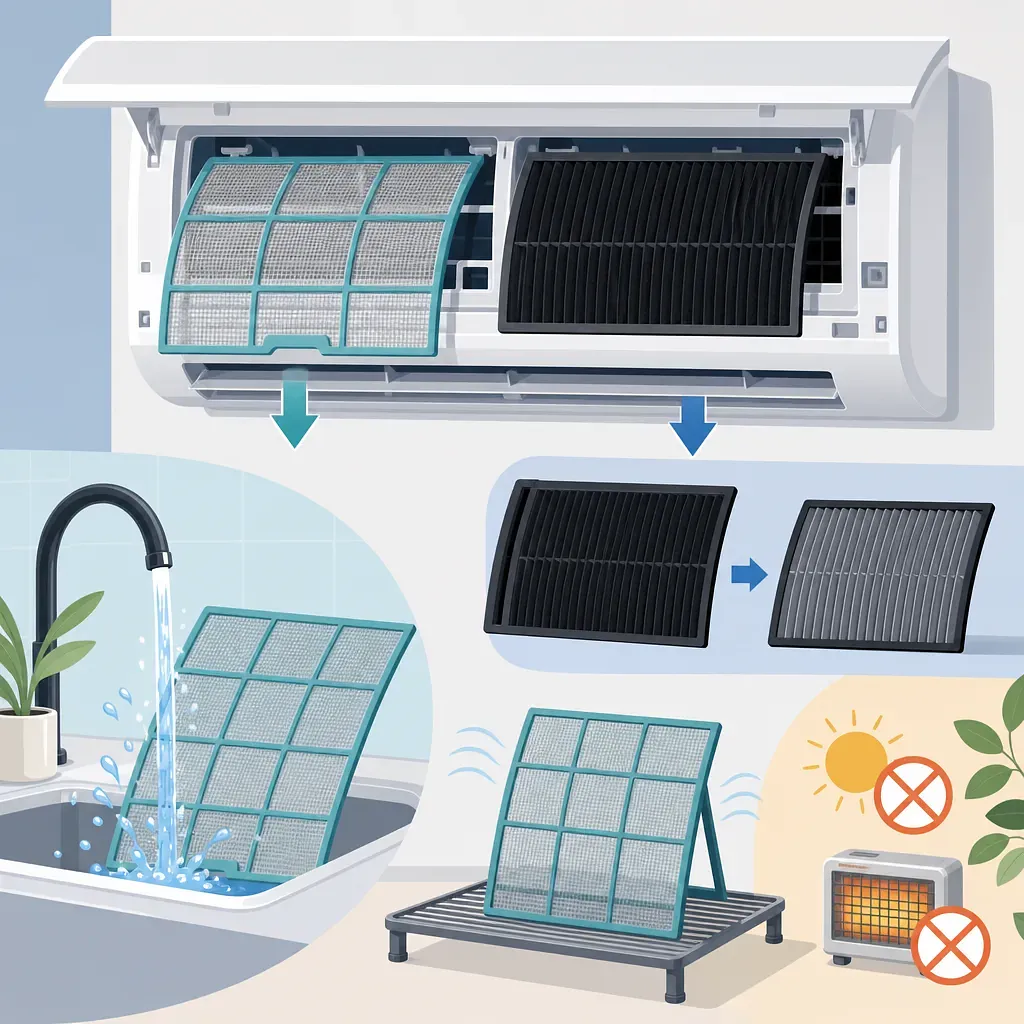
Washable filters are rinsed and air-dried, while disposable filters are replaced.

Key points

  • Determine whether a filter is washable and how often it should be replaced based on the product's user manual or the label on the filter.
  • Basic dust screens and ultrafine filters are often washable, but many deodorizing, dust-collection, and antibacterial filters are replaceable types.
  • After washing a filter, dry it completely in the shade, away from direct sunlight and high heat, before reinstalling it.
  • Filter cleaning is different from disassembly cleaning, which removes mold or contamination inside the heat exchanger, blower fan, and drain pan.
  • If odors, black debris, leaks, or reduced cooling persist after cleaning, an internal inspection is required.

Not all air conditioner filters are maintained in the same way. Thin mesh dust filters can often be washed with water, but many auxiliary filters with deodorizing or dust-collecting functions lose performance when exposed to water and must be replaced. Therefore, rather than cleaning based solely on a schedule, you should check the filter type, manufacturer’s instructions, actual dust condition, and operating hours together.

First, Distinguish Washable Filters from Replaceable Filters

Air conditioner filter names and structures vary by manufacturer and model. Even filters with the same name, such as “microfilter” or “deodorizing filter,” may use different materials and require different maintenance methods. Therefore, use the table below only as a general guide, and make the final determination based on the product manual and markings on the filter.

Filter type Typical form and function Usual maintenance method What to check
Dust mesh·prefilter Plastic or fiber mesh that filters out large dust particles and hair Remove dust with a vacuum cleaner or soft brush, and wash with water if permitted Washing symbols on the frame, user manual
Microfilter A finer mesh than the basic dust mesh that captures fine dust Many are washable, but this varies by model Whether water washing is permitted and conditions for detergent use
Deodorizing filter Adsorbs odor-causing substances using activated carbon or similar materials Commonly replaceable, and many products prohibit water washing Replacement interval, whether regeneration or sun-drying is permitted
High-performance dust collection filter Fiber or pleated filter that captures fine particles Generally replaceable and may be damaged by washing Filter grade, replacement alert, genuine-product specifications
Antibacterial·functional filter Auxiliary filter that adds specific functions such as antibacterial action or allergen reduction Depending on the product, may be either cleanable or replaceable Packaging·filter label and manufacturer’s instructions

Do not determine whether a filter can be washed with water based solely on its color or texture. The safest approach is to identify the model, consult the manual, and check the filter frame for a no-washing symbol or replacement instructions.

How to Determine Air Conditioner Filter Cleaning Intervals

There is no single cleaning interval that applies to every air conditioner. Some products recommend maintaining the basic dust filter approximately every 2 weeks, but this is closer to one manufacturer example than a universal mandatory interval. Determine actual maintenance needs in the following order.

  1. Give priority to the interval recommended in the user manual.
  2. Shorten the inspection interval if the air conditioner operates for long periods.
  3. Check more frequently if there is a lot of pet hair, cigarette smoke, cooking fumes, or construction dust.
  4. Clean before the scheduled date if the mesh is covered in gray dust or intake airflow decreases.
  5. Do not wash replaceable filters; replace them based on operating hours, replacement alerts, and the manufacturer’s criteria.

The following are conservative inspection examples for assessing filter condition when no manufacturer instructions are available.

Usage environment Example inspection guideline Maintenance decision
Used for long periods every day Visually inspect approximately every 1–2 weeks Clean immediately if dust is visible
Typical household use Inspect approximately every 2 weeks Adjust by comparing with the manufacturer’s recommended interval
Spaces with pets, smoking, or construction dust Inspect weekly or more frequently Clean before hair or dust covers the mesh
Spaces used intermittently Inspect before and after use and about once a month Clean before storage and dry completely
Products unused for an extended period Inspect before restarting Check the filter, air intake, and drainage condition

More important than the number “every 2 weeks” is maintaining the filter before it becomes clogged. Conversely, arbitrarily washing a clean replaceable filter with water may shorten its service life and reduce its dust-collection and deodorizing performance.

How to Clean Washable Filters

1. Completely Disconnect the Power

Stop operation, then unplug the power cord or disconnect the power as instructed in the product manual. Do not touch the plug or electrical components with wet hands.

2. Check the Filter Location and Installation Direction

Open the front panel or the top or rear air intake and remove the filter. Portable air conditioners may have separate upper and lower filters on the back. Taking a photo before removal can help prevent confusion about the front and back or the installation order.

3. Remove Dry Dust First

Outdoors or in a well-ventilated area, remove dust with a soft brush or a vacuum cleaner set to low suction. Do not press hard on the filter mesh or scrape it with sharp tools.

4. Recheck Whether Water Washing Is Permitted

Rinse only washable filters under running water. Running water from the side opposite the direction in which the dust was drawn in can help push embedded dust out of the mesh. Avoid hot water, bleach, strong alkaline detergents, and rough scrubbers, as they may deform the filter or damage its coating.

If contamination is difficult to remove, use diluted neutral detergent only when permitted by the manufacturer. Rinse thoroughly so that no detergent remains.

5. Dry Completely in the Shade

Gently shake off the water and allow the filter to dry completely in a well-ventilated, shaded area. Hair dryers, heaters, clothes dryers, or strong direct sunlight may deform the filter frame and mesh. Installing the filter while wet may cause odors and microbial growth.

6. Reinstall It in the Correct Direction

Fit the filter back into its original position without bending it or leaving gaps, then close the panel. If the product has a filter alert function, reset the indicator according to the manual after cleaning or replacement is actually complete. Do not operate the air conditioner with the filter removed.

How to Maintain Replaceable Filters

Maintenance instructions for replaceable filters vary by product: some can be reused after dust is shaken off, some allow only light removal of surface dust, and others must be replaced immediately without being touched. Check the following criteria.

  • Check whether the filter label states “Do not wash with water” or indicates that it is replacement-only.
  • Check the part number and compatible specifications listed in the user manual.
  • Some replacement alerts calculate only cumulative operating hours rather than measuring actual contamination, so also inspect the filter’s condition.
  • If odors return or the filter is discolored, damaged, or deformed, check whether replacement is needed even before the recommended period.
  • Washing activated carbon or functionally coated filters may not fully restore their adsorption performance.

If the replacement timing is unclear, it is safest to contact the manufacturer’s customer support using the air conditioner model name and filter part number.

The Difference Between Filter Cleaning and Internal Disassembly Cleaning

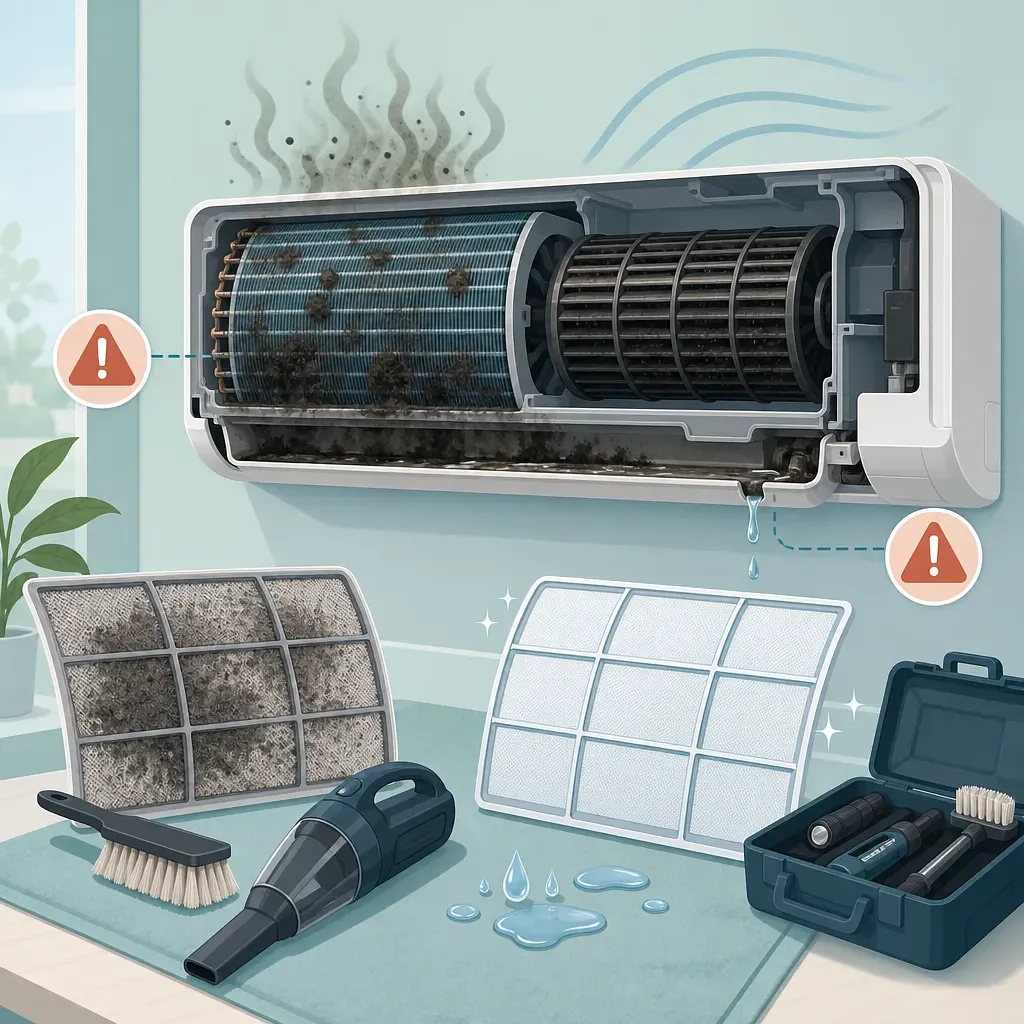
A filter is the component that provides the first stage of dust filtration for intake air. Even if the filter is clean, this does not remove contamination from the heat exchanger, blower fan, drain pan, or drainage channel inside the unit.

Maintenance task Target What users can do Problems that are difficult to resolve
Filter cleaning Dust mesh and filters approved for washing Can be removed and washed according to the manual Mold deep inside the heat exchanger and fan
Exterior cleaning Air intake, air outlet, exterior Can be maintained with a dry cloth after disconnecting the power Internal drainage failure and component contamination
Internal inspection·cleaning Heat exchanger, blower fan, drain pan, drainage channel Requires structural and safety knowledge Contamination requiring professional equipment and disassembly
Refrigerant·electrical inspection Refrigerant system, sensors, motor, circuits Unsuitable for user servicing Poor cooling, freezing, electrical abnormalities

Indiscriminately spraying commercially available cleaners inside an air conditioner may cause damage to electrical components, detergent residue, corrosion, or drainage problems. Also avoid high-pressure water cleaning not approved for the product or unauthorized disassembly.

Inspection Criteria for Odors·Black Contamination·Leaks·Reduced Cooling

When Odors Persist After Filter Cleaning

A brief odor when the unit is first turned on may be related to moisture or dust remaining inside. If a musty odor repeatedly occurs even after cleaning the filter and using the product’s automatic drying or fan function, the heat exchanger, blower fan, or drainage section may need to be inspected for contamination.

When Black Spots or Powder Appear

Black substances can result from various causes, including mold, hardened dust, or deteriorated insulation or cushioning materials, so they cannot be identified by color alone. If they are widely attached inside the air outlet or on the fan, or scatter into the room during operation, reduce use and request an inspection.

When Water Leaks or Ice Forms

Leaks may be related to a blocked drain hose, improper tilt or installation, overflowing internal condensate, or a frozen heat exchanger. If electrical components or the area around the outlet are wet, disconnect the power and stop operating the unit. Do not simply wash the filter and continue using it.

When Airflow Is Weak and Cooling Performance Drops

A filter clogged with dust can obstruct airflow. However, if airflow or cooling performance does not recover after cleaning, also check for obstructions at the air intake, outdoor unit ventilation, exhaust duct condition, heat exchanger contamination, freezing, or refrigerant·component faults. For portable air conditioners, also check whether the exhaust hose is bent or hot air is entering through gaps around the window.

Before- and After-Season Maintenance Checklist

Before the Cooling Season Begins

  • Check the model name and filter type.
  • Inspect the dust mesh and clean it using an approved method.
  • Check the service period and condition of replaceable filters.
  • Remove objects blocking the air intake and air outlet.
  • Perform a test run to check odors, noise, leaks, and cooling condition.

During the Cooling Season

  • Regularly inspect the filter according to operating hours and the dust conditions.
  • Do not rely solely on the filter alert; check the actual contamination level.
  • Use the automatic drying function according to the manual if the product has one.
  • Investigate the cause if unusual odors or water droplets recur.

Before Long-Term Storage

  • Clean the filter and dry it completely.
  • Run the internal drying operation according to the product manual.
  • For portable air conditioners, remove water from the drain tank and drain outlet.
  • Reinstall the filter and panel in their original positions, then store the unit so that dust cannot enter.

The key is not to “wash frequently,” but to identify each type correctly and maintain it accordingly. Clean washable filters before they become clogged, do not wash replaceable filters with water, and treat odors, leaks, and contamination beyond the filter as issues requiring internal inspection.

Images

Washable filters are rinsed and air-dried, while disposable filters are replaced.
The illustration compares a dirty filter with a clean one and shows tools for maintenance.

FAQ

Do air conditioner filters always need to be cleaned every two weeks?

No. About two weeks is merely an example of a maintenance interval found for many products, not an absolute standard that applies equally to all air conditioners. Follow the manufacturer's recommended interval first, and inspect the filter more often if the air conditioner is used for long hours every day or in an environment with a lot of pet hair and dust.

Can air conditioner filters be washed with water?

Only filters marked as washable or approved for washing in the user manual should be washed. Basic dust filters are often washable, but deodorizing, dust-collecting, and antibacterial filters may be replaceable types, so do not judge based only on their name or appearance.

Can I use a mild detergent on an air conditioner filter?

For washable filters approved by the manufacturer, diluted mild detergent may be used when they are heavily soiled. Rinse thoroughly so that no detergent residue remains, and avoid bleach, strong alkaline detergents, and hot water.

Can I dry the filter quickly in the sun or with a hair dryer?

Strong direct sunlight and hot air can deform the filter mesh or plastic frame. As a rule, shake off the water and let the filter dry completely in a well-ventilated, shaded area.

Can I reinstall the filter in the air conditioner while it is still slightly wet?

It is not recommended. Residual moisture can cause odors and microbial growth, so the filter should be completely dry before installation.

Will cleaning just the filter also remove mold from the air conditioner?

No. Cleaning the filter reduces dust on the air intake side. Contamination and mold on the heat exchanger, blower fan, drain pan, or drainage channel may require a separate internal inspection or cleaning.

What should I do if the air conditioner still smells after cleaning the filter?

Dry the filter completely, reinstall it, and use the automatic drying or fan function according to the manual. If a musty odor continues to recur, it is advisable to have the inside of the heat exchanger, fan, and drainage section inspected for contamination.

Are portable air conditioner filters cleaned the same way?

The basic principles are the same, but portable air conditioners may have separate upper and lower filters on the back or may include a drainage tank. Check the user manual for the filter locations, whether they can be washed with water, the drainage method, and the maintenance guidelines for the exhaust hose for your specific model.

Does the filter cleaning indicator mean that the filter is actually dirty?

Not necessarily. Some products display an alert based on cumulative operating time rather than directly measuring contamination with a sensor. Check the filter's condition yourself, maintain it as needed, and then reset the alert according to the manual.

Can cleaning the filter fix water leaking from the air conditioner?

Although a clogged filter can contribute to freezing or reduced airflow, leaks can also have other causes, such as a clogged drain hose, installation issues, or a problem with the drain pan. If the area around electrical components is wet or the leak recurs, turn off the power and request an inspection.

Sources

Data formats

This content is available in several machine-friendly formats.

Data-only languages (machine translated, files only)

Indonesian JSON MD Portuguese JSON MD Chinese (Traditional) JSON MD Deutsch JSON MD

Reuse & AI usage

Search indexing and AI citation with attribution are welcome. See the license policy for details.

CC BY · License

Corrections · Improvements · Feedback Let us know what's wrong or could be better and we'll review it. No login required.

Comments (0)

Sign-in required

Sign in with your Google account to like and comment.

Be the first to comment.

Related content