Skip to content
Injoys
How-to 🇰🇷 South Korea

This content applies specifically to South Korea.

How to Check AC Electricity Use and Estimated Bills on KEPCO ON

By registering your customer number with KEPCO ON, you can view your electricity usage and billing history and use your current meter reading to estimate this month's bill. For high-voltage apartments, KEPCO's estimate may differ from the actual maintenance fee bill because the management office calculates charges separately for each household.

Views 36 9 min read KO EN JA ES

Listen or read this article

Listen, or read the text only.

How to Check AC Electricity Use and Estimated Bills on KEPCO ON

Kokoro 82M AI-generated voice

0:00 13:05

Download audio

File name
kepco-on-electricity-usage-estimated-bill-guide-en.mp3
Format
MP3 (audio/mpeg)
Duration
13:05
File size
8.98 MB
Engine
Kokoro 82M

This audio was generated by AI.

You may download and use it freely for personal use.

How to Check AC Electricity Use and Estimated Bills on KEPCO ON

10 min read

How to Check AC Electricity Use and Estimated Bills on KEPCO ON
By registering your customer number with KEPCO ON, you can view your electricity usage and billing history and use your current meter reading to estimate this month's bill. For high-voltage apartments, KEPCO's estimate may differ from the actual maintenance fee bill because the management office calculates charges separately for each household.
Households that contract directly with KEPCO can register their customer number with KEPCO ON to view electricity usage and billing history.
The difference between the current meter reading and the previous meter-reading value is the basic electricity usage for that period.
Residents of high-voltage apartments must confirm the apartment's customer number, building and unit numbers, and other required information before calculating an estimated bill.
The summer progressive-rate tiers for residential electricity apply to usage in July and August, and the billing calculation period varies depending on the meter-reading date.
To calculate the additional cost of using an air conditioner, do not multiply its power consumption by a single rate; add it to existing usage and calculate the cost for each progressive-rate tier.
Running an air conditioner for a long time does not mean you have to wait until the end of the month to find out your electricity bill. In KEPCO ON, you can check usage and billing details for registered electricity service contracts and enter the current meter reading to calculate the estimated bill through the next meter-reading date.
However, homes that contract directly with KEPCO and high-voltage apartments where the entire apartment complex is covered by a single contract have different inquiry methods and entities responsible for final settlement. When reviewing an estimate, you should check the contract type, meter-reading date, progressive rate tier, and the management office’s allocation criteria together.
Information to Prepare Before Checking
Checking the following information in advance will make inquiries and calculations easier.
· Customer number: Find it on your KEPCO electricity bill or in the electricity service contract information in KEPCO ON. · Building and unit numbers: These may be required to check the estimated bill for an individual household in a high-voltage apartment. · Previous meter reading: Find it on the previous bill or apartment maintenance fee statement. · Current meter reading: Check the current number directly on the household meter. · Meter-reading date or usage period: The actual usage period is more important than the billing month. · Contract type: Basic charges and energy charges differ depending on the contract, such as residential low-voltage or residential high-voltage service.
If you do not know the customer number, households that contract directly with KEPCO can find it on a previous bill or in KEPCO ON. If the entire apartment complex has a contract with KEPCO, it is more accurate to ask the management office about the apartment’s customer number, how to check the household meter, and the electricity billing contract arrangement.
Checking Usage and the Estimated Bill in KEPCO ON
The screen layout and menu names in KEPCO ON may change, but the basic procedure is as follows.
Homes Contracting Directly with KEPCO
· Access KEPCO ON, log in, and complete identity verification. · Register the customer number in the electricity service contract management menu. · Check monthly usage and billing details in the usage and billing inquiry menu. · Calculate current usage that has not yet been billed in the home electricity bill preview. · Enter the previous meter reading, current meter reading, and meter-reading information. · Check usage to date and the estimated bill in the calculation results.
Usage information may be provided automatically for meters that support remote reading. However, due to delays in communication and aggregation, the latest usage shown on the screen may not exactly match the number on the meter.
Households in High-Voltage Apartments That Do Not Contract Directly with KEPCO
In a typical high-voltage apartment arrangement, KEPCO bills the entire apartment complex’s usage under a single contract, and the management office divides the usage among households and reflects it in their maintenance fees. Such households may not have individual customer numbers or may be unable to link the contract using KEPCO ON’s standard customer registration process.
· Check the apartment’s customer number and contract arrangement on the maintenance fee statement or with the management office. · In the KEPCO ON home electricity bill preview, select the inquiry type for high-voltage apartments. · Enter the information requested on the screen, such as the apartment customer number, building and unit numbers, and meter reading. · Treat the calculated amount as an estimate for reference and check the final amount on the maintenance fee statement.
Depending on the apartment’s system or contract arrangement, household information may not be available through the official calculation screen. In this case, you must use the household usage and billing calculation criteria provided by the management office.
Why the Estimate and Actual Maintenance Fee May Differ
The KEPCO ON result is an estimate calculated based on the usage entered and KEPCO’s rate system. The actual bill may differ for the following reasons.
Cause of difference | Effect on the actual bill Difference in meter-reading timing | Electricity used after the inquiry and through the meter-reading date is added. Incorrect meter reading entered | Misreading a number or omitting a decimal point or multiplier changes the calculated usage. Delay in reflecting remote meter readings | Usage shown in KEPCO ON may lag behind the latest meter reading. Entry into a higher progressive rate tier | If additional usage enters a higher tier, the average unit rate may rise. Discounts and reductions | Whether welfare discounts, large-family discounts, and other reductions apply to the actual contract changes the result. Climate and environmental charges and fuel cost adjustment charges | The final amount changes depending on the applicable rates and period. Value-added tax and Electric Power Industry Basis Fund | Statutory charges other than energy charges are included in the final bill. Allocation of common-area electricity in apartments | Common-area usage for elevators, hallways, parking lots, and other facilities may be allocated separately in maintenance fees. Management office settlement criteria | Differences may arise depending on the apartment’s contract arrangement, rounding, meter-reading date, and household allocation criteria.
Therefore, KEPCO ON calculation results for high-voltage apartments should be understood as reference values for electricity used exclusively by the household. If the electricity section of the maintenance fee includes common-area electricity charges, it cannot be directly compared with the KEPCO ON estimate.
Summer Progressive Rate Tiers for July–August and Meter-Reading Dates
Residential electricity uses a progressive rate structure in which the rate rises by tier as usage increases. Under the standard summer criteria, the progressive rate tiers for electricity used in July and August are expanded as follows.
Category | Tier 1 | Tier 2 | Tier 3 Summer, July–August | At most 300kWh | 301–450kWh | More than 450kWh Other seasons | At most 200kWh | 201–400kWh | More than 400kWh
The boundaries in this table describe usage tiers, and the actual rates may differ depending on whether residential low-voltage or high-voltage service applies and when they take effect. Calculations should prioritize the latest rates reflected in KEPCO ON.
Why You Should Check the Usage Period Rather Than the Billing Month
A bill received in August does not necessarily cover only electricity used from August 1 through 31. For example, if the meter-reading date is the 15th of every month, the billing period generally runs from the day after the previous month’s meter-reading date through the current month’s meter-reading date.
If the usage period spans summer and non-summer seasons, the seasonal tiers may be divided and applied according to KEPCO’s calculation criteria. When comparing bills, do not look only at the billing month; also check the usage period, meter-reading date, and number of usage days.
Calculating an Air Conditioner’s Monthly Electricity Usage
An air conditioner’s monthly electricity usage can be roughly calculated using the power consumption shown on the product and its operating time.
Monthly usage (kWh) = Power consumption (W) ÷ 1,000 × Hours of use per day × Number of days used × Load factor
The load factor is a simplified value representing the proportion of time the air conditioner actually operates at the stated power consumption level. In fixed-speed models, the compressor repeatedly switches on and off, while in inverter models, power consumption continuously changes according to the indoor and set temperatures. This makes it difficult to determine an exact load factor in advance.
Calculation Examples
The values below are assumptions intended to demonstrate the calculation method, not averages by product type. Actual calculations should use the rated cooling power consumption shown on the product’s energy efficiency label or nameplate.
Example appliance | Assumed power consumption | At 8 hours per day, 30 days, and a 60% load factor Window air conditioner | 900W | About 129.6kWh Portable air conditioner | 1,200W | About 172.8kWh Wall-mounted air conditioner | 700W | About 100.8kWh
For the window air conditioner, the calculation is 0.9kW × 8 hours × 30 days × 0.6 = 129.6kWh.
Efficiency should not be assumed based solely on the product type. Even among wall-mounted or window models, actual consumption can vary significantly depending on cooling capacity, whether the unit uses an inverter, installation conditions, outdoor temperature, room size, and insulation performance.
The Correct Way to Estimate Additional Air-Conditioning Costs
Multiplying air-conditioner usage by a single price per kWh does not properly account for progressive rates. A more accurate method is to compare the difference between the following two amounts.
· Calculate the electricity bill using the household’s estimated monthly usage excluding the air conditioner. · Add the air conditioner’s estimated monthly usage and calculate it again. · Treat the difference between the two estimated bills as the additional cost of using the air conditioner.
For example, if a household’s existing usage is already close to the upper limit of Tier 1, some of the air conditioner’s usage may fall into Tier 2 or Tier 3. Conversely, households with low baseline usage may incur different additional charges even when using the same air conditioner for the same amount of time because their progressive rate tier composition differs.
Checklist for Reading Inquiry Results Accurately
· Confirm that the customer number on the inquiry screen matches the actual address. · Check the meter-reading start and end dates rather than the billing month. · Verify the usage by subtracting the previous reading from the current meter reading. · If the meter has a separate multiplier, do not calculate it arbitrarily; check the criteria on the bill or with the management office. · Confirm whether residential low-voltage or high-voltage service applies. · In apartments, distinguish between household-only electricity and common-area electricity. · Account for usage that will be added through the meter-reading date after the estimate is calculated. · Confirm the final amount payable on the KEPCO bill or maintenance fee statement.
During extreme heat, it is also important not to excessively limit air conditioning in an effort to reduce costs. In particular, households with people at high risk of heat-related illness, such as older adults, infants, young children, and people with chronic illnesses, should prioritize health and safety and manage their budget by checking usage frequently.
0:00 0:00
1 / 49

Download text

File name
kepco-on-electricity-usage-estimated-bill-guide-en.txt
Format
TXT (text/plain)
Paragraphs
49

Downloads exactly what you see as a text file.

Please cite the source when quoting.

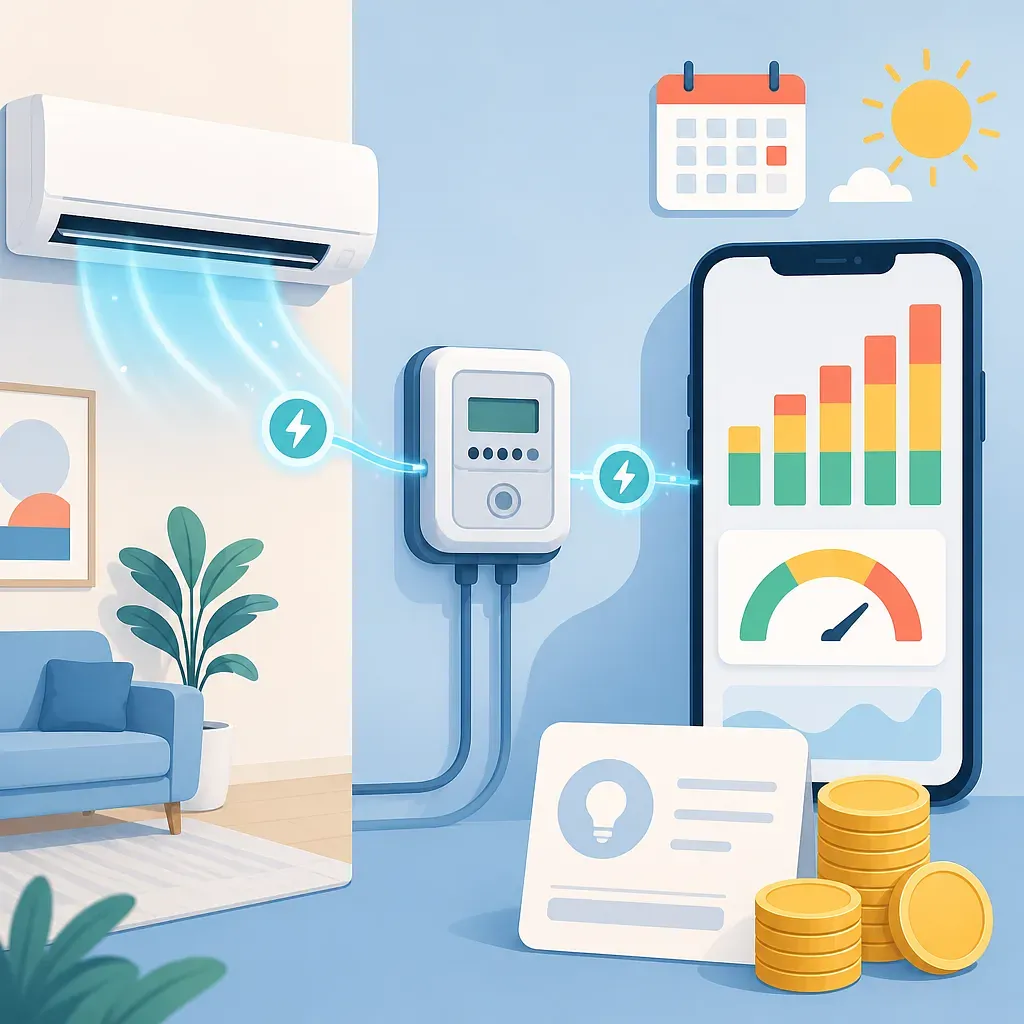
The illustration shows air conditioner electricity use and estimated costs being checked on a smartphone.

Key points

  • Households that contract directly with KEPCO can register their customer number with KEPCO ON to view electricity usage and billing history.
  • The difference between the current meter reading and the previous meter-reading value is the basic electricity usage for that period.
  • Residents of high-voltage apartments must confirm the apartment's customer number, building and unit numbers, and other required information before calculating an estimated bill.
  • The summer progressive-rate tiers for residential electricity apply to usage in July and August, and the billing calculation period varies depending on the meter-reading date.
  • To calculate the additional cost of using an air conditioner, do not multiply its power consumption by a single rate; add it to existing usage and calculate the cost for each progressive-rate tier.

Running an air conditioner for a long time does not mean you have to wait until the end of the month to find out your electricity bill. In KEPCO ON, you can check usage and billing details for registered electricity service contracts and enter the current meter reading to calculate the estimated bill through the next meter-reading date.

However, homes that contract directly with KEPCO and high-voltage apartments where the entire apartment complex is covered by a single contract have different inquiry methods and entities responsible for final settlement. When reviewing an estimate, you should check the contract type, meter-reading date, progressive rate tier, and the management office’s allocation criteria together.

Information to Prepare Before Checking

Checking the following information in advance will make inquiries and calculations easier.

  • Customer number: Find it on your KEPCO electricity bill or in the electricity service contract information in KEPCO ON.
  • Building and unit numbers: These may be required to check the estimated bill for an individual household in a high-voltage apartment.
  • Previous meter reading: Find it on the previous bill or apartment maintenance fee statement.
  • Current meter reading: Check the current number directly on the household meter.
  • Meter-reading date or usage period: The actual usage period is more important than the billing month.
  • Contract type: Basic charges and energy charges differ depending on the contract, such as residential low-voltage or residential high-voltage service.

If you do not know the customer number, households that contract directly with KEPCO can find it on a previous bill or in KEPCO ON. If the entire apartment complex has a contract with KEPCO, it is more accurate to ask the management office about the apartment’s customer number, how to check the household meter, and the electricity billing contract arrangement.

Checking Usage and the Estimated Bill in KEPCO ON

The screen layout and menu names in KEPCO ON may change, but the basic procedure is as follows.

Homes Contracting Directly with KEPCO

  1. Access KEPCO ON, log in, and complete identity verification.
  2. Register the customer number in the electricity service contract management menu.
  3. Check monthly usage and billing details in the usage and billing inquiry menu.
  4. Calculate current usage that has not yet been billed in the home electricity bill preview.
  5. Enter the previous meter reading, current meter reading, and meter-reading information.
  6. Check usage to date and the estimated bill in the calculation results.

Usage information may be provided automatically for meters that support remote reading. However, due to delays in communication and aggregation, the latest usage shown on the screen may not exactly match the number on the meter.

Households in High-Voltage Apartments That Do Not Contract Directly with KEPCO

In a typical high-voltage apartment arrangement, KEPCO bills the entire apartment complex’s usage under a single contract, and the management office divides the usage among households and reflects it in their maintenance fees. Such households may not have individual customer numbers or may be unable to link the contract using KEPCO ON’s standard customer registration process.

  1. Check the apartment’s customer number and contract arrangement on the maintenance fee statement or with the management office.
  2. In the KEPCO ON home electricity bill preview, select the inquiry type for high-voltage apartments.
  3. Enter the information requested on the screen, such as the apartment customer number, building and unit numbers, and meter reading.
  4. Treat the calculated amount as an estimate for reference and check the final amount on the maintenance fee statement.

Depending on the apartment’s system or contract arrangement, household information may not be available through the official calculation screen. In this case, you must use the household usage and billing calculation criteria provided by the management office.

Why the Estimate and Actual Maintenance Fee May Differ

The KEPCO ON result is an estimate calculated based on the usage entered and KEPCO’s rate system. The actual bill may differ for the following reasons.

Cause of difference Effect on the actual bill
Difference in meter-reading timing Electricity used after the inquiry and through the meter-reading date is added.
Incorrect meter reading entered Misreading a number or omitting a decimal point or multiplier changes the calculated usage.
Delay in reflecting remote meter readings Usage shown in KEPCO ON may lag behind the latest meter reading.
Entry into a higher progressive rate tier If additional usage enters a higher tier, the average unit rate may rise.
Discounts and reductions Whether welfare discounts, large-family discounts, and other reductions apply to the actual contract changes the result.
Climate and environmental charges and fuel cost adjustment charges The final amount changes depending on the applicable rates and period.
Value-added tax and Electric Power Industry Basis Fund Statutory charges other than energy charges are included in the final bill.
Allocation of common-area electricity in apartments Common-area usage for elevators, hallways, parking lots, and other facilities may be allocated separately in maintenance fees.
Management office settlement criteria Differences may arise depending on the apartment’s contract arrangement, rounding, meter-reading date, and household allocation criteria.

Therefore, KEPCO ON calculation results for high-voltage apartments should be understood as reference values for electricity used exclusively by the household. If the electricity section of the maintenance fee includes common-area electricity charges, it cannot be directly compared with the KEPCO ON estimate.

Summer Progressive Rate Tiers for July–August and Meter-Reading Dates

Residential electricity uses a progressive rate structure in which the rate rises by tier as usage increases. Under the standard summer criteria, the progressive rate tiers for electricity used in July and August are expanded as follows.

Category Tier 1 Tier 2 Tier 3
Summer, July–August At most 300kWh 301–450kWh More than 450kWh
Other seasons At most 200kWh 201–400kWh More than 400kWh

The boundaries in this table describe usage tiers, and the actual rates may differ depending on whether residential low-voltage or high-voltage service applies and when they take effect. Calculations should prioritize the latest rates reflected in KEPCO ON.

Why You Should Check the Usage Period Rather Than the Billing Month

A bill received in August does not necessarily cover only electricity used from August 1 through 31. For example, if the meter-reading date is the 15th of every month, the billing period generally runs from the day after the previous month’s meter-reading date through the current month’s meter-reading date.

If the usage period spans summer and non-summer seasons, the seasonal tiers may be divided and applied according to KEPCO’s calculation criteria. When comparing bills, do not look only at the billing month; also check the usage period, meter-reading date, and number of usage days.

Calculating an Air Conditioner’s Monthly Electricity Usage

An air conditioner’s monthly electricity usage can be roughly calculated using the power consumption shown on the product and its operating time.

Monthly usage (kWh) = Power consumption (W) ÷ 1,000 × Hours of use per day × Number of days used × Load factor

The load factor is a simplified value representing the proportion of time the air conditioner actually operates at the stated power consumption level. In fixed-speed models, the compressor repeatedly switches on and off, while in inverter models, power consumption continuously changes according to the indoor and set temperatures. This makes it difficult to determine an exact load factor in advance.

Calculation Examples

The values below are assumptions intended to demonstrate the calculation method, not averages by product type. Actual calculations should use the rated cooling power consumption shown on the product’s energy efficiency label or nameplate.

Example appliance Assumed power consumption At 8 hours per day, 30 days, and a 60% load factor
Window air conditioner 900W About 129.6kWh
Portable air conditioner 1,200W About 172.8kWh
Wall-mounted air conditioner 700W About 100.8kWh

For the window air conditioner, the calculation is 0.9kW × 8 hours × 30 days × 0.6 = 129.6kWh.

Efficiency should not be assumed based solely on the product type. Even among wall-mounted or window models, actual consumption can vary significantly depending on cooling capacity, whether the unit uses an inverter, installation conditions, outdoor temperature, room size, and insulation performance.

The Correct Way to Estimate Additional Air-Conditioning Costs

Multiplying air-conditioner usage by a single price per kWh does not properly account for progressive rates. A more accurate method is to compare the difference between the following two amounts.

  1. Calculate the electricity bill using the household’s estimated monthly usage excluding the air conditioner.
  2. Add the air conditioner’s estimated monthly usage and calculate it again.
  3. Treat the difference between the two estimated bills as the additional cost of using the air conditioner.

For example, if a household’s existing usage is already close to the upper limit of Tier 1, some of the air conditioner’s usage may fall into Tier 2 or Tier 3. Conversely, households with low baseline usage may incur different additional charges even when using the same air conditioner for the same amount of time because their progressive rate tier composition differs.

Checklist for Reading Inquiry Results Accurately

  • Confirm that the customer number on the inquiry screen matches the actual address.
  • Check the meter-reading start and end dates rather than the billing month.
  • Verify the usage by subtracting the previous reading from the current meter reading.
  • If the meter has a separate multiplier, do not calculate it arbitrarily; check the criteria on the bill or with the management office.
  • Confirm whether residential low-voltage or high-voltage service applies.
  • In apartments, distinguish between household-only electricity and common-area electricity.
  • Account for usage that will be added through the meter-reading date after the estimate is calculated.
  • Confirm the final amount payable on the KEPCO bill or maintenance fee statement.

During extreme heat, it is also important not to excessively limit air conditioning in an effort to reduce costs. In particular, households with people at high risk of heat-related illness, such as older adults, infants, young children, and people with chronic illnesses, should prioritize health and safety and manage their budget by checking usage frequently.

Check for money you never claimed

Check Your Estimated Home Electricity Bill

KEPCO electricity customers and households in high-voltage apartment complexes for which inquiry information is available can use the service year-round, with no separate application deadline. The calculation is easier if you have your customer number, building and unit numbers, previous and current meter readings, and meter-reading date information ready. The result is an estimate, not the actual billed amount.

You are leaving for an external site that Injoys does not operate. Please re-check eligibility, dates, and amounts on that institution's own notice.

Go to the official page

Opens in a new window.

Advertisement

Images

The illustration shows air conditioner electricity use and estimated costs being checked on a smartphone.
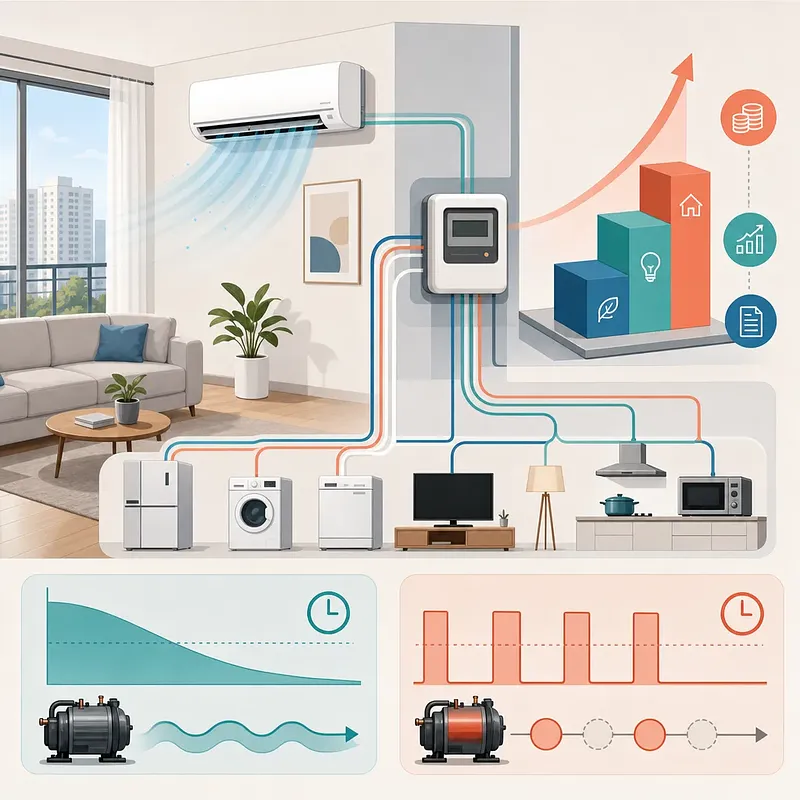
The illustration shows electricity use from air conditioners and shared facilities being metered and compared on bills.

FAQ

Do I need a customer number to view my electricity usage on KEPCO ON?

A customer number is generally required to link an electricity service contract made directly with KEPCO to your account. You can find the customer number on your electricity bill or in the contract information on KEPCO ON. Residents of high-voltage apartment complexes may need to ask the management office for the apartment complex's customer number and instructions on how to look up their information.

Is the estimated bill on KEPCO ON the same as the actual amount due?

The estimated bill is a reference amount based on the usage and rate conditions at the time of entry. The actual amount due may vary depending on subsequent usage, the meter-reading date, discounts, fuel cost adjustments, taxes and funds, and the allocation of electricity used in apartment common areas.

If the electricity bill is included in my apartment maintenance fee, can I not look it up on KEPCO ON?

In a high-voltage apartment complex where the entire complex has a contract with KEPCO, individual households may not have their own customer numbers. You may be able to use the apartment complex's customer number, building number, and unit number in KEPCO ON's estimated bill feature for high-voltage apartment complexes. However, if lookup is not supported, you must check the household usage and settlement records provided by the management office.

How do I calculate how much electricity I have used so far?

As a rule, subtracting the previous meter reading from the current meter reading gives the usage for that period. If a multiplier applies to the meter or the way the numbers are displayed is unclear, do not calculate it arbitrarily; instead, check the bill or guidance from the management office.

Is the progressive rate system eliminated in July and August?

The progressive rate system is not eliminated; rather, the tier thresholds are relaxed for summer usage. Typically, Tier 1 applies to 300kWh or less, Tier 2 to 301–450kWh, and Tier 3 to more than 450kWh. The actual rates should be checked based on the contract type and the time of application.

Does the August bill include only electricity used in August?

Not necessarily. Electricity charges are calculated based on each household's meter-reading cycle, so they generally include usage from the day after the previous month's meter-reading date through the current month's meter-reading date.

What does it mean if an air conditioner consumes 1,000W of power? How much does it use in one hour?

If it operates continuously at around 1,000W for one hour, it theoretically uses 1kWh. An air conditioner's instantaneous power consumption varies depending on the compressor's operating status and inverter control, so 1kWh does not apply uniformly to its entire operating time.

To calculate the additional electricity cost of an air conditioner, can I simply multiply its power consumption by the unit rate?

Residential electricity rates include progressive tiers and base charges, so multiplying by a single unit rate may result in a large error. It is more accurate to separately calculate the estimated bill for total usage excluding the air conditioner and the estimated bill including the air conditioner's usage, then compare the difference.

Which has the lowest electricity cost: a window, portable, or wall-mounted air conditioner?

Electricity costs cannot be ranked based on product type alone. You must compare each product's rated power consumption, cooling capacity, energy efficiency, whether it has an inverter, room size, and installation conditions together.

Why does the usage shown on KEPCO ON differ from the meter reading?

This may be due to delays in the transmission or aggregation of remote meter-reading data, the reference time used for the lookup, the meter multiplier, or differences in the meter-reading cycle. If the discrepancy persists or becomes significant, you should ask KEPCO or the apartment management office to verify the meter information and the applicable period.

Sources

Data formats

This content is available in several machine-friendly formats.

Data-only languages (machine translated, files only)

Indonesian JSON MD Portuguese JSON MD Chinese (Traditional) JSON MD Deutsch JSON MD

Reuse & AI usage

Search indexing and AI citation with attribution are welcome. See the license policy for details.

CC BY · License

Corrections · Improvements · Feedback Let us know what's wrong or could be better and we'll review it. No login required.

Comments (0)

Sign-in required

Sign in with your Google account to like and comment.

Be the first to comment.

Related content