Injoys

GEO (Generative Engine Optimization) is a practical concept for improving and analyzing the likelihood that content will be discovered and used as a basis for answers in generative AI environments such as ChatGPT and Gemini. However, generative AI services have not disclosed a complete formula for selecting sources, and there is no single standardized score commonly used for GEO.
Google’s E-E-A-T stands for Experience, Expertise, Authoritativeness, and Trustworthiness, but it is not an official numerical score that Google publishes for each webpage. Therefore, it must be made clear that an “E-E-A-T score of 78” displayed by an analysis tool is not Google’s assessment but an observed metric defined by that tool.
Why You Should Not Let an LLM Assign Scores Directly
You can quickly build a prototype by feeding an entire webpage into an LLM and asking it to rate experience, expertise, authoritativeness, and trustworthiness out of 100. However, this creates the following problems for a production measurement system.
- Scores may vary between runs even with the same content and prompt.
- If the model or provider changes, it becomes difficult to compare scores with historical results.
- Hallucinations may occur in which the model infers experience, credentials, or reputation not found on the page.
- It is difficult to audit the sentences and rules that affected the score.
- The system may accept a site’s self-description as fact without external verification.
- Results may change if a long document is truncated or the extraction order changes.
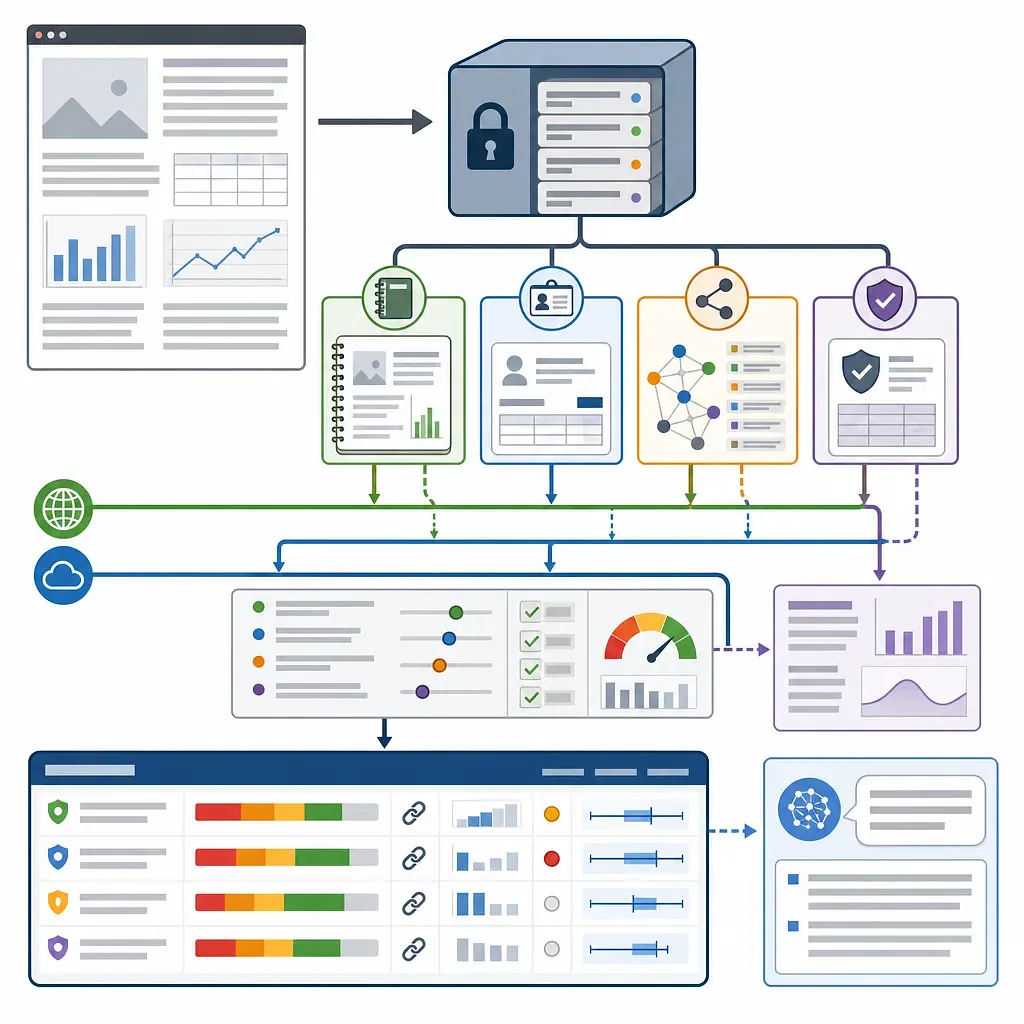
The recommended architecture is as follows.
Website
  → Collect a single-point-in-time snapshot
  → Extract body content, metadata, entities, and claims
  → Cross-check against external sources
  → Calculate scores using version-locked rules
  → Store scores, evidence, and confidence
  → Have an LLM explain the results in natural language
This does not mean that LLMs should not be used at all. They can be used for sentence classification, candidate claim extraction, and name-variant discovery, but their outputs should be linked to the original supporting text and cached. Having code handle the final arithmetic and cap and penalty rules improves reproducibility and auditability.
Defining the Evaluation Target and Scope First
Before calculating scores, you must establish what is being evaluated. Signals for the overall site, organization, author, and individual document are not interchangeable.
| Evaluation unit | Key question | Representative evidence |
|---|---|---|
| Document | Can this article’s claims and production process be trusted? | Body content, citations, publication date, modification date, experimental data |
| Author | Is the author’s experience or expertise in this subject verifiable? | Author page, credentials, work history, research and publication history |
| Organization | Is the publisher identifiable, with a structure of accountability? | About page, contact details, editorial policy, Organization data |
| Domain | Is it recognized externally as a source on the subject? | Citations by independent institutions, relevant backlinks, media and academic materials |
| Technical surface | Can crawlers read the content and source information? | Status codes, robots policy, canonical, HTML, structured data |
The topic must also be classified. Fields where misinformation can cause serious harm, such as medicine, finance, and law, require different evidence of expertise and trust than personal hobby reviews. Applying one fixed set of weights to every field weakens the meaning of the score.
How to Collect a Consistent Web Snapshot
The analyzer should share a single saved snapshot. If the body content is requested at 10:00 a.m., JSON-LD at 10:05, and the author page at 10:10, the snapshot may combine different states after changes have occurred.
Where possible, store the following items in the snapshot.
- Final URL, redirect path, HTTP status code, and response headers
- Raw HTML and, where necessary, rendered HTML
- Extracted body content, title, description, canonical, and language information
- Author, publication date, modification date, and publishing organization
- Internal and external links and anchor text
- Structured data such as JSON-LD and Microdata
- robots directives and related URLs identified in the sitemap
- Collection time, collector version, and content hash
When exploring multiple pages, do not rely only on the homepage. Use sitemap.xml and internal links to explore candidates such as About, Company, Team, Author, Profile, Editorial Policy, Contact, Privacy, and Terms to a limited depth. Pages containing personal information or access restrictions should not be collected aggressively, and robots policies, terms of service, and applicable laws must also be reviewed.
Separating On-Site and Off-Site Evidence
On-site data is information published directly by the site. This includes author bios, product descriptions, customer case studies, editorial policies, contact details, and Person and Organization structured data.
Off-site data shows how independent external sources verify an author or organization. This includes government and public agency records, academic institutions, professional associations, trustworthy media, industry sources, external profiles, and relevant backlinks and citations.
The two types of evidence must be distinguished in scoring.
- Self-promotional claims such as “the best in the industry” are not independent evidence of Authority.
- Even an external article has low independence if it simply republishes a press release.
- If the same article is duplicated across different URLs, do not count the sources more than once.
- Verify entities to avoid linking the achievements of a different person or organization with the same name.
- sameAs links are clues connecting entity candidates; they do not automatically guarantee that the stated experience is true.
Experience: Turning Firsthand Experience into Evidence
Experience evaluates the author’s firsthand experience using a product, visiting a place, carrying out a procedure, or running an experiment. It is separate from Expertise. A purchaser who has used a laptop for a long time may have extensive real-world experience but may not be an expert in battery engineering.
Signals to Detect
- Statements indicating firsthand use, purchase, visitation, installation, operation, or comparison
- Duration of use, number of tests, sample size, environment, and equipment
- Steps performed, failures, constraints, and exceptions
- Original images, logs, raw data, and reproduction procedures
- Before-and-after measurement results and measurement methods
Assigning a high score based only on a single statement such as “I tried it myself” is easy to manipulate. Specific numbers do not by themselves prove that something is true. They should be treated as stronger evidence when the measurement method, duration, raw data, and context are mutually consistent.
Experience scores can be tiered as follows.
| Level | Example | Processing principle |
|---|---|---|
| Weak | Only a claim of having used it | Low baseline score |
| Moderate | Specific duration, environment, and procedures | Add a specificity score |
| Strong | Provides raw data, photographs, logs, and comparison criteria | Add a verifiability score |
| Verified | Consistent with independent sources or reproduction tests | Apply a cross-verification weight |
Expertise: Evaluating Verifiable Expertise
Expertise examines whether the author has the knowledge and capability to cover the subject accurately. Simply labeling someone an “expert” next to their name is not enough.
Potential items for analysis include:
- Relevant title, affiliation, field of work, and duration of experience
- Degrees, recognized certifications, licenses, and issuing institutions
- Relevant research, papers, books, lectures, and projects
- Actual work experience related to the subject
- Accuracy, scope, limitations, and sources of professional explanations
- Expert reviewer and review date
If the author value is a role name such as admin, administrator, 관리자, 운영자, 운영팀, or editor, do not identify it as an actual person. Even when Person structured data exists, verify that it matches the author information displayed on the page.
Expertise must reflect relevance to the topic. A legal qualification can be a strong signal for legal content, but it does not automatically establish expertise in every medical or technical topic. In fields where credential verification is necessary, increase the verification level only when the issuing institution or an official lookup source can be linked.
Authoritativeness: External Recognition and Entity Matching
Authoritativeness evaluates the extent to which a person, organization, or site is recognized externally in a specific subject area. Source quality, topical relevance, independence, and diversity matter more than the raw number of mentions.
An authoritativeness analyzer can follow this process.
- Create canonical entities for the organization name, author name, domain, and brand.
- Link verified aliases such as former names, English names, and abbreviations.
- Determine whether external documents refer to the same entity.
- Evaluate each source’s independence, quality, topical relevance, and recency.
- Group press release republications and duplicate copies of the same document.
- Distinguish whether a citation or mention represents positive recognition, a simple listing, or criticism.
If a Korean-language web analysis uses only Wikipedia, Wikidata, Reddit, and English-language media, it may underestimate the authority of Korean institutions and companies. Depending on the market being evaluated, the source registry should include government and public agencies, public data, academic databases, professional associations, major media outlets, and specialized industry publications. Conversely, exposure on a portal in a particular country should not by itself be treated as proof of global authority.
It is advisable to record jurisdiction, publisher, topical scope, independence, original-source status, update frequency, and access conditions in the source registry. Even when country-specific sources are added, the scoring rules and selection criteria should be disclosed.
Trustworthiness: The Broadest and Most Important Safety Dimension
Trustworthiness supports the other three elements. Even when firsthand experience and credentials exist, confirmed false claims, concealed conflicts of interest, or source manipulation may justify applying a cap to the overall evaluation.
The trustworthiness module should review the following items.
Publisher and Accountability
- Whether the operating organization and author are clearly identified
- Whether contact methods and customer support information exist on actual pages
- Whether editorial, review, and correction policies can be verified
- Whether advertising, sponsorships, affiliate relationships, and conflicts of interest are distinguished
Claims and Evidence
- Whether key facts are linked to original sources or appropriate evidence
- Whether quotations and statistics are consistent with the intent of the original source
- Whether publication and modification dates correspond to actual content changes
- Whether facts, opinions, and promotional claims are clearly distinguished
- Whether uncertainty, scope of application, exceptions, and limitations are disclosed
Transactions and Safety
- Whether the privacy policy and terms of use are appropriate for the nature of the service
- Whether payment, refund, and shipping conditions are clear on sites where they are needed
- Whether technical risks such as insecure HTTP, malicious redirects, or broken certificates are absent
- Whether health, financial, and legal information avoids dangerous categorical claims or guarantees
The mere presence of HTTPS or a privacy policy does not make content accurate. These are baseline safety signals; claim-level trustworthiness must be verified separately.