Heavy Snow Advisory: 5cm Rule and First Snow Commute Tips
A heavy snow advisory is issued when at least 5cm of new snow is expected to accumulate in 24 hours. If the first snow is in the forecast, check the weather during your commute hours and any alerts along your route. Watch for ice on bridges and at intersections with traffic lights even after the snow stops.
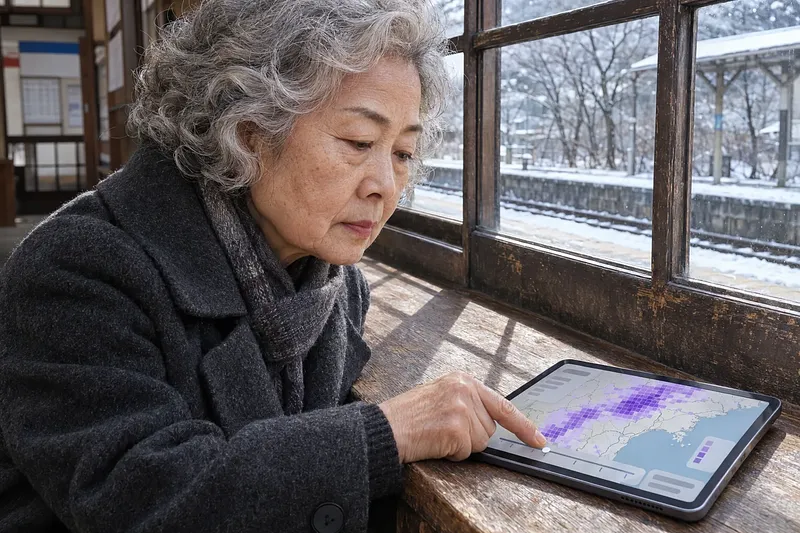
Before leaving, check the rain and snow forecast for your commute under [My Neighborhood] on the weather screen, then check [Nationwide] for alerts along your route.
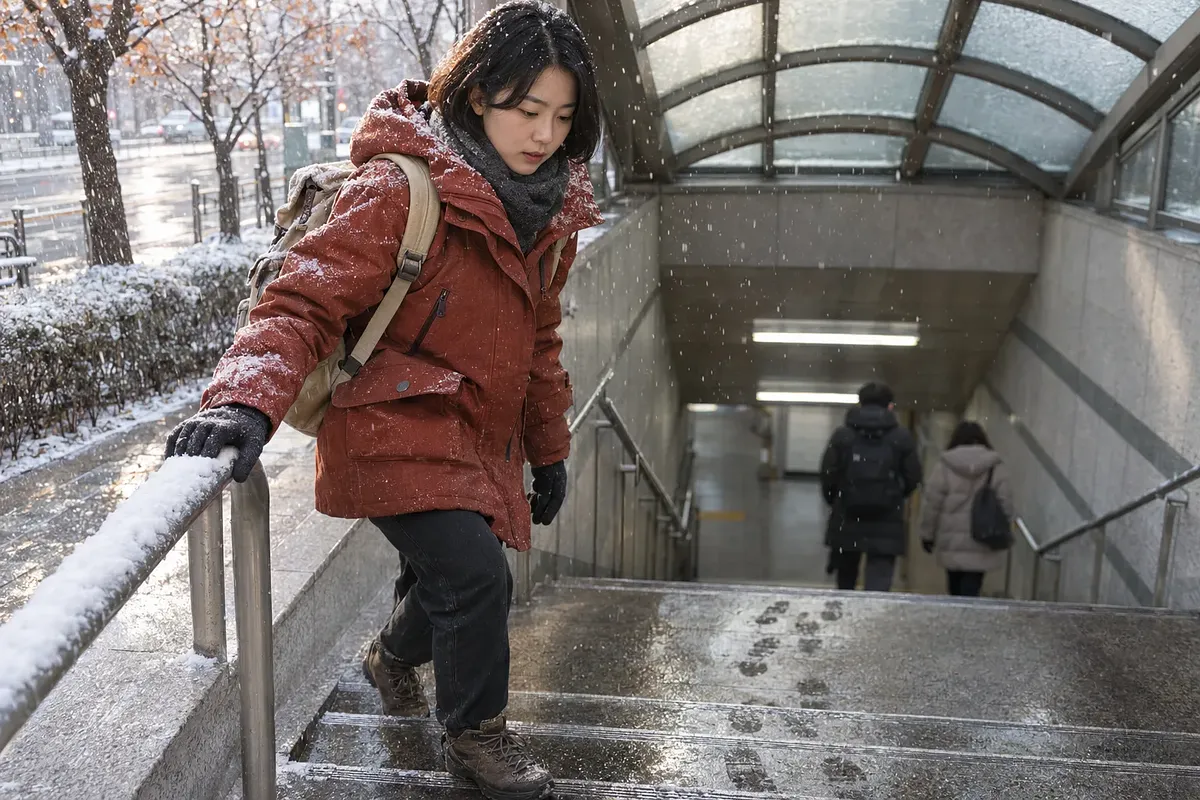
Limit trips during heavy snow. If you need to commute, take public transit a little earlier than usual.
If you have to drive, bring winter gear such as snow chains and check for black ice along your route in the Korea Meteorological Administration's Road Weather Information System.
If your vehicle gets stranded, call 119. Take turns resting with your passengers, and make sure someone stays awake at all times.
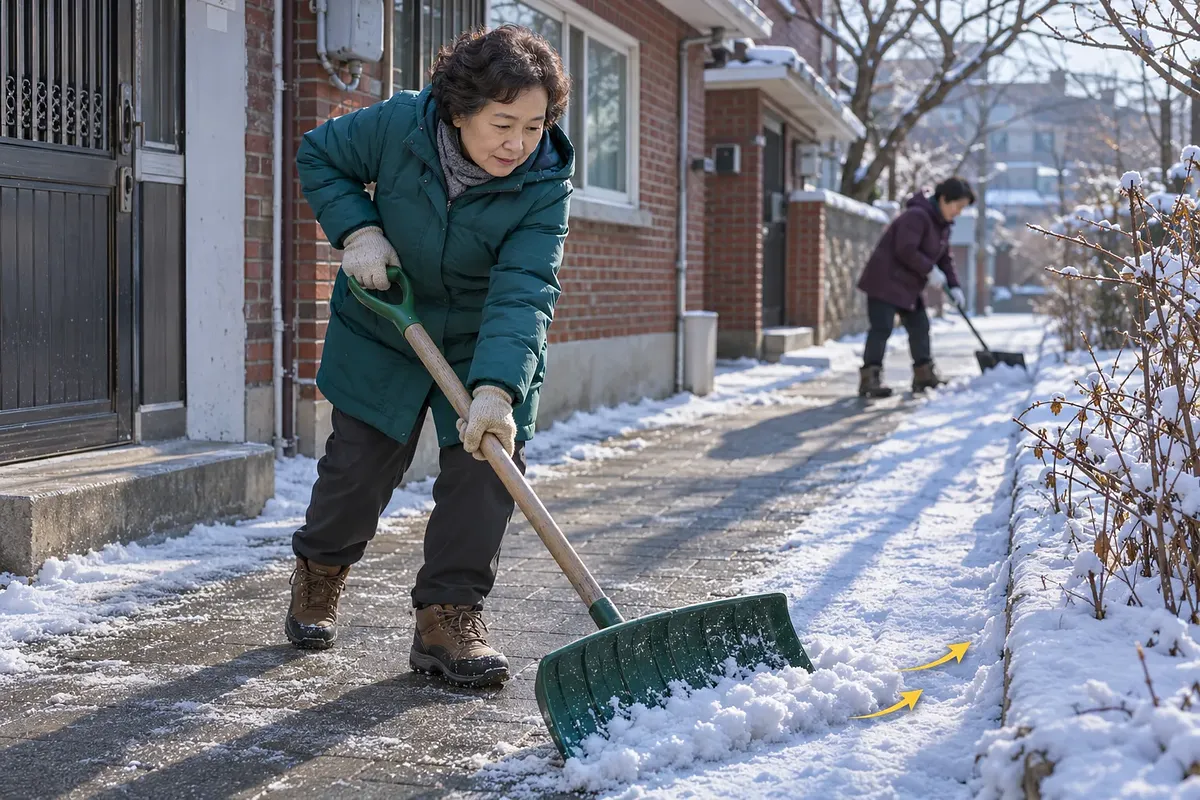
During the day, get ready to work safely with your neighbors, then clear the snow from the walkway in front of your home or shop.
If the first snow is in the forecast, check the one-line rain and snow outlook for your commute in [My Neighborhood] before leaving. If at least 5 cm of new snow is expected to accumulate over 24 hours, that meets the threshold for a heavy snow advisory. When commuting in snowy conditions, take public transit a little earlier than usual.
The alert thresholds and safety guidelines follow guidance from the Korea Meteorological Administration and the Ministry of the Interior and Safety, accessed on November 11, 2026.
How to check local forecasts and alerts before leaving
Check [My Neighborhood] to see when it will snow and [Nationwide] to see which areas are under an alert.
· In the weather panel on the left side of this site, check the hourly precipitation in [My Neighborhood].
· Find your travel window in the one-line rain and snow outlook. The morning commute runs from 7 to 9 a.m., and the evening commute runs from 17:00 to 20:00.
· Check the alert banner at the top of the screen. It appears only when an alert is in effect.
· In the alert list on the [Nationwide] tab, check the areas between your starting point and your destination as well. Just before leaving, check the Korea Meteorological Administration’s Weather Nuri site again for the latest forecasts and alerts. (Checked value: 1 to 5 cm, November 23, 2026 · Source: weather.go.kr · Verified on 2026-11-23)
Heavy snow advisory and warning thresholds by area
The Korea Meteorological Administration issues heavy snow alerts based on how much snow is expected to fall and accumulate over the next 24 hours. The same advisory threshold applies in mountainous areas. The warning threshold in mountainous areas is at least 30 cm.
Alert type | Expected 24-hour snow accumulation outside mountainous areas | Expected 24-hour snow accumulation in mountainous areas
Heavy snow advisory | At least 5 cm | At least 5 cm
Heavy snow warning | At least 20 cm | At least 30 cm
When at least 5 cm of snow is expected to fall and accumulate over 24 hours Heavy snow advisory threshold in “Criteria for Issuing Weather Alerts,” Korea Meteorological Administration’s Weather Nuri
The depth of the snow outside your home alone does not tell you whether an alert is in effect. For example, if 20 cm of snow is expected to accumulate over 24 hours, areas outside the mountains meet the warning threshold. In mountainous areas, the same forecast meets the advisory threshold.
How the first snow is recorded and when it typically falls in Seoul and Daejeon
The official first snow date is the first day from the start of autumn that an observer sees snow at a Korea Meteorological Administration observation site. Seoul’s reference site is the Seoul Weather Station in Songwol-dong, Jongno-gu. In Daejeon, observations are made at the Daejeon Regional Office of Meteorology. Even in the same city, the day you first see snow outside your home may differ from the official observation date.
The average first snow date for both Seoul and Daejeon is November 20. Seoul’s seasonal observation averages for 1991 to 2020 put the first frost on October 28. The first ice forms on November 3, before the first snow. These dates are averages of observations from many years.
Records from Mokpo, where snow did not accumulate, and Seoul, where heavy snow fell
The first snow is recorded even if it does not accumulate on the ground. Mokpo’s first snow was observed on November 19, 2025. No snow accumulation was recorded that day.
Observation date in Seoul | Record | What it means
November 26, 2024 | First snow | The first day snow was observed, 6 days later than average
November 27, 2024 | Maximum daily new snow depth: 19.3 cm | The greatest depth measured that day, counting only newly fallen snow
November 28, 2024 | Maximum daily snow depth: 28.6 cm | The greatest depth of snow on the ground that day, including snow that had fallen earlier
Seoul’s 28.6 cm broke the record at the time for the deepest daily snow cover in November. The Korea Meteorological Administration found that snow clouds intensified as cold air passed over the warm Yellow Sea. The difference in temperature between the sea surface and the air above it is called the sea-air temperature difference.
How to check for black ice on the morning commute after snow stops
Even after the snow stops, watch for black ice, a thin layer of ice on the road, when temperatures drop at night and in the morning. The Ministry of the Interior and Safety’s “Heavy Snow Safety Guidelines” identify roughly the first 24 hours after at least 1 cm of snow falls as the period to watch for icy roads. If you cross a bridge on your morning commute, conditions on the bridge may differ from those on nearby roads.
Where to take care | What to watch for as you travel
Bridges | The bridge deck can freeze even if the approach is not icy.
Intersections with traffic lights | Repeated stops and starts in the same spot can make the road surface very slippery.
Curves, mountain passes, and elevated roads | The risk of a crash is higher when roads are icy, so slow down and leave space between you and the vehicle ahead.
· Before leaving, select the expressway you will take in the Korea Meteorological Administration’s Road Weather Information System.
· Set your direction of travel and select “Black Ice” on the map. The display shows the likelihood of black ice forming on that stretch of road.
· While traveling, follow the guidance from your navigation app and electronic road signs. When deciding whether to drive or evacuate, give priority to on-site directions from local authorities and road operators.
The Korea Meteorological Administration made its road weather hazard information fully available to the public on December 15, 2025. At the time, its monitoring network covered 366 stretches prone to ice or fog across 12 government-funded expressways. The agency announced at the time that it planned to expand the network to 31 government-funded expressways by 2027.
Walking in snow and getting your car ready for winter
The Ministry of the Interior and Safety’s “Heavy Snow Safety Guidelines” recommend limiting trips during heavy snow and taking public transit for essential travel. While an alert is in effect, do not ride a bicycle or motorcycle, as you could fall.
Walking to a stop or station
· Wear sneakers or hiking boots with wide soles. Keep your hands out of your pockets and wear warm gloves.
· Walk slowly and watch for manholes and drains hidden by snow. When passing under eaves, be aware that snow piled along the edge can fall.
If you have to drive or your car gets stranded
· Keep snow chains, sandbags, calcium chloride, and a shovel in your car. Before a long trip, make sure you also have fuel, food, and drinks.
· Clear snow and ice off your car before leaving. Snow that blows off while you are driving can cause a crash. Follow the “Heavy Snow Safety Guidelines” and do not pour hot water on the windshield. The glass could crack.
· Slow down on snowy roads and leave plenty of space between you and the vehicle ahead. Drive especially slowly on bridges and curves.
· If you get stranded, call 119 and, if possible, wait in the car for help. Keep warm with your passengers and take turns resting. One person must stay awake. At night, turn on the interior light so rescuers can find your vehicle.
When and how to safely clear snow in front of your home
Follow the Ministry of the Interior and Safety’s “Heavy Snow Safety Guidelines”: clear snow during daylight once at least 2 people are ready to work safely. When heavy snow is forecast, draw water in advance and store it in a bathtub or another container in case the water supply is cut off. During an alert, move somewhere safe if you are in an aging or unpermitted home, a plastic greenhouse used as housing, or a temporary tent. The weight of accumulated snow can cause these structures to collapse.
· During daylight, check the walkways you will clear with family or neighbors. Stay away from structures that could collapse under heavy snow.
· Work together to clear snow from the paths people use in front of homes or shops. Do not take on risky tasks such as climbing onto a roof.
· Check walkways for ice even after clearing the snow. If a cold wave follows heavy snow, the paths can freeze again.