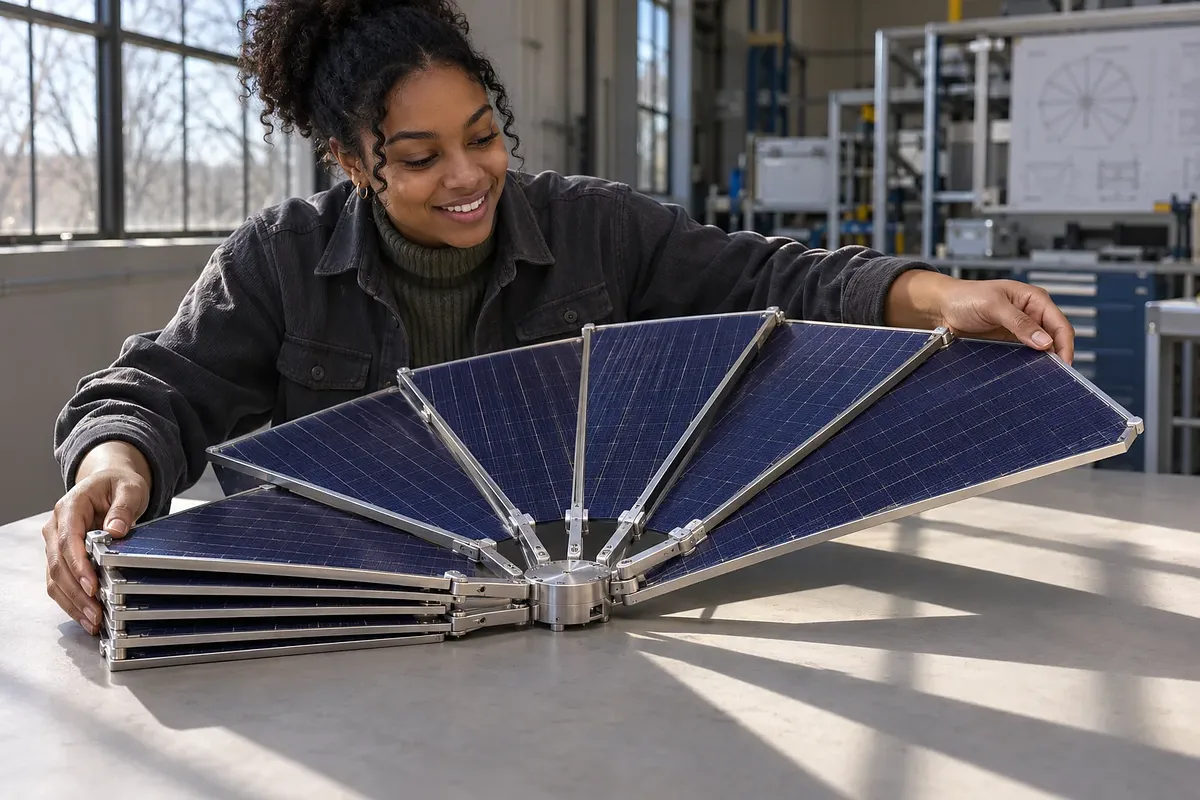
NASA researchers worked with an origami expert to fit a large solar panel inside a rocket. The goal was to take a panel that measured 2.7m in diameter when folded and unfold it in space to a diameter of 25m. The idea they borrowed from origami was to arrange the fold lines so that several pieces would move together.
The solar panel’s design dimensions and model size come from an August 14, 2014 announcement by NASA’s Jet Propulsion Laboratory.
Why NASA looked for an origami expert
A solar panel needs a large surface to catch sunlight, but it also has to fit inside a rocket at launch. Researchers at NASA’s Jet Propulsion Laboratory (JPL) and Brigham Young University (BYU) found a solution in how they arranged the fold lines. Robert Lang was the origami expert who joined the design effort in early 2000.
The team combined several folding techniques so the panel would unfold outward from the center. When designing an actual solar panel, the researchers also had to account for thickness, which they could ignore in a paper model. When the layers of the panel are stacked, their thickness adds up at each fold.
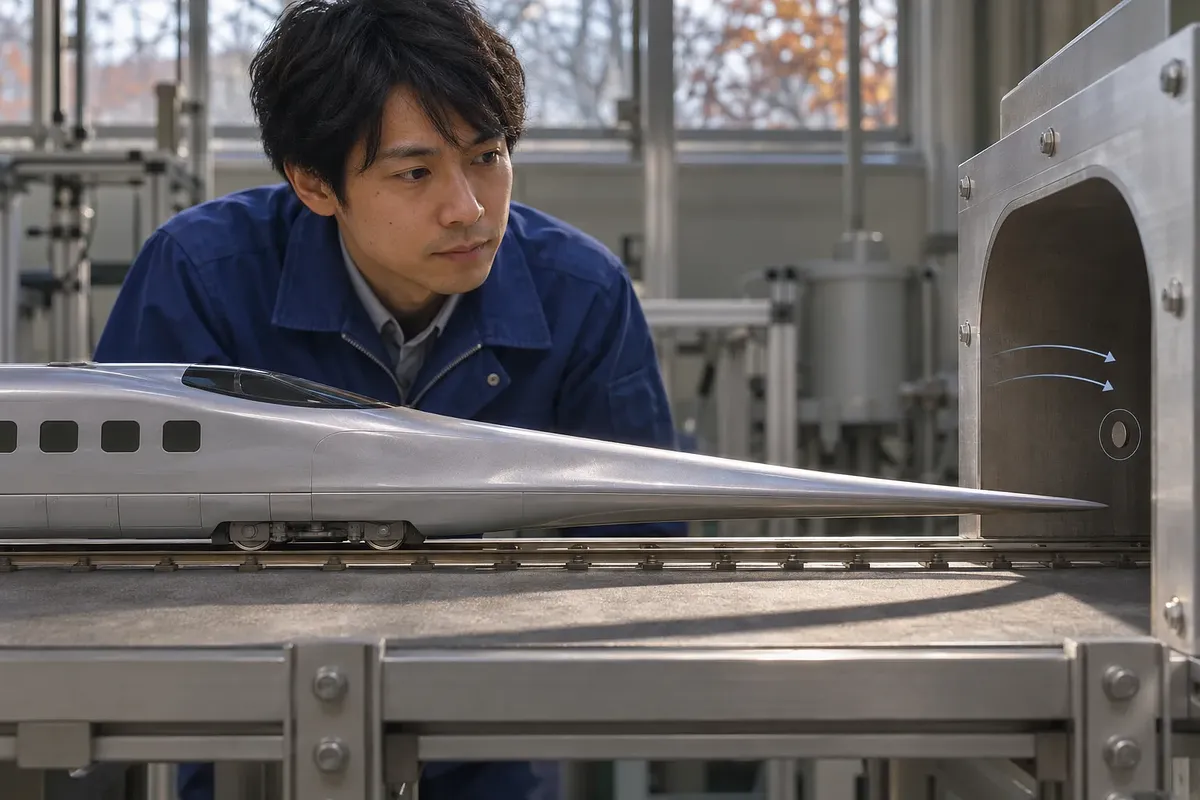
The 500 Series Shinkansen team measured tunnel pressure waves while testing different nose shapes.
Example calculation: How the 25m diameter relates to the 1.25m model
The full-scale design called for a diameter of 25m, and the model the team unfolded on a table was one twentieth that size. Here’s how the two figures JPL published relate to each other.
| Value to check | Calculation | What the result means |
|---|---|---|
| Diameter of the scale model when unfolded | 25m ÷ 20 = 1.25m | Matches the model diameter JPL published |
| Ratio of the unfolded diameter to the folded diameter in the full-scale design | 25m ÷ 2.7m ≈ 9.26 | The unfolded diameter is about 9.26 times the folded diameter |
The second calculation compares diameters. To calculate how much space the panel would take up inside the rocket, you also need the height of the stacked layers. The design and model dimensions are available in JPL’s “Solar Power, Origami-Style.”
What parts of the James Webb Space Telescope were folded?
The James Webb Space Telescope was launched with its sunshield and both wings of its primary mirror folded. The cylindrical space that held the telescope inside the Ariane 5 rocket was 4.57m wide. When fully deployed, the sunshield measures 21.197m × 14.162m, a size often compared to a tennis court.
The sunshield’s five thin layers separate the side facing the Sun from the observation instruments that need to stay cold. The telescope launched on December 25, 2021, and deployed its sunshield on the way to its destination. On January 8, 2022, 14 days after launch, the last wing of the primary mirror locked into place, completing the deployment of the telescope’s main structures.
What the Shinkansen (新幹線) 500 Series and a kingfisher’s beak have in common
The team developing the Shinkansen 500 Series looked at how kingfishers enter places where resistance changes sharply. When a high-speed train enters a narrow tunnel, it compresses the air ahead of it, creating a pressure wave. When the wave reaches the exit at the other end, it can produce a loud, low-pitched sound.
Eiji Nakatsu (仲津英治), who helped develop the train, found a clue in the way a kingfisher dives with almost no splash. The team sent models with different nose shapes through a narrow tube and measured the pressure waves. The shape they arrived at through experiments and simulations resembles the curve from the kingfisher’s beak to its head.
In a 2006 interview with Japan for Sustainability, Nakatsu compared the 500 Series with the previous model. In the original Japanese text, the 30% figure refers to the air resistance the train encounters while moving.
| Measure | Change in the 500 Series compared with the previous model |
|---|---|
| Air resistance | 30% decrease |
| Running speed | 10% increase |
| Electricity consumption | 15% decrease |
How to find clues to a problem in other fields
To find clues in another field, try writing down what the thing you’re designing needs to do without naming it. If you describe the solar panel problem as “fitting a wide panel into a narrow space and then unfolding it again,” you have something to ask an origami expert about. Finding a solution by looking at the principle two problems share is called reasoning by analogy.
- Pinpoint when the problem occurs. In the train example, it happens when the nose enters the tunnel.
- Look for something in another field that goes through a similar change. Nakatsu thought of the moment a kingfisher passes from air into water.
- Decide what to test in the idea you borrowed. For the train, you could compare how much the pressure wave changes when you change the shape of the nose under the same conditions.