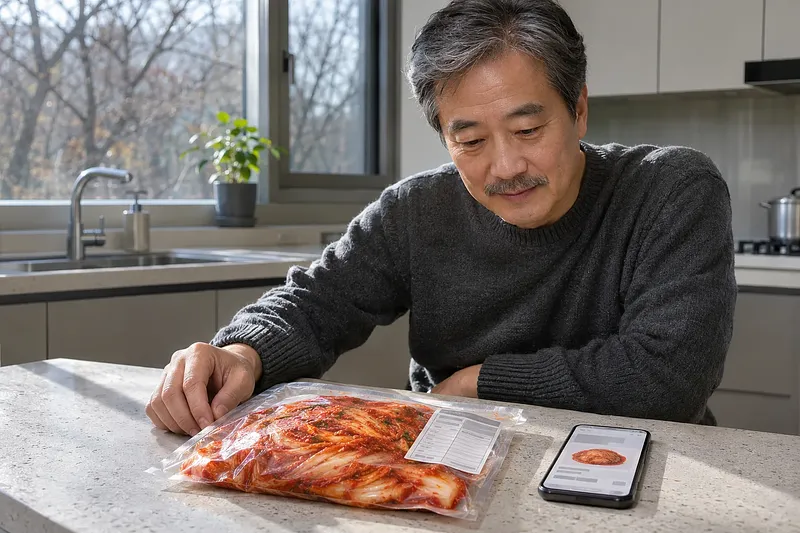
Salted napa cabbage processed in Korea must list the origins of the cabbage and salt separately. Even if the product name says where the cabbage was grown, you still need to check where the salt was produced. If kimchi is made with red pepper powder, its origin must also be listed.
The labeling rules follow the Enforcement Decree of the Act on Origin Labeling of Agricultural and Fishery Products, which took effect on October 22, 2026.
Which ingredients need origin labels on salted napa cabbage?
For products made in Korea with only napa cabbage and salt, the origins of both ingredients must be listed. If the pickled product contains other ingredients, the rules look at the proportions of the ingredients other than salt. An ingredient's proportion is the share added when the product is made.
| Conditions for pickled products processed in Korea using salt | Ingredients whose origins must be listed |
|---|---|
| Napa cabbage is the only ingredient besides salt subject to origin labeling | Napa cabbage and salt |
| One ingredient accounts for at least 98% of the ingredients other than salt | That ingredient and salt |
| There are several ingredients besides salt, and none accounts for 98% | The two ingredients with the highest proportions, in descending order, and salt |
The at least 98% threshold determines how many ingredients besides salt must be listed. Even if the napa cabbage meets this threshold, the origin of the salt must still be listed. To find where the salt was produced, check the origin listed next to “salt” or “sun-dried sea salt” in the product description.
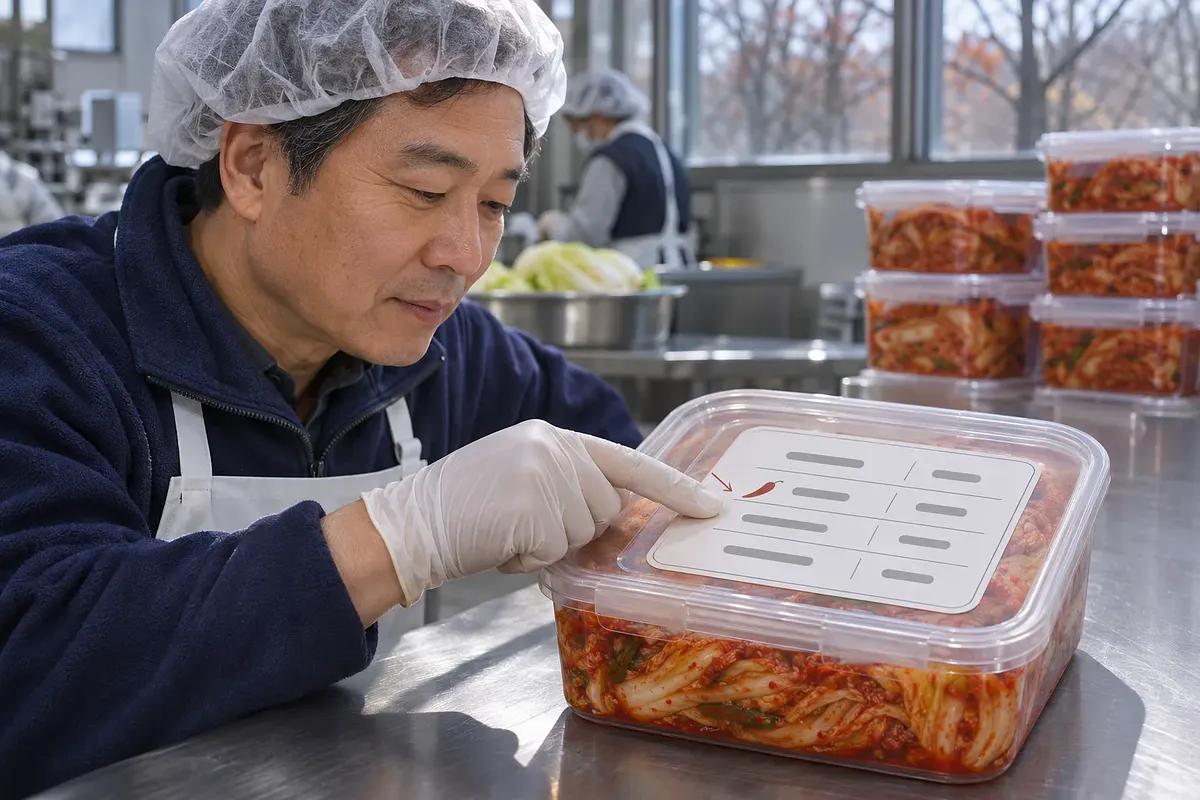
Kimchi made in South Korea with chili powder must list the origins of the chili powder, the salt, and the two remaining ingredients used in the largest proportions.
Origin labeling rules for finished napa cabbage kimchi
For kimchi processed in Korea, which ingredients need origin labels depends on whether red pepper powder was used. Kimchi made with a seasoning that contains red pepper powder also counts as kimchi made with red pepper powder. Water, food additives, and similar ingredients are left out when ranking ingredients by proportion.
| Type of kimchi processed in Korea | Ingredients listed by proportion | Ingredients listed separately |
|---|---|---|
| Kimchi made with red pepper powder | Up to two ingredients with the highest proportions, excluding red pepper powder and salt | Red pepper powder, salt |
| Kimchi made without red pepper powder | Up to two ingredients with the highest proportions, excluding salt | Salt |
Why the National Agricultural Products Quality Management Service example includes radish
In the example from the National Agricultural Products Quality Management Service (NAQS), radish has the second-highest proportion. This kimchi contains 70% salted napa cabbage and 10% radish. Red pepper powder accounts for 4% and salt for 2%, but both are listed separately. The example in the NAQS's Q&A on Origin Labeling for Agricultural and Food Products reads:
Napa cabbage kimchi: napa cabbage (from Korea), radish (from Korea), red pepper powder (from China), salt (from Korea)
Here, “from Korea” gives the origin of the napa cabbage, radish, and salt, respectively. On the same line, the red pepper powder is listed as “from China.” If the kimchi uses a different mix of ingredients, another ingredient may take the place of radish in the second spot.
How to find origin information when ordering online
When shopping online, first look for origin information next to, above, or below the product name or price. If the seller uses a separate window, it can indicate where to find it on the first screen or near the product name or price. Shoppers must be able to find the origin information from the moment the product first appears on screen.
- Check whether you are ordering salted napa cabbage on its own, a set with separately packaged seasoning, or finished kimchi.
- Look for each ingredient's origin near the product name or price. If a note tells you where the information is displayed, open the window it points to.
- Match each ingredient in the product you selected with its origin. If the seasoning comes separately, check its ingredient labels separately as well.
What you can tell from Haenam Salted Napa Cabbage 20kg
Even if “Haenam” appears in the product name, that alone does not tell you where the salt was produced. “20kg” is the weight of the product you are ordering. If the detailed label says “napa cabbage (from Haenam),” Haenam is where the cabbage was grown. Check the salt entry to see where the salt was produced.
2026 kimjang season origin inspections: dates and scope
The NAQS announced on November 2, 2026, that the intensive inspection period would run from November 4 through December 4. Products covered include salted napa cabbage, napa cabbage kimchi, red pepper powder, garlic, and ginger. Inspections cover manufacturers, sellers, mail-order businesses, and general restaurants, among others.
The NAQS focuses on products of foreign origin labeled as being from Korea. It also checks for ingredients produced in one part of Korea that are falsely labeled as coming from a well-known growing region. December 4 is the last day of the intensive inspections, but the origin labeling rules for each ingredient still apply afterward.