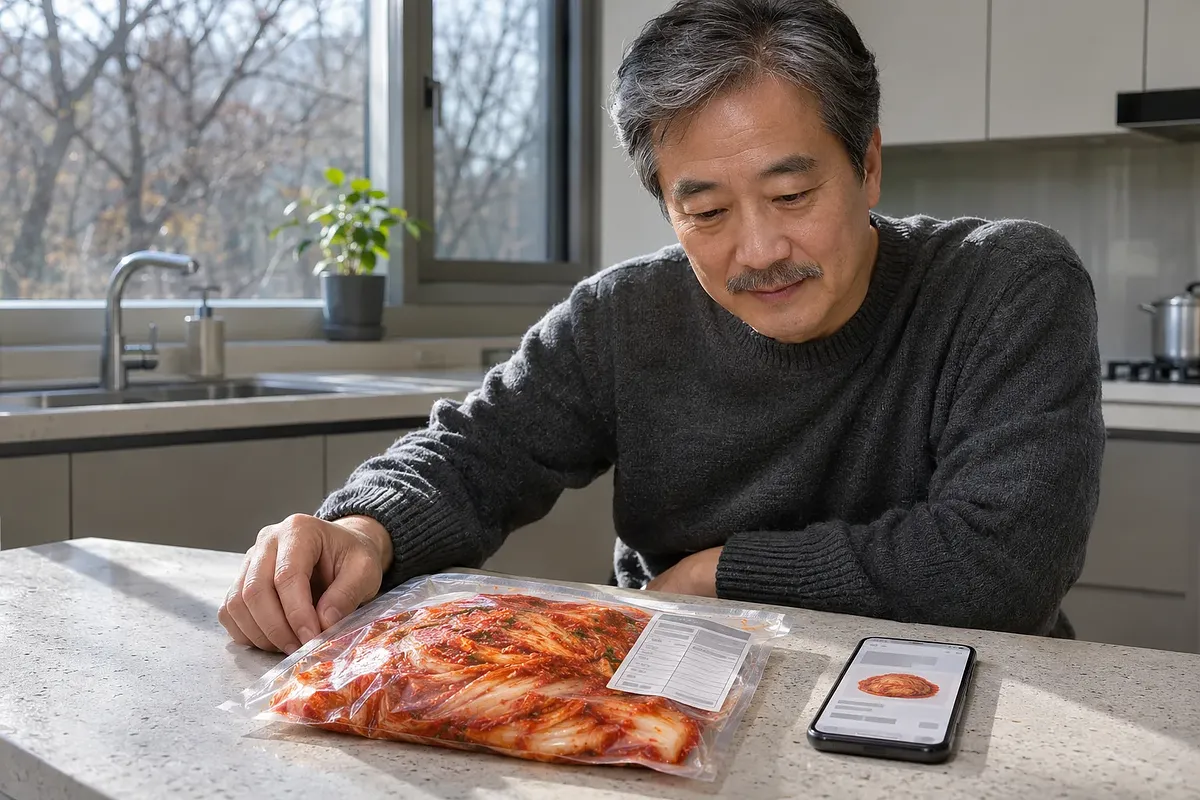
Cabbage Kimchi Labeling: Domestic and Imported Products
Even kimchi made in Korea may contain ingredients with different origins. Distinguish between labeling rules for packaged kimchi and pickled products and those for restaurants, and compare online product descriptions with the actual packaging.
A manufacturer's address in Korea does not mean the ingredients are from Korea.
For kimchi and pickled products processed in Korea, salt is also subject to country-of-origin labeling.
Restaurants serving kimchi prepared in Korea must label the origins of the cabbage and chili powder used.
For imported ready-made kimchi, restaurants must label the country of origin listed on the import declaration certificate.
If you suspect missing or false labeling, you can report it to the National Agricultural Products Quality Management Service's illegal distribution reporting center at 1588-8112.
Napa cabbage kimchi made domestically does not necessarily contain only domestic ingredients. For packaged products, check the labeling for each ingredient. Restaurants label the origins of napa cabbage and red pepper powder separately. Imported finished products are subject to separate labeling standards.
The inspection schedule is based on the National Agricultural Products Quality Management Service's announcement on November 2, 2026.
The Difference Between Origin and Place of Manufacture
Origin means the country, region, or other location where agricultural or fishery products were produced or harvested. It is different from the seller's address or the place from which the goods were shipped. An exporting country that merely handled a transaction is also distinct from the place of origin.
It means the country, region, or waters where agricultural or fishery products were produced, harvested, or caught.
This is the definition in the National Agricultural Products Quality Management Service's “Country-of-Origin Labeling Management.” Specific labeling standards are also available in the National Agricultural Products Quality Management Service's country-of-origin labeling guide.
Napa cabbage kimchi is made by adding seasonings to salted napa cabbage or mixing them together. Whether the cabbage is left whole or cut before making kimchi is not information about its origin. The product name or manufacturer's location alone cannot establish where the ingredients came from.
Information found on the label | What it tells you | What to check separately
Address of a domestic manufacturer | The manufacturer's location | Origins of ingredients such as napa cabbage and red pepper powder
Domestically grown napa cabbage | The origin of the napa cabbage | Origins of other seasonings and salt
Domestic shipping | Information about the shipping location | Origins of the product and its ingredients
Seller in a particular region | The seller's location | Whether the ingredients were produced in that region
What Must Be Labeled on Packaged Kimchi and Pickled Products
Separate ingredient labeling standards apply to domestically processed kimchi and pickled products. The ingredient-ranking rules for general processed foods should not be applied on their own. What you need to check also depends on whether red pepper powder is used.
Type of domestically processed product | Ingredients whose origins must be labeled | How to read the label
Kimchi containing red pepper powder | The top 2 ingredients by proportion, excluding red pepper powder and salt, plus red pepper powder and salt | Do not judge the origins of all ingredients from the napa cabbage label alone
Kimchi without red pepper powder | The top 2 ingredients by proportion, excluding salt, plus salt | Salt must be checked even when red pepper powder is not used
Pickled products | The top 2 ingredients by proportion, excluding salt, plus salt | Distinguish the origin of the pickled vegetables from that of the salt
Pickled products have an exception based on ingredient proportions. It applies when one of the ingredients other than salt accounts for at least 98% of the mixture. In that case, the origins of that ingredient and the salt are labeled. Details are provided in the National Agricultural Products Quality Management Service's “Questions and Answers on Country-of-Origin Labeling for Agricultural and Food Products”.
What to Check About the Origin of Salted Napa Cabbage
The key is to check the napa cabbage and salt separately. A statement that the cabbage is domestically grown does not tell you where the salt came from. Even if the product name includes a region, compare it with the ingredient labeling.
What to Check About the Origin of Red Pepper Powder
When reading red pepper powder labels, distinguish the manufacturer's address from the origin of the ingredients. Being sold by a domestic company does not mean the ingredients are domestic. If the online description is unclear, check the ingredient and origin labeling on the package.
What to Check About the Origin of Salt in Kimchi
Salt in domestically processed kimchi is subject to separate origin labeling that should be checked. This standard also applies to kimchi made without red pepper powder. Do not assume that the salt has the same origin as the napa cabbage simply because the cabbage's origin is labeled.
Comparing Restaurant Labeling and Imported Finished Products
Restaurant origin labeling for napa cabbage kimchi focuses on napa cabbage and red pepper powder. For kimchi prepared domestically, the origins of these two ingredients are listed separately. The labeling method differs for finished products made abroad and imported.
When served at a restaurant | Labeling example | Interpretation
Kimchi made with domestic napa cabbage and domestic red pepper powder | Napa cabbage kimchi, napa cabbage: domestic, red pepper powder: domestic | Both labeled ingredients are domestic
Kimchi made with domestic napa cabbage and Chinese red pepper powder | Napa cabbage kimchi, napa cabbage: domestic, red pepper powder: China | The cabbage and seasoning have different origins
Finished kimchi imported from China | Napa cabbage kimchi: China | The finished product's origin as stated on the import declaration certificate is labeled
Kimchi prepared domestically without red pepper powder | Napa cabbage kimchi, napa cabbage: domestic | The origin of the napa cabbage actually used is labeled
The table presents examples from the official guidance in an easy-to-read format. The country name on an imported finished product is not a list of the origins of all its ingredients. Relevant examples are available in the restaurant section of “Questions and Answers on Country-of-Origin Labeling for Agricultural and Food Products”.
Common Mistakes and How to Interpret Labels
The most common misunderstanding is to apply the labeling of some ingredients to the entire product. A statement that domestic napa cabbage was used is information about the cabbage. The origins of red pepper powder and salt must each be checked separately.
Common interpretation | Correct interpretation
It was made domestically, so all the ingredients must be domestic | The place of manufacture and ingredient origins must be distinguished
If the napa cabbage is domestic, the red pepper powder must be domestic too | The labeling for each ingredient must be read separately
Restaurant signs need the same information as packaged products | Labeling requirements differ for restaurants and domestically processed products
The country name on imported kimchi is the country that produced every ingredient | It indicates the origin of the imported finished product
If a company in a famous producing region sells it, the produce must come from that region | The seller's location and the ingredients' place of production must be distinguished
Avoid concluding that a labeling violation has occurred based on appearance alone. Impressions of the color or the shape of the cabbage cannot replace transaction records. Suspected issues are best reported with the labeling information.
When the Online Description Differs From the Delivered Packaging
Comparing online labeling with the actual packaging can reveal inconsistent descriptions. Online sales are also subject to country-of-origin labeling requirements. The labeling obligation also applies to food sold through delivery apps. Where labels must appear is explained in the National Agricultural Products Quality Management Service's leaflet on online sales.
Compare the labeling in the following order.
· Check the product you ordered and the options you selected.
· Save the origin information shown on the product details page.
· Check the product name and ingredient-specific labeling on the delivered packaging.
· If the labeling for the same product differs, ask the seller for an explanation.
· If you suspect missing or false labeling, report it to the National Agricultural Products Quality Management Service.
Screenshots and photographs of the packaging help compare differing descriptions. Keeping the order details as well makes it easier to identify the product purchased. These are suggestions to help with verification, not a list of documents required to file a report.
2026 Kimchi-Making Season Inspection Period and Reporting Contact
The National Agricultural Products Quality Management Service's intensive inspection period is November 4 to December 4, 2026. Products covered include kimchi, salted napa cabbage, red pepper powder, garlic, and ginger. Inspections cover manufacturers, sellers, online retailers, and general restaurants, among others.
The inspections address the practice of falsely presenting foreign products as domestic. They also cover labeling agricultural products from other domestic regions as products from well-known producing regions. Online shopping malls and online sales intermediary sites are also monitored.
Missing or suspected false labeling can be reported by calling 1588-8112. This is the number for the National Agricultural Products Quality Management Service's Fraudulent Distribution Reporting Center. The schedule and reporting information are specified in the National Agricultural Products Quality Management Service's November 2, 2026 press release.
Frequently Asked Questions
Do “domestic” and “domestically produced” mean different things?
Both expressions can be used to label the origin of domestic agricultural products. The difference in wording does not distinguish quality grades. Interpretation depends on which ingredient the label refers to.
Can kimchi made by a domestic company contain imported ingredients?
Yes. Domestic manufacture and domestic ingredient origin are separate matters. You need to check the labeling for each ingredient to tell the difference.
Can white kimchi omit red pepper powder labeling?
If red pepper powder was not used, there is no such ingredient to label. Domestically processed kimchi must still follow the salt labeling standards in this case. At restaurants, check the origin of the napa cabbage used.
Is it a violation if salt is not listed on a restaurant's sign?
The absence of salt alone does not establish a violation. Restaurant kimchi labeling covers napa cabbage and any red pepper powder used. This must be distinguished from the ingredient labeling standards for packaged kimchi.
Is kimchi used in kimchi stew or fried rice also subject to labeling?
Napa cabbage kimchi is subject to restaurant country-of-origin labeling regardless of how it is prepared. The requirement is not limited to kimchi served as a side dish. The labeling obligation also applies to food sold through delivery apps.
Does the labeling obligation end when the intensive inspections end?
The end of the intensive inspections does not end the country-of-origin labeling obligation. December 4 is the final day of this inspection schedule. The country-of-origin labeling system continues to apply separately.
 Injoys