Injoys
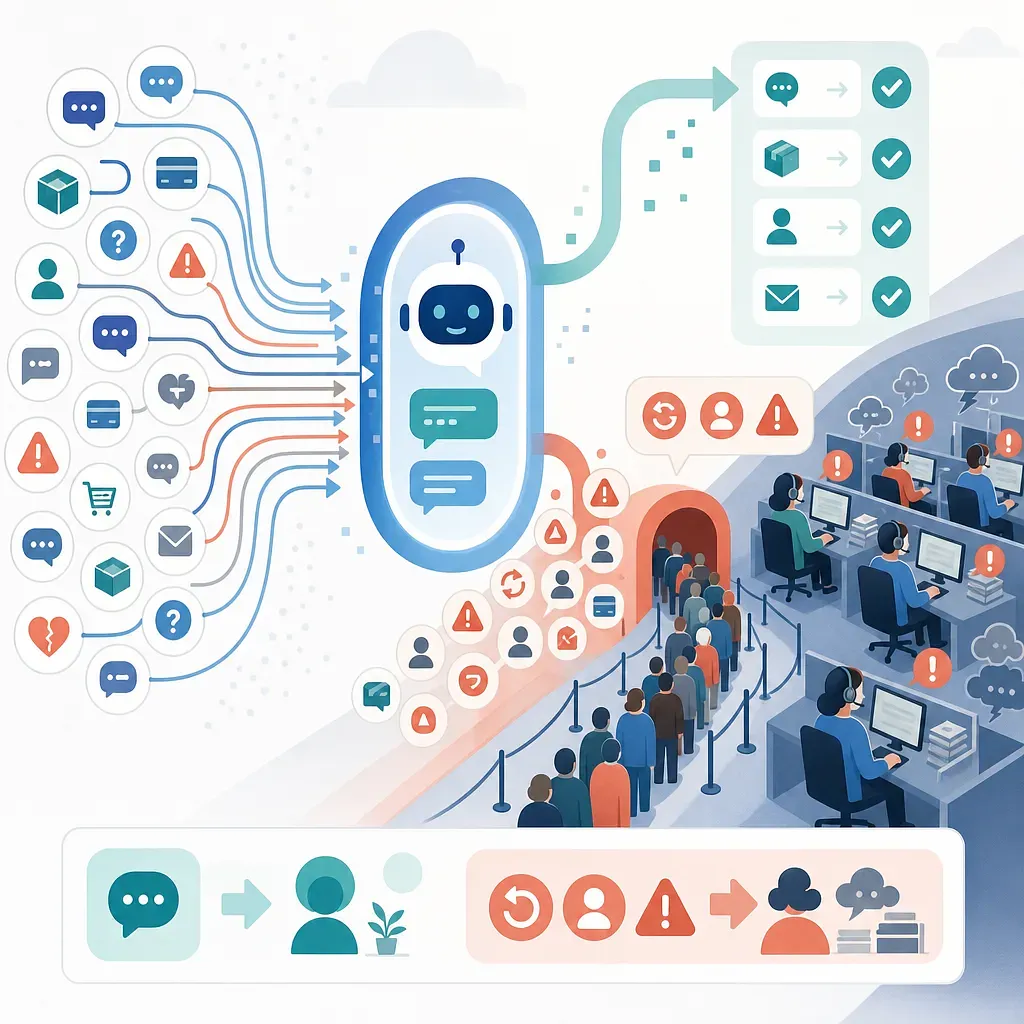
A large increase in AI chatbot conversation volume does not automatically reduce call center calls or support costs. Answering a question and resolving a customer’s problem through to completion are different tasks, and failed automation can instead push more complex and emotionally charged inquiries to human agents.
The key paradox observed in operations is this: chatbot usage rises while total call volume remains nearly unchanged, and the difficulty of inquiries handled by agents and the average handling time increase. To understand this, organizations must examine the customer’s entire resolution journey rather than usage by channel.
Why Chatbot Usage and Call Reduction Do Not Align
Chatbot usage is closer to a measure of touchpoint activity than an outcome metric. Conversation volume can increase simply because of more visitors, broader chatbot exposure, a change in its entry point within an app, or existing FAQ users switching channels.
For example, even if chatbot conversations increase by 300%, call volume will not decrease in the following situations.
- Orders and subscriber numbers both increased, raising overall inquiry demand.
- Existing search and FAQ users moved to the chatbot, while phone users remained unchanged.
- A customer used the chatbot and then called again about the same issue.
- The chatbot became a new entry point for inquiries, prompting even customers who would previously have given up to seek support.
- The proportion of complex issues requiring a phone call did not decrease.
Therefore, analysis should separate the following metrics alongside the simple number of conversations.
| Metric | Calculation or meaning | Points to note |
|---|---|---|
| Phone contact rate | Number of phone inquiries ÷ number of orders, subscribers, or active customers | Must adjust for increased inquiry volume caused by business growth. |
| Handover rate | Chatbot sessions transferred to a human agent ÷ total chatbot sessions | A low rate is not necessarily good. It can also be lowered by hiding the connect button. |
| Repeat contact rate | Percentage of customers who make contact again about the same issue within a given period | Must identify whether it is the same issue even across different channels. |
| Journey completion rate | Customers who actually completed the target task ÷ customers who attempted that task | Must distinguish providing an answer from actually completing the task. |
| First-contact resolution rate | Percentage resolved during the first interaction without additional contact | Distorted if agents arbitrarily mark cases complete without customer confirmation. |
| Total resolution time | Time elapsed from first contact to final resolution | Must include waiting, channel switching, and reauthentication time. |
| Average handling time | Total time spent on support work ÷ number of cases handled | May rise if only difficult cases remain after automation. |
Three Structural Limitations That Prevent AI Answers From Resolving Problems
1. The Gap Between the Ability to Explain and the Authority to Act
Generative AI can quickly explain information contained in documents, such as policies, instructions, and product information. However, a customer’s actual request often involves completing a multistep business process.
For example, if a customer says, “I canceled my subscription, but I was charged again, so please issue a refund,” the system may need to perform the following tasks.
- Authenticate the customer and account.
- Retrieve the cancellation date and payment history.
- Determine whether it was a duplicate charge or whether the refund conditions are met.
- Check approval authority and exception policies.
- Issue the refund and record the outcome.
If the chatbot is not connected to internal payment and order systems or lacks execution authority, it can only provide instructions. If the customer must find the relevant menu and complete the process again, the company may regard the “answer” as complete, but the customer sees the issue as unresolved.
Unconditionally granting broad authority for sensitive tasks is not a solution either. Functions such as refunds, personal information changes, and account recovery require identity verification, least-privilege access, monetary limits, approval procedures, audit logs, and recovery mechanisms for failures.
2. Lack of Context Not Revealed in the Question
It is difficult to determine an appropriate answer from the sentence, “Please recommend a resort destination for a trip with my child,” alone. Constraints such as the child’s age, travel time, budget, food allergies, pool safety, and access to medical care can change the outcome.
Ways to supplement context include the following elements.
- Follow-up questions that confirm required conditions
- Use of order and support history within the scope authorized by the customer
- Knowledge graphs representing relationships among products, policies, regions, audiences, and exceptions
- Ontologies that consistently define terms and relationships
- Retrieval from current policy documents and real-time inventory and reservation systems
Ontologies and knowledge graphs are possible implementation methods, not mandatory requirements for every chatbot. For simple tasks, structured APIs and clear conversational flows may be more efficient. What matters is preventing the model from filling gaps through guesswork and instead having it ask for the necessary information or retrieve it from a reliable system.
3. High-Difficulty Inquiries Left After Automation Fails
When a chatbot handles easy inquiries, agents are left with a relatively larger share of complex exception cases. This can be viewed as a change in case mix. Even if the number of calls stays the same or decreases slightly, total support time and costs may not decline if the remaining calls become longer.
The emotional burden also increases if customers must repeat the same explanation to an agent from the beginning after already giving it to the chatbot. What began as a simple payment confirmation may escalate into a complaint that also includes frustration over the automation failure.
However, an increase in average handling time should not automatically be blamed on the chatbot. Factors such as product outages, policy changes, the proportion of new agents, and seasonality also have an impact. When comparing performance before and after implementation, organizations should control for inquiry type and customer segment and separately analyze customers who called after using the chatbot and those who called directly.
The Solution Is Seamless Handover, Not Inquiry Deflection
Handover is the process of transferring a conversation that AI could not resolve to a human agent. The purpose of a good handover is not to keep customers inside the chatbot for as long as possible, but to quickly detect the limits of automation and allow the next party responsible for resolution to continue the work without interruption.
A connection to a human agent can be offered when signals such as the following appear.
- The customer explicitly asks to speak with an agent.
- The same or similar question is repeated.
- Answer confidence is below the threshold, or no supporting document was found.
- The situation is high risk, such as a payment dispute, account takeover, legal threat, or safety issue.
- Negative emotions persist, or the customer rejects the answer.
- An action performed by the chatbot fails or enters an exception state.
The agent’s screen should receive structured information that can be used immediately for the task, rather than just a full conversation transcript.
| Information transferred | Specific details |
|---|---|
| Customer intent | The outcome the customer ultimately wants |
| Key facts | Confirmed information such as order number, time of occurrence, product, and amount |
| Authentication status | How identity verification was completed and the scope for which it remains valid |
| Actions performed | Actions the chatbot retrieved or executed and their results |
| Cause of failure | Insufficient authority, policy exception, API error, low confidence, and so on |
| Conversation summary | Customer’s claims, explanations already provided, and remaining questions |
| Emotion and risk signals | Intensity of dissatisfaction and whether security, safety, or legal risks are present |
| Evidence | Version of the policy document used and related system records |
Because AI-generated summaries may contain errors, the original conversation must also be available for review. Authentication information and sensitive personal information should be transferred only to the extent necessary, with access permissions and retention periods managed appropriately.
A Three-Tier Operating Model for Dividing the Roles of AI and Humans
It is safer to divide the level of automation based on task risk, frequency of exceptions, and responsibility for judgment.
| Area | Suitable tasks | Role of AI | Role of humans |
|---|---|---|---|
| Automation | Business hours information, shipment tracking, low-risk reservation changes | Retrieval, explanation, and task execution | Intervene when exceptions occur |
| Collaboration | Complex product inquiries, review of policy exceptions, general complaints | Organize context, search for evidence, and suggest draft responses | Verify facts, make final decisions, and communicate |
| Human-only | Legal disputes, high-value refunds, account takeovers, safety crises, serious emotional care | Search records and provide supporting materials | Exercise accountable judgment, approve actions, and restore the relationship |
The classification criterion should not be whether “AI writes well,” but the potential harm of incorrect handling and the degree to which it can be reversed. It is appropriate to retain human review and approval for tasks involving significant financial, legal, or safety risks or frequent exceptions.