1919 Korean Independence Declaration: From Print to Protest
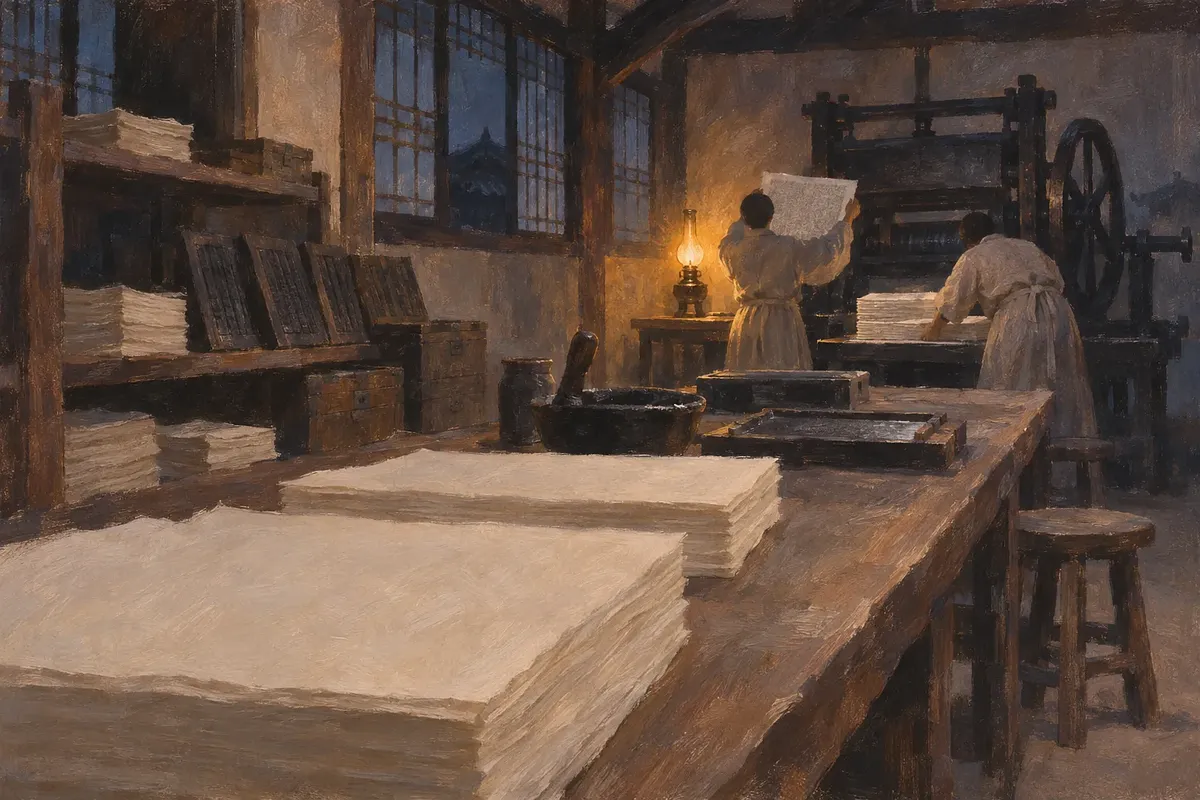
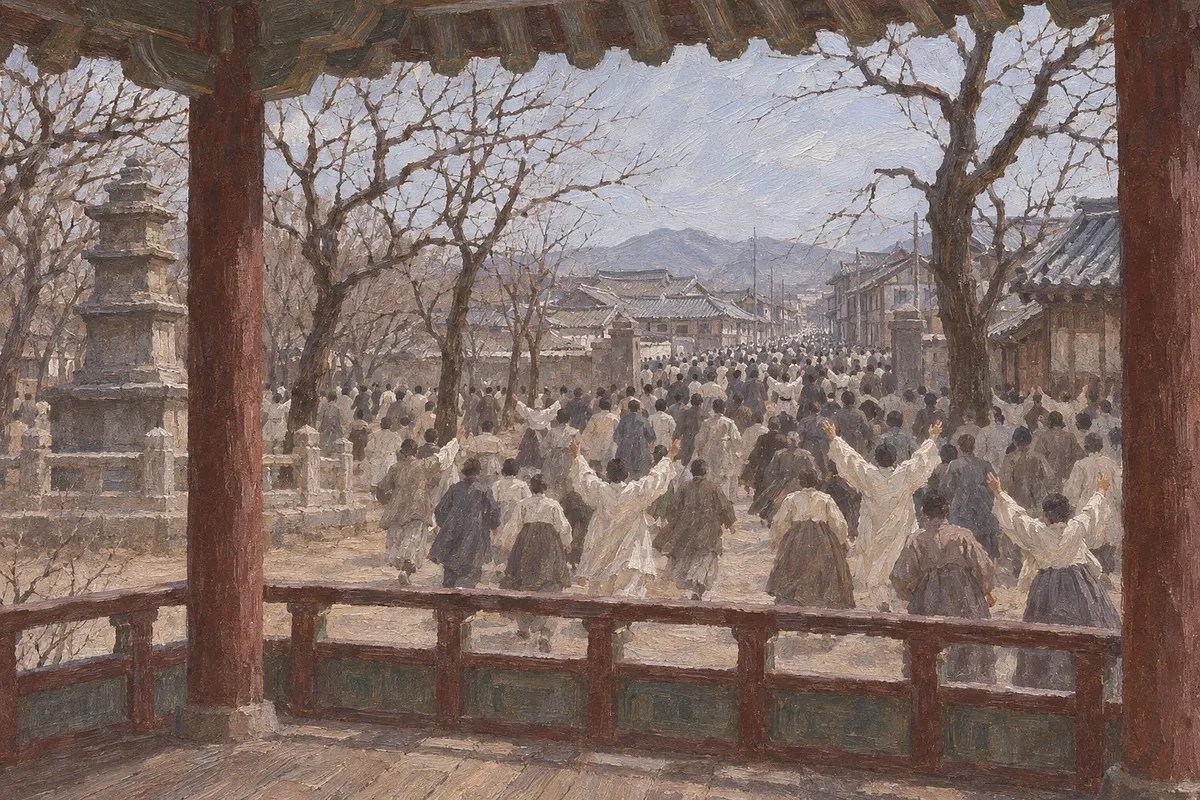
The declaration, printed at Boseongsa on the night of February 27, 1919, was carried to different parts of the country by religious figures and students. In Seoul, a reading at Tapgol Park led to a street march. In Gwangcheon, South Chungcheong Province, residents put the declaration's message into a shorter text and distributed it door to door.
The declaration, drafted by Choe Nam-seon, bore the names of 33 national representatives from the Cheondogyo, Christian, and Buddhist communities.
Under Yi Jong-il's supervision, Boseongsa began printing 21,000 copies of the declaration on the night of February 27, 1919.
On March 1, 29 national representatives held an independence declaration ceremony at Taehwagwan. At Tapgol Park, students and citizens took to the streets after the declaration was read aloud.
Pyongyang, Sonchon, and other places that had been in contact beforehand through religious networks also saw independence protests on the same day as Seoul.
A court ruling from Gwangcheon, South Chungcheong Province, records how residents made about 50 handwritten copies of a text calling for independence and distributed them on March 18.
On March 1, 1919, 33 national representatives issued the Gimi Declaration of Independence, proclaiming the independence of Joseon, then under Japanese military rule. Religious figures and students distributed copies printed at Boseongsa across the country. March 1st Independence Movement Day commemorates the day people in many places took to the streets, demanding independence and cheering for it.
I consulted the original text of the declaration on Our History Net and the National Archives of Korea’s collection of court judgments in November 2026.
The People Who Prepared the Declaration of Independence Under Military Rule
In the 1910s, Japanese military rule, enforced by military police and civilian police, made it difficult to engage openly in political activity. After World War I, the principle of self-determination, that each nation should decide its own future, became widely known. A draft of the February 8 Declaration of Independence that Korean students in Japan were preparing also reached Korea.
Members of the Cheondogyo, Christian, and Buddhist communities agreed to declare independence together. Choe Nam-seon drafted the declaration at Choe Rin’s request. Of the 33 signatories, 15 were from the Cheondogyo community, 16 were from the Christian community, and 2 were from the Buddhist community. Choe Nam-seon, who wrote the draft, was not on the list.
The Original Gimi Declaration of Independence and the Meaning of the Three Pledges
The declaration’s opening sentence states that Joseon is an independent country and that its people have the right to decide their own affairs.
We hereby declare that our Joseon is an independent country and that the people of Joseon are a self-governing people.
This is the opening sentence of the “March 1 Declaration of Independence” issued by the 33 national representatives.
The declaration makes the case for independence based on Joseon’s history and the principle that all people are equal. It goes on to argue that Joseon’s independence would also help bring peace to East Asia. The Three Pledges at the end set out principles to follow when expressing the desire for independence.
Article | Principle of conduct
Article 1 | Demand freedom without giving in to feelings of hostility toward other peoples.
Article 2 | Everyone, down to the last person, should express their desire for independence to the very end.
Article 3 | Maintain order in all actions and state your position with dignity.
Timeline of Printing at Boseongsa and Distribution Across the Country
Boseongsa, a printing house run by Cheondogyo, began printing 21,000 copies of the declaration on the night of February 27, 1919. Lee Jong-il, the head of Boseongsa, oversaw the printing. Religious figures and students began handing out copies before the March 1 declaration ceremony.
Date | What happened | Source
Night of February 27, 1919 | The declaration was printed at Boseongsa in Susong-dong, Seoul. | Our History Net, “March 1 Declaration of Independence”
February 28, 1919 | Copies circulated through religious networks. Han Yong-un directed their distribution from Yusimsa in Seoul. | National Memorial of the Korean Provisional Government, historic site commentary
March 1, 1919 | The declaration ceremony took place at Taehwagwan in Seoul. At Tapgol Park, a march began after the declaration was read aloud. | National Archives of Korea, “Commemorating March 1st Independence Movement Day”
March 1, 1919 | People also shouted “Long live independence!” in Pyongyang, Seoncheon, Uiju, Wonsan, and elsewhere. | National Archives of Korea, Collection of Court Judgments Related to the Independence Movement
March 18, 1919 | Residents of Gwangcheon, South Chungcheong Province, wrote a short version of the declaration and distributed it to several households. | Same collection, judgment in the case of Lee Myeong-jong and others
How the Taehwagwan Ceremony Differed from the Reading at Tapgol Park
On March 1, the national representatives held a declaration ceremony at Taehwagwan, while students and other members of the public began a march for independence at Tapgol Park. The representatives had moved the ceremony the day before because they feared a clash at the park. When the representatives did not arrive, the people gathered at Tapgol Park declared independence themselves.
Location | Participants | What they did that day
Taehwagwan in Insa-dong, Jongno | 29 of the 33 people who signed the declaration | They declared independence and were then taken into custody by Japanese police.
Tapgol Park and the streets of Jongno | Students and other members of the public | Someone in the crowd read the declaration from the octagonal pavilion. The participants left the park and marched through Jongno, shouting “Long live independence!”
Why Gwangcheon Residents Rewrote the Declaration
In Gwangcheon Township, Hongseong County, South Chungcheong Province, police removed the declaration posted at the market, so residents wrote up a version they could distribute from house to house. The judgment in the case of Lee Myeong-jong and others, included in the National Archives of Korea’s collection, records what happened. It shows how local residents revised the text and decided where to distribute it.
On March 6, 1919, Lee Myeong-jong heard about the protests in Seoul and saw the declaration at Park Won-sik’s house. On March 8, he copied the declaration in large lettering onto two sheets of paper and posted them at Gwangcheon Market and in Yongam-ri. After police took the notices down, the group planned to rally for independence on Gwangcheon’s market day.
Park Won-sik asked Seo Seung-tae to shorten the text so it would be easier to make multiple copies by hand. On March 18, residents made about 50 copies of the revised text at Oh In-seop’s house. That night, Lee Myeong-jong, Seong Bae-ho, and others distributed the copies to homes in Gwangcheon-ri and Yongam-ri.
Records and Interpretations
The original declaration shows signs that the main text and the list of representatives were printed separately. According to the commentary on Our History Net, the list of representatives was finalized between February 26 and 27. Writing the text and deciding whose names it would be published under were separate tasks.
How the Independence Demonstrations Spread
The National Archives of Korea’s collection explains that advance communication between regions helped the movement spread quickly. In Pyongyang and Seoncheon, where people communicated through religious networks, protests took place on the same day as in Seoul. People who had come to Seoul for Gojong’s funeral also took news of the protests back to their hometowns. The Gwangcheon judgment even shows what roles local residents took on after hearing the news.
The Dispute Over Who Wrote the Three Pledges
Choe Nam-seon wrote the draft of the declaration, but accounts differ on how the Three Pledges were written. Our History Net presents both the view that Choe Nam-seon wrote it all and the view that Han Yong-un revised parts of the text or added the pledges. Han Yong-un’s court testimony and the recollections of other participants differ on whether he made revisions.
The Outcome of the Independence Movement and the Meaning of March 1st Independence Movement Day
The March 1 Movement did not bring immediate independence, but residents across the country publicly demanded it. Even after the Japanese colonial authorities suppressed the protests, the movement spurred independence activists to establish a government. On April 11, 1919, the Provisional Government of the Republic of Korea was established in Shanghai (Shànghǎi), China.
Today, March 1st Independence Movement Day commemorates the declaration of independence and the independence demonstrations of 1919. As early as 1920, the provisional government marked March 1 as the day independence was declared. Even before liberation, it had made the day the declaration was issued a national holiday.