Battle of Bongodong: 1920 Joint Operation and Impact
The Battle of Bongodong took place in June 1920, when combined independence forces defeated Japanese troops who had entered northern Gando. This account explains how they used the terrain to lure and ambush the troops and shared supply duties, while distinguishing differences in dates and casualty counts across records.
The main fighting at Bongodong is commonly dated to June 7, 1920.
The alliance of units affiliated with the Korean Independence Army, the Military Administration Office, and the National Association provided the organizational basis for joint operations.
Lee Hwa-il's small unit lured the Japanese troops, and the ambush force attacked after the main Japanese force moved in.
Casualty figures in Korean battle reports and Japanese military reports differ and must be distinguished from confirmed totals.
The shortage of transport recorded in battle reports shows that supply constraints persisted even after victory.
The Battle of Bongodong was fought in Northern Gando on June 7, 1920, when allied Korean independence forces defeated Japanese troops. They met the Japanese troops entering their base area by luring them in and ambushing them from higher ground. The battle is remembered as an example of several units dividing responsibilities to repel an attack by regular troops.
This article follows the 『Collection of Materials on the Provisional Government of the Republic of Korea』 and was cross-checked in October 2026.
Background to the Battle of Bongodong and the Challenges Facing the Independence Forces
The immediate background to the battle was the independence forces’ operations inside Korea and the Japanese pursuit of them. After the March 1st Movement in 1919, independence forces expanded their organizations in Manchuria. They continued crossing the border to attack Japanese military and police forces. Northern Gando, north of the Tumen River, was a major area of independence forces activity.
On June 4, 1920, independence forces clashed with Japanese military and police forces around Gangyangdong. Fighting then broke out near Samdunja with Japanese troops that had crossed the Tumen River. The Japanese formed a cross-river pursuit unit and entered an independence forces base area. “Cross-river” refers to crossing the river. National Memorial of the Korean Provisional Government explanation
The independence forces needed to bring scattered units together to respond to Japanese reinforcements. The Japanese pursuit force included machine-gun troops. The independence forces were still recruiting and training personnel. They needed cooperation among units and favorable fighting positions.
It is difficult to express their personnel challenges as a definitive ratio. The total size of the organizations must be distinguished from the number of troops actually engaged. This article does not assign a single definitive figure to the total strength of either side. The key to the operation was using the terrain and troop positions to respond. National Institute of Korean History, 『New Edition of Korean History』
The Independence Forces Alliance and Timeline of the Battle
The joint operation at Bongodong rested on an alliance of units formed before the battle. The Korean Independence Army and the Military Affairs Governor’s Office took part. Forces affiliated with the National Association and led by An Mu were another part of the alliance.
Date | Event | Source
After the March 1st Movement of 1919 | Expansion of independence forces organizations and armed activity in Manchuria | National Memorial of the Korean Provisional Government explanation
May 27, 1920 | Formation of the Korean Northern Route Independence Army Command by the Korean Independence Army, the Military Affairs Governor’s Office, and the National Association’s Military Department | Encyclopedia of Korean Culture, “Northern Gando National Association”
June 4, 1920 | Fighting around Gangyangdong that prompted the Japanese pursuit | 『Collection of Materials on the Provisional Government of the Republic of Korea』 battle report
June 6, 1920 | Fighting near Samdunja | Encyclopedia of Korean Culture, “Battle of Bongodong”
June 7, 1920 | Luring and ambush operation at Bongodong | 『New Edition of Korean History』, “Victory at Bongodong”
June 21, 1920 | Independence movement organizations discussed stockpiling provisions and obtaining weapons | Independence Hall of Korea’s Korean Independence Movement Information System
October 1920 | Subsequent fighting between independence forces and Japanese troops around Cheongsanri | National Memorial of the Korean Provisional Government explanation
The Korean Northern Route Independence Army Command was an alliance intended to coordinate the military actions of several organizations. The National Association was an independence movement organization rooted in the local Korean community. The alliance of units therefore also included local organizations. Encyclopedia of Korean Culture, “Northern Gando National Association”
The Course of the Battle of Bongodong and a Terrain Diagram
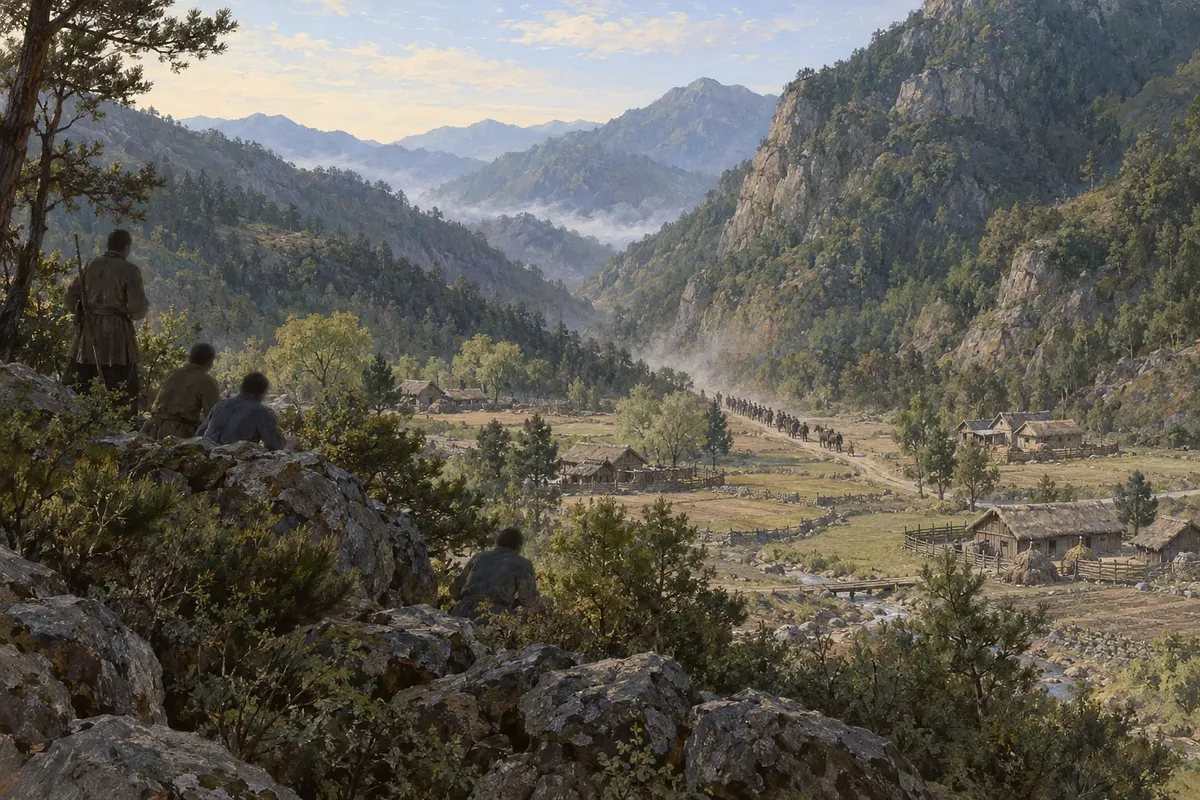
The turning point came when the main Japanese force entered the area between the ambush units. Bongodong had villages known as Lower Village, Middle Village, and Upper Village. The surrounding mountains offered positions overlooking troops entering the valley. The diagram below simplifies the positions described in the records.
                         North
                    North Mountain: 3rd Company

  Northwest edge of Upper Village: 1st Company
  North-central West Mountain: Hong Beom-do and 2 companies       East Mountain: 2nd Company
                    Upper Village area
  Southern West Mountain: 4th Company
                       Middle Village
                       Lower Village
                    Bongodong entrance
                         South
This diagram does not reproduce actual distances or scale. Unit positions follow the “Battle Report of Our Independence Forces in Northern Gando.” Routes of approach across the wider area and details of the terrain have been omitted. 『Collection of Materials on the Provisional Government of the Republic of Korea』 battle report
The battle can be described in four stages: luring, entry, concentrated attack, and retreat. Lee Hwa-il’s small unit was assigned to lure the Japanese troops in. The main force waited on higher ground for the time to attack.
· The independence forces prepared to evacuate residents and set up an ambush on higher ground.
· Lee Hwa-il’s small unit engaged the Japanese troops and lured them toward Bongodong.
· The Japanese troops passed through Lower Village and Middle Village and advanced toward Upper Village.
· After the main Japanese force entered, the ambush units began concentrated fire.
· The Japanese troops retreated after the fighting.
『New Edition of Korean History』 describes a signal flare fired by Hong Beom-do as the signal to attack. The original battle report says the troops fired on the commander’s order. The precise wording of the two accounts must be distinguished. Neither account warrants inventing a command that does not appear in the records. Account of the battle in 『New Edition of Korean History』
The Roles of Hong Beom-do and the Other Commanders
Command at Bongodong involved several people with different responsibilities. Hong Beom-do was central to command on the battlefield. The organizational and command roles of Choi Jin-dong and An Mu are also documented.
Person | Affiliation or title in the records | Role
Hong Beom-do | Korean Independence Army; regimental commander in the battle report | Commanded troops and positioned them on higher ground
Choi Jin-dong | Military Affairs Governor’s Office; commander in the battle report | Participated in allied command
An Mu | National Association affiliate; adjutant in the battle report | Served in the command group
Lee Hwa-il | Squad leader in the battle report | Led the small-unit luring operation
When describing the commanders, organizational titles must be distinguished from battlefield roles. The Encyclopedia of Korean Culture also describes the unit structure separately from Hong Beom-do’s command. One person’s name alone cannot explain how the allied force was composed. Encyclopedia of Korean Culture, “Battle of Bongodong”
The Outcome of the Battle of Bongodong and Subsequent Coordination
The immediate outcome of the battle was the Japanese retreat. The independence forces then treated the wounded and reorganized their ranks. Hong Beom-do asked National Association president Gu Chun-seon to send a doctor. A meeting on June 21, 1920, discussed securing provisions and weapons. Independence Hall of Korea explanation of activities after the battle
The possibility of further Japanese attacks remained after the victory. The independence forces continued working to coordinate their units and strengthen their fighting capacity. Fighting followed around Cheongsanri in October of the same year. Bongodong and Cheongsanri were battles fought at different times. National Memorial of the Korean Provisional Government explanation of independence forces activities
Records and Interpretation
The outcome of the battle must be explained separately from the exact scale of the losses. Korean and Japanese reports counted casualties differently. The appearance of a figure in a record does not, by itself, establish the actual losses.
Casualty Figures in the Records
The Korean battle report recorded 157 Japanese troops killed. The Japanese report’s figures differ sharply. The following table presents the claims made in each report, not confirmed figures for actual losses.
Record or source used to check the figures | Reported Japanese losses | Reported independence forces losses
『Collection of Materials on the Provisional Government of the Republic of Korea』 battle report | 157 killed, about 200 seriously wounded, about 100 lightly wounded | 4 killed, 2 seriously wounded
Japanese after-action report described by the Independence Hall of Korea | 1 killed, 2 wounded | 33 killed, many wounded
The figures in the table are reported figures for the 1920 fighting at Bongodong. The Japanese figures were checked through the Independence Hall of Korea’s explanation. It notes that both sides exaggerated the other side’s losses and understated their own. Independence Hall of Korea comparison of casualty records
An Assessment Shared by Historical Accounts
Korean historical accounts assess Bongodong as a victory for the independence forces. The Japanese retreat and the boost to independence forces morale are cited as key grounds for that assessment. Assessing the battle as a victory does not, however, establish any particular casualty figure. Encyclopedia of Korean Culture assessment
Remaining Differences in Dates and Casualty Counts
The date of the main engagement is usually given as June 7, 1920. However, the relevant passage in the Korean battle report gives the date as July 7 (七月 七日). This article follows the usual timeline while noting the different date in the original. It does not assume the discrepancy was caused by a difference between lunar and solar calendars or by a writing error. Original battle report
The Japanese report is also referred to as the “Ancheon Pursuit Unit’s After-Action Report on the Fighting Near Bongodong.” Ancheon is the Korean reading of the characters used to write the commander Yasukawa’s name (安川). The document includes a table of battle casualties for June 7, 1920. It is a military report that also records orders and terrain. Encyclopedia of Korean Culture, “After-Action Report on the Fighting Near Bongodong”
Later accounts also differ on the number of Japanese wounded. 『New Edition of Korean History』 gives 1, while the Independence Hall of Korea explanation gives 2. When citing a figure, it is therefore necessary to identify the document and count it comes from. The two figures should not be combined or averaged arbitrarily.
What Records of Captured Supplies and Logistics Show About the Operation’s Limits
The battle report also records why the independence forces could not collect much of the captured equipment. It says they had no spare horses to carry it. According to the report, they collected only some rifles.
Lee Won was assigned to bring in reinforcements and supply ammunition and food. This records a support role behind the attacking units. The lack of transport shows the limits of that support capacity. Logistics and captured-equipment records in 『Collection of Materials on the Provisional Government of the Republic of Korea』
The record suggests that victory and an increase in fighting capacity were separate matters. Even when supplies were captured on the battlefield, a way to transport them was needed. This is an interpretation based on the logistics record. It does not establish the exact number of rifles obtained.
What the Battle Teaches Today and How It Differs from the Film
Bongodong is a historical case that can be used to explain both allied operations and the comparison of records. Looking at each unit’s assignment reveals the organizational conditions behind the victory. Comparing different reports helps distinguish established facts from the claims of those who wrote them. This is why casualty figures alone cannot explain the battle’s significance.
The film of the same name is a historical drama based on the event. Directed by Won Shin-yeon, it was released on August 7, 2019 (South Korea). Its scenes and dialogue must be distinguished from battle reports written at the time. Korean Film Council KOBIZ film information
Type | What it can establish | How to read it
Contemporary battle report | Unit positions, reported losses, description of the operation | Check who wrote it and compare it with other records
Later historical account | Context of the event and researchers’ assessments | Distinguish source documents from interpretations
2019 film | A dramatic narrative based on a historical event | Do not cite scenes or dialogue as historical sources
Frequently Asked Questions
When did the Battle of Bongodong take place?
The date of the main engagement is usually given as June 7, 1920. It was connected to the earlier fighting near Samdunja. The July date in the original battle report must be noted separately.
Was Hong Beom-do the only commander?
It was an allied operation involving several commanders and units. Hong Beom-do was central to battlefield command. Choi Jin-dong and An Mu also served in the command group.
What role did Lee Hwa-il play?
According to the battle report, Lee Hwa-il was assigned to lure the Japanese troops in with a small unit. His role was to slow their advance and draw them toward Bongodong. His assignment was linked to that of the ambush units on higher ground.
Is the figure of 157 Japanese troops killed confirmed?
The figure of 157 appears in the Korean battle report. The Japanese report records far fewer losses. It should not be presented as a confirmed count of all actual losses.
Was it the same battle as the Battle of Cheongsanri?
They were different battles. The main fighting at Bongodong took place in June 1920. Fighting around Cheongsanri followed in October of the same year.
 Injoys