Injoys
Key Conclusions
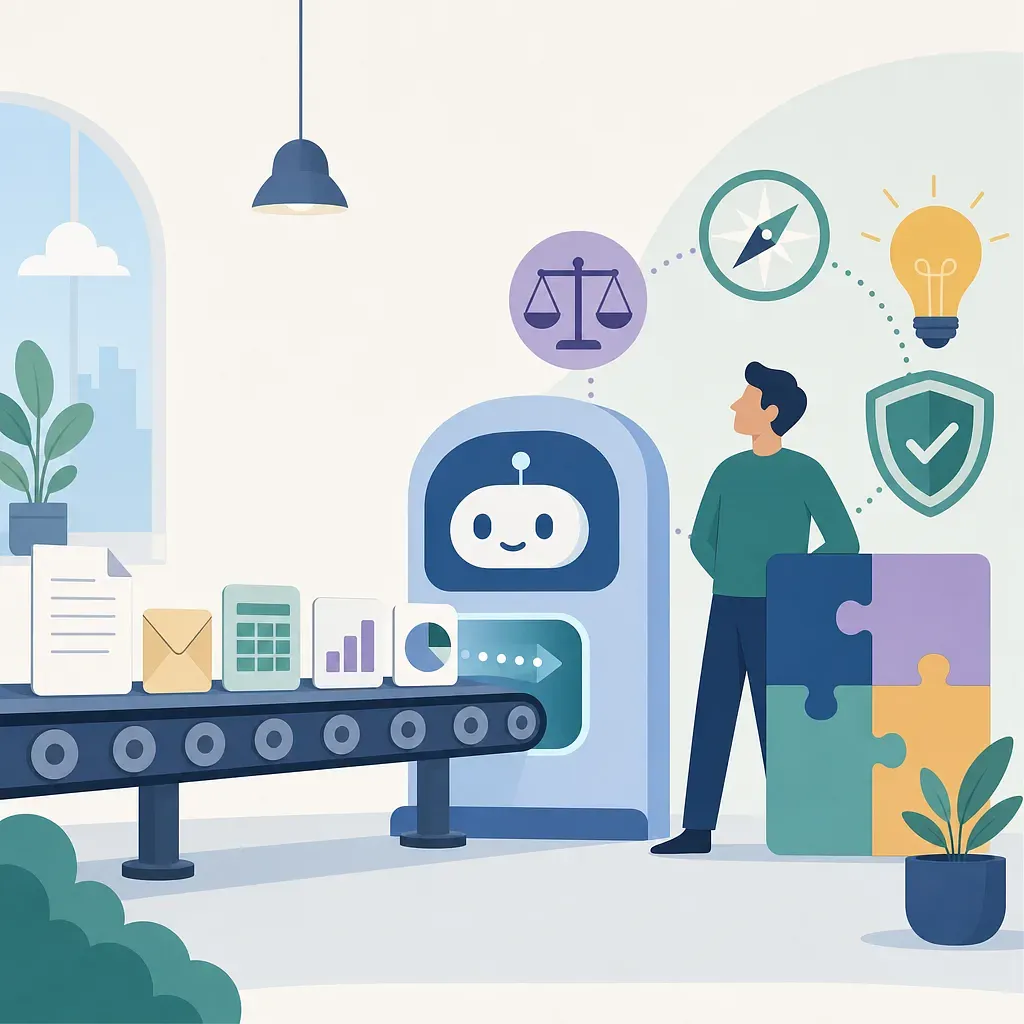
In the age of AI, the question is less “Will my job disappear?” and more “Which of my tasks will be automated, and how will I use the time I save to make high-value decisions?” Generative AI is rapidly transforming tasks that involve language and patterns, such as drafting documents, summarizing, translating, assisting with code, handling customer service, and generating images and speech. However, responsible decision-making, building trust between people, coordinating complex interests, defining problems, and making ethical judgments remain largely the role of humans.
By 2030, the people who will be best positioned are not those who fear AI, but those who do not blindly trust it either. In other words, those who can delegate work to AI while setting goals, verifying results, managing risks, and connecting these efforts to real-world challenges faced by customers, organizations, and society will be the most competitive.
1. AI Changes “Tasks” Before It Changes People
An important distinction in labor market research is between occupations and tasks. An occupation is a collection of various tasks, and AI typically automates or augments specific tasks within an occupation rather than eliminating the entire occupation at once.
| Category | Meaning | Examples of AI Impact |
|---|---|---|
| Occupation | Socially defined roles such as accountants, marketers, developers, and teachers | Work methods and required competencies change rather than the entire occupation disappearing immediately |
| Task | Specific tasks such as report writing, data organization, categorizing customer inquiries, and code testing | Repetitive, rule-based, and text-centric tasks can be automated quickly |
| Competency | Knowledge, judgment, communication, and accountability required to perform tasks | Increased value placed on the ability to utilize AI, verify results, and define problems |
The International Labor Organization (ILO) has analyzed that the primary effect of generative AI is likely to manifest as task augmentation rather than complete replacement in many jobs. However, jobs with a high proportion of language-based, repetitive tasks—such as administrative support, routine document processing, and basic customer service—may be more significantly impacted.
Tasks with High Potential for Automation
- Drafting and categorizing standardized emails
- Drafting and summarizing meeting minutes
- Simple translation and stylistic adaptation
- Repetitive data entry, organization, and labeling
- Responding to standard customer inquiries
- Generating basic code and drafting test cases
- Compiling search results to create a list of primary sources
Tasks Where Human Judgment Remains Critical
- Defining what the real problem is
- Making final judgments involving legal or ethical responsibilities
- Mediation in situations involving conflicting stakeholder interests
- Persuasion that takes into account customer emotions and context
- Long-term organizational strategy and resource allocation
- Verifying AI results for errors, bias, and security risks
2. AI in Daily Life in 2030: From a Standalone Technology to Basic Infrastructure
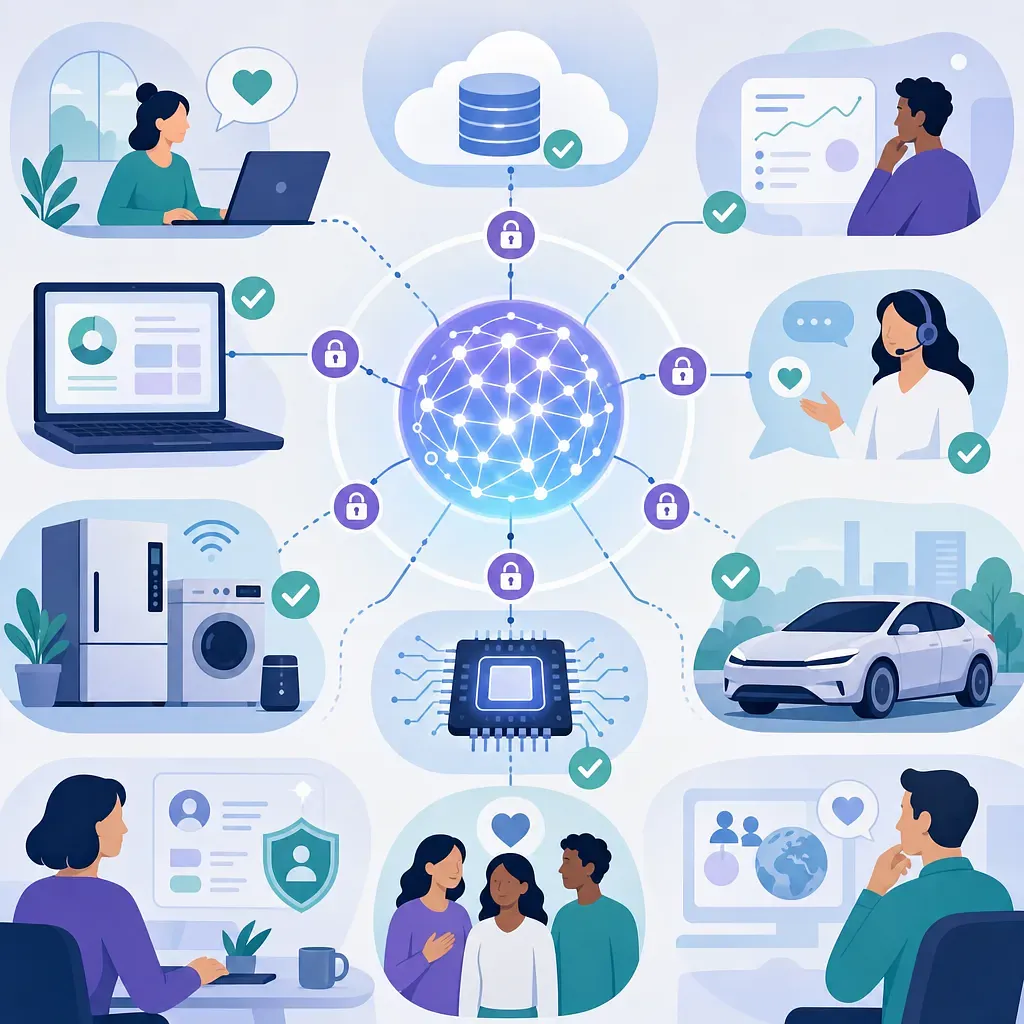
While we cannot definitively predict what 2030 will look like, current technological trends indicate that AI is expanding beyond standalone chatbot apps to become embedded in search engines, document tools, operating systems, home appliances, vehicles, customer service centers, and medical and educational support services.
AI Embedded Like Air
Currently, users often open AI services directly and enter their questions. In the future, AI is likely to function as a core feature within document creation tools, collaboration tools, home appliances, calendar management apps, financial apps, and shopping services. For example, a refrigerator might suggest meal plans based on the condition of ingredients, or a work tool might summarize meeting notes and automatically assign follow-up tasks.
The key shift here is not “whether to use AI,” but “how to work in an AI-integrated environment.” This is because the fundamental pace of searching, writing, reviewing, and decision-making will change.
Intelligent Companions and Agents
An AI agent refers to a system that understands the user’s goals and calls upon various tools to carry out tasks. For example, when preparing for a business trip, it can link multiple steps—from checking flight information and adjusting schedules to reviewing expense policies and drafting meeting materials.
However, as the number of agents increases, so do the risks of errors and security breaches. While AI that automatically sends emails, accesses files, or processes payments is convenient, the potential for significant damage increases if it is misled by incorrect instructions or malicious input. Therefore, AI proficiency in 2030 will extend beyond simply writing prompts to include permission management, verification procedures, and the design of accountability frameworks.
3. Basic Coding Alone Is Not Enough: 5 Essential Skills for Survival
This does not mean that coding will become obsolete in the AI era. On the contrary, an understanding of software will become even more important. However, it will become difficult to stand out by merely memorizing syntax or writing code at the example level, because AI can quickly generate drafts. What matters more is the ability to identify which problems need to be solved, determine whether the generated results are correct, and implement them into actual systems.
| Competency | Definition | Examples of Actual Actions |
|---|---|---|
| Problem Definition | The ability to transform vague requirements into actionable questions | Instead of saying “Increase sales,” specify customer churn groups, bottleneck channels, and experiment metrics |
| Business Creativity | The ability to link technology to customer value and revenue models | Go beyond simply creating an AI summarization feature; connect it to metrics such as cost savings, conversion rates, and repurchase rates |
| Empathy and Change Management | The ability to understand and persuade people by addressing their anxieties, resistance, and motivations | Instead of forcing employees to adopt AI, explain how it will reduce their workload and outline plans for role transitions |
| Systems Thinking | The ability to view technology, costs, security, regulations, operations, and user experience holistically | Designing criteria for personal data protection, log retention, incident response, and agent handover before implementing an AI chatbot |
| Verification and Accountability | The ability to validate AI results against facts, logic, and legal standards | Establish procedures for verifying sources, conducting sample tests, checking for bias, and requiring final human approval |
Competency 1: Business Creativity
Simply knowing how to use AI tools is not enough. The more important question is, “Whose problems can this technology solve—and how—more cheaply, quickly, and accurately?” Even when using the same AI model, some organizations limit their use to simple automated responses, while others reduce customer inconvenience, improve service quality, and create new services. The difference stems not from the technology itself, but from problem selection and execution design.
Competency 2: Empathy and Leadership
AI adoption is both a technology project and a change management project. People worry that their work will be devalued, that surveillance will increase, or that they might lose their jobs. Therefore, leaders in the AI era must not merely tout the benefits of the technology; they must acknowledge these anxieties, chart a path for transition, and ensure time for learning.
Competency 3: Systems Thinking
It is easy to fail if AI is viewed as just a single feature. For example, when implementing AI for customer service, one must consider not only model performance but also personal data handling, accountability for inaccurate responses, criteria for transferring calls to human agents, log retention periods, security permissions, cost structures, and incident response. Systems thinking is a core competency for ensuring AI operates safely within an organization.
Competency 4: AI Literacy and Data Understanding
AI literacy is not merely the skill of writing clever prompts. It is the ability to understand why models might make mistakes, the limitations of training data and its recency, whether personal information can be included, and how to verify the generated results. The better one understands the source, quality, and bias of data, the safer and more productively they can use AI.
Competency 5: Security Awareness
As AI assumes more authority in the workplace, security becomes a core competency for every role. It is essential to develop the habit of not feeding sensitive data to external AI systems, adhere to the principle of minimizing file access permissions, adopt a mindset of verifying suspicious links and instructions, and establish verification procedures for deepfake audio and video.