Skip to content
Injoys
Case Study

How Karrot Grew from Pangyo Market into a Massive Local Platform

Karrot began as a secondhand marketplace for office workers in Pangyo before pivoting to a local platform built around people's daily living areas. This founder-focused analysis traces its growth, including securing its first 1,000 users, expanding into adjacent areas, its Ruby on Rails-centered technology strategy, advertising revenue, and financial statements.

Listen or read this article

28:43

Listen, or read the text only.

How Karrot Grew from Pangyo Market into a Massive Local Platform

Kokoro 82M AI-generated voice

0:00 28:43

Advertisement

Download audio

File name
daangn-growth-from-pangyo-market-to-local-platform-en.mp3
Format
MP3 (audio/mpeg)
Duration
28:43
File size
19.7 MB
Engine
Kokoro 82M

This audio was generated by AI.

You may download and use it freely for personal use.

How Karrot Grew from Pangyo Market into a Massive Local Platform

18 min read

How Karrot Grew from Pangyo Market into a Massive Local Platform
Karrot began as a secondhand marketplace for office workers in Pangyo before pivoting to a local platform built around people's daily living areas. This founder-focused analysis traces its growth, including securing its first 1,000 users, expanding into adjacent areas, its Ruby on Rails-centered technology strategy, advertising revenue, and financial statements.
Karrot's decisive pivot was not a change in the items offered, but a shift in the unit for building trust from the workplace to the neighborhood.
Its initial growth began not with nationwide advertising, but with the founders personally posting listings, rewarding transactions, and building user density within each local area.
The choice of Ruby on Rails prioritized whether the founding team could launch and modify the product as quickly as possible rather than achieving the highest performance.
Free secondhand trading is a mechanism for building user and transaction density, while the primary source of revenue is local advertising.
A startup's profitability and valuation can be interpreted only by examining the separate and consolidated scopes, stock option expenses, overseas subsidiaries' profits and losses, and deal terms together.
Danggeun’s growth is not simply the story of a secondhand trading app becoming popular. It is a platform growth case in which trust and transaction density were first established within a small area, replicated across adjacent communities, and then converted the local traffic gathered through free transactions into an advertising business.
Its early strategy and financial figures cannot be viewed separately. Regional expansion required funding, rapid product experiments required pragmatic technology choices, and overseas expansion introduced new variables into the interpretation of consolidated earnings and corporate valuation.
Danggeun’s Growth Stages at a Glance
Stage | Key decision | Problem to solve | Business significance Launch of Pangyo Market | Verification through a Pangyo company email address | Lack of trust between strangers | Formation of a narrow, verifiable initial market Community pivot | Expansion of target users from office workers to neighborhood residents | Limits on expansion caused by dependence on business districts | Securing a repeatable local unit for nationwide expansion Acquisition of the first 1,000 users | Direct product listings and transaction rewards | Cold-start problem caused by shortages of both sellers and buyers | Establishment of minimum transaction density Expansion into adjacent areas | Expansion from Pangyo to Bundang, Suji, Giheung, Suwon, and other areas | The empty-marketplace problem that arises when opening too broadly | Replication of network effects at the community level Monetization | Local advertising instead of transaction fees | Generating revenue while preserving the free transaction experience | Connecting user activity with advertising inventory Global expansion | Expansion of Karrot in Canada and operations in Japan | Securing room for growth beyond the domestic market | Increased overseas costs and execution risk
Pangyo Market: A Starting Point That Solved the Trust Problem Through a Narrow Market
The service launched in 2015 under the initial name Pangyo Market. Users had to verify an email address from a company located in Pangyo to sign up, and they could also confirm the company affiliation of the other party to a transaction. Given the area’s high concentration of IT company employees, transactions involving digital devices were particularly prominent at first.
This structure is an example of solving trust—the central problem in secondhand transactions—by limiting the scope of the market rather than through complex technology. Company email addresses and affiliation information did not provide a complete guarantee of identity, but they signaled that the other party belonged to the same work community. The distance required for in-person transactions also became shorter.
However, the more successful the Pangyo model became, the clearer its limitations on expansion grew.
· There were not many business districts nationwide with concentrations of IT companies like Pangyo. · Residents without company email addresses found it difficult to participate in the service. · Local transactions occurred more frequently for residential needs such as childcare products, household goods, and furniture, not only around workplaces. · Replicating the company verification method unchanged would require finding a suitable group of companies every time a new area was launched.
The First Pivot: Making the Neighborhood, Not the Workplace, the Unit of Trust
Danggeun’s crucial pivot did not involve abandoning secondhand transactions, but changing the boundaries of the trading community. It moved from a marketplace centered on Pangyo office workers to a neighborhood marketplace that included actual residents.
According to operational data, requests to join continued from Pangyo residents, particularly users who wanted to trade childcare and household products. At the same time, the founding team concluded that nationwide expansion would be difficult with a model centered on business districts. It therefore relaxed the initial formula of company email verification and used the local residential community itself as a mechanism for building trust.
This decision was also reflected in the name. The “Danggeun” in Danggeun Market was introduced as a shortened form of “the market near you,” and the brand later expanded beyond secondhand transactions into Danggeun, encompassing Neighborhood Life, jobs, real estate, local advertising, and more.
Why the Pivot Worked
· It created a repeatable market unit. Areas with high concentrations of companies are limited, but residential communities exist in every city. · It broadened the range of tradable items. Supply expanded from a focus on IT devices to childcare products, furniture, household goods, and more. · It reduced the cost of in-person transactions. Users could inspect and receive items directly over short distances. · Local density became a competitive advantage. What mattered more than the nationwide number of users was whether users could quickly find a trading partner within a neighborhood.
The Founding Team’s Background and Previous Experience
Danggeun’s initial core personnel formed a team that combined development and planning experience. Publicly known co-founders Kim Yong-hyun and Kim Jae-hyun, along with CTO Jung Chang-hoon, who led technology from the early days, played major roles.
Kim Jae-hyun began his career as a developer and, before Danggeun, founded Thinkreals, which operated the coupon information service Couponmoa. After gaining experience raising investment, running a small organization profitably, and selling it to Kakao, he worked on server development at Kakao. This experience can be interpreted as part of the reason early Danggeun emphasized cost control and rapid execution over building an elaborate organization.
Kim Yong-hyun worked at Samsung C&T and Naver before planning location-based services at Kakao. He collaborated with Kim Jae-hyun through an internal Kakao project, and when the project did not become an independent service, the two left the company in 2015 to launch their startup.
CTO Jung Chang-hoon led the technology organization for an extended period, beginning with initial product development. The fact that the founding team remained together for a long time is meaningful because it preserved the decision-making context between technology and business strategy. However, co-founders, founding members, and the current corporate representative are not legally or organizationally identical concepts, so titles must be distinguished by period.
The Cold-Start Strategy That Attracted the First 1,000 Users
A two-sided marketplace faces a cold-start problem: buyers do not come without sellers, and sellers do not list products without buyers. Rather than prioritizing nationwide awareness, Danggeun first created enough density for actual transactions to occur within Pangyo.
Its early activities were far removed from an automated growth system.
· The founders listed their own items directly to fill the empty marketplace. · They held first-come, first-served sign-up events using Xiaomi fans and other products. · In August 2015, they encouraged initial transactions by providing coffee coupons to both the seller and buyer when a transaction was completed. · They also experimented with ways to attract attention within the small area of Pangyo, including attaching promotional materials to drones. · They later used Facebook advertising to acquire additional users while managing the cost per installation.
The key metrics were not simply the number of installations, but weekly active users and actual transactions. According to operational data, the target user base was expanded to Pangyo residents after weekly visitors reached approximately 1,000. Rather than collecting a large number of members and then creating a market, this approach expanded the scope only after confirming that there was enough liquidity for transactions to recur within a limited area.
Why Both Sides Were Rewarded
Completing a transaction requires action from both the seller and the buyer. If only one side receives a benefit, delayed responses or canceled appointments by the other side remain a bottleneck. Rewarding both sides helped complete the initial transaction experience and provide evidence that the service actually worked.
However, transactions generated through rewards do not guarantee long-term retention. The value of an initial incentive must be assessed based on whether users list another item and send messages again after completing a transaction.
Regional Expansion: Replicating Adjacent Markets Rather Than Launching Nationwide
Rather than moving from Pangyo to the entire country at once, Danggeun sequentially connected adjacent communities such as Bundang, Suji, Giheung, and Suwon. This was because the network effects of a local marketplace operate within a certain distance, not nationwide.
Even if there are many users in Seoul, the Suwon market will not become active if sellers in Suwon have no one to trade with. It is therefore more important to examine the following metrics by area than the total number of registered users.
· Number of active sellers and buyers within a certain distance · Probability that users will find the items they want · Time from posting to the first chat · Percentage of chats that lead to actual transactions · Rates of return visits and relisting after transactions · Rates of reports, broken commitments, and suspected fraud
Transaction value presented in operational data increased from approximately KRW 46 hundred million in 2016 to approximately KRW 7,000 hundred million in 2019. By simple calculation, this was an increase of approximately 152 times. However, transaction value is the estimated total price of goods exchanged between users and differs from the revenue recognized by the company. On a free secondhand trading platform, even a sharp increase in transaction value does not mean that the amount becomes company revenue as-is.
Technology Choices: Speed of Launch and Learning Over Maximum Performance
Ruby on Rails was selected as the initial server technology because the founding team could work with it together and build the product quickly. For an early-stage startup, the greatest risk may lie not in a language’s theoretical processing performance, but in slowly building a product that users do not want.
Rails is well suited to quickly setting up authentication, database processing, administrative functions, and the basic structure of a web application. For an early service like Danggeun, which needed to repeatedly experiment with regions, posts, chats, users, and transaction statuses, development speed was an important advantage.
Even after the service grew, rather than completely replacing the core system, Danggeun retained the existing Rails areas while separating necessary functions using Go, TypeScript, Kotlin, and other technologies. This can commonly be described as an approach similar to incremental decomposition or the strangler pattern.
Why the Initial Technology Was Not Entirely Replaced
· Rewriting proven core code can create new failures. · Development of user-facing features slows during the rewriting period. · Not every function requires the same level of performance or independent deployment. · Separating only areas with confirmed bottlenecks can be more cost-effective.
The lesson from Danggeun’s case is therefore not that Rails is optimal for every service. It means that technology should be selected and transitioned based on the team’s proficiency, launch speed, hiring feasibility, operational complexity, and actual bottlenecks.
Combining Free Transactions With Local Advertising
Danggeun has maintained a model that does not charge transaction fees on secondhand trades between individuals. Free transactions are not a direct source of revenue, but a foundation for securing local users and repeat visits.
Revenue comes mainly from advertisements through which neighborhood stores and companies reach users in specific areas. According to operational data, advertising accounts for approximately 99% of recent revenue. The exact percentage must be confirmed through the revenue notes and business classifications in the audit report for the relevant year.
The model works as follows.
· Gather local users and listings through free secondhand transactions. · Build repeat-visit habits through chats and transactions. · Expand the reasons for using the service through Neighborhood Life, local information, and other features. · Convert user density by area into advertising inventory that advertisers can purchase. · Reinvest advertising revenue in the product, safety systems, and new regions.
When dependence on advertising is high, economic fluctuations, advertising rates, advertisers’ demands for performance measurement, and users’ advertising fatigue become major risks. Conversely, not charging transaction fees has the advantage of keeping barriers to entry for individual sellers and incentives to transact outside the platform relatively low.
Financial Figures Must Always Be Read Together With Their Basis
According to operational data, revenue increased from approximately KRW 31 hundred million in 2019 to approximately KRW 2,690 hundred million in 2025. The simple multiple is approximately 86.8 times. However, when comparing figures by year, it is necessary to check changes in the company name, the inclusion of subsidiaries, accounting policies, and whether comparative financial statements were restated.
Item | Figure presented | What to verify when interpreting it 2016 transaction value | Approximately KRW 46 hundred million | Platform transaction volume, not company revenue 2019 transaction value | Approximately KRW 7,000 hundred million | Method of calculating transaction value and whether canceled transactions are included 2019 revenue | Approximately KRW 31 hundred million | Must not be compared directly with transaction value 2022 operating loss | Approximately KRW 565 hundred million | Whether it is on a consolidated or separate basis and whether overseas entities are included 2023 operating profit | Approximately KRW 173 hundred million in initial reports, approximately KRW 99 hundred million after restatement | Stock option expenses and whether comparative financial statements were restated 2023 net profit or loss | Presented as having been restated from a profit of approximately KRW 24 hundred million to a loss of approximately KRW 56 hundred million | Operating profit and net profit must be distinguished 2025 revenue | Approximately KRW 2,690 hundred million | Consolidation scope and notes in the latest audit report must be reviewed
How Stock Option Expenses Can Change a Profit
Unlike cash salaries, stock options may not cause an immediate cash outflow, but they can be recognized as an accounting expense in exchange for services provided by employees. If a company changes its accounting treatment for share-based compensation or restates prior comparative figures, previously announced operating profit and net profit may also change.
When evaluating the “first profit” in 2023, the following must therefore be distinguished.
· Whether the figure is the initially announced amount or a subsequently restated comparative figure · Whether it comes from separate financial statements covering only Danggeun’s domestic entity or consolidated financial statements that also include overseas entities · Whether it is operating profit or net profit · Whether share-based compensation expenses are included · Whether there were one-time valuation gains or losses or corporate tax effects
Turning a profit is an important business milestone, but it does not mean that accumulated deficits disappear immediately. If past losses remain or funds are reinvested in overseas expansion, accounting profit and available cash may also move differently.
How to Interpret Investment and Corporate Valuation
Operational data presents cumulative funding raised as approximately KRW 2,270 hundred million. The widely cited corporate valuation of approximately KRW 3 trillion at the time of the Series D in 2021 should be understood as an estimated post-money valuation calculated by applying the investment round’s per-share price to all outstanding shares.
Even if a valuation in the range of approximately KRW 2 trillion is later discussed in connection with a secondary share transaction, it should not be treated as identical to the corporate valuation from a new official investment round. The price of unlisted shares varies depending on the following conditions.
· Whether the shares are newly issued or existing shares sold by a current shareholder · The number of shares being traded and their voting rights · Whether preferred shares have separate rights such as liquidation preferences · Whether a minority-interest discount or liquidity discount applies · Growth rates and capital market conditions at the time of the transaction
A large capital surplus provides a clue that shares were issued at a price above par value. However, capital surplus alone cannot be used to precisely calculate a recent corporate valuation or investment price. The issuance date, number of shares, bonus issues, conversion terms, and prices from multiple rounds are also required.
Overseas Expansion and Consolidated Earnings
Danggeun operates the Karrot brand in Canada and has also entered the Japanese market. Having a founder directly oversee overseas operations demonstrates a strong commitment to learning local product-market fit quickly, but the local network proven in Korea will not automatically be reproduced in another country.
Population density, housing types, travel distances, secondhand trading culture, payment methods, personal information regulations, and existing competitors all differ in overseas markets. Because both sellers and buyers must be gathered simultaneously in each new area, cold-start costs are also repeated.
If the difference between separate and consolidated earnings is large, losses from overseas subsidiaries may be one of the causes. However, that difference should not be interpreted directly as cash invested overseas. Consolidated earnings reflect not only the operating expenses of overseas entities, but also the elimination of intercompany transactions, exchange rates, equity structures, and accounting adjustments. The actual investment amount must be confirmed by reviewing the cash flow statement, notes on investments in subsidiaries, and related-party transactions together.
Risks a Larger Platform Must Bear
Fraud and Transaction Safety
As the number of users and transactions increases, attempted fraud rises along with legitimate transactions. A platform must combine multiple control measures, including report handling, suspicious account detection, filtering of fraud-related phrases or bank account information, secure payments, and delivery support.
AI-based detection can help identify recurring fraud patterns quickly, but it is not a complete solution. Platforms must continually respond to false positives that incorrectly block legitimate posts, new evasive expressions, account takeovers, and attempts to direct users to payments outside the platform. Safety features are a cost, but they are also core infrastructure for protecting user trust and long-term retention.
Conflict Between Identity Information and Privacy
How much seller information should be disclosed in person-to-person transactions is an area where transaction safety and privacy protection conflict. In regulatory discussions over the provision of seller information, key issues may include whether the platform is an e-commerce intermediary, whether an individual seller is a business operator, and what information must be provided to whom.
Operational data includes an explanation that, after extended discussions with the Korea Fair Trade Commission, a compromise centered on verifying phone numbers and email addresses was reached for implementation beginning in July 2026. The exact scope of such legal obligations must be confirmed based on the final laws and regulations, announcements by authorities, and Danggeun’s latest user notices. Identity verification, internal storage by the platform, and disclosure to the other party in a transaction are different measures and must be distinguished.
Concentration in Advertising
When most revenue comes from advertising, performance is affected if advertising demand slows even while the transaction service grows. Large advertisers and neighborhood small businesses also have different needs. A balance is required between improving advertising effectiveness and preserving the user experience.
Five Lessons Founders Can Learn From Danggeun’s Case
· Start narrowly, but do not remain trapped in a narrow market. Pangyo company verification created initial trust, but it was not a formula for nationwide expansion. · The first market can be filled manually. Direct listings by the founders and small rewards created actual transaction experiences before automation. · Local density may matter more than total users. For a local marketplace, the key is how quickly users can find another party within a community. · Technology should be selected based on the current bottleneck. Danggeun retained Rails, which enabled rapid launches, while separating only the necessary areas into other technologies. · Financial figures must be read together with accounting standards. Failing to distinguish separate and consolidated statements, share-based compensation, operating profit, net profit, and cash flow can lead to the opposite conclusion.
Conclusion
Danggeun’s core competitive advantage lies not in the secondhand transaction feature itself, but in high neighborhood-level user density and trust. Pangyo Market began as a narrowly verified community, but the founding team accepted that its successful model could not be repeated nationwide and pivoted to a community-based platform.
The process of directly gathering the first 1,000 users and adding adjacent areas one by one demonstrates that network effects do not emerge automatically. The choice of Ruby on Rails and the gradual architectural transition are examples of prioritizing product learning and operational continuity over technological perfection.
The current challenge is to maintain the growth of the domestic advertising business while rebuilding local density overseas and bearing the costs of fraud, privacy, and regulation. Danggeun’s next stage of growth is likely to be determined not only by its number of users, but also by local transaction quality, advertising effectiveness, safety costs, and the profitability of its overseas operations.
0:00 0:00
1 / 85

Advertisement

Download text

File name
daangn-growth-from-pangyo-market-to-local-platform-en.txt
Format
TXT (text/plain)
Paragraphs
85

Downloads exactly what you see as a text file.

Please cite the source when quoting.

Large text

Makes the text larger and the colors clearer. Turn it on if the text feels too small.

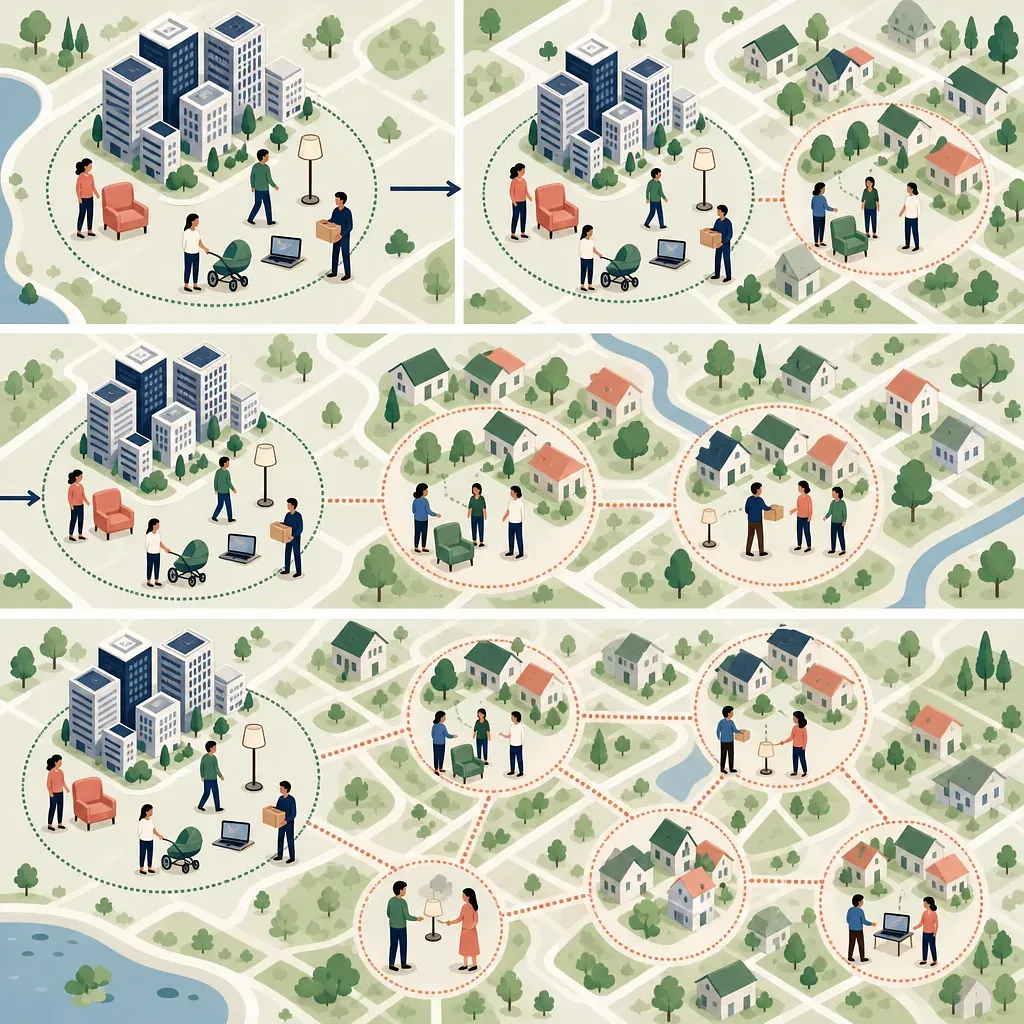
Local exchanges connect neighboring communities and grow into a wider regional network.

Key points

  • Karrot's decisive pivot was not a change in the items offered, but a shift in the unit for building trust from the workplace to the neighborhood.
  • Its initial growth began not with nationwide advertising, but with the founders personally posting listings, rewarding transactions, and building user density within each local area.
  • The choice of Ruby on Rails prioritized whether the founding team could launch and modify the product as quickly as possible rather than achieving the highest performance.
  • Free secondhand trading is a mechanism for building user and transaction density, while the primary source of revenue is local advertising.
  • A startup's profitability and valuation can be interpreted only by examining the separate and consolidated scopes, stock option expenses, overseas subsidiaries' profits and losses, and deal terms together.

Danggeun’s growth is not simply the story of a secondhand trading app becoming popular. It is a platform growth case in which trust and transaction density were first established within a small area, replicated across adjacent communities, and then converted the local traffic gathered through free transactions into an advertising business.

Its early strategy and financial figures cannot be viewed separately. Regional expansion required funding, rapid product experiments required pragmatic technology choices, and overseas expansion introduced new variables into the interpretation of consolidated earnings and corporate valuation.

Danggeun’s Growth Stages at a Glance

Stage Key decision Problem to solve Business significance
Launch of Pangyo Market Verification through a Pangyo company email address Lack of trust between strangers Formation of a narrow, verifiable initial market
Community pivot Expansion of target users from office workers to neighborhood residents Limits on expansion caused by dependence on business districts Securing a repeatable local unit for nationwide expansion
Acquisition of the first 1,000 users Direct product listings and transaction rewards Cold-start problem caused by shortages of both sellers and buyers Establishment of minimum transaction density
Expansion into adjacent areas Expansion from Pangyo to Bundang, Suji, Giheung, Suwon, and other areas The empty-marketplace problem that arises when opening too broadly Replication of network effects at the community level
Monetization Local advertising instead of transaction fees Generating revenue while preserving the free transaction experience Connecting user activity with advertising inventory
Global expansion Expansion of Karrot in Canada and operations in Japan Securing room for growth beyond the domestic market Increased overseas costs and execution risk

Pangyo Market: A Starting Point That Solved the Trust Problem Through a Narrow Market

The service launched in 2015 under the initial name Pangyo Market. Users had to verify an email address from a company located in Pangyo to sign up, and they could also confirm the company affiliation of the other party to a transaction. Given the area’s high concentration of IT company employees, transactions involving digital devices were particularly prominent at first.

This structure is an example of solving trust—the central problem in secondhand transactions—by limiting the scope of the market rather than through complex technology. Company email addresses and affiliation information did not provide a complete guarantee of identity, but they signaled that the other party belonged to the same work community. The distance required for in-person transactions also became shorter.

However, the more successful the Pangyo model became, the clearer its limitations on expansion grew.

  • There were not many business districts nationwide with concentrations of IT companies like Pangyo.
  • Residents without company email addresses found it difficult to participate in the service.
  • Local transactions occurred more frequently for residential needs such as childcare products, household goods, and furniture, not only around workplaces.
  • Replicating the company verification method unchanged would require finding a suitable group of companies every time a new area was launched.

The First Pivot: Making the Neighborhood, Not the Workplace, the Unit of Trust

Danggeun’s crucial pivot did not involve abandoning secondhand transactions, but changing the boundaries of the trading community. It moved from a marketplace centered on Pangyo office workers to a neighborhood marketplace that included actual residents.

According to operational data, requests to join continued from Pangyo residents, particularly users who wanted to trade childcare and household products. At the same time, the founding team concluded that nationwide expansion would be difficult with a model centered on business districts. It therefore relaxed the initial formula of company email verification and used the local residential community itself as a mechanism for building trust.

This decision was also reflected in the name. The “Danggeun” in Danggeun Market was introduced as a shortened form of “the market near you,” and the brand later expanded beyond secondhand transactions into Danggeun, encompassing Neighborhood Life, jobs, real estate, local advertising, and more.

Why the Pivot Worked

  1. It created a repeatable market unit. Areas with high concentrations of companies are limited, but residential communities exist in every city.
  2. It broadened the range of tradable items. Supply expanded from a focus on IT devices to childcare products, furniture, household goods, and more.
  3. It reduced the cost of in-person transactions. Users could inspect and receive items directly over short distances.
  4. Local density became a competitive advantage. What mattered more than the nationwide number of users was whether users could quickly find a trading partner within a neighborhood.

The Founding Team’s Background and Previous Experience

Danggeun’s initial core personnel formed a team that combined development and planning experience. Publicly known co-founders Kim Yong-hyun and Kim Jae-hyun, along with CTO Jung Chang-hoon, who led technology from the early days, played major roles.

Kim Jae-hyun began his career as a developer and, before Danggeun, founded Thinkreals, which operated the coupon information service Couponmoa. After gaining experience raising investment, running a small organization profitably, and selling it to Kakao, he worked on server development at Kakao. This experience can be interpreted as part of the reason early Danggeun emphasized cost control and rapid execution over building an elaborate organization.

Kim Yong-hyun worked at Samsung C&T and Naver before planning location-based services at Kakao. He collaborated with Kim Jae-hyun through an internal Kakao project, and when the project did not become an independent service, the two left the company in 2015 to launch their startup.

CTO Jung Chang-hoon led the technology organization for an extended period, beginning with initial product development. The fact that the founding team remained together for a long time is meaningful because it preserved the decision-making context between technology and business strategy. However, co-founders, founding members, and the current corporate representative are not legally or organizationally identical concepts, so titles must be distinguished by period.

The Cold-Start Strategy That Attracted the First 1,000 Users

A two-sided marketplace faces a cold-start problem: buyers do not come without sellers, and sellers do not list products without buyers. Rather than prioritizing nationwide awareness, Danggeun first created enough density for actual transactions to occur within Pangyo.

Its early activities were far removed from an automated growth system.

  • The founders listed their own items directly to fill the empty marketplace.
  • They held first-come, first-served sign-up events using Xiaomi fans and other products.
  • In August 2015, they encouraged initial transactions by providing coffee coupons to both the seller and buyer when a transaction was completed.
  • They also experimented with ways to attract attention within the small area of Pangyo, including attaching promotional materials to drones.
  • They later used Facebook advertising to acquire additional users while managing the cost per installation.

The key metrics were not simply the number of installations, but weekly active users and actual transactions. According to operational data, the target user base was expanded to Pangyo residents after weekly visitors reached approximately 1,000. Rather than collecting a large number of members and then creating a market, this approach expanded the scope only after confirming that there was enough liquidity for transactions to recur within a limited area.

Why Both Sides Were Rewarded

Completing a transaction requires action from both the seller and the buyer. If only one side receives a benefit, delayed responses or canceled appointments by the other side remain a bottleneck. Rewarding both sides helped complete the initial transaction experience and provide evidence that the service actually worked.

However, transactions generated through rewards do not guarantee long-term retention. The value of an initial incentive must be assessed based on whether users list another item and send messages again after completing a transaction.

Regional Expansion: Replicating Adjacent Markets Rather Than Launching Nationwide

Rather than moving from Pangyo to the entire country at once, Danggeun sequentially connected adjacent communities such as Bundang, Suji, Giheung, and Suwon. This was because the network effects of a local marketplace operate within a certain distance, not nationwide.

Even if there are many users in Seoul, the Suwon market will not become active if sellers in Suwon have no one to trade with. It is therefore more important to examine the following metrics by area than the total number of registered users.

  • Number of active sellers and buyers within a certain distance
  • Probability that users will find the items they want
  • Time from posting to the first chat
  • Percentage of chats that lead to actual transactions
  • Rates of return visits and relisting after transactions
  • Rates of reports, broken commitments, and suspected fraud

Transaction value presented in operational data increased from approximately KRW 46 hundred million in 2016 to approximately KRW 7,000 hundred million in 2019. By simple calculation, this was an increase of approximately 152 times. However, transaction value is the estimated total price of goods exchanged between users and differs from the revenue recognized by the company. On a free secondhand trading platform, even a sharp increase in transaction value does not mean that the amount becomes company revenue as-is.

Technology Choices: Speed of Launch and Learning Over Maximum Performance

Ruby on Rails was selected as the initial server technology because the founding team could work with it together and build the product quickly. For an early-stage startup, the greatest risk may lie not in a language’s theoretical processing performance, but in slowly building a product that users do not want.

Rails is well suited to quickly setting up authentication, database processing, administrative functions, and the basic structure of a web application. For an early service like Danggeun, which needed to repeatedly experiment with regions, posts, chats, users, and transaction statuses, development speed was an important advantage.

Even after the service grew, rather than completely replacing the core system, Danggeun retained the existing Rails areas while separating necessary functions using Go, TypeScript, Kotlin, and other technologies. This can commonly be described as an approach similar to incremental decomposition or the strangler pattern.

Why the Initial Technology Was Not Entirely Replaced

  • Rewriting proven core code can create new failures.
  • Development of user-facing features slows during the rewriting period.
  • Not every function requires the same level of performance or independent deployment.
  • Separating only areas with confirmed bottlenecks can be more cost-effective.

The lesson from Danggeun’s case is therefore not that Rails is optimal for every service. It means that technology should be selected and transitioned based on the team’s proficiency, launch speed, hiring feasibility, operational complexity, and actual bottlenecks.

Combining Free Transactions With Local Advertising

Danggeun has maintained a model that does not charge transaction fees on secondhand trades between individuals. Free transactions are not a direct source of revenue, but a foundation for securing local users and repeat visits.

Revenue comes mainly from advertisements through which neighborhood stores and companies reach users in specific areas. According to operational data, advertising accounts for approximately 99% of recent revenue. The exact percentage must be confirmed through the revenue notes and business classifications in the audit report for the relevant year.

The model works as follows.

  1. Gather local users and listings through free secondhand transactions.
  2. Build repeat-visit habits through chats and transactions.
  3. Expand the reasons for using the service through Neighborhood Life, local information, and other features.
  4. Convert user density by area into advertising inventory that advertisers can purchase.
  5. Reinvest advertising revenue in the product, safety systems, and new regions.

When dependence on advertising is high, economic fluctuations, advertising rates, advertisers’ demands for performance measurement, and users’ advertising fatigue become major risks. Conversely, not charging transaction fees has the advantage of keeping barriers to entry for individual sellers and incentives to transact outside the platform relatively low.

Financial Figures Must Always Be Read Together With Their Basis

According to operational data, revenue increased from approximately KRW 31 hundred million in 2019 to approximately KRW 2,690 hundred million in 2025. The simple multiple is approximately 86.8 times. However, when comparing figures by year, it is necessary to check changes in the company name, the inclusion of subsidiaries, accounting policies, and whether comparative financial statements were restated.

Item Figure presented What to verify when interpreting it
2016 transaction value Approximately KRW 46 hundred million Platform transaction volume, not company revenue
2019 transaction value Approximately KRW 7,000 hundred million Method of calculating transaction value and whether canceled transactions are included
2019 revenue Approximately KRW 31 hundred million Must not be compared directly with transaction value
2022 operating loss Approximately KRW 565 hundred million Whether it is on a consolidated or separate basis and whether overseas entities are included
2023 operating profit Approximately KRW 173 hundred million in initial reports, approximately KRW 99 hundred million after restatement Stock option expenses and whether comparative financial statements were restated
2023 net profit or loss Presented as having been restated from a profit of approximately KRW 24 hundred million to a loss of approximately KRW 56 hundred million Operating profit and net profit must be distinguished
2025 revenue Approximately KRW 2,690 hundred million Consolidation scope and notes in the latest audit report must be reviewed

How Stock Option Expenses Can Change a Profit

Unlike cash salaries, stock options may not cause an immediate cash outflow, but they can be recognized as an accounting expense in exchange for services provided by employees. If a company changes its accounting treatment for share-based compensation or restates prior comparative figures, previously announced operating profit and net profit may also change.

When evaluating the “first profit” in 2023, the following must therefore be distinguished.

  • Whether the figure is the initially announced amount or a subsequently restated comparative figure
  • Whether it comes from separate financial statements covering only Danggeun’s domestic entity or consolidated financial statements that also include overseas entities
  • Whether it is operating profit or net profit
  • Whether share-based compensation expenses are included
  • Whether there were one-time valuation gains or losses or corporate tax effects

Turning a profit is an important business milestone, but it does not mean that accumulated deficits disappear immediately. If past losses remain or funds are reinvested in overseas expansion, accounting profit and available cash may also move differently.

How to Interpret Investment and Corporate Valuation

Operational data presents cumulative funding raised as approximately KRW 2,270 hundred million. The widely cited corporate valuation of approximately KRW 3 trillion at the time of the Series D in 2021 should be understood as an estimated post-money valuation calculated by applying the investment round’s per-share price to all outstanding shares.

Even if a valuation in the range of approximately KRW 2 trillion is later discussed in connection with a secondary share transaction, it should not be treated as identical to the corporate valuation from a new official investment round. The price of unlisted shares varies depending on the following conditions.

  • Whether the shares are newly issued or existing shares sold by a current shareholder
  • The number of shares being traded and their voting rights
  • Whether preferred shares have separate rights such as liquidation preferences
  • Whether a minority-interest discount or liquidity discount applies
  • Growth rates and capital market conditions at the time of the transaction

A large capital surplus provides a clue that shares were issued at a price above par value. However, capital surplus alone cannot be used to precisely calculate a recent corporate valuation or investment price. The issuance date, number of shares, bonus issues, conversion terms, and prices from multiple rounds are also required.

Overseas Expansion and Consolidated Earnings

Danggeun operates the Karrot brand in Canada and has also entered the Japanese market. Having a founder directly oversee overseas operations demonstrates a strong commitment to learning local product-market fit quickly, but the local network proven in Korea will not automatically be reproduced in another country.

Population density, housing types, travel distances, secondhand trading culture, payment methods, personal information regulations, and existing competitors all differ in overseas markets. Because both sellers and buyers must be gathered simultaneously in each new area, cold-start costs are also repeated.

If the difference between separate and consolidated earnings is large, losses from overseas subsidiaries may be one of the causes. However, that difference should not be interpreted directly as cash invested overseas. Consolidated earnings reflect not only the operating expenses of overseas entities, but also the elimination of intercompany transactions, exchange rates, equity structures, and accounting adjustments. The actual investment amount must be confirmed by reviewing the cash flow statement, notes on investments in subsidiaries, and related-party transactions together.

Risks a Larger Platform Must Bear

Fraud and Transaction Safety

As the number of users and transactions increases, attempted fraud rises along with legitimate transactions. A platform must combine multiple control measures, including report handling, suspicious account detection, filtering of fraud-related phrases or bank account information, secure payments, and delivery support.

AI-based detection can help identify recurring fraud patterns quickly, but it is not a complete solution. Platforms must continually respond to false positives that incorrectly block legitimate posts, new evasive expressions, account takeovers, and attempts to direct users to payments outside the platform. Safety features are a cost, but they are also core infrastructure for protecting user trust and long-term retention.

Conflict Between Identity Information and Privacy

How much seller information should be disclosed in person-to-person transactions is an area where transaction safety and privacy protection conflict. In regulatory discussions over the provision of seller information, key issues may include whether the platform is an e-commerce intermediary, whether an individual seller is a business operator, and what information must be provided to whom.

Operational data includes an explanation that, after extended discussions with the Korea Fair Trade Commission, a compromise centered on verifying phone numbers and email addresses was reached for implementation beginning in July 2026. The exact scope of such legal obligations must be confirmed based on the final laws and regulations, announcements by authorities, and Danggeun’s latest user notices. Identity verification, internal storage by the platform, and disclosure to the other party in a transaction are different measures and must be distinguished.

Concentration in Advertising

When most revenue comes from advertising, performance is affected if advertising demand slows even while the transaction service grows. Large advertisers and neighborhood small businesses also have different needs. A balance is required between improving advertising effectiveness and preserving the user experience.

Five Lessons Founders Can Learn From Danggeun’s Case

  1. Start narrowly, but do not remain trapped in a narrow market. Pangyo company verification created initial trust, but it was not a formula for nationwide expansion.
  2. The first market can be filled manually. Direct listings by the founders and small rewards created actual transaction experiences before automation.
  3. Local density may matter more than total users. For a local marketplace, the key is how quickly users can find another party within a community.
  4. Technology should be selected based on the current bottleneck. Danggeun retained Rails, which enabled rapid launches, while separating only the necessary areas into other technologies.
  5. Financial figures must be read together with accounting standards. Failing to distinguish separate and consolidated statements, share-based compensation, operating profit, net profit, and cash flow can lead to the opposite conclusion.

Conclusion

Danggeun’s core competitive advantage lies not in the secondhand transaction feature itself, but in high neighborhood-level user density and trust. Pangyo Market began as a narrowly verified community, but the founding team accepted that its successful model could not be repeated nationwide and pivoted to a community-based platform.

The process of directly gathering the first 1,000 users and adding adjacent areas one by one demonstrates that network effects do not emerge automatically. The choice of Ruby on Rails and the gradual architectural transition are examples of prioritizing product learning and operational continuity over technological perfection.

The current challenge is to maintain the growth of the domestic advertising business while rebuilding local density overseas and bearing the costs of fraud, privacy, and regulation. Danggeun’s next stage of growth is likely to be determined not only by its number of users, but also by local transaction quality, advertising effectiveness, safety costs, and the profitability of its overseas operations.

Images

Local exchanges connect neighboring communities and grow into a wider regional network.
The illustration depicts a platform growing from neighborhood trading to connect shops and regions.

FAQ

What was Danggeun's original name?

The service was initially called Pangyo Market. It was a local secondhand marketplace centered on office workers, verifying users through company email addresses from Pangyo-based companies and displaying their employers.

Why did Danggeun pivot from the Pangyo office worker market to the neighborhood resident market?

Pangyo residents without company email addresses wanted to use the service, and nationwide expansion would have been difficult if it were limited to areas with a high concentration of companies like Pangyo. The founding team shifted the basis of trust from the workplace to the residential community.

How did Danggeun attract its initial users?

The founders listed items themselves and used sign-up promotions, coffee coupons for both parties to a transaction, local on-the-ground promotion, and small-scale Facebook ads. Rather than pursuing nationwide recognition, they focused on building enough density within Pangyo for actual transactions to occur repeatedly.

Why were the initial 1,000 weekly users important?

For a local marketplace, the probability of finding someone nearby to trade with matters more than the total number of registered users. Approximately 1,000 weekly users served as an indicator that the marketplace had reached the minimum liquidity needed to function within Pangyo.

How does Danggeun make money without charging fees on secondhand transactions?

It does not charge fees on secondhand transactions between individuals and earns most of its revenue from local advertising, which allows neighborhood stores and companies to show ads to users in specific areas.

Why did Danggeun choose Ruby on Rails?

Because the initial founding team could work with it together and use it to launch and modify the product as quickly as possible. Even after the service grew, the company did not completely replace its core Rails system, instead gradually separating out necessary peripheral functions using Go, TypeScript, Kotlin, and other technologies.

How do Danggeun's gross transaction value and revenue differ?

Gross transaction value is the total price of goods traded between users, while revenue is the income the company earns from advertising and other sources and recognizes for accounting purposes. On a free transaction platform, even if gross transaction value increases, the same amount is not recorded as company revenue.

Why did the figures for Danggeun's first profit in 2023 change?

According to operational materials, operating profit and net income figures changed after stock-based compensation expenses, including stock options, were reflected and prior-period comparative financial statements were restated. The initial announcement must be distinguished from the latest disclosure, and separate financial statements from consolidated financial statements.

What is the difference between separate and consolidated financial statements?

Separate financial statements generally show the performance of the legal entity itself, while consolidated financial statements combine overseas subsidiaries and other entities in controlling and controlled relationships into a single economic entity. If overseas operations incur losses, consolidated performance may be lower even if the domestic entity is profitable.

Can Danggeun's current valuation be determined from its cumulative funding?

No. Cumulative funding is the total amount of capital the company has raised at various points in time, while valuation is an assessment that reflects the per-share price, share rights, and transaction terms at the time of a particular investment or secondary share transaction.

What are Danggeun's biggest business risks?

The main risks are reliance on advertising revenue, cold-start costs in overseas markets, fraud and account abuse, and regulatory burdens surrounding privacy and the disclosure of seller information. As the platform grows, the costs of safety measures and regulatory compliance also increase.

Sources

Data formats

This content is available in several machine-friendly formats.

Data-only languages (machine translated, files only)

Indonesian JSON MD Portuguese JSON MD Chinese (Traditional) JSON MD Deutsch JSON MD

Reuse & AI usage

Search indexing and AI citation with attribution are welcome. See the license policy for details.

CC BY · License

Loading…

Loading…

Related content