Skip to content
Injoys
Case Study

AI Automation SaaS Growth Strategy: The Postiz Case and Validation Tasks

Based on Postiz's reported growth case, this article analyzes how to transform an existing SaaS into an AI automation system and the principles for scaling case-based content. Unverified figures such as revenue and churn rates are treated as validation tasks, while credibility, unit economics, and security are also addressed.

Listen or read this article

20:09

Listen, or read the text only.

AI Automation SaaS Growth Strategy: The Postiz Case and Validation Tasks

Kokoro 82M AI-generated voice 21 min read

0:00 20:09

Advertisement

Download audio

File name
ai-automation-saas-growth-postiz-case-study-en.mp3
Format
MP3 (audio/mpeg)
Duration
20:09
File size
13.8 MB
Engine
Kokoro 82M

This audio was generated by AI.

You may download and use it freely for personal use.

AI Automation SaaS Growth Strategy: The Postiz Case and Validation Tasks

13 min read

AI Automation SaaS Growth Strategy: The Postiz Case and Validation Tasks
Based on Postiz's reported growth case, this article analyzes how to transform an existing SaaS into an AI automation system and the principles for scaling case-based content. Unverified figures such as revenue and churn rates are treated as validation tasks, while credibility, unit economics, and security are also addressed.
The core value of an AI automation SaaS lies not in the number of features, but in how reliably it reduces users' repetitive work from planning through execution and validation.
Specific customer use cases can be a stronger signal of demand than feature descriptions, but the causal relationship between views and revenue must be measured separately.
Once growth signals are confirmed, the content format should be repeated while also managing paid collaboration disclosures, platform policies, conversion rates, and customer acquisition costs.
For products used by AI agents, clear API contracts, least privilege, idempotency, observability, and failure recovery capabilities become competitive advantages.
A decision to pause feature development should be evaluated not as a permanent strategy, but as a temporary investment in reliability to reduce error rates and customer churn.
Adding generative AI to an existing SaaS product does not automatically drive growth. The important shift is not adding AI features, but expanding the product’s responsibility so that it completes the repetitive tasks users previously performed themselves.
The operator-provided Postiz case offers a useful hypothesis for explaining this transition. However, audited financial statements or raw data were not provided for the “500% revenue in four months” claim, changes in churn, content views, or the number of trial users. Therefore, the figures below are treated as reported case figures, not confirmed results, alongside what should be verified in an actual business.
Figures and Terms to Review Before Reading the Case
The Baseline for “500% Revenue” Must Be Disclosed
Saying that “revenue reached 500%” means it became five times the initial revenue. By contrast, saying that “revenue increased by 500%” means 500% was added to the initial revenue, resulting in six times the original amount. Without the starting and ending months, whether the figure refers to monthly recurring revenue or total revenue, and how refunds, discounts, and taxes were handled, the same wording can represent different outcomes.
Reported Item | Details Presented in the Case | Data Needed Before Drawing a Conclusion Growth period | About 4 months | Exact start and end dates Revenue change | Described as 500% | Baseline revenue, ending revenue, and whether it is MRR or total revenue Customer churn rate | Fell from more than 20% to around 13% | Monthly or annual, and whether based on customer count or revenue Customer content | About 7.2 million views | Platform analytics, aggregation period, and whether paid distribution was involved Trial acquisition | About 700 people per day | Stage-by-stage figures for sign-up, activation, and paid conversion Founder content | About 500,000 views on two occasions | Reach, clicks, sign-ups, and contribution to payments for each post
Customer churn is generally calculated by dividing the number of customers lost during a period by the number of customers at the beginning of that period. However, monthly customer churn and revenue churn mean different things. It is also necessary to verify how annual plans, reactivations, and new customers were reflected in the calculation.
1. Transitioning from a Scheduling Tool to an Automation System
The core function of the existing Postiz product was for users to create content and schedule and publish it across multiple social media accounts. In the operator-provided case, the friction of requiring users to log in each time is identified as a cause of high churn. However, confirming the cause of churn would require cancellation surveys, behavioral logs, and customer interviews.
Connecting an AI agent changes the scope of what the product handles.
Category | Scheduling Tool | AI Automation System User input | Completed posts and schedules | Goals, target audience, time frame, and policies Product’s role | Store and publish at a specified time | Generate drafts, request reviews, schedule, execute, and report results Login frequency | Repeated logins whenever publishing | Log in when there is an exception or approval request Core value | Channel integration and convenience | Delegation of repetitive work and end-to-end completion Primary risk | Scheduling or publishing failure | Risk of incorrect output being distributed consecutively across multiple channels
A safe automation flow generally has the following structure.
· Structure the user’s goals and prohibited conditions. · The AI proposes content and schedules for each channel. · Check brand policies, length limits, prohibited terms, and permissions. · Require human approval for high-risk tasks. · Schedule and publish through APIs, and record the result of each task. · Retry failed tasks or hand them off to a person. · Report the actual post URLs and performance to the user.
Simply connecting Claude or ChatGPT does not complete this flow. Authentication, permission scopes, input and output schemas, duplicate execution prevention, failure handling, and audit logs must also be designed together.
2. Customer Content That Showed Outcomes, Not Features
The turning point for growth presented in the case was not a company-created feature advertisement, but a long-form use case published by a customer. The customer reportedly explained how they automated TikTok marketing using Postiz and a tool identified as “OpenClo.” However, the exact product name of OpenClo and the original post are difficult to verify from the provided materials alone.
Use cases are powerful because they allow prospective buyers to answer the following questions at once.
· What repetitive work disappeared? · What was required for setup? · How much of the process was automated? · Where did failures occur or human intervention become necessary? · Can this be replicated for my account and work?
A strong case study does not merely boast about results. It also discloses the starting conditions, tools used, setup process, time required, exception handling, and limitations. That makes it evidence needed for a purchase decision rather than merely a source of views.
The Conversion Funnel Matters More Than Views
The business impact of viral content should be measured across the following stages.
Impression → Link click → Sign-up → Core feature use → First successful automation → Paid conversion → Retention
For example, even if about 700 people started a trial each day, long-term growth would be limited if the percentage completing their first automation and the paid conversion rate were low. Tracking links for each post, acquisition sources at sign-up, the first successful task, and payment events must be connected to calculate actual contribution.
3. How to Scale Small Signals of Success
According to the operator-provided case, after observing a long-form use case spread on X, the founder tested the hypothesis by repeating a similar format on their own account. The founder was then said to have paid other creators to produce related long-form content.
The generalizable principle in this approach is not to “unconditionally replicate a format that generated views.” The budget should be increased only when the following conditions are repeatedly confirmed.
· Posts in the same format repeatedly generate reach beyond what could be attributed to chance. · Increased reach leads to more site visits and sign-ups. · New users actually complete the product’s core automation. · They perform no worse than existing customers in paid conversion and retention. · Customer lifetime value is sufficiently greater than customer acquisition cost, including content production and support costs.
Coordinated Resharing Also Requires a Policy Risk Review
Having multiple accounts reshare the same post simultaneously at a predetermined time can increase short-term exposure. However, depending on how repetitive the behavior is, the relationships among the accounts, and the automation method, it may be interpreted as platform manipulation or spam. Paid creator content may also be subject to advertising disclosure requirements in the applicable jurisdiction.
The following principles should therefore be observed.
· Allow creators to express their actual experience and independent opinions. · Clearly disclose compensation relationships. · Do not create mass postings of identical text or fake engagement. · Review the platform’s latest automation, spam, and manipulation policies in advance. · Evaluate contracts based not only on views, but also on qualified trials, paid conversions, and retention.
4. The Product Foundation for Capturing Opportunities
If a product is built from scratch after an AI trend begins, the market signal may weaken while authentication, payments, channel integrations, and operational systems are being established. In the case, Postiz’s existing publishing features, payment system, and API are presented as the foundation that enabled it to respond quickly.
However, the explanation that “the API documentation was made readable by AI” is only a starting point. For an agent to use tools reliably, the following elements are required.
· Explicit task definitions: Separate post creation, scheduling, cancellation, and status checks into distinct tasks. · Structured schemas: Define required fields, allowed values, date formats, and error responses in a machine-readable form. · Least-privilege authentication: Grant access only to the required accounts and scope of work. · Idempotency: Prevent duplicate publication when the same request is retransmitted. · Pre-execution validation: Check permission expiration, character count, media format, and scheduled time before execution. · Execution confirmation: Distinguish between request receipt and actual publication completion in the returned result. · Auditability: Record which user and agent requested what and when.
OpenAI’s function calling and similar tool-calling specifications help models generate structured arguments. However, they do not guarantee the actual execution results of external services. Execution validation and recovery remain the responsibility of the SaaS operator.
5. Why Feature Development Stopped During the Growth Period
The case explains that when inbound traffic surged, the company stopped developing new features and concentrated resources on the reliability of existing social media integrations and customer support. This can be a reasonable response because, in an automation product, a single error can propagate across multiple scheduled tasks.
However, “stopping feature development” is not itself a strategy. Improvement targets and exit criteria must first be established.
Operational Metric | Problem It Evaluates Task success rate | Was the requested publication actually completed? Duplicate execution rate | Was the same content posted multiple times? Recovery time | How long did it take to restore normal operations after an incident? Support inquiry rate | Are inquiries per active customer increasing? Failure rate by automation | Are errors concentrated in a particular channel or task? Number of unapproved executions | Were any tasks performed outside the permission policy? Customer retention rate | Did improved reliability actually reduce churn?
An “error-free product” or “100% accurate processing” is not a realistic operational goal. A more measurable approach is to define service-level objectives and slow the pace of feature releases when the error budget is exceeded.
Required technical mechanisms include exponential backoff retries, circuit breakers, task queues, per-channel rate limits, status monitoring, secrets management, rollbacks, and manual recovery tools. Allowing customer support staff to review task records also reduces resolution time.
6. The B2A Outlook, Where AI Selects Products
“Business to AI,” or B2A, is a forward-looking term describing a market in which AI agents discover, select, and invoke necessary software on behalf of users. It is not yet a broadly agreed-upon standard business category, and it should not be taken to mean that AI becomes an independent legal purchaser.
A near-term form would be a structure in which agents compare and invoke approved tools within budgets and permissions predetermined by an organization. Responsibility for contracts and payments generally remains with people or organizations, while agents operate as a delegated execution layer.
In this environment, products that are easy for machines to select have the following characteristics.
· They describe features, prices, and limitations in a structured manner. · Their inputs, outputs, and error codes are consistent. · Expected costs and impacts can be checked before execution. · They return outcomes in a form that machines can use to verify success. · They support least privilege and user approval steps. · They transparently manage incident histories and service levels. · Their paths for cancellation, refunds, data deletion, and permission revocation are clear.
It cannot be assumed that a reliable product will always be selected over one with more features. An agent’s selection is likely to reflect price, feature fit, latency, security, organizational policies, and historical success rates together.
Unit Economics and Control That Conventional Growth Narratives Often Miss
Viral growth cases tend to focus on revenue and views, but determining whether an AI SaaS business is sustainable requires examining costs and risks as well.
The Actual Cost of AI Automation
As each customer is added, the following costs may also increase.
· Model input, output, and image generation costs · Social platform API and data transfer costs · Retry costs for failed tasks · Customer support and manual recovery costs · Content review and safety filtering costs · Log storage, monitoring, and security costs
Even if revenue grows rapidly, cash generation can deteriorate if variable costs per customer rise even faster. Gross profit by plan, cost per automation, support time per customer, and refund rates should be tracked together.
The More You Automate, the More Important User Control Becomes
When AI generates content and publishes it externally, misinformation, copyright infringement, personal information exposure, and brand damage can become public immediately. The following controls should be considered defaults.
· Require human approval for the first execution and high-risk tasks. · Set daily posting limits and spending limits for each account. · Separate sensitive information and credentials from model input. · Prevent instructions embedded in external content from changing system permissions. · Support emergency stops, cancellation of all scheduled tasks, and access revocation. · Preserve generated output, approvers, edit histories, and publication results.
These controls are not obstacles that reduce the level of automation, but conditions that allow customers to delegate larger tasks with confidence.
Validation Checklist for Applying This to a Business
To apply the principles of the Postiz case, first observe the tasks users repeatedly perform in the current product. It is then safer to validate the following items in sequence.
· Identify the writing, copying, scheduling, and verification tasks users repeatedly perform outside the product. · Measure time, errors, login frequency, and completion rates before and after automation. · Automate one narrowly defined task from start to result verification. · Set approval requirements and spending and frequency limits for risky executions. · Define the first successful automation as the activation metric. · Include the setup process, failures, and limitations in customer cases. · Connect the conversion funnel from impressions through retention for each piece of content. · Expand budgets only for channels where repeatable conversion has been confirmed. · During growth periods, prioritize task success rates and recovery time over the number of features. · Verify profit per customer, including model, support, and infrastructure costs.
The core lesson of this case is not that “adding AI causes revenue to surge.” It lies in the growth hypothesis that an existing product’s workflow was restructured so AI could invoke it, customer-experienced outcomes were presented as evidence, and reliability was preserved as inbound traffic increased. This hypothesis must be revalidated with raw data and controlled experiments for each business.
0:00 0:00
1 / 69

Advertisement

Download text

File name
ai-automation-saas-growth-postiz-case-study-en.txt
Format
TXT (text/plain)
Paragraphs
69

Downloads exactly what you see as a text file.

Please cite the source when quoting.

Large text

Makes the text larger and the colors clearer. Turn it on if the text feels too small.

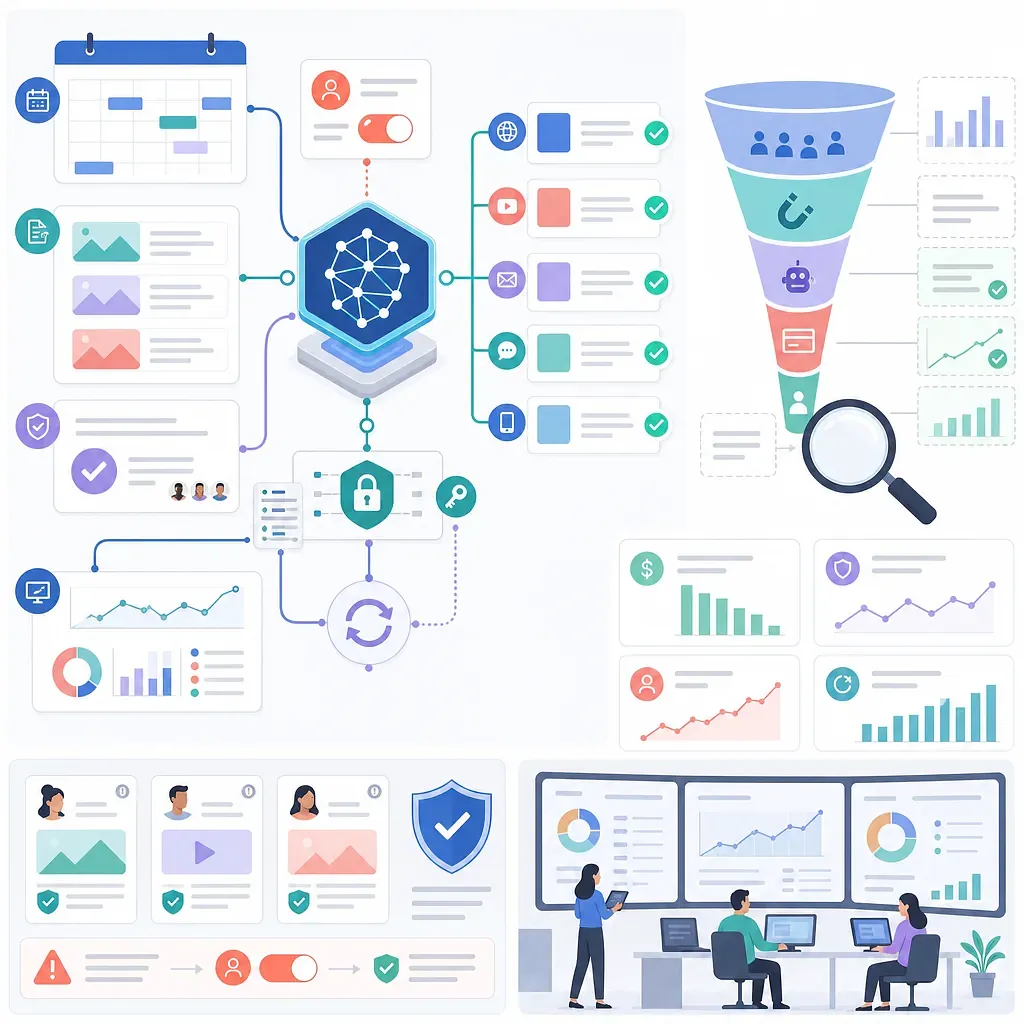
An operator reviews automation flows and performance metrics on a digital dashboard.

Key points

  • The core value of an AI automation SaaS lies not in the number of features, but in how reliably it reduces users' repetitive work from planning through execution and validation.
  • Specific customer use cases can be a stronger signal of demand than feature descriptions, but the causal relationship between views and revenue must be measured separately.
  • Once growth signals are confirmed, the content format should be repeated while also managing paid collaboration disclosures, platform policies, conversion rates, and customer acquisition costs.
  • For products used by AI agents, clear API contracts, least privilege, idempotency, observability, and failure recovery capabilities become competitive advantages.
  • A decision to pause feature development should be evaluated not as a permanent strategy, but as a temporary investment in reliability to reduce error rates and customer churn.

Adding generative AI to an existing SaaS product does not automatically drive growth. The important shift is not adding AI features, but expanding the product’s responsibility so that it completes the repetitive tasks users previously performed themselves.

The operator-provided Postiz case offers a useful hypothesis for explaining this transition. However, audited financial statements or raw data were not provided for the “500% revenue in four months” claim, changes in churn, content views, or the number of trial users. Therefore, the figures below are treated as reported case figures, not confirmed results, alongside what should be verified in an actual business.

Figures and Terms to Review Before Reading the Case

The Baseline for “500% Revenue” Must Be Disclosed

Saying that “revenue reached 500%” means it became five times the initial revenue. By contrast, saying that “revenue increased by 500%” means 500% was added to the initial revenue, resulting in six times the original amount. Without the starting and ending months, whether the figure refers to monthly recurring revenue or total revenue, and how refunds, discounts, and taxes were handled, the same wording can represent different outcomes.

Reported Item Details Presented in the Case Data Needed Before Drawing a Conclusion
Growth period About 4 months Exact start and end dates
Revenue change Described as 500% Baseline revenue, ending revenue, and whether it is MRR or total revenue
Customer churn rate Fell from more than 20% to around 13% Monthly or annual, and whether based on customer count or revenue
Customer content About 7.2 million views Platform analytics, aggregation period, and whether paid distribution was involved
Trial acquisition About 700 people per day Stage-by-stage figures for sign-up, activation, and paid conversion
Founder content About 500,000 views on two occasions Reach, clicks, sign-ups, and contribution to payments for each post

Customer churn is generally calculated by dividing the number of customers lost during a period by the number of customers at the beginning of that period. However, monthly customer churn and revenue churn mean different things. It is also necessary to verify how annual plans, reactivations, and new customers were reflected in the calculation.

1. Transitioning from a Scheduling Tool to an Automation System

The core function of the existing Postiz product was for users to create content and schedule and publish it across multiple social media accounts. In the operator-provided case, the friction of requiring users to log in each time is identified as a cause of high churn. However, confirming the cause of churn would require cancellation surveys, behavioral logs, and customer interviews.

Connecting an AI agent changes the scope of what the product handles.

Category Scheduling Tool AI Automation System
User input Completed posts and schedules Goals, target audience, time frame, and policies
Product’s role Store and publish at a specified time Generate drafts, request reviews, schedule, execute, and report results
Login frequency Repeated logins whenever publishing Log in when there is an exception or approval request
Core value Channel integration and convenience Delegation of repetitive work and end-to-end completion
Primary risk Scheduling or publishing failure Risk of incorrect output being distributed consecutively across multiple channels

A safe automation flow generally has the following structure.

  1. Structure the user’s goals and prohibited conditions.
  2. The AI proposes content and schedules for each channel.
  3. Check brand policies, length limits, prohibited terms, and permissions.
  4. Require human approval for high-risk tasks.
  5. Schedule and publish through APIs, and record the result of each task.
  6. Retry failed tasks or hand them off to a person.
  7. Report the actual post URLs and performance to the user.

Simply connecting Claude or ChatGPT does not complete this flow. Authentication, permission scopes, input and output schemas, duplicate execution prevention, failure handling, and audit logs must also be designed together.

2. Customer Content That Showed Outcomes, Not Features

The turning point for growth presented in the case was not a company-created feature advertisement, but a long-form use case published by a customer. The customer reportedly explained how they automated TikTok marketing using Postiz and a tool identified as “OpenClo.” However, the exact product name of OpenClo and the original post are difficult to verify from the provided materials alone.

Use cases are powerful because they allow prospective buyers to answer the following questions at once.

  • What repetitive work disappeared?
  • What was required for setup?
  • How much of the process was automated?
  • Where did failures occur or human intervention become necessary?
  • Can this be replicated for my account and work?

A strong case study does not merely boast about results. It also discloses the starting conditions, tools used, setup process, time required, exception handling, and limitations. That makes it evidence needed for a purchase decision rather than merely a source of views.

The Conversion Funnel Matters More Than Views

The business impact of viral content should be measured across the following stages.

Impression → Link click → Sign-up → Core feature use → First successful automation → Paid conversion → Retention

For example, even if about 700 people started a trial each day, long-term growth would be limited if the percentage completing their first automation and the paid conversion rate were low. Tracking links for each post, acquisition sources at sign-up, the first successful task, and payment events must be connected to calculate actual contribution.

3. How to Scale Small Signals of Success

According to the operator-provided case, after observing a long-form use case spread on X, the founder tested the hypothesis by repeating a similar format on their own account. The founder was then said to have paid other creators to produce related long-form content.

The generalizable principle in this approach is not to “unconditionally replicate a format that generated views.” The budget should be increased only when the following conditions are repeatedly confirmed.

  1. Posts in the same format repeatedly generate reach beyond what could be attributed to chance.
  2. Increased reach leads to more site visits and sign-ups.
  3. New users actually complete the product’s core automation.
  4. They perform no worse than existing customers in paid conversion and retention.
  5. Customer lifetime value is sufficiently greater than customer acquisition cost, including content production and support costs.

Coordinated Resharing Also Requires a Policy Risk Review

Having multiple accounts reshare the same post simultaneously at a predetermined time can increase short-term exposure. However, depending on how repetitive the behavior is, the relationships among the accounts, and the automation method, it may be interpreted as platform manipulation or spam. Paid creator content may also be subject to advertising disclosure requirements in the applicable jurisdiction.

The following principles should therefore be observed.

  • Allow creators to express their actual experience and independent opinions.
  • Clearly disclose compensation relationships.
  • Do not create mass postings of identical text or fake engagement.
  • Review the platform’s latest automation, spam, and manipulation policies in advance.
  • Evaluate contracts based not only on views, but also on qualified trials, paid conversions, and retention.

4. The Product Foundation for Capturing Opportunities

If a product is built from scratch after an AI trend begins, the market signal may weaken while authentication, payments, channel integrations, and operational systems are being established. In the case, Postiz’s existing publishing features, payment system, and API are presented as the foundation that enabled it to respond quickly.

However, the explanation that “the API documentation was made readable by AI” is only a starting point. For an agent to use tools reliably, the following elements are required.

  • Explicit task definitions: Separate post creation, scheduling, cancellation, and status checks into distinct tasks.
  • Structured schemas: Define required fields, allowed values, date formats, and error responses in a machine-readable form.
  • Least-privilege authentication: Grant access only to the required accounts and scope of work.
  • Idempotency: Prevent duplicate publication when the same request is retransmitted.
  • Pre-execution validation: Check permission expiration, character count, media format, and scheduled time before execution.
  • Execution confirmation: Distinguish between request receipt and actual publication completion in the returned result.
  • Auditability: Record which user and agent requested what and when.

OpenAI’s function calling and similar tool-calling specifications help models generate structured arguments. However, they do not guarantee the actual execution results of external services. Execution validation and recovery remain the responsibility of the SaaS operator.

5. Why Feature Development Stopped During the Growth Period

The case explains that when inbound traffic surged, the company stopped developing new features and concentrated resources on the reliability of existing social media integrations and customer support. This can be a reasonable response because, in an automation product, a single error can propagate across multiple scheduled tasks.

However, “stopping feature development” is not itself a strategy. Improvement targets and exit criteria must first be established.

Operational Metric Problem It Evaluates
Task success rate Was the requested publication actually completed?
Duplicate execution rate Was the same content posted multiple times?
Recovery time How long did it take to restore normal operations after an incident?
Support inquiry rate Are inquiries per active customer increasing?
Failure rate by automation Are errors concentrated in a particular channel or task?
Number of unapproved executions Were any tasks performed outside the permission policy?
Customer retention rate Did improved reliability actually reduce churn?

An “error-free product” or “100% accurate processing” is not a realistic operational goal. A more measurable approach is to define service-level objectives and slow the pace of feature releases when the error budget is exceeded.

Required technical mechanisms include exponential backoff retries, circuit breakers, task queues, per-channel rate limits, status monitoring, secrets management, rollbacks, and manual recovery tools. Allowing customer support staff to review task records also reduces resolution time.

6. The B2A Outlook, Where AI Selects Products

“Business to AI,” or B2A, is a forward-looking term describing a market in which AI agents discover, select, and invoke necessary software on behalf of users. It is not yet a broadly agreed-upon standard business category, and it should not be taken to mean that AI becomes an independent legal purchaser.

A near-term form would be a structure in which agents compare and invoke approved tools within budgets and permissions predetermined by an organization. Responsibility for contracts and payments generally remains with people or organizations, while agents operate as a delegated execution layer.

In this environment, products that are easy for machines to select have the following characteristics.

  • They describe features, prices, and limitations in a structured manner.
  • Their inputs, outputs, and error codes are consistent.
  • Expected costs and impacts can be checked before execution.
  • They return outcomes in a form that machines can use to verify success.
  • They support least privilege and user approval steps.
  • They transparently manage incident histories and service levels.
  • Their paths for cancellation, refunds, data deletion, and permission revocation are clear.

It cannot be assumed that a reliable product will always be selected over one with more features. An agent’s selection is likely to reflect price, feature fit, latency, security, organizational policies, and historical success rates together.

Unit Economics and Control That Conventional Growth Narratives Often Miss

Viral growth cases tend to focus on revenue and views, but determining whether an AI SaaS business is sustainable requires examining costs and risks as well.

The Actual Cost of AI Automation

As each customer is added, the following costs may also increase.

  • Model input, output, and image generation costs
  • Social platform API and data transfer costs
  • Retry costs for failed tasks
  • Customer support and manual recovery costs
  • Content review and safety filtering costs
  • Log storage, monitoring, and security costs

Even if revenue grows rapidly, cash generation can deteriorate if variable costs per customer rise even faster. Gross profit by plan, cost per automation, support time per customer, and refund rates should be tracked together.

The More You Automate, the More Important User Control Becomes

When AI generates content and publishes it externally, misinformation, copyright infringement, personal information exposure, and brand damage can become public immediately. The following controls should be considered defaults.

  • Require human approval for the first execution and high-risk tasks.
  • Set daily posting limits and spending limits for each account.
  • Separate sensitive information and credentials from model input.
  • Prevent instructions embedded in external content from changing system permissions.
  • Support emergency stops, cancellation of all scheduled tasks, and access revocation.
  • Preserve generated output, approvers, edit histories, and publication results.

These controls are not obstacles that reduce the level of automation, but conditions that allow customers to delegate larger tasks with confidence.

Validation Checklist for Applying This to a Business

To apply the principles of the Postiz case, first observe the tasks users repeatedly perform in the current product. It is then safer to validate the following items in sequence.

  • Identify the writing, copying, scheduling, and verification tasks users repeatedly perform outside the product.
  • Measure time, errors, login frequency, and completion rates before and after automation.
  • Automate one narrowly defined task from start to result verification.
  • Set approval requirements and spending and frequency limits for risky executions.
  • Define the first successful automation as the activation metric.
  • Include the setup process, failures, and limitations in customer cases.
  • Connect the conversion funnel from impressions through retention for each piece of content.
  • Expand budgets only for channels where repeatable conversion has been confirmed.
  • During growth periods, prioritize task success rates and recovery time over the number of features.
  • Verify profit per customer, including model, support, and infrastructure costs.

The core lesson of this case is not that “adding AI causes revenue to surge.” It lies in the growth hypothesis that an existing product’s workflow was restructured so AI could invoke it, customer-experienced outcomes were presented as evidence, and reliability was preserved as inbound traffic increased. This hypothesis must be revalidated with raw data and controlled experiments for each business.

Sign-in required

Sign in with your Google account to like, comment, and save highlights.

Images

An operator reviews automation flows and performance metrics on a digital dashboard.
The illustration shows an AI-powered SaaS system integrating content distribution, conversion, security, and analytics.

FAQ

Does adding AI features to an existing SaaS automatically make it an automation SaaS?

No. Simply adding AI features such as text generation makes it closer to an assistive tool. It can be considered an automation system only if it takes the user's goal as input, handles planning, execution, result verification, and failure recovery, and provides the necessary approval and permission controls.

Does the phrase “500% revenue” mean that revenue increased fivefold?

If it means “revenue became 500% of the original revenue,” then it increased fivefold, but if it means “revenue increased by 500%,” then it increased sixfold. The exact scale of growth cannot be determined unless the baseline period, initial revenue, ending revenue, and whether the figures represent monthly recurring revenue are provided.

If customer churn falls from more than 20% to around 13%, does that mean the AI transition was successful?

It may be a positive sign, but that alone cannot establish causality. Other factors must also be examined, including the measurement period, the distinction between customer churn and revenue churn, pricing changes, customer mix, and annual plans.

How should the business performance of a viral post be measured?

Do not look only at views; connect post impressions to link clicks, sign-ups, the first successful automation, paid conversion, and retention. Using tracking links and product events makes it possible to compare customer acquisition cost and retained revenue by content item.

Is stopping feature development during a growth phase always a good strategy?

Not always. It is a strategy of temporarily prioritizing reliability improvements when job failures, duplicate executions, support inquiries, and recovery times fall outside target levels. Once service levels recover, feature development should resume based on customer value and operational risk.

What is needed for AI agents to use APIs reliably?

Clear input and output schemas, least-privilege authentication, idempotency, pre-validation, structured error codes, execution result verification, and audit logs are required. A model's tool-calling capability only generates arguments; it does not guarantee the success of external operations.

Does B2A refer to a market where AI directly enters into contracts and makes payments?

B2A is not yet a standardized business category, but rather a forward-looking term. In practice, a model in which AI agents select and invoke approved tools within budgets and permissions set by people or organizations is more likely to become widespread first.

What costs should be included when assessing the profitability of an AI automation SaaS?

Costs for model usage, external APIs, infrastructure, retries of failed jobs, customer support, manual recovery, safety reviews, and log retention should be included. Alongside revenue growth, it is important to track gross profit by pricing plan and cost per automation.

Sources

Data formats

This content is available in several machine-friendly formats.

Data-only languages (machine translated, files only)

Indonesian JSON MD Portuguese JSON MD Chinese (Traditional) JSON MD Deutsch JSON MD

Verification

Reviewed by 신익희 · 편집장 · 2026-08-27

Figures in this article were checked against the source material during generation. 2 correction(s) applied. · 2026-08-27

This translation has been cross-checked by AI. · 2026-08-27

Reuse & AI usage

Search indexing and AI citation with attribution are welcome. See the license policy for details.

CC BY · License

Loading…

Loading…

Related content

From Injoys

Request the content you want and take 70% of what it earns

Just leave the subject. We handle production, review, translation and distribution.

See how revenue sharing works

Comments