Injoys

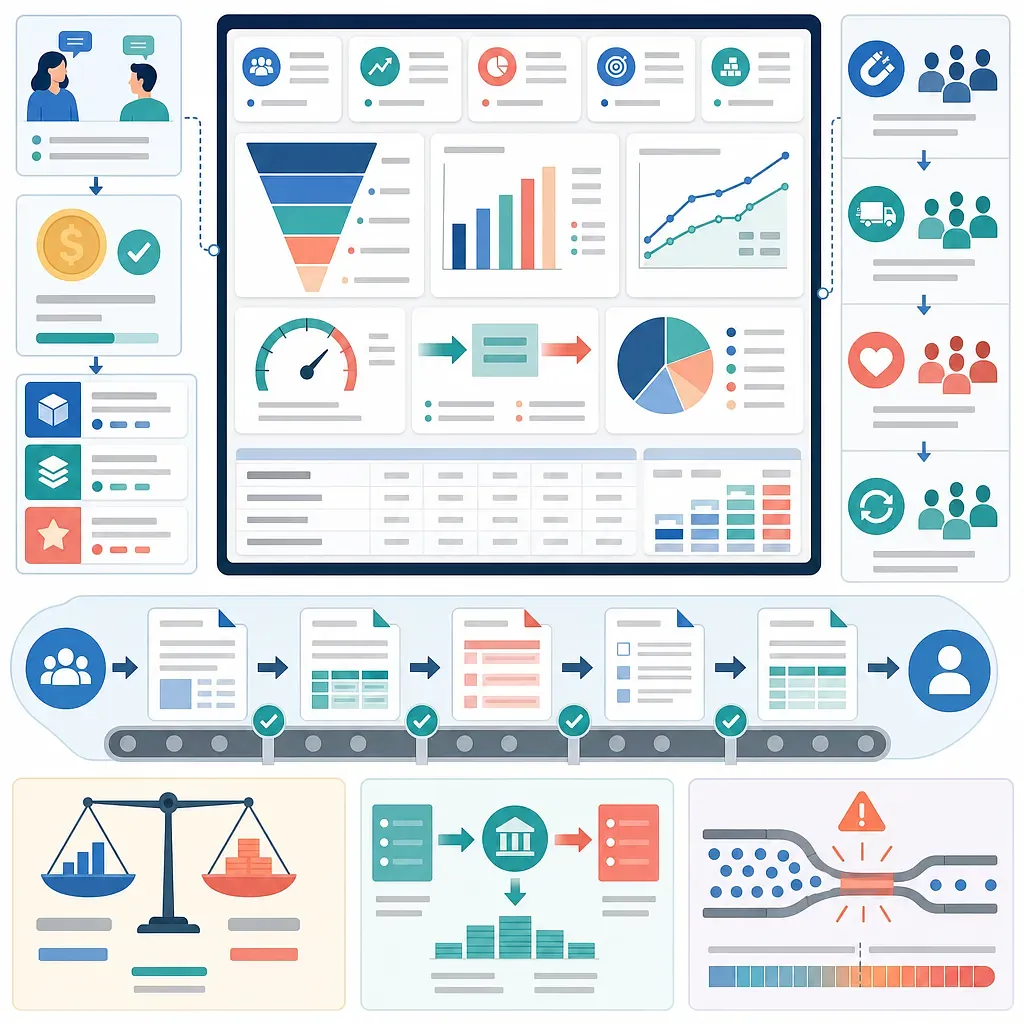
Monthly revenue of KRW 100 million is not a figure achieved through a single idea, but the combined result of pricing, customer volume, conversion rate, retention rate, and delivery capacity. Therefore, when setting a goal, you should design which tasks to standardize, automate, and delegate, and which responsibilities people should continue to handle, rather than focusing on “how to make money without working.”
The system discussed in this article does not mean completely labor-free income. It means reducing the founder’s direct workload while turning customer acquisition, quality control, cash flow, staffing, technology, and regulatory compliance into a repeatable operating structure.
Step 1: Break Down the Monthly Revenue Goal into a Business Equation
The most basic revenue formula is as follows.
Monthly revenue = Average payment amount × Number of paying customers that month
There are many combinations that can generate KRW 100 million per month.
| Average payment amount | Required number of paying customers | Main advantage | Main risk |
|---|---|---|---|
| KRW 100 million | 1 | Few transactions | Concentration risk: losing one customer effectively eliminates revenue |
| KRW 10 million | 10 | Can provide in-depth service to a small number of customers | Long sales cycles and high expectations |
| KRW 1 million | 100 | Relatively balanced transaction size and customer volume | Delivery workload surges without standardization |
| KRW 100,000 | 1,000 | Access to a broader market | Requires automation of marketing, payments, and customer support |
| KRW 10,000 | 10,000 | Low barrier to purchase | Large-scale traffic and low support costs are essential |
“Selling a KRW 1 million service to 100 people” is merely an easy-to-understand example, not the ideal combination for every business. The appropriate price and customer volume depend on market size, customer acquisition cost, delivery time, churn rate, and repurchase rate.
You Must Also Calculate the Number of Prospects Required
If you need 100 new customers and the purchase conversion rate after consultation is 20%, simple arithmetic shows that you need 500 qualified consultations. If the consultation booking rate is 10% of prospect contacts, you may need 5,000 qualified contacts.
- Required purchases = Target revenue ÷ Average payment amount
- Required consultations = Required purchases ÷ Consultation conversion rate
- Required contacts = Required consultations ÷ Consultation booking rate
Conversion rates vary greatly by industry and channel, so do not simply use internet averages; accumulate your own actual data.
Step 2: Choose a Problem Customers Will Pay to Solve
Customers pay not for features themselves, but to move from their current state to a better one. Problems worth paying to solve are generally connected to one or more of the following forms of value.
- Time savings: Reduce time spent on repetitive tasks, waiting, searching, data entry, or coordination.
- Financial improvement: Increase revenue opportunities or reduce errors, waste, and losses.
- Risk reduction: Lower the likelihood of regulatory violations, operational disruptions, security incidents, or poor decisions.
- Convenience and certainty: Handle complex processes on the customer’s behalf and simplify the steps required to achieve a result.
- Identity and status: Enable customers to express expertise, belonging, exclusivity, or a desired image.
When evaluating an idea, consider the following four questions together.
- Can I remain interested in it over time?
- Do I have the ability to solve it better or faster than the customer?
- Is there a group of customers who repeatedly experience the same problem?
- Are those customers already spending money or personnel on similar solutions?
The final question is especially important. Praise, views, and survey responses are signs of interest, but they do not directly prove willingness to pay.
B2B Is Not Always Easier
Business customers can evaluate time savings or cost reductions in terms of financial impact, which may make it easier to propose high-priced services. On the other hand, purchase approvals, budget cycles, security reviews, and contract negotiations can lengthen the sales process. Individual customers may make decisions quickly, but they can be more price-sensitive and may require you to acquire a larger number of customers.
Therefore, B2B and B2C should not be compared in terms of “which is easier,” but according to the following criteria.
| Criterion | What to Check in B2B | What to Check in B2C |
|---|---|---|
| Buyer | Are the user, approver, and budget owner the same person? | Are the buyer and user the same person? |
| Value | Can cost savings, revenue, and risk reduction be measured? | Do convenience, satisfaction, and time savings justify the price? |
| Sales cycle | How long are the contract, security, and procurement processes? | What concerns prevent an immediate purchase? |
| Retention factors | How deeply is it integrated into the workflow? | Is there a reason for repeated use or repurchase? |
Step 3: Make an Offer Based on Measurable Outcomes, Not Features
A weak offer merely describes the technology or a list of tasks.
- Weak wording: “We install an AI phone automation system.”
- Improved wording: “We build an intake process that categorizes inquiries missed during fieldwork and ensures follow-up with customers who can book appointments.”
An outcome-focused offer requires the following elements.
- Audience: Who is the service for?
- Problem: What loss or inconvenience does it reduce?
- Outcome: What will change, and how?
- Scope: Which tasks are included and excluded?
- Timeline: When will diagnosis, implementation, and operation take place?
- Measurement: Which metrics, such as booking rate, processing time, or error rate, will be used to verify the outcome?
- Responsibility: What materials and cooperation must the customer provide?
Selling outcomes does not mean exaggerating or guaranteeing performance. You must not make definitive promises about revenue or profit that you cannot control. Numerical claims in advertisements and proposals must be supported by evidence, and you must check the applicable consumer protection, advertising, and contract regulations in the relevant country.
Step 4: Validate Paid Demand Before Building the Finished Product
If you build an entire app, course, or automation system before looking for customers, you may invest time and money in features for which there is no demand. Validate the idea by progressively increasing the strength of the evidence as follows.
- Problem interviews: Ask about situations customers have recently experienced, their current solutions, costs, and frequency.
- Offer testing: Present a specific offer that states the audience, scope, timeline, and price.
- Intent signals: See whether the customer takes action, such as scheduling a follow-up meeting, requesting internal approval, or providing materials.
- Paid pilot: Charge an actual fee to deliver the service within a limited scope and timeframe.
- Repeat purchase validation: Confirm whether customers beyond the first one buy under similar terms.
Payment is a strong demand signal, but it is not the only evidence. If refunds, low usage, or high churn continue, payment alone does not mean that the value has been validated.
Principles to Follow When Pre-Selling
If you accept money before a product or service is complete, you must clearly disclose the following.
- Deliverables and exclusions
- Start date and estimated completion date
- The nature of the advance payment or deposit
- Cancellation and refund terms
- How delays or an inability to deliver will be handled
- How customer data and confidential information will be handled
Using deposits or a waitlist alone does not fully prove demand. A paid pilot with clear refund terms is a stronger signal than a free waitlist, but you must first check the relevant laws and payment provider rules.
Step 5: Acquire Your First Customers Through Inbound and Outbound Channels
Inbound: Create Problem-Solving Content
Rather than offering general commentary on broad topics, content should address problems that prospects actually search for or ask about.
- Checklists for diagnosing the problem
- Examples calculating the costs and errors of existing methods
- Anonymized before-and-after improvement processes
- Data and personnel to prepare before implementation
- Unsuitable customers and conditions for failure
Good content does not replace all execution. Customers may pay for diagnosis, implementation, integration, and accountable execution tailored to their environment rather than for publicly available information.
Outbound: Aim for the Next Conversation, Not Payment
The initial goal of direct sales is not an immediate sale, but to confirm the existence of the problem and identify the person responsible, then schedule a brief diagnostic conversation.
- Ask people in your existing network for introductions to those experiencing the problem.
- Narrow the industry and company size to create a list of suitable businesses.
- Briefly explain the problem you observed and your hypothesis for improvement.
- Offer a 15-minute diagnosis or demonstration.
- Categorize reasons for rejection as price, timing, trust, necessity, or authority issues.
Indiscriminate mass outreach can damage your brand and delivery rates, and may violate spam and privacy regulations. Use messages relevant to the recipient and comply with local marketing contact rules and opt-out requirements.