How to Report Deepfake Investment Scam Ads in Japan and What Evidence to Save
This guide explains what evidence to preserve when you discover a celebrity deepfake investment ad in Japan and outlines the roles of the Financial Services Agency, the Internet Hotline Center, and the police. If you have already transferred money, contact the financial institutions and police before reporting the ad.
Stop engaging with the ad and the other party, and preserve the ad URL, library ID, account address, and original screen images.
Check the corporate name and registration number of the company shown in the ad against the list of registered businesses maintained by Japan's Financial Services Agency, and verify whether the company is being impersonated.
Save transaction evidence, including LINE conversations, investment website screens, and the transfer account, amount, and time, without deleting or editing it.
Report information about investment scam ads to the Financial Services Agency, and report illegal content and information needed for removal measures to the IHC.
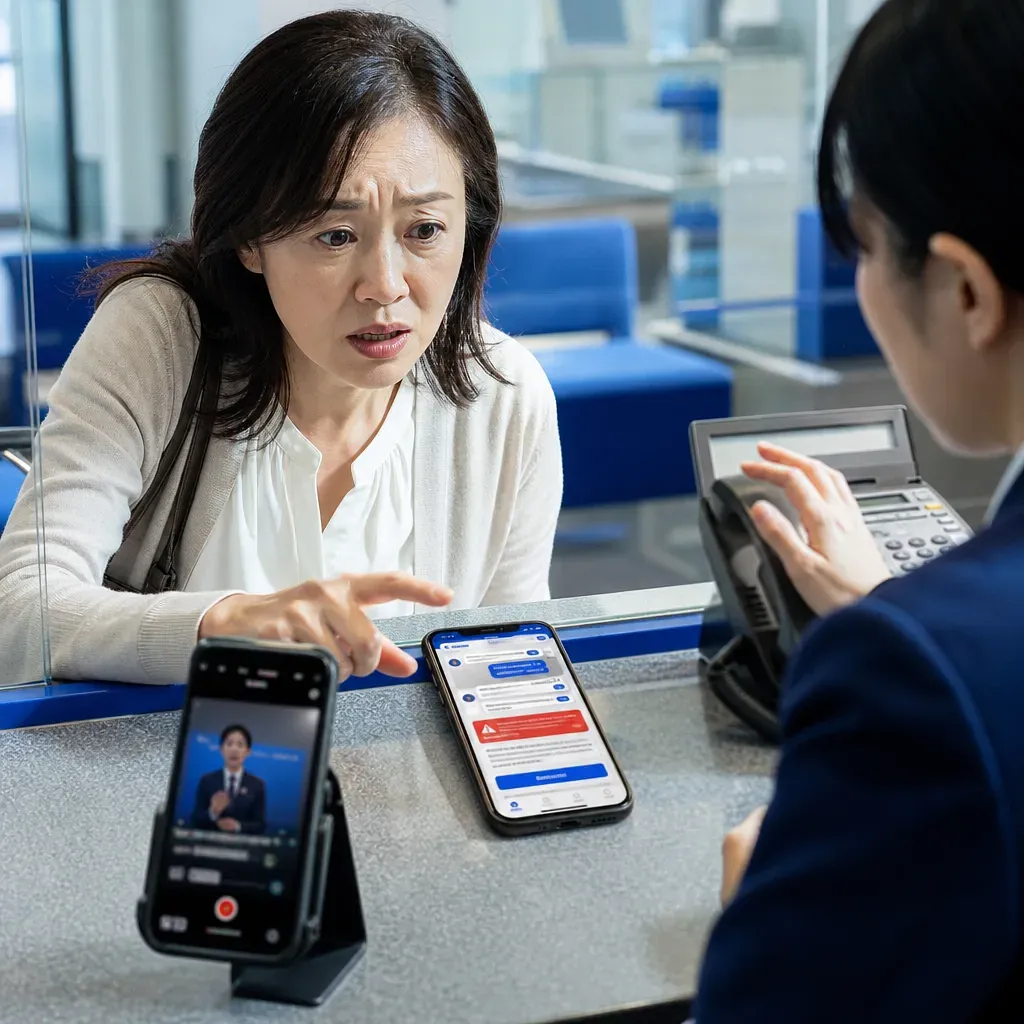
If you have already sent money, stop making further transfers and immediately contact the sending financial institution, the receiving financial institution, and the police.
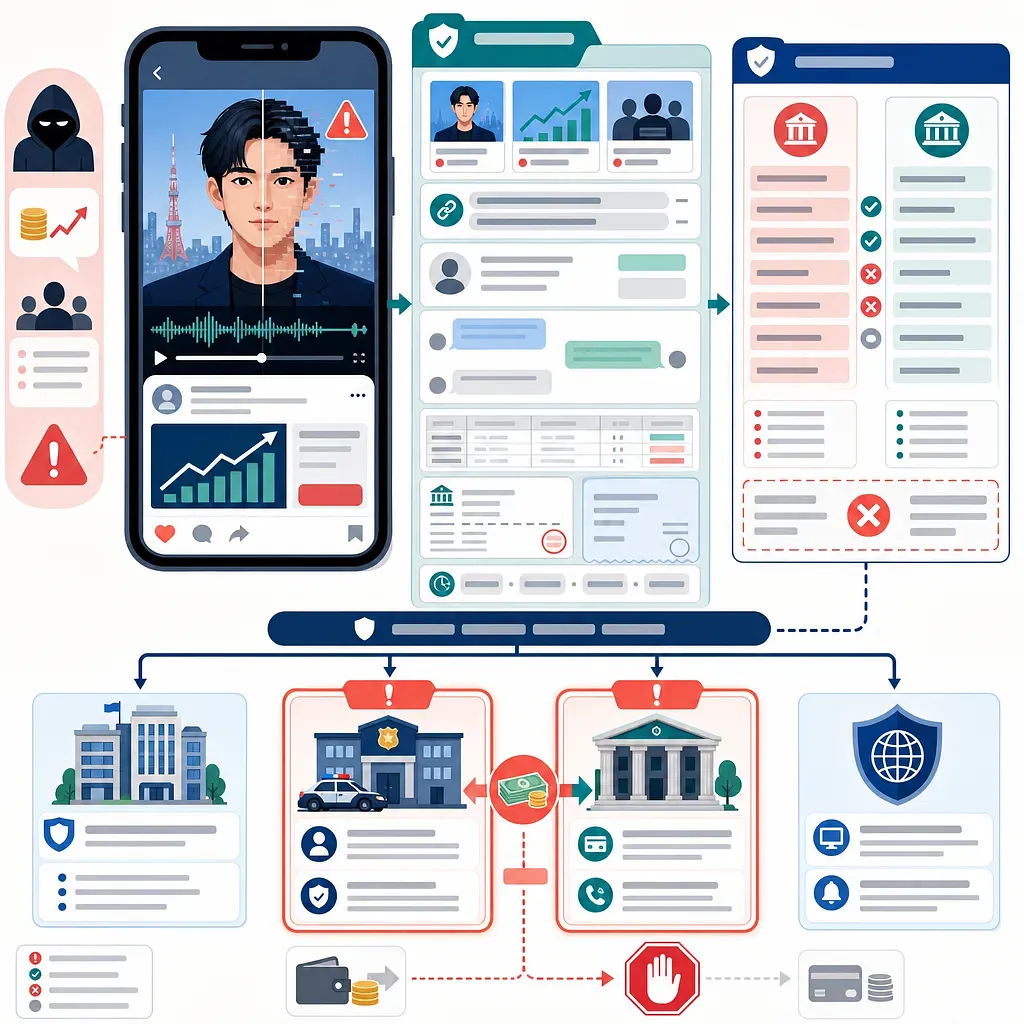
If you discover a social media ad in Japan that uses a synthesized face or voice of a celebrity or investment expert, rather than spending time trying to prove its authenticity yourself, you should respond in the following order: stop contact, preserve evidence, verify registration, and file official reports. If you have already sent money, contacting your financial institution and the police takes priority over completing a report form.
· Who can report: Anyone who discovered the ad, anyone whose rights or identity were misused, or a victim who contacted someone or sent money through the ad
· Reporting deadline: Although the Financial Services Agency and IHC do not specify a separate uniform deadline, it is best to submit a report as soon as possible before the ad and account are deleted.
· What to prepare first: Ad URL and ad library ID, post and account addresses, the person being impersonated, LINE redirect links, linked investment sites, and conversation and remittance records
· Main official channels: The Japanese Financial Services Agency’s information submission portal for social media investment scam ads, the Internet Hotline Center IHC, the police consultation line #9110, and the Consumer Hotline 188
On August 7, 2026, seven Japanese ministries and agencies, including the Digital Agency, National Police Agency, and Financial Services Agency, jointly requested that major platform operators strengthen measures against impersonation scam ads. From the same day, impersonation-based fake investment ads were also included among the illegal information report categories handled by IHC.
Step 1: Stop contact with the ad and preserve evidence immediately
Do not close the window assuming that you will be able to find the ad again. Scam ads, posts, accounts, LINE invitation links, and linked sites may quickly be deleted or have their addresses changed, even before a report is filed.
Ad information to save first
Category | Information to preserve | How to preserve it
Ad identification information | Ad URL, ad library ID, date and time displayed | Copy the address and capture the entire screen.
Posting party | Ad account name, profile address, post URL | Save not only the display name but also the account’s unique address.
Impersonated party | Name of the celebrity, expert, media outlet, financial company, or other party | Also note why you confused it with the genuine official account.
Ad claims | Claims such as guaranteed returns, no losses, or AI-powered automated trading | Use screen recording so that the video, captions, and audio are all preserved.
External redirection | LINE account or group invitation address, QR code, separate site URL | Save both the original QR code and the address reached after following it.
Linked site | Addresses of login, deposit, and earnings screens, and displayed operator information | Capture the full domain together with the company information.
In apps where the URL is not displayed on the screen, use the sharing function to copy the address or check the identification information in the ad menu. Keep the original files separately without cropping them or adding text. If an explanation is needed, it is better to make a copy and annotate that copy.
You do not need to determine technically whether the ad is a deepfake. Simply state the factual reasons for your suspicion, such as a mismatch between lip movements and audio, unnatural facial expressions, a video that does not appear on the official account, or excessive promises of returns.
Step 2: Check whether the business is registered with the Financial Services Agency
Before sending money, verify the corporate name, Financial Services Agency registration number, address, telephone number, and website domain, rather than relying on the business name shown in the ad. Use the Japanese Financial Services Agency’s List of Licensed, Authorized, and Registered Businesses to check whether the business is registered in the relevant category, such as a financial instruments business operator.
The fact that a registered company’s name appears in the search results does not by itself mean that the ad is genuine. Scammers may copy the name and registration number of an actual registered business, so you must also compare the following:
· Is the corporate name in the ad exactly the same as the corporate name in the registration list?
· Do the competent local finance bureau and number in the registration number match?
· Are the telephone number and domain in the ad the same as the registered business’s official contact details?
· Does the official website also provide information about the relevant social media account or investment product?
· Does the name on the deposit account match the contracting party?
If verification is necessary, contact the business directly using the contact details listed in the registration list and on the official website, not a number provided in the ad or through LINE. Do not send money if the business is unregistered or there are signs that it is impersonating a real business.
Step 3: Organize conversation and remittance evidence
If you were redirected to LINE or another messaging service, do not capture only selected parts of the conversation. Preserve the entire sequence from the initial contact through the request for payment.
Conversation and transaction records to preserve before reporting
· The other party’s LINE ID, display name, profile screen, and invitation link
· The group name, administrators and participating accounts, and the date you were invited
· The roles and names used by the other party, such as professor, secretary, or investment manager
· Conversations containing recommended stocks, guaranteed returns, withdrawal conditions, and requests for additional deposits
· The name and download address of any app you were asked to install, and screens showing permission requests
· Investment site account information, balance, rate of return, and failed withdrawal screens
· Date and time of remittance, amount, recipient bank, branch, account number, and account holder name
· Card payment records, crypto-asset exchange withdrawal records, and transaction identifiers
· Contracts, identification documents, business registration materials, and business cards sent by the other party
· Telephone numbers, email addresses, call records, and voice messages
Save the necessary records before deleting the conversation or blocking the other party, but do not continue the conversation or send additional money in an attempt to obtain more evidence. Do not submit account security information, such as passwords, verification codes, or recovery codes, to reporting agencies.
Step 4: Report to the Financial Services Agency and IHC according to their respective purposes
The Financial Services Agency and IHC have different roles, so reporting the same ad to both agencies cannot necessarily be considered duplicate reporting. However, neither agency can issue an emergency freeze on the victim’s funds or accept a criminal case in place of the proper authorities.
Channel | Main role | Appropriate situations | Limitations
Financial Services Agency | Receives information about suspected social media investment scam ads and financial businesses | Unregistered operations, impersonation of financial companies, ads redirecting users to LINE for investments | It is not an agency for recovering victims’ funds or providing emergency response.
IHC | Receives reports of illegal online information, provides information to the police, and requests deletion by site administrators and others | Impersonation-based fake investment ads available publicly online | It is not a channel for emergency victim reports or resolving individual disputes.
Police #9110 | Provides police consultations about criminal harm or suspicious situations and directs callers to the appropriate local office | Remittance losses, threats, repeated contact, or situations requiring a criminal report | It is not an emergency number for situations involving immediate danger.
Consumer Hotline 188 | Connects callers to a nearby consumer affairs center and provides consultations about contract and payment issues | Consumer issues such as cancellation, payment, and dealings with businesses | It does not replace a police report or a payment freeze by a financial institution.
Submitting to the Financial Services Agency
Submit the advertising medium, ad URL or library ID, ad account and post addresses, impersonated person, redirect addresses such as LINE, and linked site information through the Japanese Financial Services Agency’s Information Submission Portal for Suspected Social Media Investment Scam Ads. Check the fields marked as required on the submission screen, and do not guess when entering information you do not know.
The Financial Services Agency also provides separate guidance on common scam patterns and precautions. It is advisable to describe specifically any operations that appear suspicious under financial regulations, any unregistered businesses, or signs of impersonation of a registered company.
Submitting to IHC
Follow the illegal information reporting procedure through the Internet Hotline Center. Focus your submission on the exact URL of the publicly available ad or post and the relevant screen, and briefly explain why you believe it is an impersonation-based fake investment ad.
Among the information it receives, IHC may provide relevant material to the police or request that site administrators and others delete it. However, victims who have already sent money should not wait only for IHC to process the report; they must separately contact their financial institution and the police.
Step 5: If you sent money, contact the financial institution and police first
If you have already sent money, do not send any additional amount requested under the pretext of withdrawal fees, taxes, deposits, account recovery costs, or similar charges. The earnings or balance displayed on the screen may be manipulated numbers rather than actual financial assets.
Respond immediately in the following order:
· Contact the incident reporting department of the bank, card issuer, or crypto-asset exchange used to send the money.
· For a bank transfer, also inform the recipient financial institution that the transaction is suspected of being fraudulent and ask what action may be taken.
· Contact a nearby police station or the police consultation line #9110 to confirm what materials are required to file a case.
· If there are signs that an account has been compromised, change the passwords for your email, social media accounts, and LINE, and review multi-factor authentication and login records.
· After contacting the financial institution and police, separately report the ad to the Financial Services Agency and IHC.
If funds remain in a bank account used for criminal activity, Japan’s victim recovery distribution procedure may apply. However, this depends on the status of the account and the applicable legal procedure, and recovery is not guaranteed. You must confirm eligibility and the notice and application procedures with the relevant financial institution. Different recovery procedures may apply to crypto-asset transfers or international remittances.
If a crime is currently in progress or there is an immediate danger, such as a physical threat, check and use the emergency reporting number provided in official guidance from the Japanese police rather than a consultation line.
Typical scam sequence and warning signs requiring you to stop
Impersonation-based social media investment scams often do not end with a single ad but instead combine trust-building with repeated remittances.
· They display an ad that appears to feature a celebrity, economic expert, or media outlet.
· They promote free investment courses or recommended stocks and redirect users to a private LINE group.
· Multiple accounts posing as professors, assistants, secretaries, or successful members build trust.
· A separate investment site or app displays fabricated earnings and balances.
· They permit a small withdrawal or present success stories to induce a larger remittance.
· When a withdrawal is requested, they demand additional payments for taxes, fees, deposits, or credit score restoration costs.
If any of the following applies, stop sending money and providing personal information:
· They guarantee the principal or high returns.
· They provide information only in a private LINE chat rather than through a publicly available official consultation channel.
· They request payment to an account held in an individual’s name or a name different from that of the contracting party.
· They ask you to install an investment app through a link or file rather than an app store.
· They claim that you must first send money for taxes or a deposit to make a withdrawal.
· They demand that you not tell family members, bank employees, or the police.
· The earnings shown on the screen increase, but you cannot verify an official transaction statement or the institution holding the assets.
Account and personal information protection required separately from reporting
Official guidance focuses on collecting ad URLs and transaction evidence, but if you logged in to a scam site or installed an app, you must also protect your accounts at the same time.
· If you entered a password that you also use for other services, change it for all of them from a trusted device.
· Secure your email account first and enable multi-factor authentication.
· Review login devices, connected apps, and sessions for social media and messaging services.
· If you installed a remote-control app or an investment app from an unknown source, disconnect the device from the network, notify your financial institution, and have the device undergo a security inspection.
· If you sent a photo of your identification, document the possibility of identity theft and periodically check the relevant financial accounts.
· Also report the ad to the platform, but do not assume that reporting it to the platform completes the reporting process with the Financial Services Agency, IHC, or police.
If evidence preservation conflicts with security measures, first use another device to photograph the screen or record the necessary transaction information, and then secure the account. Do not change your online banking password on a device suspected of containing a malicious app.
 Injoys