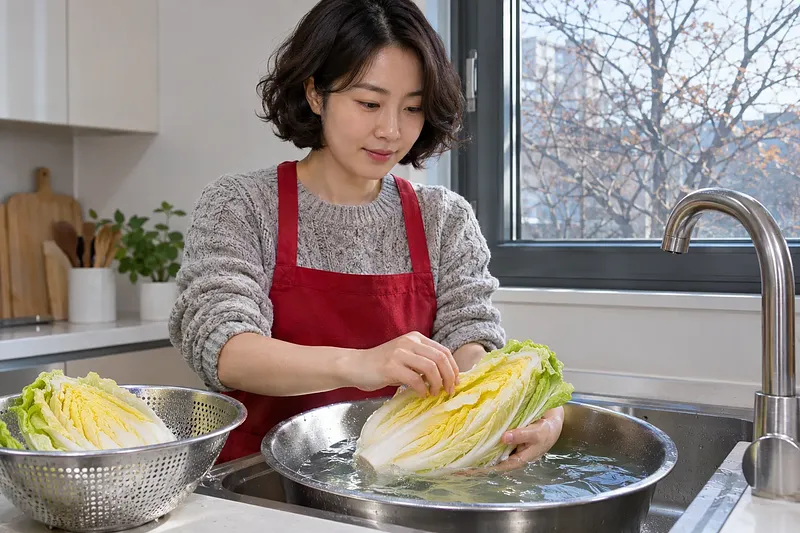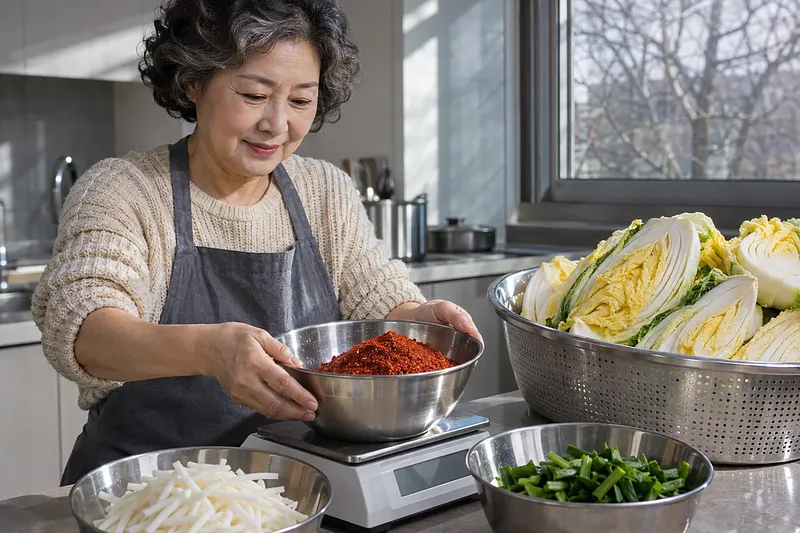
The number of heads in 20kg of salted napa cabbage varies by product. The Goesan Nonghyup product was listed as 6 to 10 heads, and one product from Haenam was listed as 7 to 9 heads. Calculate the amount of seasoning based on the weight of the salted cabbage. One box takes 4.4kg of base seasoning, or 7.4kg if you include the vegetables.
The head counts come from Nonghyup Mall product listings on November 23, 2026, and the ingredient amounts come from the National Institute of Crop Science recipe.
How many heads are in a 20kg box?
Larger cabbages mean fewer heads are needed to reach the same weight. The 20kg products in the Nonghyup Mall Kimjang Fair also listed different counts, as shown below. When ordering, check the details of the product you plan to buy, even if it comes from the same region.
| Nonghyup Mall product | Listed head count per 20kg box |
|---|---|
| Goesan Nonghyup Salted Napa Cabbage | 6 to 10 heads |
| Haenam Yellow Clay Salted Napa Cabbage | 7 to 9 heads |
| Jeungpyeong Miamgol Salted Napa Cabbage | 7 to 10 heads |
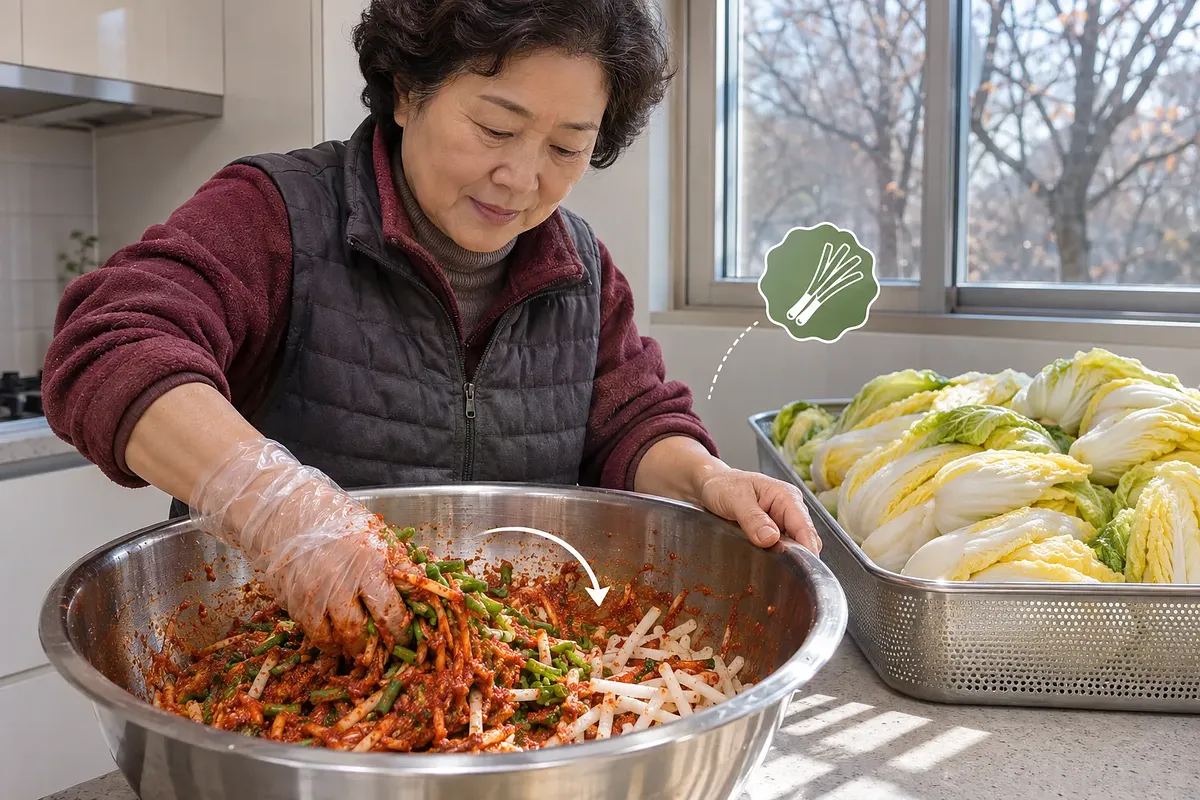
For one 20 kg box of salted napa cabbage, use 4.4 kg of base seasoning, or 7.4 kg of filling once radish and leafy greens are included.
How to scale the kimchi seasoning recipe
The National Institute of Crop Science’s “An Easy Way to Make Kimchi” gives ingredient amounts for 50kg of salted napa cabbage. If you use a full 20kg box, multiply each ingredient amount by 0.4. The calculation is the same whether the box contains 6 heads or 10.
- Check the weight of the salted cabbage you’ll be mixing with the seasoning. If you’re using only part of a box, weigh just the portion you’ll use.
- Divide that weight by the recipe’s starting weight of 50kg. 20kg ÷ 50kg is 0.4, and 10kg ÷ 50kg is 0.2.
- Multiply each ingredient amount in the recipe by the same factor. For the red pepper powder, calculate 2.25kg × 0.4 and measure out 900g.
Ingredient amounts for 10kg and 20kg of salted cabbage
The first numeric column shows the original recipe from the National Institute of Crop Science. The two columns on the right show the amounts scaled to each weight.
| Ingredient | Original recipe for 50kg of cabbage | For 10kg of cabbage | For 20kg of cabbage |
|---|---|---|---|
| Red pepper powder | 2.25kg | 450g | 900g |
| Garlic | 1kg | 200g | 400g |
| Ginger | 500g | 100g | 200g |
| Salted fermented seafood | 2.5kg | 500g | 1kg |
| Sesame seeds | 250g | 50g | 100g |
| Sugar | 250g | 50g | 100g |
| Glutinous rice paste | 4.25kg | 850g | 1.7kg |
| Base seasoning subtotal | 11kg | 2.2kg | 4.4kg |
| Radish | 5kg | 1kg | 2kg |
| Leafy greens | 2.5kg | 500g | 1kg |
| Total kimchi filling with vegetables | 18.5kg | 3.7kg | 7.4kg |
The weight of the glutinous rice paste is measured after it has been cooked with water. Count all the leafy greens you’ll use, such as scallions, mustard greens, and water dropwort, toward the 1kg total. The 900g of red pepper powder and 1kg of salted fermented seafood are also amounts for this particular recipe.
How to account for radish and scallions when comparing store-bought seasoning
When choosing store-bought seasoning, first check whether the weight on the package includes the radish and scallions. For 20kg of cabbage, adding 2kg of radish and 1kg of leafy greens to 4.4kg of base seasoning gives you 7.4kg of kimchi filling. The 3kg difference is the weight of the vegetables.
| What the package contains | What to compare when shopping |
|---|---|
| Seasoning with neither radish nor leafy greens | Compare it with 4.4kg of base seasoning and calculate the vegetables separately. |
| Kimchi filling with both radish and leafy greens | Compare it with the 7.4kg total that includes the vegetables. |
| A product with only some of the vegetables or no amounts listed for individual ingredients | Check how much cabbage the seller says the product is for and which vegetables to add. |
Example: Splitting one box between two households
When two households split 20kg equally, weigh out 10kg of cabbage for each household so the seasoning can be split in half as well. If the box contains both large and small cabbages, giving each household the same number of heads won’t give them the same weight. If each household takes 10kg, its share is 2.2kg of base seasoning, 1kg of radish, and 500g of leafy greens.
Delivery dates and rinsing after arrival
Check the estimated arrival date on the order page so you can mix the cabbage with the seasoning the day it arrives. If the product has a specified dispatch date, that’s the day it ships. If your kimchi-making plans change, check the storage temperature and use-by date on the package.
It’s best to use salted napa cabbage on the day you receive it.
Ministry of Food and Drug Safety, “What to Know About Using Salted Napa Cabbage Safely During Kimchi-Making Season”
The Ministry of Food and Drug Safety recommends rinsing the cabbage before use if it has been stored at room temperature for at least a day. Coliform bacteria, which are an indicator of sanitary conditions, can multiply during storage at room temperature. Too much rinsing can soften the cabbage, so it’s best to rinse it no more than 3 times.