Skip to content
Knowledge Base

Salted Cabbage: Same-Day Use and at Most 3 Washes

Using salted cabbage the day it is received is recommended. If stored at room temperature for at least a day, it should be washed before use, preferably at most 3 times.

Read text only

8 min read

Just the words, no images.

Salted Cabbage: Same-Day Use and at Most 3 Washes

8 min read

Salted Cabbage: Same-Day Use and at Most 3 Washes
Using salted cabbage the day it is received is recommended. If stored at room temperature for at least a day, it should be washed before use, preferably at most 3 times.
The Ministry of Food and Drug Safety's recommendation to use it the day it is received was also issued in 2015 as part of its earlier guidance.
After at least a day at room temperature, levels of coliform bacteria, a hygiene indicator, may increase.
Even for prewashed products, check both the actual storage conditions and the directions for use on the label.
Excessive washing can damage the cabbage, so it is best to wash it at most 3 times.
Check each product's instructions for how long it can be refrigerated and how much additional draining time it needs.
Salted napa cabbage is best used on the day it is received. If it has been stored at room temperature for at least one day, it should be washed before use. When washing it again, it is best not to exceed 3 washes. Also check whether the product has already been washed and what storage instructions are on its label.
The storage and washing guidelines in this article are based on guidance issued by the Ministry of Food and Drug Safety on October 27, 2015.
Why use it on the day it arrives?
The same-day use recommendation reflects concerns about microbial growth during room-temperature storage. The Ministry of Food and Drug Safety stated that coliform bacteria may increase if the cabbage is left at room temperature for at least one day. Coliforms are a group of bacteria used as an indicator of hygiene conditions.
The ministry's “Use Salted Napa Cabbage Safely During Kimjang Season” includes the following statement.
It is best to use salted napa cabbage on the day it is received.
Here, “the day” means the day the product arrives, not the day it is ordered online. If you can choose a delivery date, matching it to your planned kimjang date is more consistent with the recommendation. This schedule reduces the chance of leaving the cabbage unused for a long time after receipt.
This recommendation was not newly introduced in 2026. The same advice was already included in the 2015 guidance. Even if a recent post quotes it, distinguish the post's date from the year the guidance was issued.
Guidelines by storage condition
To decide whether to wash the cabbage again, check both its condition when shipped and how it has been stored since receipt. Some products are sold after being salted, washed, and drained. Some come with instructions to use them without further washing.
Product and storage condition | Guideline to apply | What to check Already washed and being used on the day it arrives | Check the product's usage instructions | Whether further washing or draining is needed Stored at room temperature for at least one day | The ministry recommends washing before use | Actual time stored at room temperature and the product's condition Must be stored because kimjang has been delayed | Check the product's specified storage conditions | Storage location, temperature, and use-by period No label or unclear instructions | Ask the producer or seller about the conditions | When it was received and how it has been stored since Suspected spoilage | Do not try to solve the problem by washing | Stop using it and ask about exchange or disposal procedures
The washing recommendation applies when the cabbage has been stored at room temperature for at least one day. Do not take this as a guarantee that room-temperature storage is safe for up to one day. It is not a recommendation to leave the cabbage at room temperature for a day in the first place.
Why wash salted napa cabbage no more than 3 times?
Excessive washing can damage the cabbage, including making it soft. The Ministry of Food and Drug Safety recommends washing it at most 3 times at home. It does not recommend repeatedly increasing the number of washes.
The washing method described in the 2015 guidance is as follows. This method applies when washing is needed. The ministry's “2 Things You Must Watch Out for When Making Kimjang” emphasizes using clean water.
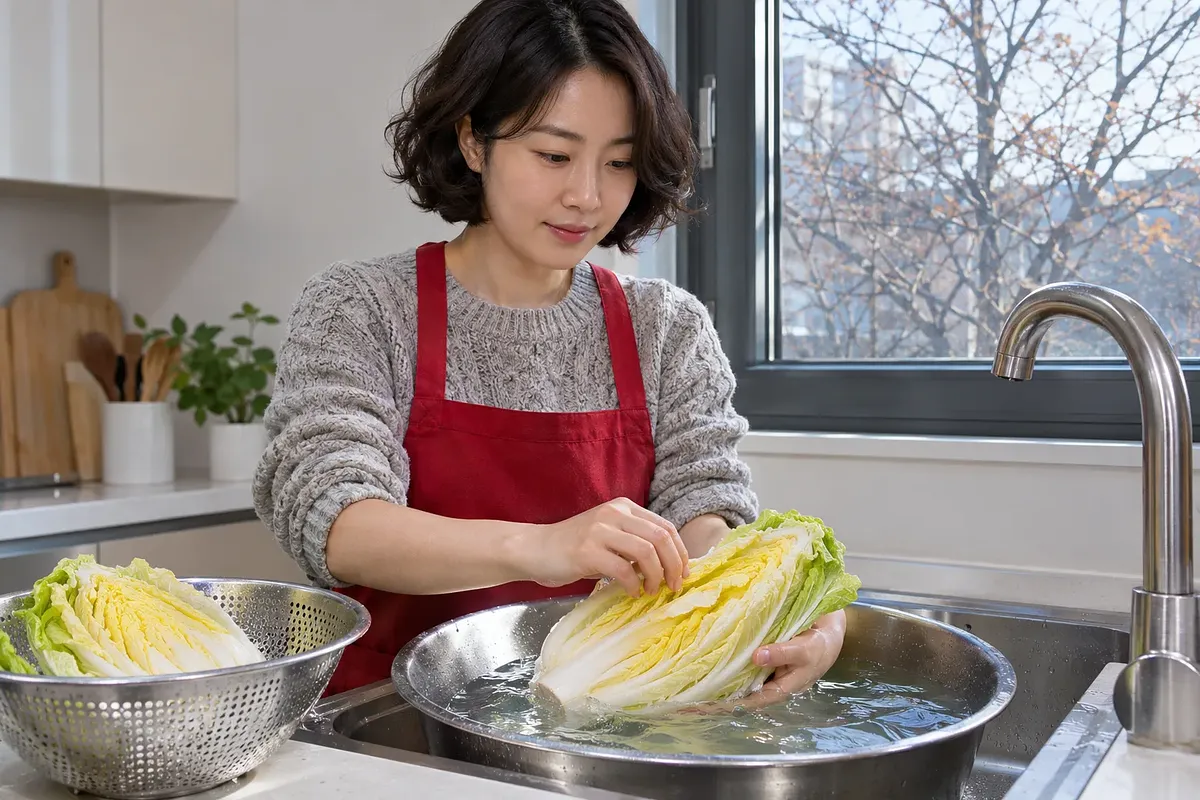
· Immerse the cabbage in water. · Gently rub the root area and between the leaves with your fingers to wash them. · Rinse with water 2 times.
This method combines an initial rubbing wash with rinsing. It does not mean rubbing and washing the cabbage 3 times and then rinsing it again. The ministry warns that washing too much can damage the cabbage.
Where to check how long salted napa cabbage can be stored
If you postpone kimjang, check the label on the product you bought for storage conditions. The same-day use recommendation alone cannot determine how many days the cabbage can be refrigerated. The consumer guidance reviewed does not specify a refrigeration period that applies to all products.
· Storage instructions and date markings on the packaging · Instructions in the product description for use after receipt · Conditions provided by the producer or seller for delayed use
If a product's instructions call for refrigeration, follow both the specified temperature and storage period. Do not assume that a balcony or entryway meets refrigeration conditions simply because it feels cool. If the label is unclear, do not decide on a storage period yourself.
Draining time also needs to be checked based on how thoroughly the product you bought has already been drained. The ministry's same-day use recommendation does not set a common draining time. Check the product description or ask the producer whether further draining is needed.
Criteria for comparing 20kg packs, origins, and seasoning
Read package weight and origin information separately from storage and washing instructions. A 20kg label does not indicate the number of cabbage heads or how many times to wash them at home. Nor can origin alone, such as Haenam, Goesan, Yeongwol, or Pyeongchang, determine whether the cabbage needs to be washed again.
Comparison item | Information to check | Common point of confusion Package weight | Cabbage weight and the seller's information on the number of heads | Assuming the same weight means the same number of heads Origin | Place of origin and actual producer | Deciding storage conditions based only on the region's name Manufacturing process | Washing and draining before shipment | Assuming factory washing must be repeated at home Price | Amount paid for the same weight and shipping costs | Directly comparing products that include seasoning with cabbage-only products Seasoning | The weight of cabbage the seasoning is intended for | Applying one product's mixing ratio as a universal standard Delivery schedule | Shipping date and expected arrival date | Treating the shipping date as the date kimjang can be made
Haengbokhan Haenam Nongjang lists the amount of seasoning for 10kg of cabbage as 3.5kg. The same sales listing also includes 7kg of seasoning for 20kg of cabbage. These are instructions for that particular seasoning product, not a universal mixing ratio.
Applying the same product instructions to 40kg of cabbage gives a calculated seasoning amount of 14kg. The calculation is 7kg × 2, not a figure separately provided by the seller. If you use a different seasoning, check that product's recommended amount.
The difference between factory washing and hygiene at home
Hygiene management at production facilities serves a different purpose from guidance on how long a product can be kept before use at home. During manufacturing, raw materials, water, workers, and equipment are managed. Even if washing has been completed before shipment, subsequent storage conditions must be checked separately.
Category | Main focus | Relevance at home Hygiene management at production facilities | Raw materials, manufacturing water, washing processes, and worker hygiene | Information about the production process Consumer usage instructions | When to use the product after receipt and whether to wash it again | Deciding how to use it based on actual storage conditions Home working environment | Washing water and equipment used to hold the cabbage | Preventing contamination during washing
The ministry's “2 Things You Must Watch Out for When Making Kimjang” also covers water and equipment. Washing water must meet drinking-water quality standards. Check that basins, plastic sheeting, and mats used to hold the cabbage are food-safe.
These conditions deserve as much attention as the number of washes. Increasing the number of washes cannot solve the problem of contaminated water. Equipment used for washing and draining should be checked against the same standard.
Common mistakes
A common error is turning a conditional recommendation into a rule for every product. Consider both the product's condition when shipped and its actual storage history. In particular, distinguish the following misinterpretations.
· Taking an “already washed” label to mean the product can be stored for a long time · Reading “at least one day at room temperature” as a guarantee of safety for one day · Trying to address spoilage by increasing the number of washes · Applying the seller's recommended seasoning amount to every product · Replacing the year the ministry's guidance was issued with the publication year of a recent article
0:00 0:00
1 / 42

Advertisement

Download text

File name
salted-cabbage-same-day-use-washing-storage-2-en.txt
Format
TXT (text/plain)
Paragraphs
42

Downloads exactly what you see as a text file.

Please cite the source when quoting.

Advertisement

Large text

Makes the text larger and the colors clearer. Turn it on if the text feels too small.

Salted napa cabbage should be rinsed no more than three times to avoid damage from excessive washing.

Key points

  • The Ministry of Food and Drug Safety's recommendation to use it the day it is received was also issued in 2015 as part of its earlier guidance.
  • After at least a day at room temperature, levels of coliform bacteria, a hygiene indicator, may increase.
  • Even for prewashed products, check both the actual storage conditions and the directions for use on the label.
  • Excessive washing can damage the cabbage, so it is best to wash it at most 3 times.
  • Check each product's instructions for how long it can be refrigerated and how much additional draining time it needs.

Salted napa cabbage is best used on the day it is received. If it has been stored at room temperature for at least one day, it should be washed before use. When washing it again, it is best not to exceed 3 washes. Also check whether the product has already been washed and what storage instructions are on its label.

The storage and washing guidelines in this article are based on guidance issued by the Ministry of Food and Drug Safety on October 27, 2015.

Why use it on the day it arrives?

The same-day use recommendation reflects concerns about microbial growth during room-temperature storage. The Ministry of Food and Drug Safety stated that coliform bacteria may increase if the cabbage is left at room temperature for at least one day. Coliforms are a group of bacteria used as an indicator of hygiene conditions.

The ministry's “Use Salted Napa Cabbage Safely During Kimjang Season” includes the following statement.

It is best to use salted napa cabbage on the day it is received.

Here, “the day” means the day the product arrives, not the day it is ordered online. If you can choose a delivery date, matching it to your planned kimjang date is more consistent with the recommendation. This schedule reduces the chance of leaving the cabbage unused for a long time after receipt.

This recommendation was not newly introduced in 2026. The same advice was already included in the 2015 guidance. Even if a recent post quotes it, distinguish the post's date from the year the guidance was issued.

Salted napa cabbage is best used on the day it is received.

Guidelines by storage condition

To decide whether to wash the cabbage again, check both its condition when shipped and how it has been stored since receipt. Some products are sold after being salted, washed, and drained. Some come with instructions to use them without further washing.

Product and storage condition Guideline to apply What to check
Already washed and being used on the day it arrives Check the product's usage instructions Whether further washing or draining is needed
Stored at room temperature for at least one day The ministry recommends washing before use Actual time stored at room temperature and the product's condition
Must be stored because kimjang has been delayed Check the product's specified storage conditions Storage location, temperature, and use-by period
No label or unclear instructions Ask the producer or seller about the conditions When it was received and how it has been stored since
Suspected spoilage Do not try to solve the problem by washing Stop using it and ask about exchange or disposal procedures

The washing recommendation applies when the cabbage has been stored at room temperature for at least one day. Do not take this as a guarantee that room-temperature storage is safe for up to one day. It is not a recommendation to leave the cabbage at room temperature for a day in the first place.

Why wash salted napa cabbage no more than 3 times?

Excessive washing can damage the cabbage, including making it soft. The Ministry of Food and Drug Safety recommends washing it at most 3 times at home. It does not recommend repeatedly increasing the number of washes.

The washing method described in the 2015 guidance is as follows. This method applies when washing is needed. The ministry's “2 Things You Must Watch Out for When Making Kimjang” emphasizes using clean water.

  1. Immerse the cabbage in water.
  2. Gently rub the root area and between the leaves with your fingers to wash them.
  3. Rinse with water 2 times.

This method combines an initial rubbing wash with rinsing. It does not mean rubbing and washing the cabbage 3 times and then rinsing it again. The ministry warns that washing too much can damage the cabbage.

Where to check how long salted napa cabbage can be stored

If you postpone kimjang, check the label on the product you bought for storage conditions. The same-day use recommendation alone cannot determine how many days the cabbage can be refrigerated. The consumer guidance reviewed does not specify a refrigeration period that applies to all products.

  • Storage instructions and date markings on the packaging
  • Instructions in the product description for use after receipt
  • Conditions provided by the producer or seller for delayed use

If a product's instructions call for refrigeration, follow both the specified temperature and storage period. Do not assume that a balcony or entryway meets refrigeration conditions simply because it feels cool. If the label is unclear, do not decide on a storage period yourself.

Draining time also needs to be checked based on how thoroughly the product you bought has already been drained. The ministry's same-day use recommendation does not set a common draining time. Check the product description or ask the producer whether further draining is needed.

Criteria for comparing 20kg packs, origins, and seasoning

Read package weight and origin information separately from storage and washing instructions. A 20kg label does not indicate the number of cabbage heads or how many times to wash them at home. Nor can origin alone, such as Haenam, Goesan, Yeongwol, or Pyeongchang, determine whether the cabbage needs to be washed again.

Comparison item Information to check Common point of confusion
Package weight Cabbage weight and the seller's information on the number of heads Assuming the same weight means the same number of heads
Origin Place of origin and actual producer Deciding storage conditions based only on the region's name
Manufacturing process Washing and draining before shipment Assuming factory washing must be repeated at home
Price Amount paid for the same weight and shipping costs Directly comparing products that include seasoning with cabbage-only products
Seasoning The weight of cabbage the seasoning is intended for Applying one product's mixing ratio as a universal standard
Delivery schedule Shipping date and expected arrival date Treating the shipping date as the date kimjang can be made

Haengbokhan Haenam Nongjang lists the amount of seasoning for 10kg of cabbage as 3.5kg. The same sales listing also includes 7kg of seasoning for 20kg of cabbage. These are instructions for that particular seasoning product, not a universal mixing ratio.

Applying the same product instructions to 40kg of cabbage gives a calculated seasoning amount of 14kg. The calculation is 7kg × 2, not a figure separately provided by the seller. If you use a different seasoning, check that product's recommended amount.

The difference between factory washing and hygiene at home

Hygiene management at production facilities serves a different purpose from guidance on how long a product can be kept before use at home. During manufacturing, raw materials, water, workers, and equipment are managed. Even if washing has been completed before shipment, subsequent storage conditions must be checked separately.

Category Main focus Relevance at home
Hygiene management at production facilities Raw materials, manufacturing water, washing processes, and worker hygiene Information about the production process
Consumer usage instructions When to use the product after receipt and whether to wash it again Deciding how to use it based on actual storage conditions
Home working environment Washing water and equipment used to hold the cabbage Preventing contamination during washing

The ministry's “2 Things You Must Watch Out for When Making Kimjang” also covers water and equipment. Washing water must meet drinking-water quality standards. Check that basins, plastic sheeting, and mats used to hold the cabbage are food-safe.

These conditions deserve as much attention as the number of washes. Increasing the number of washes cannot solve the problem of contaminated water. Equipment used for washing and draining should be checked against the same standard.

Common mistakes

A common error is turning a conditional recommendation into a rule for every product. Consider both the product's condition when shipped and its actual storage history. In particular, distinguish the following misinterpretations.

  • Taking an “already washed” label to mean the product can be stored for a long time
  • Reading “at least one day at room temperature” as a guarantee of safety for one day
  • Trying to address spoilage by increasing the number of washes
  • Applying the seller's recommended seasoning amount to every product
  • Replacing the year the ministry's guidance was issued with the publication year of a recent article
Open the link

Opens in a new window.

Advertisement

Sign-in required

Sign in with your Google or Apple account to like, comment, and save highlights.

FAQ

Does “use on the day you receive it” mean the day you place the order?

It means the day you receive the product. This must be distinguished from the online order date or the date the producer ships it.

Do even products meant to be used without washing need to be washed again?

Check both the product’s instructions for use and its actual storage conditions. If it has been stored at room temperature for at least one day, the Ministry of Food and Drug Safety recommends washing it before use.

Does that mean it is okay to leave it at room temperature for up to one day?

The guidance does not guarantee safety for one day. The Ministry of Food and Drug Safety’s basic recommendation is to use it on the day you receive it.

Does washing 3 times include rinsing?

The 2015 guidance describes soaking it in water and rubbing it gently to wash it, then rinsing it 2 times. The rinses follow the initial wash.

Is washing it more often better?

The Ministry of Food and Drug Safety advises washing it no more than 3 times. Excessive washing can damage napa cabbage, including making it mushy.

How many days can it be stored in the refrigerator?

Check the storage temperature and use-by date of the product you purchased. The Ministry of Food and Drug Safety’s consumer guidance reviewed here is not enough to establish a refrigerated storage period that applies to all products.

How many hours should the napa cabbage be left to drain?

Check how well the product was drained before shipment and consult its instructions for use. The recommendation to use it on the day you receive it does not include a draining time that applies to all products.

Does a 20kg box always contain the same number of heads?

The weight label alone cannot tell you the exact number of heads. Check the number of heads listed for the product you plan to buy separately.

Is 7kg of seasoning always the right amount for 20kg of napa cabbage?

Some products are sold with that guidance, but it is not a universal mixing ratio. Check the weight of napa cabbage that the seasoning you plan to use is intended for.

If it was washed several times at the factory, should I wash it the same number of times at home?

The number of washes during manufacturing must be distinguished from instructions for rewashing at home. At home, decide based on the product label and the storage conditions after receipt.

Were these guidelines newly announced in 2026?

The recommendations to use it on the day you receive it and to wash it after storage at room temperature appear in the Ministry of Food and Drug Safety’s 2015 guidance. Being quoted in a recent post does not make them new guidelines.

Sources

Data formats

This content is available in several machine-friendly formats.

Data-only languages (machine translated, files only)

Indonesian JSON MD Portuguese JSON MD Chinese (Traditional) JSON MD Deutsch JSON MD

Verification

This article was drafted with AI and then reviewed and edited by a person.

Reviewed by 신익희 · 편집장 · 2026-11-17

Figures in this article were checked against the source material during generation. · 2026-11-17

This translation has been cross-checked by AI. · 2026-11-17

Reuse & AI usage

Search indexing and AI citation with attribution are welcome. See the license policy for details.

CC BY · License

Loading…

Loading…

Loading…

Where this content lives

Related content

From Injoys

Request the content you want and take 70% of what it earns

Just leave the subject. We handle production, review, translation and distribution.

See how revenue sharing works

Comments